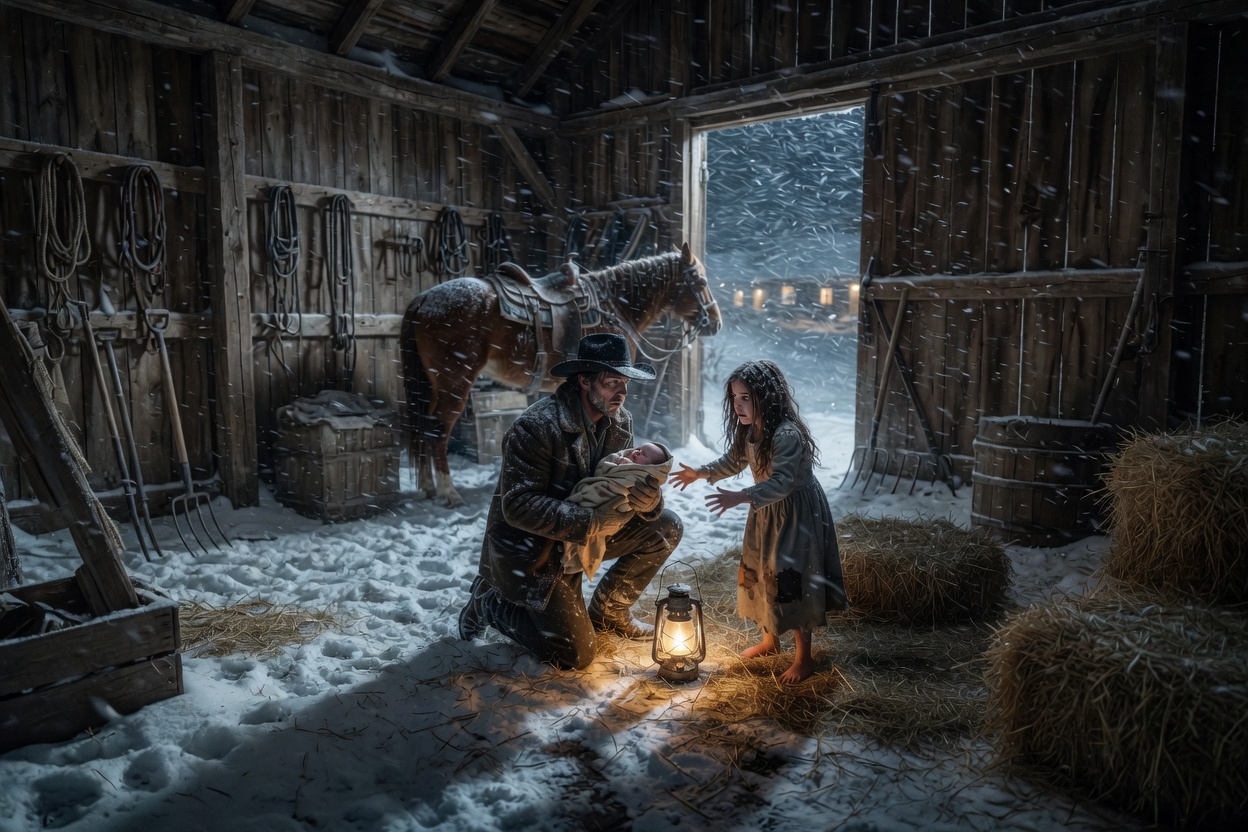
The rancher’s baby was dying in a blizzard until a 12-year-old girl saved her. The blizzard came like a verdict.
No warning bell. No second chance. One moment the Wyoming plains lay stretched and silent beneath a brittle winter sky.
Fence posts vanished. Hills folded into white. Nothing. Even the sky forgot its color. Eli Calder felt it before he saw it.
A pressure in his chest, the kind that came when something precious was about to be taken.
He stood on the porch of his ranch house, coat half-fassened, beard stiff with frost, staring into the wall of moving white.
The barn behind him groaned as if the wood itself were afraid. Somewhere out there, cattle loaded in confusion, their voices thin and distant.
Swallowed by the storm. Inside the cabin, his baby cried. Not the strong cry of hunger, not the sharp protest of discomfort.
This was different. It was small, broken, like a sound already tired of being alive.
Eli turned hard and went inside. The cabin smelled of iron and smoke and fear.
The stove glowed dull orange, fighting a losing battle against the cold that seeped through the logs.
On the narrow bed, his wife Margaret lay propped on one elbow, her face pale, eyes ringed dark with sleeplessness.
Their baby girl lay against her chest. Little Anna, wrapped in wool, wrapped in prayers, wrapped in the lie that love alone could keep her warm.
She’s worse. Margaret whispered. Her voice shook, but her hands didn’t. She’d already cried all the tears she had.
She won’t stop burning. Eli knelt and placed two fingers against Anna’s cheek. The heat startled him.
It didn’t belong in winter. It felt wrong, like fire in snow. “How long?” He asked.
Since before morning light outside, the wind slammed against the cabin like a living thing trying to get in.
Eli stood slowly, his jaw clenched. I’ll ride to town. Margaret caught his sleeve. Her grip was weak but desperate.
You can’t. He looked back out the window. The road was gone. Not covered, not hidden.
Gone. The world beyond the glass had been erased. “No doctor’s coming,” Margaret said. Her voice broke now.
“Not in this storm,” Eli turned away. Because if he didn’t, she’d see the truth on his face.
Fear, the kind that hollowed men out.” Anna whimpered again, her tiny body shuddering like a leaf caught between seasons.
Margaret bowed her head and whispered prayers that felt too small for the moment. That was when the knock came.
Three soft taps barely louder than breath. Eli froze. No one knocked in a blizzard like this.
Not unless they were lost or desperate or already halfway to dead. The knock came again.
Eli crossed the room and opened the door. The wind exploded inside, snow rushing in like a living thing, and with it someone small.
A girl stood on the threshold, no more than 12. Her coat was too big, sleeves hanging past her hands.
Snow clung to her dark hair, frozen into sharp little stars. Her cheeks were raw and red, her lashes white with ice.
Her boots were soaked through, leather cracked and stiff. She swayed but did not fall.
“I saw your smoke,” she said. Her voice was thin but steady. Thought someone might need help.
Eli stared at her stunned behind him. Margaret lifted her head. “Eli, who is that?”
The girl stepped inside before he answered. The door slammed shut behind her, sealing them into the moment.
She took in the room with one glance. The bed, the baby, the fear hanging in the air.
Her eyes locked on Anna. “She’s sick,” the girl said. “Not a question. A knowing,” Eli swallowed.
“Fever.” The girl nodded once, then reached for the small satchel slung across her shoulder.
“I might be able to help.” Margaret let out a soft, broken laugh. You’re just a child.
The girl looked at her then. Really looked at her. Her eyes were dark, serious, older than they should have been.
So is she, the girl said. The wind howled outside. Inside silence fell. And in that silence, with death breathing close and time running thin, Eli Calder made a choice that would change all of their lives.
“Come in,” he said quietly. The girl stepped forward and Winter held its breath. The girl shut the door with both hands, leaning into it for a moment as the wind tried to take it back.
When she turned around, snow slid from her shoulders and hit the floor in small, darkening piles.
“I’m Ruth,” she said. My ma called me Ruthie. Her hands were shaking when she pulled her gloves off, not with fear, but cold that had gone too deep.
Her fingers were cracked, red, angry at the world. Still, they moved with purpose. She crossed the room without waiting for permission and knelt beside the bed.
Eli noticed something then. She wasn’t looking at the parents. She was looking only at the baby.
Ruth placed two fingers gently against Anna’s neck, then her wrist. She closed her eyes and counted under her breath, her lips moved silently, numbers slipping out like prayers meant only for her.
Margaret watched, unsure whether to hope or stop her. “Fever’s high,” Ruth said at last, “but she’s still fighting.”
Eli exhaled shakily. “Can you help her?” Ruth looked up at him, eyes steady, honest in a way that hurt.
“I don’t know,” she said, “but I know how not to make it worse. That was enough.
Tell us,” Margaret whispered. Ruth stood and shrugged out of her coat, hanging it carefully on the back of a chair like this was any other afternoon.
“First thing, don’t bundle her tighter. Fever needs room to breathe,” Margaret hesitated, then slowly loosened the blanket around Anna.
“She’ll get cold,” she said. “She’s already burning,” Ruth replied gently. Cold isn’t the enemy right now.
She asked for clean cloths, for water, not hot, not icy, for the stove to be turned down just a touch.
Eli did everything she asked without question. Ruth soaked a cloth, rung it out, and laid it across Anna’s forehead, then her chest.
The baby whimpered weakly, her tiny fists clenching and unclenching. Ruth leaned close and began to hum.
It wasn’t a song Eli recognized. No words, just a low, steady sound like wind moving through tall grass or a heart remembering its rhythm.
Anna’s breathing slowed. Margaret covered her mouth, tears spilling silently. Outside, the storm screamed. Inside, something fragile held.
“How did you learn this?” Eli asked quietly. Ruth didn’t stop humming. “My little brother,” she said.
Two winters ago. Fever took him anyway, but not before my ma taught me everything she knew.
Her voice didn’t break, but something behind her eyes did. The hours stretched long and heavy.
Ruth changed the cloths again and again. She checked Anna’s breathing, her color, her tiny hands.
Once the baby’s fever spiked suddenly, her cry sharp and thin, and Margaret sobbed openly, clutching Eli’s coat like it was the last solid thing in the world.
Ruth didn’t panic. She reached into her satchel and pulled out a small bundle wrapped in cloth, dried herbs crushed carefully between her fingers.
“This might help,” she said. “Or it might not, but it’s what I’ve got.” Eli’s voice was rough.
“Do it.” Ruth mixed the herbs with warm water, testing it on her own skin before dipping a finger in.
She touched a few drops to Anna’s lips. The baby gagged once, then swallowed. Time stopped being anything Eli understood.
Then slowly, Anna’s cries softened. Her body relaxed. The burning heat eased just enough to feel like a promise.
Ruth sagged back on her heels, exhaustion finally breaking through her small frame. Margaret reached out and touched Anna’s cheek.
She’s cooler. Eli sat down hard, his legs no longer holding him. Outside, the blizzard still ruled the world.
But inside the cabin, for the first time since dawn, hope dared to breathe. Night did not fall so much as it settled.
The blizzard dimmed the world until time itself seemed to blur. There was no clear dusk, no clean edge where day ended, just a slow thickening of dark pressed against the cabin windows like a held breath.
The wind did not rest. It circled the house, testing it, slamming one wall, then another.
It slipped down the chimney and moaned through the cracks between the logs, a sound like something grieving.
Inside the cabin glowed dim in amber. Anna slept. Not deeply, not yet, but she slept.
Her breaths were shallow but steady, each one a fragile thread holding her to the world.
Ruth sat cross-legged on the floor beside the bed, her back against the frame, her head tilted just enough to watch the rise and fall of the baby’s chest.
She hadn’t moved in a long time. Margaret noticed at first, the way the girl’s shoulders trembled, not from cold, but exhaustion finally reaching bone.
The way her eyes blinked slower now, longer pauses between them. “You should rest,” Margaret whispered.
Her voice sounded too loud in the quiet. “You’ve done enough.” Ruth shook her head.
“Not yet.” Her voice was calm, but there was stubborn iron beneath it. Eli fed another piece of wood into the stove.
The fire flared briefly, then settled again, casting shadows that stretched and shrank along the walls.
He glanced at the girl. This child who had walked out of a blizzard like it was nothing and felt something twist uncomfortably in his chest.
“How old are you?” He asked quietly. “12,” Ruth said. After a pause, she added, “Almost 13.”
Eli nodded slowly. His own hands looked older than they should have. Hers looked younger than they had any right to.
Anna stirred suddenly. A sharp, weak cry cut through the room. Margaret gasped and surged forward, hands already reaching.
Ruth was there first. She pressed her palm lightly against Anna’s chest, grounding, steady. Her other hand went to the cloth, testing it, replacing it with one freshly dampened from the basin.
It’s all right, Ruth murmured. Not to the parents, but to the baby. I know, I know.
Anna’s cry faltered, then softened. Her tiny fingers curled around nothing, then loosened again. Margaret covered her face and wept silently.
Eli stepped behind her and rested his hands on her shoulders. He felt how small she felt under them now, how helpless.
They stood like that for a long time. The hours dragged. At some point, Eli realized he could no longer feel his own feet.
He shifted his weight, rubbed warmth back into them, but he didn’t move far. It felt wrong to leave the room.
Ruth finally leaned her head back against the bed frame, her eyes closed just for a moment.
Eli noticed immediately. Ruth, he said softly. Her eyes snapped open. I’m here. He crouched down in front of her, lowered himself so they were eye to eye.
You can sleep, he said. I’ll watch her. Ruth studied him, not like a child looks at an adult, but like someone weighing truth against fear.
You wake me if her breathing changes, she said. I will. If her skin turns cold or blotchy, wake me.
I will if she stops crying altogether. I will, Eli repeated more firmly. Now Ruth nodded once, just once.
Then she leaned sideways and still sitting upright, fell asleep. It happened that fast. Her head tipped against the bed, her hands slackened in her lap, her breathing deepened.
Uneven at first, then slower. Margaret stared at her. She’s just a baby herself. Eli said nothing.
He pulled another blanket from the trunk at the foot of the bed and draped it gently around Ruth’s shoulders.
She didn’t stir. The storm roared on. Sometime in the deepest part of night, Anna’s fever rose again.
Not as violently as before, but enough. Eli felt it first when he checked her forehead.
The heat was creeping back slow and sly. His heart kicked hard against his ribs.
He looked at Ruth. She slept on for one terrible moment. He considered waking her immediately, shaking her, letting panic have its way.
Then he remembered her words. “Wake me if her breathing changes.” Anna’s breathing was still steady.
Eli swallowed and forced himself to stay calm. He changed the cloth himself, just like he’d seen Ruth do, not rushed, not rough.
He kept the water lukewarm. He hummed quietly, uncertainly, trying to match the rhythm Ruth had used.
It wasn’t the same, but it was something. Anna stirred, whimpered, then settled again. When Ruth woke on her own sometime later, blinking in confusion, Eli met her eyes immediately.
Fever nudged up, he said, “But it didn’t spike.” Ruth studied Anna, then nodded. “That’s all right,” she said.
“That happens before it breaks.” “Before it breaks.” Margaret clung to those words like a lifeline.
The longest stretch of the night came after that. The part where nothing happened. No cries, no sudden turns, just waiting.
Waiting was the hardest thing Eli had ever done. Then, just before the dark outside began to thin, Ruth touched Anna’s cheek and smiled.
“She’s cooler,” she said softly. Margaret leaned forward, hands shaking. She touched her daughter’s skin.
It was true. Not cold, not warm, normal. A sound escaped Margaret’s throat that was half laugh, half sobb.
She pressed her forehead to Anna’s and cried freely now, her whole body shaking. Eli closed his eyes and bowed his head.
Outside, the wind began to die, not all at once, but in pieces, like something exhausted finally giving up the fight.
Ruth sat back, every bit of strength leaving her now that the danger had passed.
She wiped her nose on her sleeve, embarrassed. “I think she’s going to live,” she said quietly.
Margaret reached out and pulled her into an embrace without thinking. Ruth stiffened at first, startled, then melted into it, her small body folding in on itself as she finally let herself be held.
Eli watched them both, his chest tight, his eyes burning. The storm had come to take something from him.
Instead, it had delivered a miracle, and a 12-year-old girl who knew how to stand in the cold and not turn away.
Morning did not arrive with light. It arrived with quiet. Eli noticed it when he woke, slumped in the chair beside the stove, his spine stiff, his neck aching.
The sound that had filled the night, the relentless howl, the clawing wind, was gone.
Not faded, gone. The cabin felt different without it, larger, almost hollow. He stood slowly and crossed to the window.
Frost still webbed the glass, but through it he could see pale gray sky and a world buried deep beneath snow.
Fence posts leaned at odd angles. The barn roof was half swallowed. Drifts rose higher than the window sills, smooth and innocent looking, like the storm hadn’t nearly killed anyone.
Behind him, Anna slept deep now. Her breaths were even, warm fog blooming softly in the cold air.
Margaret stirred on the bed, lifting her head when she saw Eli at the window.
Her eyes were red and swollen, but there was color in her cheeks again. Life had crept back into her.
“She’s still cool,” she whispered. Eli nodded. “She made it.” They stood there in silence for a long moment, listening to the stove crackle and the quiet settle around them.
Ruth slept curled on the floor beside the bed, the blanket pulled up to her chin.
In sleep, she looked younger somehow, her brow unnit, her hands slack, her mouth parted slightly like any other child.
Margaret watched her with something close to awe. She walked through that storm, Margaret said softly.
Alone. Eli followed her gaze. Some people learn early how to walk through worse. Margaret nodded, then hesitated.
Where will she go now? Eli didn’t answer right away. The day crept on slowly.
Eli shoveled a narrow path to the barn and checked the cattle. One had gone down during the storm, old, already weak.
The others were alive, hungry, confused. He fed them, his breath puffing white, his muscles burning.
When he returned, Ruth was awake, sitting cross-legged near the stove, holding a tin cup in both hands.
Steam curled up around her face. Margaret had brushed her hair back and given her one of Anna’s old wool socks for her hands.
“How are you feeling?” Margaret asked. Ruth shrugged. “Tired.” “You can stay as long as you need,” Margaret said.
“Storm like that? Nobody expects you to go anywhere.” Ruth glanced at the window, then down at her cup.
“I was supposed to reach the Miller place,” she said. “My uncle sent me. They’re expecting medicine.”
Eli frowned. Miller place is 3 mi east. Ruth nodded. Through trees. Snow won’t drift as bad there.
Eli shook his head. Not today. Not alone. Ruth’s jaw set. They might need it.
So do you, Margaret said gently. The girl didn’t argue, but she didn’t agree either.
That afternoon, Anna woke and cried. Not weakly this time, but with full offended lungs.
Margaret laughed through tears and held her close, rocking her gently. Ruth watched from the corner, a small smile tugging at her mouth.
“She’s strong,” Ruth said. Margaret nodded. “Because of you.” Ruth ducked her head. “Because she wanted to be.”
Eli studied her from across the room. “You didn’t have to knock,” he said quietly.
“You could have kept walking. Could have turned back.” Ruth looked at him. Smoke in a storm means someone’s fighting to stay warm.
My ma said you don’t ignore that. Your ma taught you a lot, Eli said.
Ruth’s smile faded slightly. She had to. Night came again, but this one felt different.
Softer, safer. They ate together. Simple food, nothing fancy. But Ruth ate like someone who hadn’t had a full meal in a while.
Margaret noticed and slid more onto her plate without comment. Later, as Anna slept again, Ruth stood near the door, her coat folded over one arm.
I should go in the morning, she said. If the trail holds, Margaret’s throat tightened.
You don’t have to. Ruth met her eyes. I know. Eli stepped forward. I’ll take you.
Ruth blinked. What sled? Eli said, “Roads buried, but I can cut a path partway, get you closer, safer.”
Ruth hesitated, pride wared with relief on her face. “All right,” she said finally. They left at first light.
The world was white and vast, the storm’s violence hidden beneath calm beauty. The sled creaked softly as Eli pulled, Ruth walking beside him, her breath steady.
They reached the treeine where the path forked. This is far enough, Ruth said. Eli nodded.
He reached into his coat and pulled out a small bundle, wrapped bread, dried meat for the road.
Ruth accepted it, then surprised him by stepping forward and hugging him quick, fierce, gone before he could react.
Thank you, she said. For what? He asked. For letting me help. She turned and walked into the trees, small figure swallowed by white and shadow.
Eli stood there longer than he needed to. When he returned home, Margaret was waiting on the porch with Anna bundled in her arms.
“She left?” Margaret asked. “Yes,” Margaret swallowed. “Will we see her again?” Eli looked out at the path, disappearing into the trees.
“I think so.” Winter lingered long after that, but it never felt quite as cruel.
Because sometimes, Eli learned, the storm doesn’t come to take. Sometimes it comes to reveal what survives.
Winter loosened its grip slowly. Not the way people like to remember it later with clean endings and sudden thaws, but the honest way.
Nights still cut sharp. Snow stayed piled along fence lines. The world remained quiet, watchful, like it wasn’t sure whether to trust peace yet.
Anna grew stronger by the day. Her cries came loud now, demanding, full of offense at the slightest delay in warmth or milk.
Margaret laughed more easily. Color returned to her face. She slept again. Eli watched it all with the careful awe of a man who had nearly lost something irreplaceable.
Some nights, when the fire burned low, and the house settled into its familiar creeks, he thought of Ruth.
He imagined her small figure moving through the trees, boots crunching softly, breath steady. He wondered if the Miller place had needed her as badly as they had.
He wondered who had taught a child to carry so much calm into chaos. Weeks passed.
Then one afternoon, as winter light slanted long and pale across the snow, Eli spotted movement near the fence line.
A girl smaller than the drift beside her. Dark hair tucked beneath a knitted cap, a satchel slung over her shoulder.
Eli didn’t run. He just stood there, heart thutudding, until she came close enough to see.
Ruth smiled first. “You made it back,” Margaret said later, her voice thick as she hugged the girl again.
Ruth shrugged out of her coat. “Told you I might.” Anna lay on the bed, bundled and alert, her dark eyes tracking the movement in the room.
Ruth stepped closer and leaned over her. “Well,” she said softly, “look at you.” Anna gurgled.
Ruth laughed. Short, surprised, real. That night, they ate together again. Simple food, shared warmth, the kind of quiet that didn’t need filling.
Ruth stayed. At first, it was just until the roads cleared, then until spring came fully.
Then, until it stopped being a question, she helped Margaret with chores, learned the rhythm of the ranch.
She read by the fire at night, her boots drying nearby, her satchel always within reach.
Eli noticed how she moved now, still careful, but lighter, like someone who had learned she didn’t always have to be the strongest one in the room.
One evening, as winter finally began to release the land, Ruth sat on the porch steps, watching the snow melt into dark earth.
“Why did you knock that night?” Eli asked quietly, settling beside her. Ruth thought for a long moment.
Because if I didn’t, she said, “And something happened, I’d have carried that forever.” Eli nodded.
He understood that kind of weight. Spring came in fits and starts. The snow retreated.
The cattle grazed. The land breathed again. Anna took her first steps in the soft mud near the barn, laughing as she fell.
Ruth clapped and laughed with her, tears bright in her eyes. One night, as the fire crackled low, Ruth pulled something from her satchel, a folded piece of paper worn thin.
“My ma,” she said quietly. She wrote this before she died. Margaret took it gently, reading the careful, uneven handwriting.
“Teach what you know. Stand where you’re needed. Don’t turn away.” Margaret looked up, eyes wet.
“She’d be proud of you.” Ruth swallowed and nodded. Years later, people would still talk about the blizzard.
They’d talk about how the road vanished, how a rancher’s baby nearly died, how a child walked through a storm no one else dared face.
But Eli knew the truth was quieter than the stories. It wasn’t bravery that saved his daughter.
It wasn’t luck. It wasn’t even the storm breaking at just the right moment. It was a girl who knew how to listen to the cold and didn’t let it decide who lived.
Winter left its mark on that ranch, but so did Ruth.