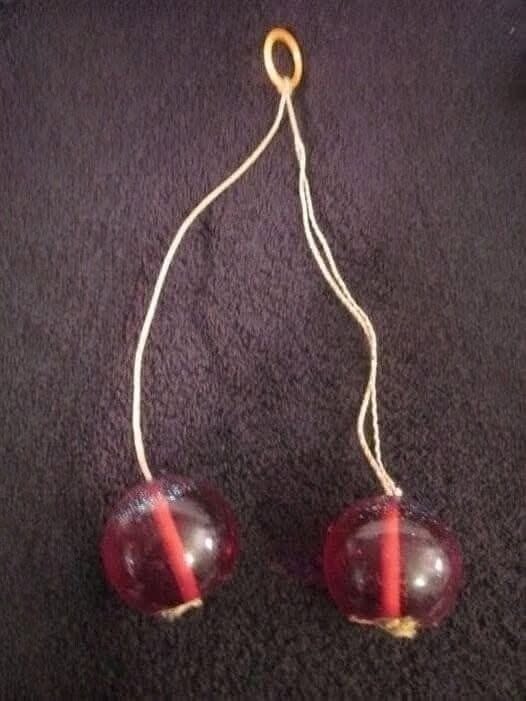
The Mystery Vintage Massager Finally Explained
That odd little gadget in the old photo looks like it belongs in a toolbox, a sewing basket, or perhaps a drawer full of things nobody remembers buying. Yet the answer is much more ordinary: it is an old-fashioned handheld massager, designed to help work over tense muscles without batteries, motors, or a wall outlet.
These vintage massagers are easy to mistake for toys because of their rounded ends and simple string or cord. However, that basic construction was the point. The user could hold the cord, position the rounded pieces against a muscle, and move the tool back and forth to create gentle pressure.
What Is That Strange Two-Ball Massager?
The object is generally described as a manual massage tool. Instead of using electricity, it relies on your hand movement and the shape of its rounded ends. Depending on the version, the ends may be made from wood, hard rubber, plastic, or another smooth material.
The cord does more than connect the pieces. It gives you a simple handle and helps control how the two ends move across the body. That made the tool inexpensive to produce, easy to store, and convenient to use at home.
Naturally, designs varied over the years. Some vintage massage tools had larger wooden balls, while others used smaller rounded pieces or textured surfaces. So, if the object in a photograph looks slightly different from another example you have seen, that does not automatically mean it served a different purpose.
Why Did People Use It?
The main attraction was convenience. A person could use a manual massager on areas such as the shoulders, upper back, arms, hands, or legs without setting up an electrical device.
For instance, after a long day of repetitive work, someone could gently roll or press the rounded ends over a tense area. The sensation comes from pressure and movement rather than vibration from a motor.
That distinction matters. This was not a high-tech recovery device with adjustable speeds, heat settings, or rechargeable batteries. It was a simple household tool that could be picked up and used in seconds.
How the Simple Design Worked
At first, the construction seems almost too basic. There are rounded pieces, a connecting cord, and not much else. However, that simplicity gave the user plenty of control.
You could hold the cord loosely and let the ends move across a muscle, or use a little more control to apply gentle pressure to a specific spot. The rounded shape helped avoid the sharp edges you would get from an ordinary rigid object.
A practical approach is to start lightly. Place the rounded ends over a comfortable area, move them slowly, and stop if the pressure feels painful or unpleasant. There is no prize for pressing harder.
Pro Tip: If you own a vintage version, inspect the cord, knots, and surfaces before using it. Old materials can become brittle with age, and cracked or rough pieces should be treated as display items rather than everyday tools.
Why the Cord Was So Useful
The string or cord is one of the biggest clues to the object’s purpose. It lets the two ends move together while giving the user a place to grip.
That design also makes the tool compact. Instead of a bulky frame, the massager could be tucked into a drawer, bathroom cabinet, bedside table, or small storage box.
For today’s shopper, a modern manual massage tool may use silicone, flexible handles, or molded plastic. Vintage examples, by contrast, often have a more homemade or utilitarian appearance.
Why Modern Eyes Find It So Confusing
The biggest problem is context. If you have never seen a manual massager like this before, two balls connected by string can resemble almost anything.
Modern households are filled with objects designed around batteries, USB charging, touch controls, and specialized functions. As a result, an object that needs nothing more than your hands can look strangely mysterious.
There is another clue hiding in the design: it has very few parts. Manufacturers often favored straightforward tools that were inexpensive, repairable, and easy to keep around. Before every household gadget came with an instruction screen, people were accustomed to figuring out simple tools by feel.
Vintage Tool or Useful Household Item?
It can be both. Collectors may enjoy these objects because of their age, materials, packaging, or unusual construction. Someone else may simply appreciate the cleverness of a tool that requires no power source.
If you are shopping for a vintage example, however, condition matters more than appearance alone. Check for splits in wooden parts, peeling finishes, hardened rubber, loose knots, damaged cord, or unpleasant odors from old materials.
For a modern replacement, search terms such as manual massage tool, handheld muscle massager, or wooden massage roller can bring up newer options. Those products may be easier to clean and inspect, especially when you want something for regular household use.
Common Mistakes When Identifying Old Household Objects
One mistake is assuming every unfamiliar object has a complicated mechanical purpose. Older household products were often remarkably straightforward.
Another mistake is focusing on one photograph without considering how the pieces interact. Ask what the cord connects, whether the ends are rounded, and whether the object appears designed to be held or moved by hand.
Also, do not assume that every two-ended vintage tool is a massager. Similar-looking objects can have completely different purposes. The exact shape, materials, markings, packaging, and original context can change the answer.
Quick Identification Checklist:
- Are the ends rounded and smooth?
- Are they connected by a cord, string, or flexible handle?
- Does the design appear intended for controlled hand movement?
- Are there no electrical parts, switches, or batteries?
- Does the object resemble other vintage manual massage tools?
How to Care for a Vintage Example
If you find one in an old drawer or at a flea market, resist the urge to scrub it aggressively. Start by removing loose dust with a soft, dry cloth.
Next, identify the material. Wood, rubber, painted surfaces, and plastic can react differently to moisture and cleaning products. When the material is uncertain, a small hidden test is safer than soaking the entire object.
Most importantly, preserve any original label, box, or printed instructions. Those details can help identify the manufacturer and date, and they may be more valuable to collectors than a shiny surface.
When to Leave It Alone
If the cord is frayed, the material is cracked, or the surface is breaking down, keep the item for display rather than personal use. Old household objects can be interesting without being suitable for everyday handling.
For a functional alternative, a new manual massage roller is usually a more practical choice. You can also compare washable materials, ergonomic handles, and different pressure surfaces before buying.
The Bigger Lesson Behind This Mystery
What makes this little object so fascinating is not that it hides some secret technology. Quite the opposite.
It represents a time when household products often solved everyday problems with a handful of materials and a bit of clever design. No charging cable. No settings menu. No complicated manual.
And that is exactly why these objects can fool us today. We are used to asking what an unfamiliar gadget plugs into, connects to, or powers. With an old manual massager, the answer is wonderfully simple: your hands do the work.
So the next time you see two rounded pieces joined by a string, do not dismiss it as a random antique or strange toy. Look at the shape, the construction, and the way it was meant to move. You may be looking at a small piece of everyday history—a practical manual massager that once had a perfectly ordinary place in the home.