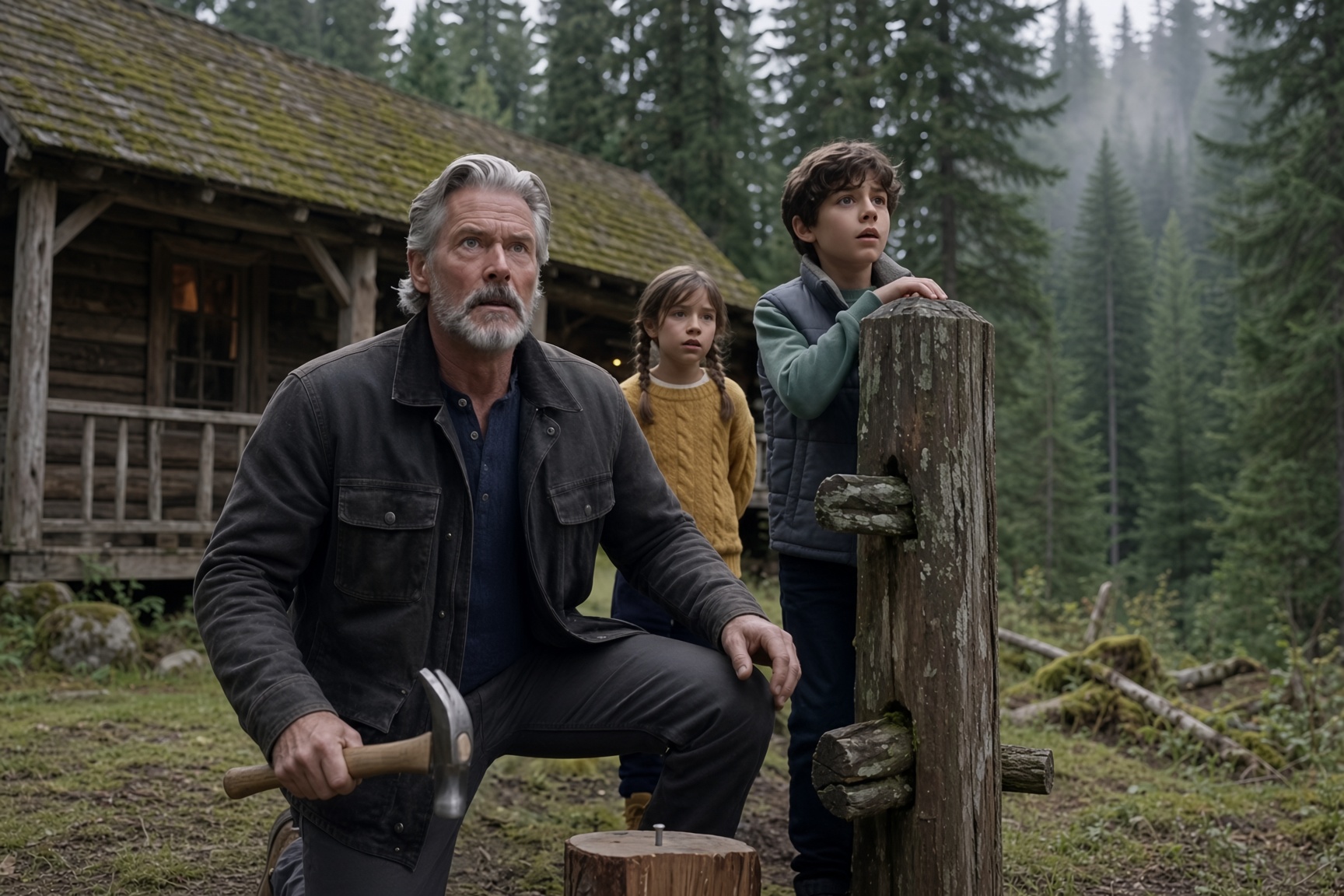
When three blacked-out dirt bikes tear through the mountain gate to erase a retired auditor, an off-grid grandfather triggers a sealed bunker protocol to get his grandchildren out alive.
THE CLICK
Nicholas Vance drove his thumb hard into the red mushroom button.
The switch gave way with a heavy, industrial snap that resonated through the wall studs.
Beneath the cedar tongue-and-groove paneling, high-pressure pneumatic valves hissed in rapid unison.
Caleb gasped, his small hands clutching the rough denim of Nicholas’s work trousers.
Hazel pressed her face into his left hip, her yellow knit sweater trembling against the leather of his tool belt.
Above their heads, inside the ceiling headers, four-inch manganese steel drop-plates broke free from their electromagnetic catches.
They slammed down through internal channels inside the door frames with a deafening, metallic crash that rattled the framed family photographs off the walls.
Across the front porch, the windows vanished behind quarter-inch cold-rolled steel shutters.
Thud. Thud. Thud.
The daylight was guillotined instantly.
The hallway fell into absolute pitch, saved only by the crimson halo ring glowing around the recessed button.
Outside, heavy rubber-soled combat boots hit the wooden porch steps.
A mechanical ram hammered against the exterior oak skin of the front door.
Crack.
The dry timber splintered, but behind it, the solid ballistic core didn’t even vibrate.
“Grandpa!” Caleb cried out, his voice cracking in the dark.
“I’m right here,” Nicholas said, keeping his voice dead-calm, stripped of every ounce of fear. “Both of you, listen to the sound of my breath.”
“They’re hitting the door,” Hazel whispered, her fingers digging through his field jacket.
“The door is four hundred pounds of case-hardened alloy, little bird,” Nicholas said softly. “It will hold until tomorrow morning. But we won’t be here to see it.”
THE TRAPDOOR
Nicholas reached into his pocket and clicked on a low-lumen green LED penlight.
The soft emerald beam cut across the pine floorboards, avoiding the reflective surfaces of the walls.
He stepped three paces down the corridor toward the coat nook, dropped to one knee, and pulled his pocketknife.
He wedged the flat blade into an almost invisible seam between two wide floorboards.
A six-foot section of the flooring, counterweighted with lead bars hidden in the crawlspace, rose silently on hydraulic hinges.
A wave of cool, damp earth air rushed up into the warm hallway, smelling of granite dust and cold moss.
“Caleb, feet first,” Nicholas commanded gently. “Drop your weight. There is a foam landing pad five feet down.”
The boy peered into the black rectangular void, his brown eyes reflecting the green light.
“Is it dark down there?” Caleb asked, his chin shaking.
“It’s safe down there,” Nicholas replied, placing a firm, warm hand on the boy’s shoulder. “Go. Right now, Caleb.”
Caleb sat on the edge of the opening, gripped the wood with both hands, and slid forward.
A soft thud and a quiet exhale came from the darkness below.
“I’m down!” Caleb called up, his voice hushed. “I’m on the foam!”
Nicholas turned to Hazel, whose brown braids were disheveled against the collar of her mustard sweater.
“Your turn, little bird. Land on your toes and roll.”
Hazel didn’t hesitate; she grabbed her grandfather’s forearms, lowered her legs into the hole, and let go.
Another soft thump.
“I’ve got her, Grandpa!” Caleb whispered from below.
Above them, on the exterior of the cabin, the high-pitched shriek of a gasoline rotary saw bit into the steel window shutters.
Sparks showered through the gaps in the timber cladding.
They were bringing industrial rescue equipment to bear.
Nicholas pulled the rucksack from the wall peg, dropped it through the hatch, and swung his long legs into the opening.
He caught the underside cable of the floor trap, pulled it downward until the brass magnetic latches seated with a dull click, and plunged them into the sub-floor.
THE SUB-SLAB
The chamber beneath the cabin was six feet high, lined with dry-stacked basalt blocks and heavy cedar posts.
Nicholas clicked on a secondary magnetic lantern, sticking it to an iron beam overhead.
The pale light illuminated a concrete trench running thirty yards south, following the natural slope of the ridge.
On a wooden pallet against the wall sat two canvas field satchels, three sealed five-gallon water jugs, and a long olive-drab hard case.
Nicholas unlatched the hard case with practiced speed.
Inside lay a stainless-steel scout carbine chambered in .308 Winchester, its bolt stripped, oiled, and gleaming in the lantern light.
He slotted the bolt into the receiver, snapped a five-round box magazine into the well, and racked the action.
The metallic clack was loud and definitive in the stone cellar.
“Grandpa,” Caleb said, staring at the rifle with wide, terrified eyes. “You said you don’t hunt anymore.”
“I don’t hunt animals, Caleb,” Nicholas said, sliding the safety to the rear.
He pulled two lightweight windbreakers from the pallet—dark forest green—and handed them to the children.
“Put these on over your sweaters,” he said. “Zip them to the chin. Hide the yellow, Hazel. In the woods, bright colors get you spotted.”
Hazel pulled the dark green shell over her mustard sweater, tucking her braids inside the hood.
Nicholas opened the smaller canvas satchel.
Inside was a sealed titanium cylinder, four inches in diameter, etched with a serial number from a life he had buried twelve years ago.
The Vesper Ledger.
Every offshore account, every forged safety report, every payout to the regional magistrates who covered up the industrial basin collapse that took his son and daughter-in-law.
He slung the satchel diagonally across his chest, over his dark jacket, and settled the strap against his collarbone.
“We move through the conduit,” Nicholas said, pointing to a corrugated steel pipe set into the south basalt wall.
“Where does it go?” Caleb asked.
“To the creek draw,” Nicholas answered. “Three hundred yards past their bikes.”
THE CORRUGATED RUN
The pipe was three feet in diameter, designed thirty years ago as a high-volume culvert for spring runoff.
The bottom was dry, covered with a thin layer of fine mountain silt and dried hemlock needles.
“Crawl on your hands and knees,” Nicholas instructed, guiding Hazel into the mouth of the tube. “Keep your elbows off the metal. It rings like a bell if you hit it hard.”
Hazel scrambled in first, her small hiking boots squeaking against the galvanized steel ridges.
Caleb followed directly behind his sister, his breath coming in short, controlled puffs.
Nicholas crawled in last, pushing the canvas pack ahead of him with his left hand while keeping the carbine balanced across his right forearm.
Behind them, a dull, concussive boom vibrated through the floor joists of the cabin above.
The assault team had breached the front steel plate with a linear cutting charge.
A cloud of fine, grey plaster dust drifted into the mouth of the pipe, carrying the sharp, chemical stench of burnt plastic and cordite.
“Keep moving,” Nicholas whispered forward. “Don’t look back.”
The pipe sloped downward at an eight-degree angle, cutting beneath the root systems of the giant Douglas firs.
Every twenty yards, thick taproots had forced their way through the seams, dangling down like tangled rope in the gloom.
Hazel crawled with remarkable speed, her small frame navigating the tight space easily.
“Grandpa,” she whispered back, her voice bouncing strangely in the hollow tube. “I can smell gas.”
“That’s exhaust from the bikes,” Nicholas said. “They’re idling up by the split-rail fence.”
He checked his mechanical watch under the penlight: three minutes since the button press.
The intruders would clear the ground floor within sixty seconds, realize the bedrooms were empty, and begin scanning the foundation with ground-penetrating radar.
They had less than two minutes before the culvert exit was compromised.
THE DAYLIGHT BREAK
The mouth of the culvert emerged beneath the undercut bank of the southern wash.
A heavy lattice of mountain willow and wild blackberry canes hung down over the opening, creating a natural curtain of dripping green leaves.
Hazel stopped at the threshold, the grey mountain mist washing across her face.
“Stay down,” Nicholas whispered, sliding past Caleb’s shoulder.
He parted the thorny vines with the gloved fingers of his left hand, the steel barrel of the scout rifle resting on a dead branch.
The wash was ten feet deep, choked with wet shale and rotted logs, completely invisible from the cabin yard.
Up the slope, through the dense pine trunks, grey smoke was rising into the overcast sky.
The cabin wasn’t burning—the assault team was deploying smoke grenades to mask their entry from potential perimeter snipers.
Down by the open wooden gate, the three black dirt bikes sat in the mud, their headlights cutting bright white beams through the trees.
One rider remained by the bikes, standing with his back against a fence post, a short-barreled carbine slung across his chest.
He wore a full-face matte-black helmet, heavy tactical armor, and the triangular grey patch of Vesper Security on his right shoulder.
He was speaking into a radio mounted to his tactical vest, his head scanning the access road.
“Only one on the machines,” Nicholas murmured to himself.
“Where are the other two?” Caleb breathed into his ear.
“In the house,” Nicholas said. “Looking for bodies.”
THE RAVINE
Nicholas dropped from the lip of the culvert into the soft silt of the creek bed.
His boots sank two inches into the wet clay without making a sound.
He reached up, caught Hazel around the waist, and swung her down beside him.
Caleb jumped next, landing with a muffled grunt on the soft moss.
“We stay in the water,” Nicholas said, pointing down the narrow channel of the wash. “The creek bed is eighteen inches below the bank line. If you stay crouched, they cannot see you from the ridge.”
The water was ice-cold, fed by the early autumn rains and the high mountain snows.
It rose to Caleb’s shins, soaking through his trousers and filling his hiking boots with freezing grit.
The boy gasped at the chill, but he clamped his teeth together and didn’t make a sound.
Hazel pulled her hands inside the sleeves of her green shell, wading through the current directly behind her brother.
Nicholas walked backward for the first fifty yards, the scout rifle held across his chest, watching the lip of the ravine.
A crow called out from the top of a dead hemlock—a sharp, alarmed croak that echoed across the valley.
Nicholas froze, pressing both children against the damp clay of the eastern bank.
Through the mist above, a high-pitched mechanical whine cut through the trees.
A drone.
THE ROTOR IN THE MIST
It was a compact quadcopter, painted flat black, flying twenty feet above the forest canopy.
Its forward sensor gimbal was tilted forty-five degrees down, scanning the floor of the wash with a thermal camera.
“Under the bank,” Nicholas hissed, shoving Caleb and Hazel into a deep recess where the spring floods had carved a hollow beneath an old spruce stump.
He reached into his field jacket, pulled out an emergency thermal bivy sack made of silver mylar, and shook it open.
The thin sheet crinkled softly as he draped it over the children and himself, pressing the reflective edges against the wet clay.
Through a tiny slit in the foil, Nicholas watched the drone drift over the creek.
Its electric motors hummed like a swarm of hornets.
The thermal bivy was cold on the outside, matching the ambient temperature of the wet gravel within five seconds.
To the drone’s infrared sensor, they were indistinguishable from the damp earth of the bank.
The machine hovered for ten agonizing seconds directly over their hiding spot, its gimbal rotating slowly as it checked the water flow.
A voice crackled from a small speaker on the drone’s chassis—a recorded command looped on high volume:
“Nicholas Vance. Identify yourself and step into the open. The children will not be harmed if the property is surrendered.”
Hazel shuddered under the mylar, her small forehead pressed hard against Nicholas’s ribs.
“Liar,” Nicholas whispered into her hair.
The drone banked sharply to the north, its sensors catching the heat plume of the smoke grenades back at the cabin, and vanished over the ridge.
Nicholas folded the foil into a tight square, shoved it into his pocket, and stood up in the current.
“Move,” he said. “The drone will loop back in four minutes.”
THE OLD CLAIM
They followed the creek for a mile until the wash flattened out into the cedar flats of the old Miller logging claim.
Here, the timber was second-growth, dense and dark, choked with devil’s club and rotting nurse logs six feet thick.
The rain was coming down steadily now, turning the grey afternoon into early twilight.
Caleb’s lips were pale blue, his teeth clicking together with a rhythmic chatter he couldn’t control.
Nicholas stopped beside a hollow cedar, knelt down, and pulled a dry wool scarf from his pack.
He wrapped it twice around Caleb’s neck, tucking the ends under the boy’s vest.
“How are the feet, buddy?” Nicholas asked, his hand squeezing Caleb’s knee.
“Heavy,” Caleb whispered. “They feel like rocks.”
“We have half a mile to the mill road,” Nicholas said. “Marty has an oil stove and a dry pair of wool socks for both of you.”
“Is Marty the lady with the big dogs?” Hazel asked, her eyes searching the dark trees.
“Marty is the lady who used to pull your mother out of snowbanks when she was your age,” Nicholas said. “She knows how to keep a secret.”
He stood up, scanning the ridge behind them.
Two miles to the north, a faint pop echoed through the valley.
A gunshot.
The tactical team had realized the culvert was an exit; they had fired a probe shot into the mouth to check for return fire.
Now they would mount the dirt bikes.
On the logging road, a motorcycle could cover two miles in three minutes.
THE LOGGING ROAD
They reached the gravel logging road where it crossed the creek over a rusted steel culvert.
The road was narrow, flanked by steep ditches filled with blackberry vines and yellowed ferns.
Nicholas climbed the bank first, staying low behind a stack of weathered timber ties.
The road was empty, but fresh tire tracks—deep knobby tread from a heavy four-stroke motorcycle—cut through the soft mud of the shoulder.
A scout had already ridden past toward the lower highway an hour before the assault.
They had sealed the primary exit before they even hit the gate.
“They’re thorough,” Nicholas muttered.
He led the children across the gravel, stepping only on the hard-packed stones to leave no clear boot impressions.
They ducked into the brush on the far side, following an overgrown skidder trail that climbed steeply toward the abandoned shingle mill.
The sound of four-stroke engines broke through the rain behind them.
Distant, but distinct.
Two bikes, running in second gear, their engines roaring as they negotiated the muddy ruts of the creek road.
“Run,” Nicholas said, his hand firm on Caleb’s back. “Don’t look at the trees. Look at your boots and run.”
THE SHINGLE MILL
The mill rose out of the mist like a ruined cathedral of cedar and corrugated iron.
Its roof was half-collapsed, covered in thick green moss, but the heavy timbers of the lower framing remained solid and upright.
Parked inside the open bay of the central barn sat a 1978 Dodge Power Wagon, its olive-drab paint faded to flat primer, fitted with a heavy steel winch bumper.
A thin wisp of grey smoke rose from an iron chimney pipe protruding from the side office.
Nicholas led the children straight to the heavy fir door of the office, his fist hammering three times against the planks:
Rap. Rap-rap.
A bolt slid back with a dry scrape.
The door swung inward four inches, revealing the muzzle of an old 20-gauge pump shotgun held by hands with liver spots and silver rings.
Behind the shotgun stood Martha “Marty” Hayes.
She was sixty-five, with iron-grey hair cut short to her jaw, wearing a fleece-lined canvas barn coat and grease-stained corduroy trousers.
She looked at Nicholas, then down at the two shivering children in their green rain shells.
“You’re five years late for coffee, Nick,” Marty said, lowering the shotgun.
“I brought company, Marty,” Nicholas said, pushing Caleb and Hazel gently over the threshold.
“Get inside,” she barked, her grey eyes darting past his shoulder to the foggy road below. “I heard the engines ten minutes ago. Sounded like three four-strokes heading for your ridge.”
“They’re already at the creek,” Nicholas said, stepping inside and pulling the door shut behind him.
THE MILL OFFICE
The room was small, heated to seventy degrees by an old cast-iron potbelly stove that glowed a faint cherry red in the dark.
The air smelled of dry pine, machine grease, and peppermint tea.
Marty didn’t ask questions; she grabbed two dry army blankets from an iron cot and wrapped them around Caleb and Hazel, dropping them onto a bench by the stove.
She reached into a tin breadbox, pulled out two cold venison biscuits, and pressed them into the children’s hands.
“Eat,” Marty ordered gently. “Chew slow. You’re running on shock.”
Hazel took a bite, her eyes closing as the warmth of the meat and bread hit her tongue.
Caleb clutched his biscuit with both hands, staring at the floorboards, his shivering finally beginning to subside.
Nicholas set the scout carbine on the wooden table, alongside the titanium cylinder from his satchel.
Marty looked at the cylinder, her weathered mouth setting into a hard, grim line.
“You still have that damn thing?” she asked, her voice dropping to a harsh whisper.
“It’s the only reason they haven’t put a missile through my roof from five miles up,” Nicholas said. “They need the physical drive. The encryption keys are hard-coded to my retinal scan. If they kill me before they extract the ledger, fifty-four offshore holding companies freeze forever.”
“Well, they aren’t trying to capture you with tea and biscuits, Nick,” Marty said, nodding toward the road. “They brought tactical operators. Men who don’t care about asset recovery until the perimeter is sanitized.”
“They know the kids are with me,” Nicholas said. “They won’t leave witnesses.”
“Then we don’t give them a target,” Marty said, reaching for a set of brass keys hanging from an iron nail by the door.
THE POWER WAGON
Marty led them through a side door into the main bay of the mill.
The Dodge Power Wagon sat on heavy 35-inch traction tires, its four-wheel-drive transfer case dripping a single bead of amber oil onto the concrete floor.
“She has forty gallons of farm diesel in the saddle tanks,” Marty said, opening the heavy steel driver’s door. “The radiator has a pinhole leak, but she’ll carry us twenty miles down the old flume road to the county highway.”
“The flume road is washed out at the third bridge,” Nicholas noted, throwing their packs into the back of the cab.
“The bridge is out for cars,” Marty countered, climbing into the driver’s seat. “Not for this truck. I laid six-inch steel pipeline across the gap two weeks ago to haul timber. We can crawl across if you keep the tires centered.”
Nicholas hoisted Caleb and Hazel into the wide bench seat, tucking them between the gear shift and the passenger door.
“Caleb, hold your sister’s hand,” Nicholas said, climbing into the passenger side and resting the scout rifle across his knees. “Keep your heads below the glass if you hear glass break.”
Marty pulled the manual choke, turned the heavy brass key, and stepped on the floor starter.
The six-cylinder diesel engine turned over with a deep, chattering roar that shook the corrugated siding of the barn.
Grey smoke billowed from the vertical exhaust stack behind the cab, curling up into the rafters.
Marty slammed the transfer case into four-wheel low, popped the clutch, and the truck lunged forward out of the barn into the pouring rain.
THE FLUME ROAD
The road was little more than an abandoned ditch carved into the side of the mountain forty years ago to service the timber flumes.
To their left, the granite cliff rose sheer and black; to their right, the slope dropped three hundred feet down into the roaring whitewater of the North Fork.
The Dodge bounced violently through the washouts, its heavy leaf springs groaning under the impact.
Marty worked the unassisted steering wheel with corded, muscular forearms, her teeth clenched around an unlit match.
“Two miles to the crossing,” she shouted over the rattle of the diesel.
Nicholas looked through the rain-streaked side mirror.
Behind them, three hundred yards back along the winding track, a pair of high-intensity LED headlights surged around the rock bend.
A black dirt bike, its rider standing on the pegs, was closing the distance at forty miles an hour.
The rider had a tactical submachine gun clamped in a scabbard beside the front forks.
“We have company,” Nicholas said, his voice flat.
“Can you hit him from here?” Marty asked, not taking her eyes off the muddy track ahead.
“The truck is bouncing three inches on every rock,” Nicholas said, rolling his window down two inches, the freezing rain spraying across his cheek. “I have five rounds. I don’t waste lead on guesses.”
THE FIRST BIND
The bike closed to fifty yards, the roar of its high-revving engine screaming over the diesel rumble.
The rider raised his left hand from the grip, drawing a heavy semi-automatic pistol from a chest holster.
He fired three rounds through the rear window of the Dodge.
The safety glass shattered into thousands of tiny green cubes, showering Caleb and Hazel’s shoulders.
The children screamed, dropping into the footwell beneath the dashboard, clutching each other’s coats.
“Stay down!” Nicholas yelled.
He twisted in his seat, thrusting the barrel of the scout rifle through the broken rear window frame.
Through the rain and the swirling exhaust, the black helmet of the rider filled the peep sight.
The bike hit a water-filled rut, its front wheel kicking out six inches to the left.
Nicholas waited for the rebound.
As the rider corrected and rose on the pegs, Nicholas squeezed the trigger.
The .308 cracked with an ear-splitting boom inside the steel cab.
The heavy bullet struck the front fork assembly of the motorcycle, shattering the aluminum triple-clamp and severing the brake line.
The front wheel seized instantly at thirty-five miles an hour.
The bike cartwheeled violently forward, throwing the rider forty feet through the air into the blackberry brambles of the gorge slope.
The machine disintegrated against a granite outcrop in a shower of sparks, plastic fairings, and burning fuel.
“One down!” Nicholas barked, working the heavy bolt with a sharp flick of his wrist.
An empty brass casing bounced onto the rubber floor mat.
“Second one is coming up the lower switchback!” Marty shouted, hauling the wheel hard to the right as the truck approached the narrow gorge crossing.
THE STEEL CROSSING
The bridge was gone.
Where fifty feet of timber trestle had once spanned the chasm, only two twelve-inch industrial steel pipes remained, laid side by side across the thirty-foot gap.
Below the pipes, the North Fork boiled over jagged black boulders eighty feet down.
“Marty, you’re out of your mind,” Nicholas said, staring at the twin steel cylinders slick with rain.
“I built it, Nick!” she yelled back, dropping the truck into first gear. “The tires have six inches of tread on either side! Keep your eyes on the far bank!”
The front tires climbed onto the steel pipes with a sickening, metallic screech.
The truck hesitated, its tires slipping on the wet industrial paint before the deep rubber lugs bit into the steel.
The Dodge moved forward inch by inch, suspended over the abyss.
Inside the cab, the only sound was the low, rhythmic chugging of the diesel and the ragged breathing of the two children huddled in the footwell.
“Don’t look down, kids,” Caleb whispered to his sister, his arm wrapped tight around her neck. “Look at Grandpa’s boots.”
Halfway across the span, the second dirt bike burst from the trees on the near bank.
The rider stopped on the gravel verge, dismounted instantly, and unslung a heavy tactical rifle with a sound suppressor.
He dropped to one knee, steadying his aim on the driver-side door of the Dodge.
“Marty, punch it!” Nicholas yelled.
Crack.
The suppressed round punched through the thin sheet metal of the driver’s door with a dull thud.
Marty gasped, her left shoulder jerking backward against the seat as a spray of crimson dotted the rear cab wall.
Her foot slipped from the clutch, but she jammed it back down with a snarl of pure fury.
“I’ve got it… I’ve got the line!” she choked out, her face turning grey under the rain.
She slammed the accelerator flat.
THE COLLAPSE
The rear tires kicked, spinning against the wet steel pipe, sending a shower of orange rust down into the gorge.
The Dodge lunged forward, its front bumper smashing into the mud of the far bank.
The rear tires caught the gravel lip, hauling the two-ton truck onto solid ground with a violent heave.
Behind them, the rider on the bank fired two more rounds into the tailgate.
Nicholas leaned out the passenger window, leveled the scout carbine across the mirror, and fired two rapid rounds into the timber cribbing that supported the near end of the steel pipes.
The old dry-rotted cedar timbers, already splintered by decades of mountain frost, gave way under the kinetic shock of the heavy .308 rounds.
The near end of the northern pipe slipped off its stone footing.
With a groan of twisting steel, the thirty-foot pipe fell into the gorge, smashing against the rocks below and washing away in the brown foam.
The crossing was severed.
The second rider stood alone on the opposite cliff, his rifle lowered, watching the truck disappear into the hemlocks.
“Marty,” Nicholas said, turning to her.
Her left arm was limp, blood soaking through the canvas of her barn coat, pooling on the vinyl seat between her legs.
“Just… keep the wheel straight, Nick,” she whispered, her head slumping toward her shoulder. “The road… it drops into the state highway in two miles.”
Nicholas grabbed the steering wheel across her lap with his left hand, his right hand keeping the carbine steady.
“Caleb,” Nicholas commanded. “Get up here. Sit on the seat. Press this towel against Marty’s shoulder. Press hard. Don’t stop pressing.”
The eight-year-old boy scrambled up from the footwell, his face pale as chalk, but his hands were steady.
He took the thick cotton shop towel Nicholas handed him and jammed it into the wound on Marty’s shoulder with all his small weight.
“I’m pressing, Grandpa,” Caleb said, his voice trembling with an unnatural, fierce resolve. “I’m holding it.”
THE DESCENT
The logging road plunged through a series of steep switchbacks, the mud turning into slick grey clay that threatened to slide the truck sideways off the shelf.
Nicholas steered with one arm, using the engine’s low-gear compression to brake, avoiding the foot pedal to prevent a slide.
Beside him, Hazel reached out and took Marty’s cold, limp right hand, holding it between her two small palms.
“Wake up, Miss Marty,” the girl whispered softly. “We’re almost at the big road.”
Marty groaned, her eyes fluttering open behind her wire-rimmed glasses.
“Good girl… Hazel,” the old woman breathed. “Keep… holding on.”
The trees began to thin.
Ahead, through the falling rain, the high sodium-vapor lights of the state highway junction appeared through the fog.
State Route 12.
Tractor-trailers, their yellow marker lights glowing through the mist, roared past at sixty miles an hour, their air brakes hissing with the sound of the outside world.
Civilization.
After seven years in the timber, the noise was deafening.
Nicholas hauled the wheel hard to the right, bouncing the Dodge off the gravel embankment and onto the wide, paved shoulder of the highway.
The knobby tires hummed on the smooth asphalt.
A quarter-mile south, beside a closed weigh station, sat the neon sign of an all-night diner and fuel stop:
THE TIMBER INN – FOOD – PHONES – DIESEL.
Six civilian pickups and two logging trucks sat in the gravel parking lot, their headlights off, their drivers inside drinking coffee.
“We go to the light,” Nicholas said.
THE DINER AT THE JUNCTION
Nicholas pulled the steaming Dodge directly across the front entrance of the diner, blocking the double glass doors.
He killed the engine.
The silence that followed was heavy and strange, broken only by the tick of the cooling manifold and the steady drumming of the rain on the steel roof.
“Caleb, keep that towel held down,” Nicholas said, unbuckling his door. “Hazel, stay right beside your brother.”
Nicholas stepped down onto the asphalt, the scout carbine left on the floorboards, but his hand resting on the heavy titanium cylinder in his satchel.
He walked into the warm, bright fluorescent light of the diner.
The smell of fried onions, bacon grease, and strong coffee hit him like a physical blow.
A waitress with red hair and an apron froze behind the counter, a glass coffee pot held in mid-air.
Four loggers in flannel shirts turned on their swivel stools, staring at the tall, grey-bearded man in the soaked field jacket, covered in mud and wood smoke.
In the corner booth sat two county sheriff deputies, their beige patrol jackets unzipped, paper plates of cherry pie between them.
Nicholas walked straight to the deputies’ table.
He didn’t raise his voice; he didn’t pull a weapon.
He reached into his satchel, pulled the heavy titanium cylinder, and set it on the laminate table between their pie plates with a solid, metallic thud.
“My name is Nicholas Vance,” he said, his voice cutting through the hum of the refrigerator cases. “Twelve years ago, I was chief safety auditor for the Vesper Basin project.”
The older deputy, a man in his fifties with a silver star pinned to his pocket, frowned, looking from the cylinder to Nicholas’s eyes.
“Vance?” the deputy said. “Vance died in an industrial explosion in the capital eleven years ago.”
“I am standing right here, Sheriff,” Nicholas said. “And thirty yards outside your window, Martha Hayes is bleeding to death from a gunshot wound in the cab of my truck.”
THE DISPATCH
The two deputies were out of their booth before Nicholas finished the sentence.
The younger deputy kicked open the diner door, his hand on his sidearm, while the older sheriff sprinted to the driver’s side of the Dodge.
“We need a medical unit to Junction Twelve!” the sheriff roared into the radio mic clipped to his shoulder. “Gunshot victim, female, severe trauma! Get the county rig rolling Code Three!”
Inside the cab, Caleb was still pressing the blood-soaked shop towel into Marty’s shoulder, his small arms shaking with exhaustion.
Hazel sat beside him, still holding the old woman’s hand.
The sheriff gently lifted Caleb off the seat, pulling the boy into the rain.
“Good job, son,” the sheriff said, his voice surprisingly soft. “You saved her life. You hear me? You held that line.”
Caleb looked up at the officer, his brown eyes huge, then turned and threw his arms around Nicholas’s legs, burying his face in his grandfather’s wet coat.
Nicholas lifted the boy with one arm, reached down with the other, and scooped Hazel into his chest.
He held both of them against his ribs, feeling the wild, rapid pounding of their hearts against his own.
Across the highway, three hundred yards back along the tree line, the single remaining black dirt bike sat idling on the gravel apron of the old weigh station.
The third rider sat motionless on the machine, his black visor reflecting the red and blue flashing lights of the sheriff’s cruiser.
He watched the scene for five long seconds.
Then, with a low twist of the throttle, the rider turned the bike around and vanished into the darkness of the mountain road.
THE VAULT TERMINAL
By midnight, the basement briefing room of the county courthouse in Oakhaven was crowded with fifteen state investigators, two assistant attorneys general, and three armed federal marshals.
The titanium cylinder sat open on a stainless-steel examination tray under bright magnifying lamps.
An optical fiber cable ran from the cylinder’s internal drive port directly into an air-gapped government terminal.
The screen was scrolling continuous lines of decrypted transaction logs:
VESPER CONSOLIDATED – SUB-ACCOUNT 09-DELTA.
PAYMENT AUTHORIZATION: $1.4M – BASIN RUNOFF FABRICATION.
RECIPIENT: REGIONAL REGULATORY COMMISSION.
STATUS: EXECUTED.
An assistant attorney general, a woman in her forties with sharp, intelligent eyes, looked up from the terminal at Nicholas.
“Mr. Vance,” she said, her voice shaking slightly with the magnitude of the data. “This isn’t just an audit. This is the entire corporate structure. It links seven members of the state procurement board directly to the hit on your family.”
“I know what it is,” Nicholas said, sitting on a wooden bench against the wall.
He had a clean, dry flannel shirt on, borrowed from the sheriff’s locker, but the mud was still dried in the creases of his leather boots.
Caleb and Hazel were asleep on two foam cots in the corner of the room, wrapped in thick wool emergency blankets, their breathing deep and rhythmic.
A nurse had bandaged a small scrape on Caleb’s knee and checked Hazel for hypothermia before giving them each a bowl of chicken broth.
“They’re raiding Vesper headquarters in the capital right now,” the attorney general said. “We have twenty-two warrants being served by the state police. The tactical unit they sent after you… we found their staging base at an abandoned airfield six miles from your cabin.”
“Did you find the third rider?” Nicholas asked.
The woman hesitated, looking down at her files.
“The dirt bike was found abandoned at the river bridge. The rider had an extraction vehicle waiting. He cleared the state line before we had the roadblocks set.”
Nicholas looked down at his calloused hands.
“He’ll keep running,” Nicholas said. “That’s what they do when the money stops.”
“He has no contract now, Mr. Vance,” she assured him. “The company is in receivership. The assets are frozen. The people who signed those checks are in handcuffs.”
“A wolf doesn’t need a check to remember a scent,” Nicholas said quietly.
THE CLINIC WARD
The morning sun broke through the coastal clouds at eight o’clock, painting the high windows of the county hospital in pale yellow light.
Nicholas stood in the doorway of Room 204, holding a paper cup of black coffee.
Marty Hayes was propped up in the hospital bed, her left shoulder bound in clean white surgical dressings, an IV line dripping saline into her right arm.
Her face was pale, but her eyes were sharp, focusing on the morning newspaper resting on her blanket.
The headline was three inches high:
STATEWIDE CRACKDOWN ON VESPER CONSOLIDATED FOLLOWING WHISTLEBLOWER DISCLOSURE.
Below the fold was a photograph of the corporate headquarters surrounded by state police cruisers, and a smaller, blurred picture of the burning ruins of Nicholas’s mountain cabin.
“You look terrible, Nick,” Marty rasped, a faint grin touching her cracked lips.
“You look like you tried to catch a rifle bullet with an old coat,” Nicholas replied, stepping into the room and pulling a chair beside the bed.
“How are the little ones?” she asked, her voice softening.
“Asleep in the waiting room with the sheriff’s wife,” Nicholas said. “They ate three cinnamon rolls each.”
Marty looked down at the newspaper, then out the window at the coastal pine hills.
“The cabin is gone, Nick,” she said quietly. “The deputy told me the fire took the roof and the framing before the volunteers got up the ridge.”
“The stone is still there,” Nicholas said. “Basalt doesn’t burn.”
“You aren’t going back there, are you?”
Nicholas took a slow sip of the bitter coffee, watching a pair of gulls circle the hospital roof.
“No,” he said. “The woods were good for seven years. They kept us hidden while the children grew strong enough to run. But you can’t live behind a red button forever, Marty. Sooner or later, you have to stand on ground where the sun hits.”
“Where will you go?”
“West,” Nicholas said. “Down to the coast. Near the docks where the timber boats come in. A man who knows how to swing a hammer and set a diesel timing mark can always find work.”
Marty reached out with her good hand, resting her calloused fingers on his forearm.
“Don’t buy a house with a red button, Nick,” she said.
“No,” Nicholas smiled faintly, the first real smile in twelve years. “Only latch bolts from here on out.”
THE COAST ROAD
Two weeks later, the salt air was crisp and cold off the Pacific.
Nicholas stood on the wooden deck of a low-slung cedar cottage overlooking the grey waters of Coos Bay.
The house was small, with white trim around the windows and a stone chimney that drew clean and sweet from a load of dry alder firewood.
Down by the shoreline, thirty yards below the house, Caleb and Hazel were throwing flat river stones into the gentle shorebreak.
Caleb wore a new dark blue jacket with brass snaps, his wavy dark hair whipping in the sea wind.
Hazel was skipping across the wet sand, her brown braids bouncing against a red wool scarf, laughing as a small wave chased her boots up the gravel.
Behind them on the gravel driveway sat an old green pickup truck, its bed loaded with two toolboxes, a circular saw, and six planks of clear-grain cedar.
The legal proceedings in the capital would take three years.
There would be grand juries, depositions, and testimony behind bulletproof glass in the supreme judicial building.
The name Vance would be dragged through thirty different news cycles before the public forgot about the poisoned basin and the men who paid for it.
Nicholas didn’t care about the news cycles.
He walked down the wooden stairs of the deck, his boots crunching into the soft grey sand of the beach.
Caleb looked up, holding a smooth, black basalt stone in his palm.
“Grandpa,” the boy called out over the sound of the surf. “Look at this one. It’s flat enough to skip four times.”
Nicholas knelt beside his grandson, his hand closing over the boy’s cold fingers to adjust his grip on the stone.
“Keep the edge down,” Nicholas said, his voice warm and patient in the morning wind. “Parallel to the water. When you release, snap your wrist.”
Caleb stepped forward, drew his arm back, and let fly.
The stone skipped once, twice, three times, four times, before vanishing into the grey swell of the incoming tide.
“Four!” Hazel cheered, jumping on the sand. “He did it, Grandpa!”
Nicholas stood up, his arm resting across Caleb’s shoulders, his other hand finding Hazel’s small, warm fingers.
The ocean stretched out before them, vast, open, and gray, with no fences, no gates, and no dirt bikes in the trees.
Just the open water, the cold wind, and the road ahead.
—
DISCLAIMER
This is an original work of fictional entertainment. All characters, names, private security organizations, corporate entities, municipal departments, and events depicted are entirely products of the author’s imagination or used fictitiously. Any resemblance to real persons, living or dead, or to actual commercial entities, military contractors, or law enforcement investigations is purely coincidental. This text does not provide real-world tactical advice, emergency response guidelines, or legal instruction.