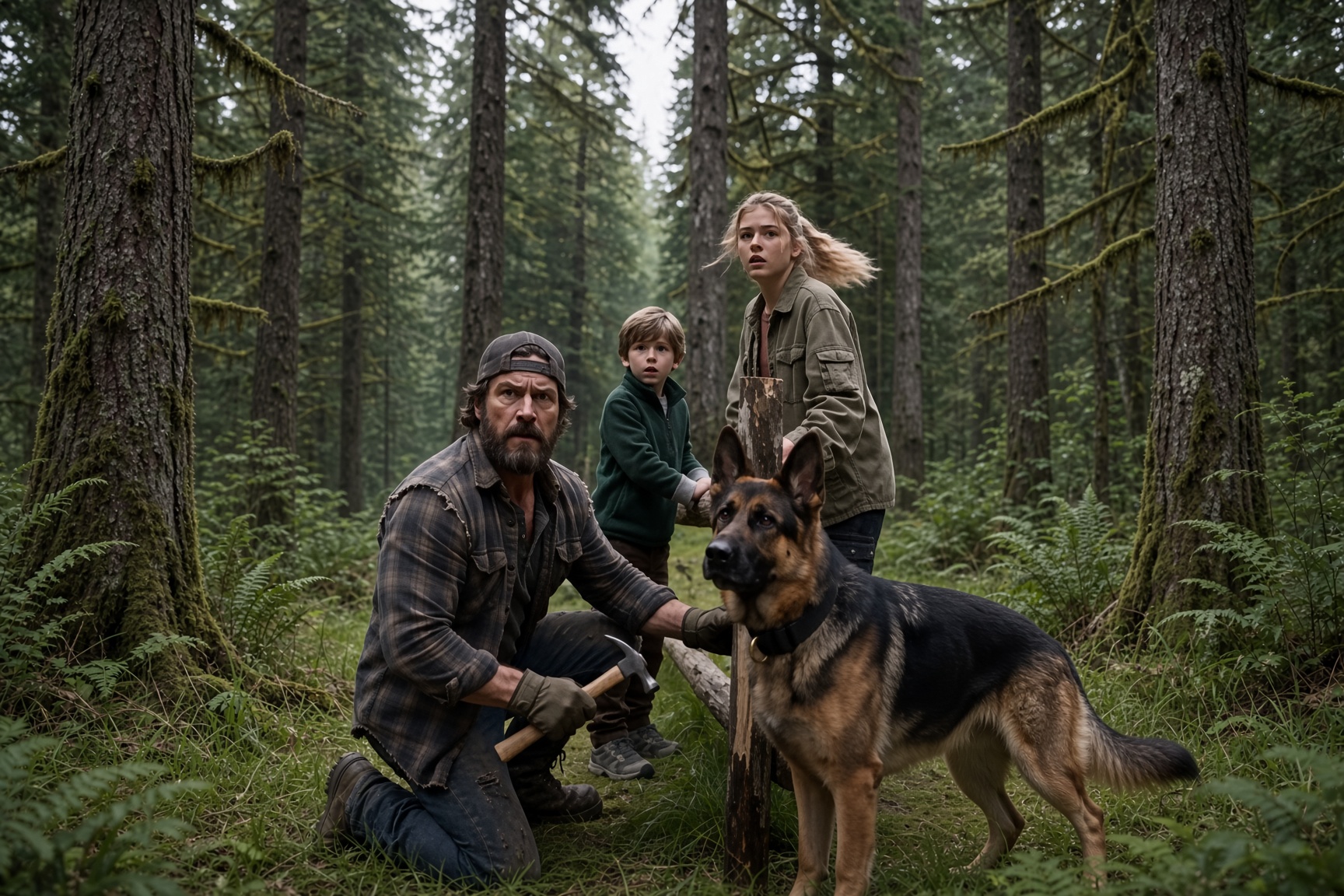
THE BUTTON UNDER THE PINES
They found him in the yard. The button was never meant to be a way out.
THE CLICK
Garrett Cole Harlan’s thumb hit the red switch before Clara finished saying his name.
The cover snapped shut on his knuckles. A hard plastic bite. The hallway smelled like pine sap and old wool and the dust the kids had tracked in from the yard.
Outside, boots hammered the porch boards.
Bear hit the door with his whole chest. The German Shepherd’s bark went high and raw, the kind that meant he had already decided he would die in that doorway if nobody moved him.
“Grandpa, what’s happening?” Clara said again, smaller now.
“I have to press the button now,” Garrett had told her.
He had pressed it.
The house answered.
A sound rolled through the logs like a truck crossing a frozen lake. Not a boom. A sequence. Bolts. Slides. Weight.
Steel shutters dropped over the front windows and killed the afternoon in one blink. The hallway went the color of a storm cellar. A strip of red light woke along the baseboard and ran toward the back of the cabin like a fuse that knew the floor plan.
Sam grabbed Clara’s sleeve with both hands.
“What did you do?” he whispered.
“I bought us minutes,” Garrett said. “Not hours. Minutes. Bear. Heel.”
The dog came off the door shaking. Foam at the corners of his mouth. His nails clicked on the boards as Garrett shoved the kids toward the kitchen.
Fists hit the front door. Not knocking. Testing.
A man’s voice came through the wood, muffled by a mask.
“Harlan. Open it. We only need you.”
Clara’s eyes found Garrett’s face and stayed there.
“They said your name.”
“I know.”
“You said they found you.”
“I know what I said.”
The red line on the floor stopped at the pantry. A panel in the wall that had always looked like bad carpentry popped its seam with a hiss. Cold air came up from under the house, wet stone and iron and something stored too long in the dark.
Garrett dropped to one knee.
“Clara. Sam. Listen to me like this is the last time I get to say it clean. You go down first. You do not wait at the bottom. You do not call my name if I don’t come. You take Bear. You keep your heads down. If I tell you to crawl, you crawl.”
Clara’s mouth shook.
“I’m not leaving you.”
“You’re not leaving me. You’re going first. That’s different.”
Sam looked at the hole.
“What’s down there?”
“The reason this place is still standing,” Garrett said.
He put a hand on each of their backs and pushed.
THE LOCKDOWN
The cabin had been a lie the whole time it looked like a cabin.
When the red switch went down, eight things happened in a row that Garrett had built across eleven winters and had prayed he would never have to count.
First, the shutters.
Second, the door bars. Two steel tongues drove into the frame from inside the jamb. The front door stopped being a door. It became a wall that still had a handle.
Third, the porch lights died and the yard floods died with them. The men outside lost their clean picture of the windows.
Fourth, a charge no bigger than a fist popped under the gravel at the tree line and threw a sheet of white smoke across the dirt road. Not fire. Cover.
Fifth, every battery pack Garrett had hidden in the eaves sent a hard pulse through a buried loop. The nearest ATV coughed and stalled like it had swallowed a rock. The second one kept running. The third one screamed and then cut out.
Sixth, a floor plate in the pantry unlocked.
Seventh, a radio in the room under the house woke on a frequency nobody legal still used.
Eighth, a mark went out. Not to any office. Not to any patch. To one name.
Boone.
The fists on the door got smarter.
They stopped pounding the center. They moved to the hinges.
Garrett heard a saw start up on the porch. Small. Battery. Mean.
“Down,” he said.
Clara went first because she always did when she was scared and trying not to be. The ladder was pine, worn smooth, twelve rungs into a dark that smelled like wet earth.
Sam followed with Bear’s collar in his fist. The dog did not like the hole. He went anyway.
Garrett took one last look at the hallway.
The hammer he had dropped in the yard was still out there in the grass. The fence timber the kids had been holding was still leaning against the post. A quiet afternoon, unfinished, sitting in the sun like it belonged to another family.
Glass cracked in the side window. Not through the shutter. Around it. They were going for the frame.
Garrett went down and pulled the pantry floor over his head. The plate seated with a sound like a vault trying to be polite.
Above them, the saw found wood.
THE ROOM UNDER THE HOUSE
The room was not a basement.
Basements had boxes and canning jars and the good kind of dark.
This was a throat.
Stone walls. A low timber ceiling. One narrow bunk. A metal locker. A map table bolted to the floor. A radio with a handset hanging off a hook like it had been waiting for a man who hoped he was wrong.
A red lamp the size of a fist burned over the table. Same color as the switch upstairs.
Clara stood with her arms around herself.
“Grandpa.”
“I’m here.”
“This was under the kitchen the whole time?”
“Under the pantry. Under the lie. Yes.”
Sam’s voice cracked.
“Are those guns?”
The locker stood open an inch. Inside: two rifles that did not look like hunting rifles, a canvas bag, three dark jackets, a first-aid tin that had been opened and closed too many times.
Garrett shut the locker with his boot.
“Not for you.”
Bear paced the stone, sniffing the seams. He stopped at the far wall and growled at nothing the kids could see.
Garrett crossed to the radio, thumbed it once, and spoke without raising his voice.
“Boone. It’s live. Three machines. Masks. They came down the pine road in daylight. I’ve got the kids. I’m going for the tube. If you’re still the man I drank coffee with, you be on the creek side. If you’re not, don’t answer.”
Static.
Then a cough. Then a voice like gravel that had learned manners.
“I told you not to press it unless the yard filled up.”
“The yard filled up.”
“How many?”
“I counted six off the machines. Maybe more in the trees. They knew the porch.”
A pause.
“Clara and Sam with you?”
“Yes.”
“Elena know?”
“Not yet.”
Boone swore once, quiet.
“I’m twenty minutes if the ford’s not swollen. Fifteen if I don’t care about the axle. You move. Don’t wait on me in that hole. Holes turn into graves when the saws start.”
“Copy.”
“Garrett.”
“What.”
“You press that thing, the cabin is done. You know that.”
“I know.”
The radio went back to breathing static.
Clara stared at him.
“Who’s Boone?”
“A man who used to keep my worst secrets in his pocket and never spent them.”
“Is he police?”
“No.”
“Are they police?” she asked, pointing at the ceiling, at the boots, at the saw.
Garrett looked at the red lamp.
“They wear the shape of it,” he said. “They talk like justice. They move like a warrant. They are not here to take me to a room with a table and a lawyer. They are here to close a file that has my name on it.”
Sam swallowed.
“What did you do?”
The saw changed pitch above them. Wood giving up.
Garrett pulled the canvas bag from the locker and slung it. He took one jacket and threw it at Clara, one at Sam. Too big. Better than bright shirts.
“I saw something I was told to forget,” he said. “I didn’t forget. I wrote it down. I hid the pages. Then I took you into the pines and I pretended a hammer and a fence could make a life.”
Clara’s eyes were wet and furious at the same time.
“You said we came here to disappear.”
“We did.”
“Then why is there a button?”
Garrett put his hand on the far wall. His palm found a seam the lamp barely showed.
“Because disappearing only works until it doesn’t.”
He pressed.
The wall did not swing like a door. It slid into itself, stone on stone, and showed them a black mouth the width of a man’s shoulders.
Cold air came out of it. Creek water. Roots. Distance.
“The tube,” Garrett said. “On your bellies. Clara first. Sam, you hold Bear’s collar and you do not let go even if he pulls. I am last. If the light dies, you keep crawling toward the sound of water.”
Clara looked into the dark.
“I can’t see the end.”
“You’re not supposed to,” Garrett said. “That’s how you stay alive in a place like this.”
BOOTS IN THE KITCHEN
They were not all the way into the tube when the pantry plate jumped.
Dust sifted down from the timber. Someone had found the seam.
A voice dropped into the room under the house, closer than the porch had been.
“Below. He’s below.”
Another voice, flatter.
“Burn the floor if you have to.”
Garrett shoved Clara into the tube so hard she scraped her palms.
“Go.”
She went.
Sam hesitated one heartbeat too long. Bear lunged toward the ladder instead of the dark, teeth bared at the men he could smell but not see.
Garrett grabbed the dog’s scruff and hauled.
“Bear. With them.”
The Shepherd fought him. Then he heard Clara’s breathing in the tube and the fight went out of him like a switch.
Sam crawled.
Garrett reached back, yanked a cord on the map table, and the red lamp died.
In the new dark, he heard a canister bounce off stone.
He did not wait to learn if it was smoke or worse.
He dove into the tube as the first hiss started behind him.
THE TUBE
The tube had been a drainage line in another century.
Garrett had widened it with a short shovel and a winter’s patience and a back that still remembered how to hate a job. He had shored it with salvaged timber. He had lined the worst dips with boards so a child would not drown in standing water if the creek rose.
It was still a grave that moved.
Clara’s sneakers scraped ahead. Sam’s breath came in little punched sounds. Bear’s claws clicked and slid.
Behind them, the room under the house filled with a chemical bite that made Garrett’s eyes water even in the pipe.
Someone shouted.
Someone else dropped onto stone.
A flashlight beam stabbed the mouth of the tube and died against the first bend.
“He’s in the pipe,” a man said.
“Send a body.”
Garrett reached into the canvas bag without looking and found the thing he had promised himself he would only use in a pipe. A short flare. Not for light. For the opposite.
He cracked it, tossed it backward without turning his head, and the tube behind them went to a white hell that would blind any man who put his face in the hole.
The shout that followed was not language. It was pain.
Clara whimpered.
“Don’t look back,” Garrett said. His voice came out as a rasp against the clay. “Water. Forward. That’s the only direction that exists.”
The tube sloped.
Mud took their elbows. A root hung down and slapped Sam in the mouth. He spat and kept moving because Clara kept moving and that was the whole religion of the next four minutes.
Garrett counted bends.
One.
Two.
Three, where the pipe narrowed and his shoulders scraped and he understood, not for the first time, that he had built this for children and for a thinner version of himself.
Four, where the sound of the creek arrived like a promise that might be a lie.
“I see light,” Clara gasped.
“Gray light,” Garrett said. “Not sky yet. Don’t stand up until I say.”
They spilled out into a culvert of wet stone half-hidden by ferns. The creek ran cold over black rock. Pine shadow laid stripes on the water. Afternoon had gone thinner, like the day was trying to leave without them.
Garrett came last, coughing the chemical taste out of his throat.
Bear shook creek water off his coat and put his nose into the wind.
The dog froze.
Garrett heard it too.
Engines.
Not all three had died. One ATV still lived, and it was coming off the pine road and down along the bank the way a man comes when he has a map of your land that you never sold him.
“Left,” Garrett said. “Stay in the water. It kills the trail.”
Clara stared at him, soaked to the ribs, hair stuck to her face.
“Grandpa. Your hand.”
He looked down.
The flare had kissed his palm on the throw. The skin was already tightening. He flexed it once and put it in his pocket like it belonged to somebody else.
“It’s a hand,” he said. “I’ve got another one. Move.”
THE CREEK
They waded.
The water hit Clara mid-thigh and Sam higher than that. Bear swam in short angry bursts and then found footing and then lost it again.
Behind the cabin, smoke was starting to mean something. Not the white sheet from the yard charge. Real smoke. Gray. Rising through the pines in a column that would be visible from the ridge.
Boone had been right.
The cabin was done.
Sam looked back once and made a sound that was not a word.
“Don’t,” Garrett said.
“That’s our house.”
“That was a box I put you in so you could sleep. The house is you two breathing. Keep breathing.”
A shout carried down the slope.
“Tracks in the culvert.”
Then the ATV, closer, rattling over root and stone.
Garrett pulled them under the undercut bank where the creek had chewed a shelf into the dirt. Roots hung in their hair. Cold water pushed at their knees.
The machine passed on the high side, ten yards off, engine snarling. Two men on it. Masks. Black gear. The lead man had a patch on his shoulder that was not a star and not a badge. A gray bar over a closed eye.
Fictional. Local. The kind of symbol men sew on when they want to look like a law that does not have to answer to a town.
They did not see the shelf.
They would on the way back.
Garrett waited until the engine note dropped, then he put his mouth to Clara’s ear.
“When I squeeze your shoulder, we cross to the far bank and we climb. There is a deer trail. It looks like nothing. That is why it works.”
“What if they see us?”
“Then we stop being a family on a walk and we become a problem. I need you not to become a problem until I say.”
Clara nodded against his jacket.
Sam’s lips were blue.
“I’m cold.”
“Good,” Garrett said. “Cold means you’re still in there. When you go numb, you tell me.”
He squeezed Clara’s shoulder.
They crossed.
THE DEER TRAIL
The far bank was gravel and pine duff and the kind of slope that punished knees.
Garrett went first and pulled Sam by the wrist. Clara climbed with her jaw set the way Elena’s used to set when a bill came that the month could not pay.
Bear took the hill in three ugly lunges and then stood above them panting, watching the creek like it had personally betrayed him.
The deer trail was a rumor in the brush. Garrett found it by the way the ferns leaned.
They ran it in a crouch.
Every few seconds the woods gave them a gift they did not want: a snippet of radio chatter from the men below, bounced off water and rock.
“—cabin’s cooking—”
“—old man had a hole. Repeat, a hole—”
“—kids are with him. Do not lose the kids. The kids are the lever—”
Clara heard that last one.
She stopped so suddenly Sam ran into her.
“They’re going to use us,” she said.
Garrett did not lie to her. He had already used up his lifetime supply of soft answers in the years he spent calling this place safe.
“Yes,” he said. “That is why you stay where I can reach you. That is why you do not offer yourself as a trade, not even in your head. You hear me?”
“I hear you.”
“Say it back.”
“We are not a lever.”
“Good.”
They moved.
A half mile up, the trail broke onto a bench of rock with a view they could not afford and took anyway.
Below, the log cabin was a black rectangle with an orange mouth. The porch was gone. The yard where Bear had slept in the grass was a smear of heat. One ATV sat dead near the fence like a toy somebody had stepped on. Another circled the burning box, a man standing on the footpegs, scanning the tree line.
The third machine was the one in the creek bed, working the bank.
Six men in the yard. Two on the live machine below. Maybe more in the timber.
Garrett had been right and he had been short.
Sam whispered, “The hammer’s still there.”
It was. A small dark shape in the grass the fire had not reached yet. A stupid, human leftover.
Garrett looked away first.
“Come on.”
THE RIDGE
They hit the ridge as the light went the color of old brass.
Garrett’s burned hand had started to shake. He taped it with a strip from the first-aid tin while they crouched in a blowdown, pine needles sticking to the wet on their clothes.
Clara watched him wrap.
“You built all of that,” she said. “The shutters. The hole. The pipe.”
“Yes.”
“For us?”
“For the day they stopped letting me be a grandfather.”
Sam picked at a scab on his knuckle that had nothing to do with today.
“Mom thinks you retired from the mill.”
“I did retire from the mill.”
“That’s not the same as the truth.”
Garrett tied the tape off with his teeth.
“No,” he said. “It isn’t.”
Bear’s head snapped left.
Not a bark. A sound in his throat that was older than training.
Garrett followed the dog’s stare.
A man stood in the trees thirty yards downslope. Mask. Black. A rifle held low, not aimed, which was worse in its way. It meant he thought he had time.
The man raised his other hand.
Not a wave.
A signal.
Garrett did not wait for the rest of the net to close.
“Down the back side,” he said. “Now. No trail. Just down.”
They slithered off the bench into laurel so thick it took skin.
Behind them a whistle cut the ridge. Short. Short. Long.
The woods started to move with men.
THE ALLY
The ford was a slab of rock in a bend of the creek that wagons had used when this county still pretended wagons were enough.
A battered green truck sat on the far side with its nose pointed at the trees, engine off, a man sitting on the hood like he had been poured there.
Boone Calder was sixty-one, raw-boned, gray at the mouth, wearing a canvas coat that had outlived two dogs and one marriage. He had a scoped rifle across his thighs and a look on his face that said he had already done the math and hated the number.
He saw the kids first and the look changed.
Then he saw Garrett’s hand and the look changed again.
“You’re late,” Boone said.
“You’re early,” Garrett said.
“Get in. Dog in the bed. Kids on the floorboards. Heads below glass.”
Clara stopped at the bumper.
“Who are you?”
“Boone. I used to pull your grandfather out of holes he dug with his mouth. Today I’m just a ride.”
Sam eyed the rifle.
“Are you going to shoot them?”
Boone glanced at Garrett.
“Only if they make me choose between manners and you,” he said. “Get in the truck, son.”
They got in.
Garrett took the passenger seat and kept his eyes on the ridge.
“How bad?” Boone asked, rolling the engine. It caught rough, then steadied.
“They burned the cabin. They know about the tube. They called the children a lever. Patch on the shoulder is a closed eye over a bar. Same as the night in Calder Hollow.”
Boone’s jaw worked.
“So it’s not local boys playing soldier.”
“It’s the same file,” Garrett said. “They just waited until I had something I couldn’t stand to lose.”
The truck took the logging spur like it knew the potholes by name.
Behind them, an engine note rose that did not belong to Boone’s old green box.
“ATV,” Clara said from the floor.
“I hear it,” Boone said.
He did not go faster. He went smarter. He killed the lights even though the evening had not fully committed to night, and he took a cut through a stand of dead pine that looked like a mistake until it wasn’t.
The ATV stayed on the main spur.
For a minute they had a gap.
Boone used it to talk.
“Elena called me last week,” he said. “Said the kids were up here finishing fence with you. Said you sounded tired.”
“I was tired.”
“She ask why you really left town?”
“She asked. I gave her the mill story again.”
Boone shook his head.
“You can’t keep feeding that girl sawdust and calling it bread.”
“I can until they’re off this mountain.”
A branch slapped the windshield. Bear barked once in the bed, then went quiet because Garrett rapped the back glass with his knuckles, a code the dog still kept.
Clara’s voice came up from the floor mats.
“Grandpa. If we get to town, are we safe?”
Garrett watched the trees.
“Town is witnesses,” he said. “Witnesses are a different kind of weapon. They are not a wall.”
Sam: “Then what’s the plan?”
Garrett looked at Boone.
Boone kept his eyes on the spur.
“There’s a woman in Whitlow who runs a night press out of a back room,” Boone said. “Name’s Marisol Vane. She prints what the courthouse won’t stamp. If your grandfather still has the pages he swore he had, she can put them on paper that people have to hold in their hands.”
Clara: “Pages of what?”
Garrett’s burned hand rested on his knee, taped, ugly.
“Of a hanging that was called an accident,” he said. “Of a ledger that moved land off a family’s name in the dark. Of men who wore masks in a hollow and called it justice because the county was tired of trials. I was supposed to sign the clean version. I signed the true one and I walked. They have been walking after me ever since.”
Silence in the truck, except the engine and the dog’s nails on metal.
Sam said, very carefully, “Did you kill anybody?”
“No.”
“Would you?”
Garrett did not answer as fast as a better man would have.
“To get you two off this ridge,” he said. “Yes.”
Boone exhaled through his nose.
“That’s the sentence that gets a man found,” he said. “Keep it in your chest, not your mouth.”
The ATV note came back, closer, joined by a second engine that had found a way around the dead pine.
“They split,” Boone said. “Of course they split.”
He yanked the wheel and put the truck down into a ditch that wanted to be a road and then up the other side with the frame screaming.
In the bed, Bear lost his footing and slammed the wheel well.
Clara started to rise.
“Stay down,” Garrett said.
She stayed down.
The rear window starred. Not a rock. A round. High, on purpose or not, glass raining onto the back of Garrett’s neck.
Boone did not swear. He drove.
THE COST
They almost made the blacktop.
The spur spat them onto a two-lane that ran toward Whitlow like a held breath. For five seconds there were yellow lines and a world that still believed in speed limits.
Then the second ATV came out of the tree break on the right and tried to lay itself across the nose of the truck.
Boone stood on the brakes and the wheel at the same time. The green truck slewed. The ATV clipped the front quarter and went spinning into the ditch in a spray of dirt and plastic.
The man on it rolled.
The man behind him did not. He came up on one knee in the road with a weapon at his shoulder.
Garrett opened his door before the truck had fully stopped.
“Stay,” he told the kids, and the word had all the years in it.
He went out into the two-lane with his hands visible and his body between the muzzle and the cab.
“You want a file,” Garrett called. “You’ve got me. The children are done being in this.”
The kneeling man tilted his head. The mask made him a blank.
“Come walk toward me, Harlan. Slow. The dog stays. The kids stay. Calder stays in the truck and keeps his rifle on the floor or I change the math.”
Boone’s voice, from the cab, low:
“Don’t you do a noble thing and make me bury you in front of them.”
Garrett took one step.
Bear came over the tailgate like a thrown coat.
The Shepherd hit the kneeling man high in the chest and the shot that went off was not the shot the man had wanted. It cracked the evening open and went into the trees.
They went down in a tangle of black cloth and tan fur and noise.
Garrett ran.
He did not run like a grandfather. He ran like the mill years had only been a costume.
He kicked the weapon wide. He got a hand in the mask strap and ripped. The face under it was young. Too young to be this sure. A white scar through one eyebrow. Eyes already going to panic because the dog was not a theory.
“Bear, out,” Garrett said.
The dog did not come out.
The second man from the wrecked ATV was on his feet in the ditch, swinging something short and ugly.
It caught Bear across the hip with a sound Garrett would hear for the rest of his life.
The Shepherd screamed.
Garrett turned on the second man with the kind of close, ugly work that does not look like a story when you tell it later. He put the man down on the road and kept him down until the short ugly thing skittered into the weeds.
Boone was out of the truck by then, rifle up, covering the tree line, covering the first man, covering the fact that this two-lane had become a room with no walls.
“Kids,” Boone snapped. “Eyes on the floor.”
Clara did not keep her eyes on the floor.
She saw Bear try to stand and fail.
She made a sound that belonged in a smaller day.
Garrett scooped the dog with both arms. Bear was heavy in the way living things are heavy when they stop helping you lift them. Blood darkened the tan of his hip and ran onto Garrett’s burned hand and made the tape look childish.
“Truck,” Garrett said.
They put Bear on the back seat because the bed was a promise of more bullets. Sam climbed in beside the dog without being told and pressed both hands to the wound the way he had been taught to press a cut on his own knee, except this was not a knee and the blood did not care about being taught.
Clara stared at Garrett’s face.
“Is he dying?”
“Not while I’m in this truck,” Garrett said.
Which was not an answer.
Boone gunned it.
Behind them, the first man was on his elbows in the road, mask off, shouting into a collar mic. The words were lost. The meaning was not.
The net would close on Whitlow now.
The file had a town.
WHITLOW
Whitlow was four streets, a grain elevator that no longer elevated anything, a diner with a dead neon pie, and a brick building that called itself a courthouse because the sign still said so.
Night had come down hard by the time Boone rolled them in behind the press building. The alley smelled like ink and fryer oil and wet cardboard.
Marisol Vane opened the back door before they knocked. She was forty, sharp-shouldered, hair pinned like she had done it for a war and then forgotten to undo it. Ink on her fingers. A look that took in the kids, the dog, the blood, the burned hand, and did not waste time on surprise.
“Inside,” she said. “All of you. That alley is a throat.”
They laid Bear on a table that had known only paper. Marisol’s mouth tightened. She pulled a kit from under a counter that was not a first-aid kit for paper cuts.
“I’m not a vet.”
“You’re what we’ve got,” Garrett said.
She worked.
Sam would not take his hands away until she made him. Then he stood with those red hands hanging like they did not belong to a boy who had been holding fence timber that same afternoon.
Clara sat on a stack of unsold sheets and shook.
Boone watched the alley through a crack in the door.
Garrett set the canvas bag on Marisol’s desk and took out a bundle wrapped in oilcloth. It made a sound when it hit the wood. Not heavy. Final.
“That’s the Hollow,” he said. “Names. Dates. The drop on the east slope. The men who held the rope and the men who held the pens. The land that changed owners before morning. My signature on the version they didn’t want. Copies of the version they did.”
Marisol unwrapped enough to see.
She did not whistle. She did not bless him. She turned a page with the care of someone who understood that paper could get you buried.
“You brought this into my shop with a wounded dog and two children,” she said. “So we’re past the part where I ask if you’re sure.”
“I’m sure.”
“They’ll come here.”
“I know.”
“Then we don’t hide it,” Marisol said. “Hiding it is how they win in places like this. We print. We put it on the courthouse board. We put it in the diner. We put it in every mailbox I can walk before my legs quit. We make the file too public to close quiet.”
Boone, from the door: “That’s a pretty speech until the masks roll up Main.”
Marisol did not look up.
“Then you and the old man keep Main busy,” she said. “I didn’t buy this press to die with clean hands and empty trays.”
Clara spoke from the paper stack.
“They burned our house.”
Marisol’s hands paused.
“I heard the scanner. They called it an isolated structure fire. They called your grandfather a person of interest. They did not call themselves anything at all.”
Clara’s face went hard in a way that did not fit her age.
“Print that too.”
Marisol almost smiled. It did not last.
“I will.”
On the table, Bear’s breathing evened into something that was not good and was not gone. Marisol had packed the hip and tied it like she was binding a book.
“He needs a real table and a real doctor of animals,” she said. “If you run again tonight, he may not finish the run.”
Garrett looked at the dog.
Bear looked back, brown eyes fogged with pain and still doing the job of watching doors.
The cost sat in the room with them and did not ask to be named.
Garrett named it anyway.
“He took a hit that was meant to drop me,” he said. “That’s the bill. We pay it by not wasting what he bought.”
Sam wiped his face with his wrist and smeared blood there by accident.
“I’m not leaving him.”
“Nobody’s leaving him,” Garrett said. “We are changing the kind of fight we’re in.”
THE PUBLIC TURN
They did it at first light because night belonged to men who liked masks.
Marisol’s press ran until the building shook. The smell of ink got into everybody’s hair. Clara fed sheets. Sam stacked. Boone hauled bundles like they were feed sacks. Garrett stood at the front glass with his taped hand and watched the street learn how to be a street again.
At six, they walked.
Not a march. A carrying.
Stacks of paper to the diner, where the cook took one look and put a bundle by the register without asking if it would cost him. Stacks to the hardware. Stacks under the wiper blades of every truck on Main. Stacks on the courthouse board over a notice about a bake sale that belonged to a softer county.
People came out in coats. They read. Some shook their heads like paper could not be true. Some went still in a way that meant they had always known and had been waiting for the knowing to grow a spine.
A man in a tan jacket that wanted to be official stepped onto the courthouse steps and told them to disperse.
He had no mask.
He had a voice that had practiced reasonable.
“This is a matter for the proper channels,” he said. “You are interfering with an active recovery.”
Marisol held up a sheet.
“Then recover this,” she said. “Out loud. In front of them.”
The crowd was not a mob. Whitlow did not do mobs. It did a circle. A quiet, ugly circle of people who had lived next to a hollow and told their children not to ask why certain last names sat on certain acres.
Garrett stepped onto the first courthouse step because the kids were behind him and because a step is a kind of witness stand if you make it one.
“My name is Garrett Cole Harlan,” he said. He did not raise his voice. The circle leaned in and did the raising for him. “I kept a cabin in the pines. Yesterday three black machines came down my road and men in masks called my grandchildren a lever. They burned the cabin. They shot at a truck. They broke my dog. They did it in the name of a file they don’t want you to read. So I brought you the file. If that makes me a person of interest, write it on the board next to the bake sale.”
A murmur.
The man in the tan jacket tried again.
“You are endangering minors.”
Clara stepped up beside Garrett. She did not take his hand. She stood on her own feet in a jacket that was still too big.
“We were already endangered,” she said. “We were holding a fence.”
Sam stayed on the walk with Bear, who had been carried on a canvas sling Boone made from a drop cloth. The dog lifted his head at the sound of Clara’s voice and then set it down again, done with the day and not done living it.
From the east end of Main, engines.
Not ATVs this time.
Two dark trucks with no county seal and no name on the door. Men got out who had put away the masks because the sun was up and the circle had phones out now, cheap cameras catching faces whether the faces liked it or not.
The closed-eye patch was still on one shoulder, half-hidden under a civilian coat that fooled nobody who had seen the yard burn.
They stopped at the edge of the circle.
They did the calculation men like that do when a job that was supposed to be a quiet snatch on a dirt road turns into paper on a courthouse board.
The young one with the scar through his eyebrow was not among them. Maybe still on the two-lane. Maybe already rewritten.
The lead man looked at Garrett like they were the only two people on the steps.
“You made a mess, Harlan.”
“You brought fire to a fence repair,” Garrett said. “Don’t talk to me about mess.”
“The pages don’t make you clean.”
“They don’t have to. They make you visible.”
A woman in the circle, older, hair like wire, spoke without being invited.
“I remember the Hollow,” she said. “I remember who told us to call it weather.”
That did more than the paper. That put a human mouth on a thing the masks had kept in ink and threat.
The lead man’s eyes flicked. Just once.
Then he smiled with no warmth.
“This isn’t over because you threw a parade.”
“I know,” Garrett said.
“You’ll sleep with one eye for the rest of your life.”
“I already was.”
The tan jacket man found a spine that was more procedure than courage.
“There will be no seizures on these steps in front of a crowd,” he said. “If you have a warrant that a judge in this county signed, lay it on the board. If you don’t, you get back in those trucks and you wait your turn like everybody else who thinks they own the law.”
It was not heroism. It was a man who had just realized the bake sale notice was no longer the most dangerous paper on his wall.
The dark trucks sat.
The circle held.
Phones stayed up.
After a long minute that had weather in it, the men got back in.
They left Main slower than they had arrived, which is how predators leave when the grass has too many eyes.
Nobody cheered.
Whitlow did not do that either.
THE CALL
Elena Harlan arrived at noon in a rust-red sedan that had thrown a belt on the last hill and kept coming anyway.
She was thirty-eight. Clara’s mouth. Sam’s stubborn shoulders. Eyes that had been tired before this day and had now found a new floor.
She saw the sling and the dog and the tape on her father’s hand and the ink on her children’s fingers and she did not start with a hug.
She started with a question that had been waiting in her for years.
“What did you bring my kids into?”
Garrett stood in the alley behind the press and took it.
“A lie that ran out of road,” he said. “I took them to the pines because I thought distance was a father. It isn’t. I’m sorry.”
Elena looked at Clara.
“You okay?”
Clara’s voice was scraped.
“Bear got hurt. The house is gone. Grandpa pressed a red button and the walls moved. Men in masks called us a lever. We crawled through a pipe. Miss Vane printed the truth. I’m not okay. I’m here.”
Elena pulled both kids in then, hard, the way you do when the alternative is falling down in an alley.
Over their heads she stared at Garrett.
“You will tell me all of it. Not the mill story. Not the tired story. All of it. And then we will decide if you get to be around them while the rest of this lands.”
“That’s fair.”
“It’s not fair. It’s what I’ve got.”
Boone stood off a few paces, giving the family a box of air.
Marisol came out with a stack of the afternoon extra.
“They’re already calling it a stunt,” she said. “They’re also calling the Hollow by name on two other town boards. That’s the part they can’t put back in the bottle.”
Elena took a sheet, read three lines, and closed her eyes.
“I knew you were in something,” she said to her father. “I told myself it was pride. It was never pride.”
“No,” Garrett said.
Sam, muffled against his mother’s coat: “Can Bear come with us?”
Elena looked at the dog. The dog looked at her like he remembered her from a kinder math.
“Yes,” she said. “He comes. Everybody who bled for you comes.”
AFTERMATH
They did not go back to the pines.
There was nothing to go back to but a black rectangle and a fence that would never get finished and a hammer in grass that would rust into the story.
They slept that first night in a room over the diner because the cook had a key and a son who had read the pages and decided the old man on the steps was not the danger.
Bear lay on a blanket. His hip was a landscape of stitches put in by a woman in a low building at the edge of town who did not ask for a name before she started. She said the leg would work if the dog believed it would. Bear believed in work. That would have to do.
Clara sat on the floor with her back to the bed and told the dark the true sequence until it stopped feeling like a dream.
Yard.
Bark.
Three machines.
Porch.
Hallway.
Button.
Shutter.
Hole.
Tube.
Creek.
Ridge.
Truck.
Road.
Shot.
Bear.
Ink.
Steps.
Sam fell asleep with his hand in Bear’s ruff, the way he had fallen asleep through thunderstorms when the cabin still had a roof.
Garrett sat in a chair by the window and did not pretend to sleep.
Elena sat on the other chair and made him start at the beginning.
He told her about the Hollow. About the night the masks had called a man’s death weather. About the ledger. About the signature they wanted and the one he gave instead. About the years of mills and quiet and a cabin that was a locked box with a red switch in the wall.
He told her about Boone, who had carried part of the secret because some men will carry a friend’s worst fact farther than a church will.
He told her about the button.
What it did. What it cost. What it could not do.
“It locked a house,” he said. “It woke a hole. It called one friend. It did not make us innocent. It did not kill the file. It bought a crawl through a pipe and a morning on courthouse steps. That’s all a button is good for. The rest is walking.”
Elena listened until her face looked older than his.
“They’ll come again.”
“Yes.”
“Not always in masks.”
“No.”
“And the kids are in the picture now. Because you put paper in the wind with their day attached to it.”
Garrett nodded.
“I can send you three states over,” he said. “I can stay and be the name they hunt. That is still on the table.”
Clara, who had not been asleep, spoke from the floor.
“We’re not splitting,” she said. “That’s how they use us. You said we are not a lever. So don’t turn us into one.”
Elena looked at her daughter for a long time.
“You sound like him.”
“I sound like somebody who crawled through a pipe,” Clara said. “That’s different.”
Outside, Whitlow’s one working streetlight buzzed.
A truck went by too slow.
Boone’s shape crossed the alley, rifle under the canvas coat, doing a circuit because some habits are love with a weapon in them.
Garrett watched the glass.
“I swore I would never touch that switch,” he said.
Elena: “And then you did.”
“And then I did.”
WHAT THE BUTTON LEFT BEHIND
Two weeks later the cabin site was a story people drove out to see.
They took pictures of the black rectangle. They argued in comment boxes that did not know a creek shelf or the smell of a chemical canister in a stone room. They used words like hoax and hero and criminal like those words were hats.
The pages did their slower work.
A land office clerk in a neighboring county put a hold on three transfers that had been moving like weather. A widow whose husband had died in the Hollow stood on her own porch and said his name into a recorder Marisol held. The tan jacket man from the courthouse asked for a review that might have been courage and might have been cover. It was too early to know which.
The masks did not vanish.
They changed clothes.
A man with a closed-eye patch under a flannel shirt was seen at the feed store asking who had printed the extra. A dark truck sat an hour at a time on the ridge above Whitlow, engine off, watching the diner.
Garrett moved the family to a rented place behind a shuttered orchard, ten miles out, gravel drive, no porch worth naming. He did not build a button into the wall.
He built other things.
A second door in the pantry that was only a door. A bag that stayed packed. A route to Boone’s place that did not use the same spur twice. A promise to Elena that he would not disappear the children in the name of saving them.
Bear walked with a hitch and then with less of one. He slept with his body across the bedroom threshold like a sentence that had not finished.
Sam started talking again in full strings instead of fragments. He asked if the fence timber had burned. Garrett told him the truth. Yes.
Clara wrote the day down in a cheap notebook Marisol had given her. She wrote the spoken lines as they had been, not as a storyteller would clean them.
Oh shit. They found me.
Grandpa, what’s happening?
I have to press the button now.
She underlined the last one.
On a Thursday near dusk, Garrett stood in the orchard with Boone and listened to crows argue in the dead trees.
“They’ll make another run,” Boone said.
“I know.”
“Next time it won’t be three ATVs on a dirt road. It’ll be a paper with a stamp, or a cousin with a smile, or a fire that starts in the walls without a switch.”
“I know that too.”
Boone spat into the grass.
“You going to build another hole?”
Garrett watched the light on the gravel.
“I’m going to build a life that can move,” he said. “Holes are for when you still think a house can love you back.”
From the rented kitchen, Clara called.
“Grandpa. Mom says food.”
“Coming.”
He did not go right away.
He looked at his burned palm, the new tight skin, the way it would always catch on cloth and remind him of a flare in a pipe and a dog screaming on a two-lane.
He had pressed the button.
The button had done its eight things.
The ninth thing was this: they were still here, and so was the file, and so were the men who wanted both of them gone.
That was not victory.
It was a continuation.
In the kitchen, Sam was telling Elena about the tube like it was a cave they had chosen. Clara corrected him on the order of the bends. Bear sat with his hip against the stove and accepted a scrap because the world, even now, contained scraps.
Garrett washed his hands.
The water ran cold.
Somewhere out past the orchard, an engine idled too long and then moved on.
He dried his palms.
He sat down with his family.
He did not tell them they were safe.
He told them to eat.
And when the sun dropped behind the dead trees, he stood up again and checked the gravel drive, and the second door, and the dark between the trunks, because the red switch was gone with the cabin and the work it stood for had only changed rooms.
DISCLAIMER
This is a work of fiction created for entertainment. Any resemblance to actual persons, living or dead, or to real organizations, agencies, companies, or events is coincidental. It is not a report, not a claim of fact, and not a guide to any real-world action.