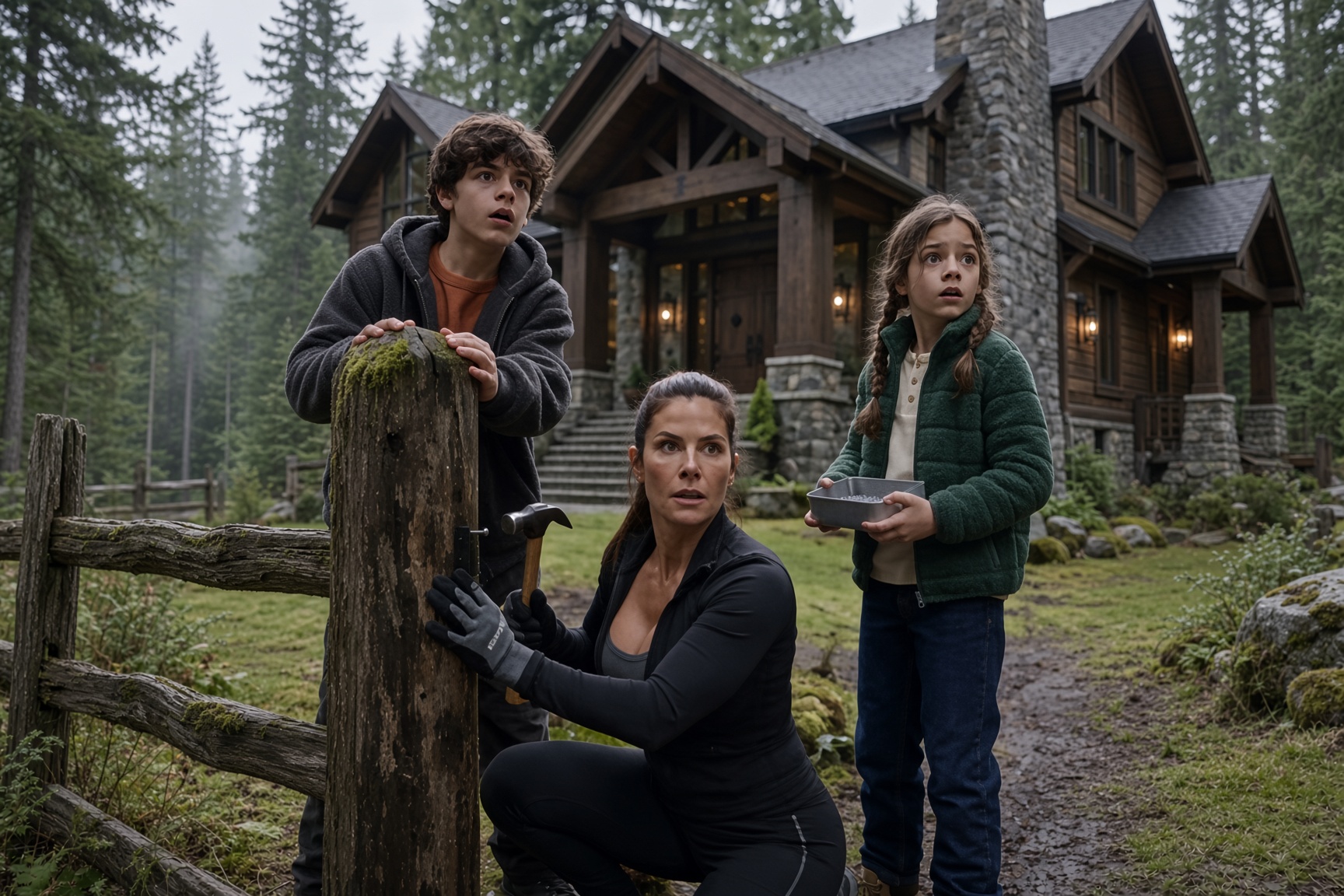
When the iron shutters drop, the past is already inside the walls.
THE SHUTTER
Mara slammed her palm into the red mushroom cap.
The contact housing shattered against the stone grout.
A heavy pneumatic shriek tore through the timber framing overhead.
Three-inch manganese steel plates dropped down inside the door frames and window casements, hitting the sills with a dull, concussive thud that rattled the stone foyer.
The light from the overcast woods vanished instantly.
Only the red emergency diodes along the baseboards remained, bathing the foyer in crimson.
Outside, the first burst of carbine fire struck the exterior slab doors.
The rounds sounded like dull ball-peen hammers striking an anvil.
“Mom!” Leo yelled, shoving Sophie behind his back. “What is that?”
“Breathe,” Mara whispered, stripping off her grey work gloves and tossing them onto the flagstones. “Both of you, on me. Don’t touch the outer walls.”
Sophie still clutched the metal tin of fence nails against her green puffer jacket.
Her small knuckles were bone-white.
THE BASEMENT CHUTE
Heavy mechanical thuds rattled the roofline.
“Breaching charges on the upper balcony,” Mara said quietly. “They know the floor plan.”
She grabbed Leo’s orange sleeve and pulled Sophie by the wrist, dragging them down the central corridor past the silent kitchen.
The house shuddered as a blast detonated upstairs.
Plaster dust fell through the floorboards like fine dry snow.
Mara reached the end of the hall, gripped the bronze coat rack, and levered it forty-five degrees to the left.
The floor grate beneath the boot bench popped open on counterweighted springs.
A dark steel chute angled downward into the blackness below the foundation.
“Feet first, arms crossed over your chest,” Mara instructed. “Leo, go.”
“Where does it go?” Leo demanded, his voice cracking.
“Down to the intake room. Move, Leo. Right now.”
Leo slid into the chute, his dark cargo pants hissing against the sheet metal before vanishing.
A dull thud echoed from below. “I’m okay!”
Mara looked down at Sophie. “Drop the tin, sweetie.”
“My nails,” Sophie whispered, tears tracking through the dust on her cheeks.
“Drop them. Take my hand.”
Sophie let the tin fall; the nails scattered across the hardwood like loose change.
Mara guided the girl into the mouth of the slide and let go.
Heavy boots slammed onto the timber floorboards above them—the roof breach was clear.
Mara slid in backward, kicking the spring release to drag the steel hatch shut behind her.
THE CRAWLWAY
The drop ended on a sand-filled impact berm inside a narrow, low-ceilinged concrete plenum.
The air was damp, cold, and smelled of wet earth and diesel exhaust.
Mara landed on her feet, caught her balance, and pulled both children into the alcove.
“Flashlights off,” she whispered. “Follow the yellow tracer wire along the wall.”
Above them, muffled concussions vibrated through eight inches of reinforced slab.
The strike team was clearing room by room with flashbangs and short rifle bursts.
They reached an iron access hatch marked with faded yellow stencils.
Mara spun the central wheel until the locking lugs retracted with a loud snap.
She swung the door out into a horizontal corrugated culvert running beneath the gravel access road.
“We have four minutes before they bring thermal scanners around the perimeter,” Mara said, checking her watch.
“Who are they?” Leo asked, his chest heaving under his hoodie. “You said nobody knew where this valley was.”
“They aren’t police,” Mara said coldly. “They’re Blackridge Vanguard.”
She crawled into the pipe, her knees grinding against the corrugated ridges.
The kids crawled behind her, Sophie’s small boots scuffing the steel.
Fifty yards down, the culvert opened into an overgrown drainage ditch hidden beneath thick salal and wild blackberry brambles.
THE DITCH
Rain misted down through the conifer canopy.
The cold air hit their faces, sharp and clean compared to the concrete cellar.
Two hundred yards up the slope, their home stood sealed and dark, smoke drifting from the shattered second-story balcony.
Two black armored trucks idle at the gate, their roof LED bars throwing harsh white beams across the wet gravel.
A third truck sat blocking the timber bridge half a mile down the only driveway.
“They’re deploying perimeter drones,” Mara said, spotting the high-frequency whine cutting through the engine rumble.
“Mom, look,” Sophie whispered, pointing toward the tree line.
Four men in matte-black tactical gear were moving down the slope in a sweeping wedge formation.
Their suppressed carbines were held at the low ready.
“Keep low in the creek bed,” Mara ordered. “If you hear a rotor, bury your face in the mud and do not move.”
They waded through calf-deep runoff, the muddy water soaking through Leo’s sneakers and Sophie’s tan boots.
The bank offered three feet of cover, but the brush was thinning ahead where an old logging road crossed the ravine.
A low hum buzzed directly over the canopy.
“Down!” Mara hissed, shoving both kids into the hollow under an overturned cedar root.
A black quadcopter drone drifted over the creek, its forward optic housing panning left to right.
Mara held her breath, pressing Sophie’s face against her jacket.
The drone paused directly above them for three agonizing seconds.
The thermal lens rotated, swept the opposite bank, and surged forward toward the timber gate.
“Move,” Mara whispered. “Now.”
THE WORKSHOP
Three miles west through unbroken timber, deep within the state forest cut, sat an abandoned Forest Service maintenance shed.
Mara forced the padlocked side door with an iron pry bar stashed behind a rotted stump.
Inside, rain drummed loudly against a corrugated tin roof.
An old green flatbed truck sat over a grease pit, surrounded by rusted oil drums and hanging chains.
In the corner, an elderly man in a grease-stained wool coat stood holding an antique 12-gauge shotgun leveled at the door.
“Stand down, Caleb,” Mara said, stepping into the weak light filtering through the grime-coated windows.
Caleb Reyes lowered the barrel, his weather-beaten face tightening as he looked past her to the children.
“Mara Linnea Vance,” Caleb said softly. “I heard the charges echoing off the ridge ten minutes ago.”
“They brought two trucks and eight operators,” Mara said, guiding the kids to an overturned wooden crate. “They had satellite coordinates.”
“Then the sealed court docket leaked,” Caleb said, setting the shotgun on a workbench. “Arthur Vance’s estate was opened in probate yesterday morning.”
Mara froze. “Arthur died?”
“Forty-eight hours ago,” Caleb said. “His board took control of the holding firm before the body was cold. The non-disclosure agreements died with him. They sent their retrieval team to clear the heirs.”
“Heirs?” Leo stepped forward, his eyes wide. “Mom, who is Arthur Vance?”
Mara looked at her son, the truth stripping away years of carefully constructed quiet.
“Your grandfather,” Mara said. “The man who built the surveillance software they just used to find our fence.”
THE AMBUSH
Before Caleb could start the flatbed, the tin roof rattled under a deafening downwash of air.
A light utility helicopter hovered fifty feet above the clearing, flattening the hemlocks with rotor wash.
A high-output spotlight burned through the shed’s skylights, turning the dust into blinding white glare.
“Vance family,” a voice boomed through an external loudspeaker, flat and electronically distorted. “Exit the structure with hands raised. Property retrieval protocol is in effect.”
“They skipped local dispatch,” Caleb growled, throwing open an old metal locker. “They bought private airspace rights over the whole county.”
“They aren’t taking my kids,” Mara said, grabbing an iron wrench from the bench.
The front barn doors blew inward under the impact of an armored bumper.
The black truck smashed through the dry-rotted wood, headlights pinning them against the back wall.
Two operators jumped from the running boards, weapons raised.
Caleb fired a blast from the shotgun into the truck’s radiator, steam and coolant erupting in a blinding cloud.
“Out the trench!” Caleb shouted, racking another shell. “Go!”
An operator fired three rapid suppressed rounds through the steam.
Caleb grunted, stumbled back against the workbench, and slumped onto the concrete floor, his hand clutching his shoulder.
“Caleb!” Sophie screamed.
“Run, Mara!” Caleb roared, firing blindly into the radiator grille to force the operators behind the engine block. “Take the creek road!”
Mara grabbed both children, shoved open the rear emergency door, and plunged out into the freezing downpour.
Behind them, the shotgun fell silent.
THE HIGHWAY
They hit the state route as twilight turned to ink.
Mara flagged down an old timber hauler grinding up the grade in low gear.
The driver, seeing a blood-streaked mother and two soaking-wet children emerging from the ditch, slammed on the brakes.
“Need help?” the driver called out, leaning over the passenger door.
“Hospital,” Mara lied, pulling Leo and Sophie up the high metal steps into the cab. “Car slid off the logging spur.”
The driver shifted into gear, the big diesel engine roaring as the rig pulled away into the night.
Through the side mirror, Mara watched two pairs of headlights emerge from the forest road, turning onto the asphalt behind them.
“They’re trailing,” Leo whispered from the sleeper berth in the back.
“I know,” Mara said, staring forward through the windshield wipers. “They won’t strike on an open interstate.”
She reached into her hidden interior pocket and pulled out an encrypted thumb drive Caleb had pressed into her palm before the shed collapsed.
The label read: *VANCE HOLDINGS – CORE ARCHIVE 01.*
“Where are we going?” Sophie asked, shivering under a greasy wool blanket the driver gave her.
“To the county courthouse in Olympia,” Mara said. “We’re putting Arthur’s files on public record before they can bury us.”
THE CLERK’S OFFICE
At dawn, the marble rotunda of the county courthouse was quiet and cold.
Mara walked through the metal detector with Leo and Sophie at her side, her clothes stiff with dried mud.
Two private security guards in Vanguard tactical jackets were already standing by the elevators.
Mara didn’t head for the elevators.
She walked straight to the public records counter and slammed the thumb drive down in front of the deputy clerk.
“I need an emergency ex parte filing for evidence preservation,” Mara said in a clear, carrying voice.
The clerk looked up, startled. “Ma’am, you need an appointment—”
“My name is Mara Linnea Vance,” she said, loud enough for every deputy and reporter in the lobby to hear. “I am submitting the internal audit of Blackridge Vanguard.”
The two private operators at the elevators froze, their hands dropping to their concealed holsters.
A county sheriff’s deputy stepped out from the main office, hand resting on his service weapon, his eyes darting between Mara and the armed men.
“Hold right there,” the deputy commanded, addressing the operators. “Hands where I can see them.”
The operators exchanged a brief look, turned on their heels, and walked out the glass doors into the grey morning rain.
THE SHADOWS
The docket was filed, but the victory was thin.
By noon, the television in the courthouse waiting room flashed breaking news: Vanguard’s corporate headquarters had initiated structural bankruptcy, liquidating the subsidiary that held the contracts.
No arrests were made.
The operators who broke their door had vanished into unmarked charter flights before the sheriff could sign the warrants.
Mara sat on the wooden bench, watching Leo help Sophie tie her damp bootlaces.
Caleb was alive in county intensive care, stable under guard, but their house in the timber valley was gone—burned to the ground by an electrical fire the fire marshal called accidental.
“Can we go home now?” Sophie asked, looking up with tired, red-rimmed eyes.
Mara knelt down, brushing a damp lock of hair from her daughter’s forehead.
“No, baby,” Mara said gently. “We have to find a new place now.”
“Will they come back?” Leo asked quietly.
Mara looked past him through the tall courthouse windows, out at the city streets filled with ordinary people moving under the grey sky.
“They might,” Mara said. “So we stay ready.”
DISCLAIMER: This work is a work of fiction designed purely for entertainment purposes. All names, characters, organizations, businesses, locations, and incidents are products of the author’s imagination or are used fictitiously. Any resemblance to actual persons, living or dead, or actual agencies, companies, or events is entirely coincidental.