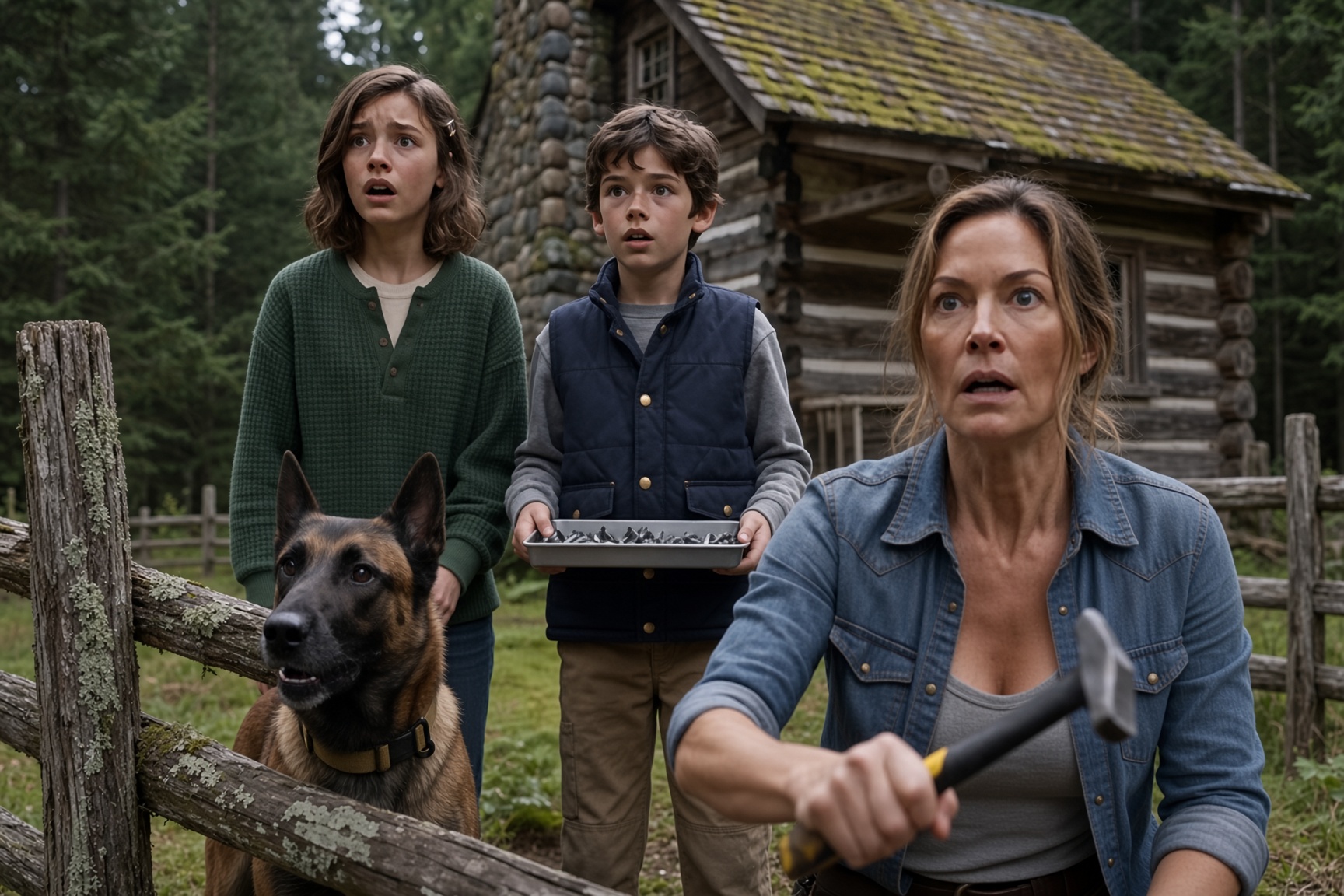
When the blast doors slammed down over the cabin windows, Maggie Vance knew the quiet life she had spent six years building for her children was dead.
PART 2:
THE CLICK
The red mushroom switch bottomed out with a sharp, hydraulic snap.
Deep inside the timber framing, high-voltage relays clattered like a burst of dry gunfire.
A deafening clatter of sheared pins followed, and four inches of case-hardened steel shutters dropped down inside every window frame of the cabin.
The room went instantly black, saved only by the single warm filament bulb vibrating in the ceiling socket above the hall.
Outside, the heavy timber porch groaned under the boots of four fully geared tactical operators.
Bruno planted his forepaws into the pine planks and let loose a guttural, chest-rattling roar.
“Mom!” Toby cried, his small knuckles white where he clutched Clara’s frayed green sleeve. “Mom, the windows!”
“I’ve got you,” Maggie said, her voice dropping into a flat, practiced cadence she hadn’t used in half a decade. “Both of you, eyes on me.”
A violent concussive thud struck the exterior door, bowing the thick oak inward against the iron deadbolt.
Wood dust drifted through the seam like powdered bone.
“Stand clear of the threshold,” Maggie whispered, grabbing Toby’s vest and shoving him behind the fieldstone hearth. “Clara, hold his collar. Don’t let Bruno charge.”
Clara dropped to her knees, her hands burying into the thick tan fur of the Malinois’s neck. “Who are they, Mom? You said no one knew this valley.”
“They don’t know the valley,” Maggie said, pulling her leather tool belt free and letting the hammer clatter to the boards. “They know my old radio frequencies.”
A metallic crack echoed from the porch—a shape charge being set against the exterior hinge plates.
“Ears!” Maggie shouted.
THE BREACH
The blast blew the top hinge straight through the inner pine paneling, spraying splinters across the ceiling.
Smoke rolled through the widening gap, smelling of burnt cordite and vaporized lacquer.
Maggie didn’t hesitate. She dragged the braided wool rug away from the base of the woodbox with one violent yank.
Beneath it lay a recessed hatch made of bolted Douglas fir, flush with the subfloor.
“Down,” she ordered, twisting the recessed brass ring and hauling the trapdoor open. “Now.”
A black-gloved hand thrust through the fractured seam of the cabin door, groping for the slide lock.
Maggie snatched an eighteen-inch carpenter’s pry bar from the wall peg beside the hearth.
She brought the curved steel end down onto the tactical operator’s wrist with everything in her shoulders.
Bone gave way with a wet crunch through the Kevlar glove.
A muffled howl of pain cut through the respirator mask on the other side, and the arm yanked back into the smoke.
“Toby, feet first!” Maggie commanded, not looking back. “There’s a ladder. Four rungs to the dirt. Go!”
Toby didn’t ask questions; terror had turned his legs to pistons, and he slid down into the darkness below the floorboards.
“Clara, dog next,” Maggie said.
“He won’t fit the ladder!” Clara yelled over the hiss of a second breaching strip burning outside.
“Push him into the slide chute beside it! He knows it! Rex, drop!”
Bruno didn’t need to be told twice; smelling the burning accelerant, the dog tucked his shoulders and scrambled into the angled wooden trough built beneath the root store.
“Your turn, Clara,” Maggie said, grabbing her daughter’s collar and lowering her until her boots caught the timber struts below. “Run to the junction box. Do not stop for me.”
“Mom—”
“Go!”
The front door tore inward off its bottom pins, the iron deadbolt ripping free of the splintered jamb.
A tactical operator in unmarked matte-black plate carriers filled the frame, the barrel of a suppressed carbine clearing the threshold.
Maggie kicked the heavy oak woodbox with her heel, sending fifty pounds of split birch tumbling across the entranceway.
The operator tripped forward into the logs, his weapon barking twice into the floorboards.
Maggie grabbed the hatch handle, dropped through the floor, and pulled the two-inch solid fir door shut above her head.
The spring-loaded deadlatch clicked home just as the operator’s boots hammered down on the top boards.
THE UNDER-FLOOR
The crawlspace smelled of damp soil, cold stone, and decades of dried pine pitch.
A single battery-operated amber LED strip cast a sickly, flickering trail along the low ceiling.
“Keep your heads down,” Maggie hissed, catching up to the kids in two long strides through the narrow trench.
The ceiling shook violently as the team above realized the cabin was empty.
Muffled voices barked through tactical headsets, distorted by the four inches of tongue-and-groove flooring overhead.
“Ground level clear! Primary targets displaced down! Find the sub-grade access!”
Toby was trembling so hard his teeth clicked together, but he kept moving, following Clara’s dirty sneakers through the mud.
“Mom, where does this go?” Clara whispered, her hand dragging along the damp stone wall of the foundation.
“Under the garden, past the chicken run, into the old drainage culvert by the creek,” Maggie said.
She reached up to an exposed PVC pipe running along the trench ceiling and pulled down a small steel toggle switch.
Twenty feet behind them, beneath the trapdoor they had just used, an incendiary fuse wire sparked.
A low, muffled whoosh vibrated through the earth as the decoy battery pack in the root cellar ignited, flooding the crawlspace behind them with thick, choking white phosphorus smoke.
“That will blind their thermal scopes,” Maggie said. “Keep moving. Five more yards.”
The trench terminated at a corrugated steel culvert pipe three feet in diameter, angling sharply downward toward the ravine.
Bruno was already waiting at the mouth, his ears pinned back, panting softly with his muzzle caked in brown clay.
“Toby first,” Maggie said. “Slide on your backside. Keep your feet out in front.”
Toby looked at the dark, rusted interior of the pipe, then up at Maggie’s face.
“Will they shoot Bruno?” he asked, tears cutting pale streaks through the dust on his cheeks.
“Not if we move faster than they do,” Maggie said firmly, kissing the crown of his head. “Slide. Now, buddy.”
He sat, gripped the rim, and dropped into the chute.
The sound of his corduroy pants whistling down the corrugated steel faded into the roar of the rushing creek below.
“Clara, right behind him,” Maggie urged.
Clara paused, looking at her mother’s empty belt. “You left your hammer.”
“I have something better at the cache,” Maggie replied, unzipping her denim cuff to reveal a braided paracord bracelet with a brass key woven into the center. “Go, sweetheart.”
Clara slid.
Maggie turned back toward the crawlspace.
Through the white smoke, two beam lights from weapon-mounted strobes were already cutting through the gloom, slicing through the phosphorus fog.
Maggie dropped onto her rear, grabbed the lip of the pipe, and kicked herself down into the dark.
THE RAVINE
The culvert emptied out into a jumble of mossy granite boulders forty feet below the cabin’s foundation shelf.
Maggie hit the wet mud at the bottom in a controlled slide, rolling onto her hip to absorb the shock.
The air out here was cold, sharp with the scent of hemlock and moving water.
Toby and Clara were crouched behind a downed cedar log, Clara’s arm slung tight over Bruno’s ribs to keep him still.
Up above, through the thick canopy of fir trees, the roar of the armored truck’s turbocharged diesel engine revved hard.
Then came the sharp, angry whine of two smaller engines.
Maggie looked up through the needle-thick branches.
“Dirt bikes,” she muttered under her breath. “They brought outriders.”
“They’re going to come down the logging switchbacks,” Clara said, her voice shaking but her eyes sharp. “That path cuts right across the creek bed half a mile down.”
“Then we don’t take the path,” Maggie said.
She reached into the hollow base of the cedar log where a six-inch PVC tube was sealed with wax and threaded caps.
She wrenched the cap off with her teeth and extracted a worn canvas satchel, a loaded 9mm semi-automatic pistol with three spare magazines, a water filter, and a handheld VHF radio with the display screen scratched out.
She racked the slide of the pistol, checked the chamber, and tucked it into the waistband of her work pants behind her back.
“Take off your vest, Toby,” she said.
“My vest? It’s cold, Mom.”
“It’s navy blue. Out here, you look like a flag against the moss. Turn it inside out.”
He looked down; the lining was a dull, mud-colored fleece. He pulled it off, flipped it, and zipped it back up without another word.
“Good boy,” Maggie said softly. “Clara, tie your hair back. If a branch snags you, don’t scream, just pull.”
A rifle shot cracked through the woods above them, striking the culvert pipe they had just exited with a deafening ring.
The sound rolled down the canyon like thunder.
“Discovered the exit,” Maggie said calmly, though her pulse was hammering against her ribs. “We stay in the water. Ankle-deep. It kills the scent for their dogs and hides our footprints in the silt.”
She stepped into the rushing mountain stream.
The glacial runoff hit her boots like needles, ice-cold and gray-green over slick stones.
Toby gasped as the water breached the tops of his leather boots, but Clara grabbed his hand, locking her fingers between his.
“Step where Mom steps,” Clara told him. “Don’t look at the trees. Look at the stones.”
They moved downstream, hugged tight against the undercut dirt banks where the roots of hemlocks hung down like coarse hair.
THE ROAR IN THE TIMBER
They had covered barely three hundred yards when the roar of the first dirt bike crested the ridge directly above them.
The rider was standing on the pegs, his black helmet visor completely opaque, a short-barreled shotgun slung across his chest.
The machine was an electric conversion—nearly silent except for the violent chewing of its knobby tires on wet shale and the hum of its motor.
He wasn’t looking at the water yet; he was scanning the game trail that ran parallel to the ridge.
Maggie pulled both children flat against the muddy bank, tucking them under a shelf of hanging fern roots.
Bruno dropped unbidden, his belly pressed flat into the cold sludge, ears swiveling toward the mechanical whine.
The rider stopped his bike thirty yards away on the timber bench above them.
He swung one leg off, unholstering a handheld thermal tracker.
Maggie watched the red power indicator on the device blink once, twice.
The phosphorus smoke from the cabin had coated their jackets, but the icy mountain water was already cooling their legs and torsos below the ambient ground temperature.
To the tracker, they would look like cold rocks, provided they didn’t move an inch.
Toby’s breath hitched in his throat. A tear formed in the corner of his eye, hanging on his lashes.
Maggie slowly slid her right hand behind her back, her fingers wrapping around the checkered grip of the 9mm.
She didn’t want to fire. A gunshot in this narrow valley would draw the armored truck down the fire road like a magnet.
The rider took three steps toward the edge of the drop-off, boots crunching through dead bracken.
He paused.
He looked down directly into the creek bed.
Through the hanging ferns, his black visor reflected the gray sky above.
Bruno’s chest vibrated with a growl so deep it was felt rather than heard, the skin above his black lips pulling tight over his teeth.
Maggie pressed her thumb against the dog’s jawline, applying pressure to the nerve cluster she had trained him on since he was a pup.
Bruno swallowed the sound, keeping his head anchored in the mud.
The rider reached for the radio on his shoulder harness.
“Bench one clear,” a crackling voice reported from his unit before he could speak. “Vehicle tracks detected at the northern cattle guard. They may have had a runner staged.”
The rider paused, his head tilting toward the radio.
He pressed his mic. “Copy. Leaving the creek sector. Moving to support perimeter north.”
He swung back onto his machine, twisted the throttle, and the electric dirt bike surged forward, showering the ferns above with damp loam and pine mulch.
THE OLD FLUME
“Out of the water,” Maggie whispered the second the engine whine faded into the trees. “Now.”
Her legs were numb from the knees down, the glacial creek leeching the strength from her calves.
She hauled Toby up onto a dry shelf of slate, then pulled Clara by the arm.
“Where now?” Clara asked, her face gray with cold, her teeth chattering uncontrollably. “The north road is cut off.”
“We don’t go north,” Maggie said, wringing out the hem of her denim overshirt. “The northern cattle guard was where I left the old Scout three years ago without an engine. It’s a tripwire decoy. It bought us ten minutes.”
“Did you know this would happen?” Toby asked, his brown eyes wide, searching her face for something that wasn’t terrifying. “Did you know they were coming?”
Maggie stopped, kneeling down in the needles until she was eye-to-eye with her seven-year-old son.
“I hoped they wouldn’t,” she said, her voice steady and clear. “I worked very hard to make sure they couldn’t. But when you run from men with unlimited fuel and radios, you always build a back door.”
She pointed through the thick stand of second-growth timber toward a rotting timber structure half-buried in the hillside.
It was an abandoned logging flume, built eighty years ago to float timber down to the Black River.
The wooden trough had long since rotted away, but the stone foundation piers remained, forming a hidden terrace halfway up the canyon wall.
“We take the high line,” Maggie said. “It leads to the railway crossing at MP-44.”
“That’s four miles,” Clara said, looking down at Toby’s small boots. “He can’t run four miles in wet shoes.”
“He doesn’t have to run,” Maggie said. “He just has to not quit.”
She looked at Toby. “Can you do that, Tobe?”
Toby wiped his nose on the sleeve of his inverted fleece vest. He nodded once, hard.
“Bruno will lead,” Maggie said. “He knows the trail scent. Let’s move.”
THE SCENT OF DIESEL
The rain began half an hour later—a miserable, needle-fine mist that slicked the slate and turned the pine needles to grease.
Behind them, deep in the valley they had left behind, a dull orange flash lit the low clouds.
A second later, the deep rumble of an explosion shook the ground under their boots.
Maggie didn’t stop, but her jaw tightened until the muscles bunched at her cheek.
“The cabin?” Clara asked, her voice cracking.
“The cabin,” Maggie confirmed quietly. “They breached the interior, didn’t find us, and blew the perimeter to clear line-of-sight.”
Everything was gone. The schoolbooks on the pine table, the cedar chest with their winter blankets, the sketches Toby had pinned to the refrigerator with magnets shaped like little river trout.
Six years of quiet, erased in forty-five minutes of tactical efficiency.
“Mom,” Toby said, pulling on her hand. “My wooden deer. The one we carved.”
“We’ll carve another one,” Maggie said, never breaking her stride. “The deer is wood, Toby. You are bone and blood. We keep the bone and blood.”
Ahead of them, Bruno suddenly halted on the narrow stone shelf.
His tail went rigid, pointing straight out, his nose lifted into the wet updraft coming off the logging road two hundred yards below.
Maggie froze, extending her arms to pin both children against the rock wall.
Down on the switchback, through the gray lattice of wet hemlock boughs, the massive black armored truck was crawling at walking speed.
Its amber roof lights were off now; it moved like an iron slug through the gloom, its heavy tires flattening saplings with a dry, splintering crack.
On its roof, an omnidirectional antenna cluster rotated slowly, clicking at every quarter turn.
“They’re sweeping the lower valley with broad-spectrum RF,” Maggie muttered, recognizing the mast. “They know I took the radio.”
She reached into her canvas satchel, pulled out the handheld VHF radio, and popped the battery pack off the base with her thumb.
She threw the lithium pack twenty feet down the slope into a briar patch, then shoved the dead radio back into her bag.
“If that battery shorts, it gives them a beacon,” she told Clara. “Never carry live cells when an Apex rig is sweeping.”
“Apex?” Clara repeated the word, catching it before Maggie could pull it back. “Is that what they’re called?”
Maggie looked at her daughter. Clara was twelve now, tall for her age, with her father’s steady, unblinking gray eyes.
“That’s what they called the operational arm,” Maggie said. “Before they privatized it. Before I left.”
“Were you one of them?” Clara asked.
The armored truck below rumbled past a gap in the trees, its exhaust manifold glowing dull red in the murky afternoon.
“I built their logistics networks,” Maggie said simply. “I told them where the roads were. Then I found out what they were putting on those roads.”
She turned and began climbing again. “Keep up.”
THE SPUR TRACK
They reached Milepost 44 just as the light was failing, the sky turning the color of wet zinc.
The spur track had been decommissioned twenty years earlier; saplings grew between the rotted ties, and the iron rails were thick with red rust that flaked off on Maggie’s trousers as she climbed the embankment.
At the side of the cut stood an old corrugated iron maintenance shed, its sliding doors hanging crooked on rusted runners.
Bruno trotted directly to the padlocked side door and sat down, his tongue lolling out the side of his mouth.
Maggie reached into her pocket, produced the brass key from her paracord bracelet, and slid it into the rusted padlock.
With a sharp twist and a grunt of effort, the cylinder gave way.
Inside, the shed smelled of grease, mouse droppings, and 90-weight gear oil.
Resting on the dirt floor under an oilcloth tarp was a heavy, four-wheeled rail maintenance cart—a gas-powered pump car with a pull-start Briggs & Stratton engine mounted over the rear axle.
Beside it sat two five-gallon steel jerrycans of stabilized aviation gas and a long iron crowbar.
“We’re riding the rails?” Clara asked, stepping inside and pulling Toby out of the rain.
“Only for three miles,” Maggie said, hauling the tarp off the cart with a flourish that sent a family of field mice scattering into the shadows. “The track runs through the Black Gorge tunnel. The road doesn’t go through the tunnel. It has to circle seven miles around the mountain to the west.”
“If they’re tracking the railway line, won’t they see us?” Clara asked.
“The tunnel collapsed thirty percent on the north portal in ninety-eight,” Maggie said, checking the fuel tank on the cart. It was full, sealed with silicone grease. “Their trucks can’t fit through the clearance. This cart can.”
She grabbed the pull-cord of the engine.
“Wait,” she told them. “Once this fires, they’ll pick up the acoustic signature within two miles. Clara, help me shove it onto the iron first.”
Together, mother and daughter leaned their shoulders into the heavy steel frame of the maintenance cart.
The iron wheels shrieked against the rusty rails, a terrible, grinding sound that set Maggie’s teeth on edge, but the cart rolled out onto the main spur with a heavy clunk.
Maggie lifted Toby onto the wooden bench between the fuel cans.
“Hold the frame rail with both hands,” she told him. “Do not let go, no matter how fast it feels.”
“Bruno too?” Toby asked.
“Bruno rides between my feet,” Maggie said.
She set the choke, planted her boot on the frame, and hauled on the starter rope.
THE RUN THROUGH THE RIDGE
The small engine sputtered, coughed a cloud of blue two-stroke smoke, and caught with a violent, rhythmic rattle.
Maggie shoved the drive lever forward.
The centrifugal clutch engaged with a metallic snap, and the cart lurched, its flanged wheels biting into the rusted iron.
Within ten seconds they were rattling down the grade at twenty miles an hour, wind whipping Maggie’s loose hair across her eyes.
Behind them, down the spur toward the timber cut, two sets of ultra-bright LED headlights exploded through the dusk.
The black armored truck had found the rail crossing.
The vehicle didn’t attempt to mount the ties; its front bumper smashed through the crossing gate, sending splintered white wood twenty feet into the air.
Maggie opened the throttle to the stop.
The small engine roared, vibrating through the cart’s frame so violently that Toby had to bite his lip to keep from crying out.
The wind was freezing, stinging their cheeks with rain.
“Duck down!” Maggie yelled.
A heavy, high-caliber round slammed into the gravel between the rails forty feet behind them, kicking up a fountain of ballast stones.
The sound of the shot arrived an instant later—a flat, sharp thud that echoed off the rock cut.
They weren’t using carbines now; they had mounted a heavy rifle to the truck’s roof turret.
“Get flat!” Maggie screamed, shoving Clara down onto the floorboards over Toby’s back.
She dropped to her knees, keeping her right hand locked onto the vibrating throttle arm.
Another round struck the rear timber bumper of the cart, shearing a chunk of weathered oak into spinning toothpicks.
The cart swerved on its springs, the left wheel lifting two inches off the iron before slamming back down with an ear-splitting shriek.
Ahead, the black mouth of the Black Gorge tunnel opened in the granite cliff like a missing tooth.
“Hold on!” Maggie roared.
The cart shot from the misty drizzle into absolute, swallowing darkness.
THE TUNNEL
The noise inside the tunnel was terrifying.
The rattle of the Briggs & Stratton engine multiplied tenfold against the dripping stone walls, reverberating in their skulls until it felt like their ears would bleed.
Water rained down from the ceiling in steady, icy sheets, smelling of soot and lime.
Maggie reached down with her left hand, feeling blindly for the toggle switch on the cart’s crude headlamp.
She clicked it on.
A dim, yellow six-volt beam cut through the wet fog inside the shaft, illuminating the rusted rails twenty feet ahead.
Fifty yards in, the obstruction appeared.
A massive rockfall from the nineteen-nineties had choked the double-track tunnel down to a narrow, jagged notch along the east wall.
Old rotten timbers jutted from the heap like broken ribs.
Maggie didn’t cut the throttle.
“Lean right!” she screamed into Clara’s ear. “Both of you, lean into the wall!”
The children threw their weight toward the rock face.
The cart hit the clearance gap at twenty-five miles an hour.
The left-side steel frame scraped against a granite boulder with a shower of orange sparks that lit the tunnel like fireworks.
The screech of tortured metal was deafening.
Maggie felt the impact travel through her hips, nearly tearing her hand from the throttle lever.
A projecting timber beam caught the engine’s air cleaner, ripping it clean off the carburetor in a spray of shredded paper and foam, but the engine didn’t die—it screamed louder, sucking in the cold, wet tunnel air directly through the intake.
Then, with a final sickening scrape that tore the satchel from the cart’s side rail, they cleared the choke point.
Behind them, deep in the tunnel mouth they had entered, a brilliant white light flared.
The armored truck had reached the portal.
Its massive searchlights probed the gloom, but the beam stopped dead against the mountain of fallen granite boulders.
Maggie looked back over her shoulder.
The lights were pinned against the rockfall, powerless to follow.
A single horn sounded from the truck—a low, rhythmic blast of fury that resonated through the stone tube like the roar of a trapped beast.
Two miles later, the cart burst through the northern portal into the open air of Cold Branch basin.
SILAS
The rail cart sputtered and died half a mile past the tunnel exit, its abused engine finally seizing in a cloud of white oil smoke.
Maggie didn’t waste time trying to restart it.
She hoisted Toby onto her hip, grabbed Clara’s hand, and led them down the steep gravel embankment into the willow thickets of Cold Branch.
They were five miles outside the small timber town of Oakhaven now, in a swampy bottomland where the river split into four sluggish channels.
Hidden among the black cottonwoods stood a low, corrugated metal workshop surrounded by rusted school buses, backhoes, and stacks of reclaimed steel plate.
A hand-painted sign by the gravel turnoff read: *WARD SALVAGE & REPAIR. NO TRESPASSING. WE DO NOT CALL 911.*
Bruno trotted straight to the workshop’s side door and whined once, scratching his paw against the sheet metal.
The door swung open four inches.
The black, unblinking eye of a twelve-gauge shotgun barrel poked through the gap.
“Dog belongs to Maggie Vance,” a gravelly, dry voice rasped from behind the steel. “Which means whatever’s behind the dog is trouble I don’t need.”
“Silas,” Maggie said, her voice dropping all its tactical hardness, replaced by pure exhaustion. “It’s me. Open the damn door.”
The barrel lowered.
The door pulled open to reveal Silas Ward—seventy years old, wearing oil-stained blue coveralls over a gray thermal shirt, his left eye milky with a cataract, his right eye as sharp as a newly ground chisel.
He looked at Maggie’s soaked denim shirt, at Clara shivering in her wet sweater, and at Toby, whose lips were turning a faint, dangerous shade of violet.
Silas didn’t ask a question.
He stepped back and swung the door wide. “Wood stove is lit in the back room. Get them out of those clothes.”
THE WOOD SHOP
The interior of the salvage shed was warm, smelling of cedar sawdust, diesel fuel, and stale Folgers coffee.
In the center of the office room, an old barrel stove made from two fifty-five-gallon drums welded together glowed a faint, cherry red at the base.
Silas grabbed two heavy wool moving blankets from a shelf and dumped them into Clara’s lap.
“Strip him down and wrap him,” Silas ordered the girl, nodding toward Toby. “Hang their wet gear on the conduit above the drums.”
He walked over to a scarred laminate counter, poured black coffee from an ancient glass pot into a tin mug, and slid it toward Maggie.
Maggie wrapped both hands around the hot metal, letting the heat seep into her cracked palms.
“They brought a Mastiff-series tactical chassis,” Maggie said, her voice flat. “Two electric outriders. Broad-spectrum RF sweepers.”
Silas took a drag from an unfiltered cigarette, the ember flaring orange against his leathery face.
“They breached your cabin?”
“Bore-charged the front plate. Dropped incendiaries in the crawlway. Then leveled the site with C-four.”
Silas exhaled a long stream of blue smoke toward the tin roof. “I told you six years ago, Margaret. You can’t retire from those people. You know the delivery manifest for the whole southern corridor.”
“I took nothing with me,” Maggie said fiercely. “Not a file. Not a drive.”
“You took your head,” Silas said, tapping his temple with a grease-stained finger. “That’s the only hard drive they care about.”
“Mom,” Toby’s small voice called from by the stove.
He was bundled like a cocoon in the gray moving blanket, his hair sticking up in wet spikes, his feet tucked close to the warm metal of the drum.
“Where’s Bruno?”
“He’s right here, Tobe,” Clara said, her fingers buried in the dog’s neck fur. Bruno was lying stretched out across the woodchips, his flank rising and falling in deep, rhythmic shudders of relief.
Silas walked to a reinforced steel locker in the back corner of the workshop, spun a combination dial, and swung the heavy door open.
Inside lay three desktop computer terminals, disconnected from any wall jack, powered by a rack of deep-cycle marine batteries.
“You need to make noise,” Silas said, not looking back at her. “You spent six years playing dead. Dead doesn’t work once they drop armor on your porch. The only thing that stops an extrajudicial sweep is daylight.”
“If I broadcast to the county, they’ll jam the repeater towers before the packets clear the switch,” Maggie said.
“Not to the county,” Silas replied. He pulled a thick, heavy optical cable from the back of the rack. “To the State Circuit Court repository at the capital. And to the regional news desks. All fourteen of them.”
Maggie stared at him. “You still have the hardline drop into the old railway telegraph conduit?”
Silas smiled, revealing teeth stained yellow by tobacco. “The state thinks that conduit was abandoned in nineteen-eighty-one. But the copper is still dry inside the lead shielding. It crosses thirty-four miles of marsh straight to the main terminal in Helena.”
He looked at her, his expression turning solemn.
“Once you plug in, Margaret, you tell the whole story. Not just what they did to your house today. You tell what was in the containers at the rail yards in twenty-twenty.”
Maggie looked back at her children.
Toby was dozing against the warmth of the drum stove, his face relaxed for the first time since the wooden gate had shattered.
Clara was watching her mother, her gray eyes steady, understanding more than she should have had to understand.
“If I do that,” Maggie said quietly, “there’s no quiet cabin at the end of this. Ever.”
“There wasn’t one anyway,” Silas said. “The minute that truck crossed your fence, the quiet cabin was a ghost.”
THE WIRE
Maggie sat before the flickering green monochrome monitor of the terminal.
Her fingers, stiff from the cold and scarred from years of carpentry, hesitated over the mechanical keys.
“They’re coming around the western spur,” Silas said, checking an old analog scanner on the workbench. “The local sheriff’s dispatch is totally dead. That means your friends have dropped an area-wide cell blanket over the county.”
“They’ll have the road outside blocked within twenty minutes,” Maggie said.
“Ten,” Silas corrected. “They don’t drive twenty miles an hour on asphalt.”
Maggie began to type.
She didn’t write an emotional plea. She didn’t write about her burned home, her terrified children, or the split-rail fence she hadn’t had time to finish.
She wrote numbers.
She typed the manifest serial codes for thirty-six unmarked rail containers that had passed through the Pacific Northwest transit corridor between 2018 and 2020.
She typed the names of three private defense shell corporations registered in the Cayman Islands.
She typed the coordinates of four clandestine disposal sites in the Idaho panhandle where soil contamination tests had been systematically altered by company contractors.
And at the bottom, she typed her own name:
*Margaret Linnea Vance. Formerly Logistics Director, Operations Group Four, Ironwood Directorate.*
“Is it ready?” Silas asked.
“It’s seventy megabytes of uncompressed shipping logs,” Maggie said, her fingers flying across the keys. “The line speed on this lead wire is thirty-three point six kilobits. It will take six minutes to transmit the batch.”
“You have four,” Silas said, cocking his head toward the metal wall.
Outside, the rain had stopped.
In the sudden stillness of the marshland, the low, unmistakable idle of two heavy diesel engines vibrated through the steel siding of the building.
THE PERIMETER
Silas picked up his twelve-gauge shotgun and walked to the small observation slit cut into the sliding front doors.
“They brought both rigs,” he said calmly. “The heavy truck and a chase van. They’re staging at the bridge sixty yards out.”
“Did they see the lights?” Maggie asked, not taking her eyes off the upload progress bar crawling across the green screen.
*42% TRANSMITTED.*
“They don’t need lights,” Silas said. “They have forward-looking infrared. They can see the heat bloom from my drum stove through the tin siding.”
A voice boomed through an external loudspeaker outside—flat, amplified, carrying no human inflection:
“OCCUPANTS OF THE COMMERCIAL STRUCTURE. YOU ARE HARBORING A FEDERAL FUGITIVE SUBJECT TO ARREST WARRANT SEVEN-ZERO-NINE. CUT MAIN POWER AND EXIT WITH HANDS VISIBLE.”
Toby sat bolt upright, the wool blanket slipping from his shoulders. “Mom?”
“Stay by the stove, Toby,” Maggie said, her voice dropping into iron. “Clara, get him behind the steel anvil base. If you hear metal hitting the walls, you both get flat on the concrete.”
*58% TRANSMITTED.*
“Federal warrant,” Silas spat toward the door. “They haven’t held a federal badge in eight years. Pure corporate muscle.”
He racked the slide of the shotgun, chambering a round of three-inch copper-plated buckshot.
“Silas, don’t,” Maggie said, rising from the terminal. “They have level-four plates. Buckshot will just make them use gas.”
“I’m seventy-one years old, Margaret,” Silas said, his single good eye crinkling at the corner. “I’ve lived in this swamp forty years. Nobody tells me to cut my power.”
A canister hissed outside.
An instant later, a steel CS-gas grenade punched through the corrugated tin wall three feet above the floor, spinning across the oil-stained concrete and spewing dense, white chemical smoke.
“Toby, wet rag!” Clara shouted, grabbing a dirty shop towel, dumping the remaining cold coffee over it, and pressing it against her little brother’s nose and mouth.
Maggie didn’t cough; she grabbed a five-gallon steel grease bucket and slammed it upside-down over the burning grenade, trapping the majority of the gas beneath the steel seal.
*76% TRANSMITTED.*
Outside, the heavy armored truck revved its engine.
The driver wasn’t going to wait for the gas to work.
The front bumper of the black monster struck the sliding doors of the salvage shed at fifteen miles an hour.
THE IMPACT
The structural steel posts buckled with a horrifying shriek of sheared bolts.
The doors tore inward like tin foil, the truck’s massive reinforced radiator grille coming to rest ten feet inside the shop floor, showering the interior with shattered glass and metal studs.
Two flashbang grenades arced through the gap, detonating with twin concussions that blew the remaining window glass out of the office frame and left Maggie’s ears ringing with a piercing white noise.
Through the smoke, two operators advanced, carbines raised, laser sights painting thin red lines through the haze.
The lead operator’s dot settled directly on the computer terminal.
He fired three rounds of five-point-five-six armor-piercing ammunition, smashing the cathode-ray monitor into a spray of green glass and sparking plastic.
The hard drive tower beneath the desk took two rounds, smoke pouring from its vents.
Maggie didn’t flinch.
She knew what the operator didn’t: the data had cleared the buffer forty seconds earlier.
The screen had died, but the terminal had finished its handshake.
The files were already sitting on thirty-four newsroom servers and the clerk’s intake queue in the capital.
Silas fired from behind a lathe.
The blast of buckshot struck the lead operator in the chest plate, staggering the two-hundred-pound man back two steps into the radiator of the truck.
The armor held, but the impact took the operator’s wind, sending him down to one knee.
The second operator swung his carbine toward Silas.
“No!” Maggie shouted, lunging forward with the 9mm she had carried from the creek.
She didn’t aim for the chest; she knew the plates.
She aimed low, firing two shots into the operator’s exposed right thigh just below the ballistic groin guard.
The operator collapsed with a sharp grunt of agony, his weapon clattering across the oil-slick concrete.
Behind the truck, a third man stepped into the gap—taller, broader, wearing no helmet, only a black tactical cap and a headset.
His face was scarred along the jawline, his eyes cold and pale.
Maggie froze, her pistol leveled at his forehead.
“Hello, Margaret,” the man said, his voice entirely calm over the hiss of leaking radiator fluid from the truck. “You always were terrible at inventory management.”
THE MAN FROM THE DIVISION
“Vance,” Maggie said, her hands locking rigid around the pistol grip.
“You should have kept running south,” the man said. His hands were resting casually on his tactical belt, three inches from his sidearm. “Canada was the smart play. Why stay in the valley?”
“My children were born in this valley,” Maggie said.
“And they’re going to watch you bleed out in this swamp,” he replied. “Give me the primary drive.”
“It’s already gone, Thomas,” she said.
The man’s eyes flickered toward the shattered computer on the bench, then to the blinking activity light on the ancient lead-wire transmitter box bolted to the wall behind it.
The light was green. Constant. Not blinking.
*Transfer complete.*
Thomas Vance’s jaw tightened.
He wasn’t her husband; he was her former squad commander. The man who had signed off on the false manifests six years ago.
The man who had promised her she could leave if she kept her mouth shut.
“You didn’t,” he whispered.
“I kept it shut until you drove through my fence,” Maggie said. “Until you pointed carbines at my son.”
Outside, in the distant mist toward the highway, a new sound began to rise.
It wasn’t the roar of an armored diesel or the whine of an electric bike.
It was the high-low wail of state police sirens—not one or two, but a chorus of them, coming down Route 12 at full throttle.
Thomas Vance looked toward the open marsh behind him.
“You sent the whole archive,” he said.
“Every page,” Maggie said. “Every signature you forged. Every site in the panhandle. The Helena bureau has had the transmission for four minutes.”
Thomas stared at her for five long seconds.
He didn’t draw his gun. He was a professional; he knew when an operation had crossed from an extraction into a catastrophe.
“You think they care about contaminated water in the panhandle?” he said softly. “In six months, this will be an administrative error.”
“Maybe,” Maggie said. “But tomorrow morning, it’s on the front page of every paper between Seattle and Chicago. Which means your board of directors is going to find someone to blame.”
She took one step forward, the muzzle of her pistol never deviating from the center of his forehead.
“And you’re the one holding the invoice.”
Thomas slowly raised his right hand, two fingers extended toward his downed operators.
“Fall back,” he commanded quietly into his mic. “Extract now.”
The uninjured operator dragged his wounded comrade backward through the shattered doorway, leaving a smeared trail of crimson across the threshold.
Thomas Vance backed out after them, his eyes locked on Maggie until the mist of the swamp swallowed his silhouette.
The chase van revved hard, tires spinning in the salvage yard mud, before tearing down the driveway toward the back fire road, fleeing the highway sirens that were already lighting the trees with flashing red and blue strobes.
THE COST
Maggie didn’t lower her gun until the sound of the van had completely vanished into the distance.
Then her knees buckled.
She slumped against the side of the lathe, her pistol clattering to the concrete floor.
“Maggie,” Silas coughed, waving his hand through the lingering smoke. He was sitting on a wooden crate, his face pale, holding his left shoulder where a piece of flying door shrapnel had torn through his coverall.
“Silas,” she gasped, scrambling toward him on her knees. “You’re hit.”
“Just tin,” the old man wheezed, wincing as she pressed her thumb against the tear. “Old tin doesn’t kill anything but your tetanus record. Is the upload clear?”
“It’s clear,” she said, her voice breaking.
Behind them, Clara stepped out from behind the heavy steel anvil.
She was leading Toby by the hand.
Toby’s face was soot-stained, his small hand clutching Clara’s fingers like a lifeline, but he wasn’t crying anymore.
He looked at the wreckage of the shop, at the shattered front doors, at the puddle of red transmission fluid and coolant spreading across the floor from the abandoned armored truck that Thomas’s men hadn’t had time to tow.
Bruno trotted over to Maggie, his tail giving two slow, cautious wags before he pressed his wet nose against her neck.
Maggie pulled the dog tight to her chest, burying her face in his coarse fur, her shoulders shaking with silent, ragged sobs that she had held back for twelve miles.
Clara knelt beside her, wrapping her arms around her mother’s waist.
Toby followed, burying his head against Maggie’s back.
For three minutes, in the ruined, smoke-filled salvage shed, the only sound was the crackle of the wood stove and the distant, approaching wail of the sirens.
THE ROAD AHEAD
The Montana State Troopers arrived with eight patrol cruisers, rifles drawn, their spotlights sweeping the yard.
Maggie didn’t run.
She walked out into the cold drizzle with her hands empty, her children behind her, and Silas leaning heavily on her arm.
When the troopers ordered her to the ground, she stood her ground, her voice cutting through the flashing red and blue light:
“My name is Margaret Vance. I am the sender of the Helena dossier. Call your attorney general before you touch my children.”
It took two hours for the calls to go through.
Two hours of sitting on the bumper of an ambulance while paramedics wrapped Silas’s shoulder and checked Toby’s lungs for smoke inhalation.
The local troopers didn’t know what was in the dossier, but they had received orders from the state capital within twenty minutes: *Secure the witnesses. Do not release them to any federal or private entity. Hold in place under state executive protection.*
By dawn, the rain had cleared.
A pale, cold sun rose over the Bitterroot Range, lighting the snow-dusted peaks in pink and gold.
The cabin in the woods was gone—nothing left but a smoking rectangle of charred timbers and twisted metal roofing.
The fence Maggie had spent three weeks repairing was splintered into kindling where the heavy truck had smashed through the gate.
They were sitting in the back of an unmarked state vehicle, waiting for the convoy that would take them to an undisclosed safe house in Bozeman.
Toby had fallen asleep with his head in Clara’s lap, his small chest rising and falling in deep, unbroken rhythm.
Clara was looking out the tinted window at the highway stretching south toward the open plains.
“Are we ever going back?” she asked softly.
Maggie looked down at her hands. The grease under her fingernails was mixed with wood ash and dried mud from the creek bed.
“No,” she said.
“Where do we go after Bozeman?”
Maggie reached over and smoothed Clara’s hair back behind her ear, her thumb catching on the edge of the small metal clip.
“Somewhere with fewer trees,” Maggie said, a faint, tired smile touching the corners of her mouth. “Somewhere you can see five miles in every direction.”
“Can we get another dog?” Clara asked, glancing at Bruno, who was curled across the floorboards between the front seats, his ears twitching at the sound of the cruiser’s radio.
“We keep Bruno,” Maggie said. “We don’t need another dog. Bruno has four miles of running to make up for.”
The cruiser pulled out onto the asphalt, falling in behind two black-and-white pursuit units with their emergency lights flashing silently against the morning mist.
Maggie looked out the rear window one last time.
The valley was behind them now, hidden beneath a blanket of low, white fog that filled the hollows like a lake of milk.
The quiet was over.
The hiding was done.
For the first time in six years, Maggie Vance didn’t look over her shoulder to see who was following.
She looked ahead, toward the rising sun, where the road was wide, open, and impossible to hide.
DISCLAIMER:
This work is a purely fictional narrative created strictly for entertainment purposes. All characters, names, events, organizations, and tactical scenarios depicted herein are entirely fictitious. Any resemblance to real persons, living or dead, or to actual commercial entities, law enforcement agencies, or historical events is purely coincidental. This text does not represent a factual report, tactical manual, or instructional guide.