Alex was halfway through his second bowl of cereal when he announced, with absolute gravity, that dinosaurs would make terrible firefighters because their arms were far too short to unroll the hose.
“That does sound like a major structural flaw,” I said.
“Right?” He delivered the word with the exhausted weight of a researcher whose warnings had been ignored by the scientific community for decades. Whole milk dripped from his spoon, splashing back into the bowl unnoticed, because his small arms were pinned tightly against his ribs, demonstrating the exact physical impossibility of a Tyrannosaurus rex operating emergency equipment.
I laughed, reaching across the maple table to catch a stray smear of syrup on his cheek before it could wander into his hairline. He tolerated the wipe with a dramatic, put-upon sigh, as if enduring my maternal upkeep were a formal charity he performed on my behalf.
Motherhood, across five years, had taught me that life rarely offered the swelling soundtrack or golden-hour montage promised by the movies. Real life was sticky laminate counters, nonsensical bathtub songs, and urgent, high-stakes theological debates about prehistoric reptiles before eight in the morning—conducted between an earnest little boy who desperately needed answers and a mother inventing them out of thin air. It was seven dependable meals on a ceaseless loop. It was unearthing a shriveled raisin from deep between the sofa cushions weeks after you thought every raisin had been accounted for. It was small, hypnotic, and repetitive, and most days it filled me with a quiet, aching happiness that felt almost too full to carry.
I loved the steady rhythm of our home. Alex in the morning light, radiating syrup, endless questions, and ironclad dinosaur logic. Warm laundry fresh from the dryer, folded on the rug while a morning talk show hummed through the television speakers. And Brandon walking through the front door late from the job site, plaster dust clinging to his eyelashes, sawdust ground into the denim over his knees, wearing that tired, crooked half-smile he reserved exclusively for the instant his eyes found us. That was our whole world. It wasn’t wealthy, and it wasn’t grand. We were not destined for magazine spreads or exotic vacations. But it belonged to us, and it fit our family the way a favorite flannel shirt fits—soft, worn, and forgiving in all the right places.
“Mommy, can I have more orange juice?” Alex asked, thrusting his plastic cup across the table.
“You just finished a cup, sweetheart.”
“Yes, but the cup was tiny.” He held it up as Exhibit A, pointing to the faded brontosaurus on its side as though the vessel’s inadequate volume were a legal loophole entitling him to an immediate appeal.
I smiled, pouring another half-inch into the cup. He swung his sneakers beneath the chair, the rubber soles squeaking against the chair legs, deeply satisfied that the scales of justice had balanced in his favor.
No matter how punishing Brandon’s hours were, the final fifteen minutes of every evening belonged entirely to him and Alex. That was the unmovable pillar around which our entire domestic universe revolved. Some nights Brandon would come through the mudroom barely able to drag his steel-toed boots across the threshold, yet without fail, he would haul his aching frame down the hallway, drop to his knees beside that toddler bed, and lean in close. He would whisper something into the shadows, and Alex would erupt into that breathless, muffled giggle children make when they are hoarding a delicious secret they can barely contain.
Often, I lingered in the hallway with a stack of folded bath towels pressed against my chest, just listening. Not trying to decode the words, which were spoken in low, conspiratorial murmurs, but simply drinking in the music of it—the deep, gravelly hum of my husband’s voice paired with the bright, silvery chime of our son’s laughter. The two of them constructing a private fortress in the dark that I was gently excluded from.
“Are you two planning a mutiny in there?” I would call softly through the doorway.
“Never against you, Cece,” Brandon would answer, using the nickname that had started as a private joke when we were dating and had grown, over seven years of marriage, into the very sound of home. “Never you.”
“Never, Mommy,” Alex would chime in, and then both of them would dissolve into quiet, smothered snickering, thick as thieves, and I would shake my head, smile, and walk back to the kitchen.
If there was a faint twinge of envy beneath my ribs during those moments, it was the gentle kind—gratitude wearing a thin disguise. I had grown up in a house ruled by an exhausting silence, where my father would sink into his armchair after work and make it brutally clear that the children he had fathered were an intrusion on his peace. I had spent my girlhood learning how to walk on tiptoe, navigating around a man who occupied physical space but was absent in every way that matters to a child’s heart. Long before Alex was conceived, long before I ever laid eyes on Brandon, I had made a silent vow: if I ever brought a child into this world, he would have a father who knelt on the floor. A father who whispered, who invented bedtime magic, and who treated tuck-in as the highlight of his day rather than an exhausting chore.
Alex had that father. Whatever small secret was being traded in that bedroom, it was the exact blessing I had prayed for my son to have. I would never have traded it for the world, not even to be let inside the circle. So I stood in the hall with my laundry, let the small pang dissolve into pure thankfulness, and walked away smiling night after night.
The forks began disappearing in mid-October. I remember the exact day, because it initially felt like one of those bizarre domestic blips that vanish as quickly as they happen, and it took weeks for me to realize I was standing on the fault line of an earthquake.
I opened the silverware drawer on a Tuesday morning to grab a fork for Alex’s banana pancakes, and my fingers grasped empty space. I blinked down at the plastic organizer. There were only three forks left. Three. Out of our eight-piece wedding set—sturdy stainless steel with matte handles and slightly bent outer tines from seven years of high-heat dishwasher cycles. Utensils I had handled ten thousand times without ever really looking at them, the way you never look at things that are simply part of the scenery.
“Alex, sweetie,” I said, keeping my tone light as I flipped a pancake, “did you borrow the forks for your toy trucks?”
He looked up from his coloring book, his brown eyes going wide as saucers. There was a sudden stillness in his posture, a quick, darting flicker across his face that I completely misread as childhood guilt.
“No, Mommy.”
“Are you sure, honey? You’re not in trouble if you did. Mommy just needs to know where they went so we can wash them.”
“I didn’t touch them,” he said, speaking far too fast, and then he dropped his chin and stared down at his crayon with intense, artificial concentration.
I searched the kitchen. I checked the dishwasher racks twice. I held my breath and dug through the trash bin, sifting past wet coffee grounds and eggshells. I pulled off the couch cushions, and then, feeling slightly unhinged, I shoved the entire sofa away from the wall, finding nothing but dust bunnies, a stray hair tie, and a petrified Cheerio. I even popped open the dryer door, half-wondering if I had suffered a mental break and tossed the silverware into the wash with the dishcloths. Nothing. Five heavy steel forks had simply vanished from the face of the earth.
That evening, when Brandon came in through the back door with sawdust dusting his collar and dark circles carved under his eyes, I brought it up while he sat unlacing his boots on the mat.
“The forks are gone,” I said. “Almost the entire set.”
“The forks?” He didn’t look up, focusing hard on a stubborn double knot in his leather laces.
“There are three left, Brandon. Three out of eight.”
He rubbed his eyes with the palms of his hands and let out a dry, exhausted chuckle. “Cece, he’s five years old. He probably buried them in the yard playing sandbox pirate. Don’t lose sleep over it.”
“I already searched the yard. There’s nothing out there.”
“Then just order a replacement box on your phone. It’s cheap flatware,” he said, finally kicking his boots aside against the wall. “It’s not a mystery.”
I wanted to press him. There was an odd, flat cadence to his voice—a dismissive urgency that landed a beat off-key. But the hollow fatigue in his posture was so pronounced, and Alex was already sprinting down the hall to throw his little arms around his neck, burying his face into Brandon’s dusty flannel shirt, that my frustration melted. I let it go.
I pulled up the Amazon app on my phone and ordered a massive forty-eight-piece stainless steel set—enough heavy-duty forks to cater a small wedding banquet, operating on the logic that if the house was somehow swallowing cutlery, I would simply drown the problem in overwhelming inventory. Two-day shipping. Problem solved.
“There,” Brandon murmured, pressing a soft kiss into Alex’s messy hair as he held him. “All fixed.”
“All fixed,” I echoed.
Later that evening, as I stood at the sink drying wine glasses, I heard the familiar routine down the hall: the splash of water, the brushing of teeth, the soft thud of a little body jumping under the quilt, and the wooden bedroom door swinging shut—leaving just that narrow, golden slit of hallway light falling across Alex’s carpet.
Then, through the gap, Brandon’s voice drifted out, low and urgent.
I paused, dish towel in hand. I had never eavesdropped on them before; their bedtime moments were sacred territory. But an inexplicable knot tightened in my stomach, pulling me toward the door on silent bare feet.
“Remember the rule, buddy,” Brandon was whispering, his voice trembling slightly at the edges. “That’s our secret. Nobody can know. Okay?”
“Okay, Daddy.”
“You promise me? On your absolute honor?”
“I pinky promise.”
A cold prickle traveled down the back of my neck. I opened my mouth to push the door open, to laugh and ask what kind of top-secret mission was underway, but something froze my hand on the doorknob. Every family has silly secrets, code words, and harmless jokes. I didn’t want to be the overbearing mother who shattered a sweet bonding ritual out of petty paranoia. I swallowed the lump in my throat, turned around, and walked back to the dark kitchen.
I told myself it was an innocent game. I told myself that if it were anything serious, my husband would tell me. I was completely wrong on both counts.
The cardboard box arrived that Thursday. Forty-eight gleaming, factory-polished forks wrapped in clear sleeves. I washed every single one by hand, dried them, and arranged them into the drawer in crisp, gleaming rows—tines facing upward, handles perfectly aligned. It looked like an armory. I felt a small, foolish sense of control looking at that shiny abundance.
Eight days later, on a Friday morning, I slid the drawer open.
There were seven forks left.
I froze, staring down at the near-empty tray. I counted them once, twice, three times, my pulse hammering in my temples. Forty-one forks had vanished into thin air in barely a week.
“Alex,” I called out, keeping my voice carefully measured. “Honey, could you come here for a minute?”
He shuffled into the kitchen from the living room rug, dragging his favorite green plastic stegosaurus by its chewed tail. The instant his eyes landed on the open drawer, his gaze snapped up to mine, wide and terrified—the look of a child who knew the house was burning down.
“Sweetheart,” I said gently, crouching down to his eye level. “Do you know where the new forks went?”
He shook his head violently, his shoulders hunching up to his ears.
“Are you sure? It’s okay if you used them for a game. Mommy promises she won’t be upset. I just need to understand where they are.”
“I don’t know, Mommy,” he squeaked.
“Alex, look at me.”
He pressed his lips together until they turned white, shaking his head over and over. His small fingers squeezed the toy dinosaur so hard his knuckles went bloodless. Seeing that raw terror in my happy, fearless little boy chilled me to the bone. This was the child who gave lectures on fire safety and negotiated bedtime like a diplomat. He had never hidden anything from me in his life, and now he was trembling in our kitchen over silverware.
I let him go. I didn’t want to break him.
During his lunch break, I dialed Brandon’s cell. The call rang four times before clicking through to background noise—wind whipping against a microphone, the distant roar of a generator, and the shouting of construction workers.
“Hey, Cece. Everything okay at home?”
“The forks are gone again, Brandon.”
“The… what?”
“The forks. The entire forty-eight pack I bought last week. There are seven left in the drawer.”
He let out a short, hollow laugh that sounded completely staged. “Cece, come on. He’s five. You remember when he tried to flush three pairs of socks down the guest toilet? Kids get fixated on weird stuff. Don’t make a mountain out of this.”
“This isn’t socks in the toilet, Brandon! He is hiding them, and he is terrified because he’s lying to me. He couldn’t even look me in the eye. He was shaking.”
“He’s not lying, he’s playing some imaginary game. Don’t interrogate him.”
“Why would an imaginary game make our five-year-old look like he’s about to be executed?”
A heavy silence fell over the line. I knew Brandon’s silences better than anyone alive; I knew the difference between his tired silence and his thinking silence. This was neither. This was the calculated pause of a man desperately weighing his next lie.
“Babe,” he said, his tone shifting into something unnervingly smooth, soft, and patronizing. “You sound completely run down. Have you eaten anything today? Why don’t you put on a movie for Alex and take an hour nap? It’s just forks. We’ll look around together when I get home. Don’t spiral over this.”
“Do not patronize me, Brandon. I am not spiraling.”
“I’m just saying, don’t work yourself into a panic over kitchen utensils. It’s not healthy.”
I ended the call before the rage in my chest could spill out. I stood in the quiet kitchen, the phone burning in my palm, feeling an icy dread settle into my stomach. In seven years of marriage, Brandon had never gaslit me. He had never reached for that classic, insidious playbook: suggesting that the woman noticing the crisis was the real crisis. Have you eaten? Take a nap. Don’t spiral. As though my arithmetic were the defect, rather than forty-one missing pieces of heavy metal.
That night, Brandon stayed in Alex’s room far longer than usual. Through the door, I heard low, steady murmurs, followed by a stifled giggle, and then an extended, suffocating quiet. When Brandon finally stepped out into the hall, he was wearing a calm, polished smile that didn’t reach his tired eyes.
“Out like a light,” he said softly.
“What were you two whispering about?”
“Nothing special,” he said, brushing past me toward the master bathroom. “Just guy stuff.”
I stared at his back, searching for a giveaway, a twitch, an ounce of truth. He turned, kissed my cheek with dry, ordinary lips, and went in to start the shower as if our world were completely stable. I remained standing in the hallway feeling like a trespasser in my own marriage—certain that an enormous conversation had ended the precise millisecond I entered the room.
The next morning over coffee, he dropped the bomb.
“I’ve got an out-of-town job for the weekend,” he said casually, keeping his eyes glued to the screen of his phone. “Upstate warehouse retrofit. Double overtime just to have extra hands on site. I have to leave before lunch.”
“Since when do you take travel assignments?” I set his mug down hard against the countertop. “You’ve never traveled for a job in your life.”
“Since they offered the rate. It’s incredible money, Cece. We really need the buffer right now.”
An hour later, I stood in the bedroom doorway with my arms crossed, watching him pack his canvas duffel bag. Every time I tried to meet his gaze, his eyes flicked away, darting to a folded shirt, a zipper, the floor—anything to avoid looking directly into my face.
“Brandon.”
“Yeah?” He didn’t stop packing.
“Look at me. Is everything okay between us?”
His hands froze over the duffel. For five agonizing seconds, the room fell dead silent, and I thought, This is it. He’s going to break down, sit on the mattress, and tell me the awful truth. I could feel the weight of it vibrating in the air between us. But then his practiced smile snapped back into place. He stepped across the room, wrapped his strong arms around me, and buried my head beneath his chin just as he had done since we were in college.
“Everything is completely fine, Cece,” he whispered into my hair. “I promise you. Everything is fine.”
He walked out the front door at eleven. I didn’t feel relief; I felt that sick, heavy pressure that settles into your bones right before a violent summer thunderstorm—the sky sickly yellow, the wind dead still, every instinct screaming that shelter is already too far away.
That evening, I prepared grilled cheese sandwiches, cutting them into four neat little triangles the way Alex loved. He ate half of one triangle, pushed the crusts around his plate with his thumb, and then looked up at me with pale cheeks, asking in a small, trembling voice if he could go straight to bed.
That should have been my clearest warning. Bedtime with Alex was usually a protracted, high-energy negotiation involving endless requests for extra storybooks, cups of water, and imaginary monsters cleared from the closet. A five-year-old begging to go to sleep at seven o’clock is a child desperate to hide from something, or desperate to protect something.
I carried his favorite bedtime book into his room, sat down on the edge of his mattress, and instantly felt something bizarre beneath my thigh.
The mattress wasn’t soft, nor was it sagging with the normal lumpiness of batting. It was rigid. Hard, geometric ridges pressed up through the fitted sheet, perfectly spaced and solid, like a layer of steel rebar laid beneath my child’s sleeping body.
“Alex, sweetheart, stand up for a second.”
“Why?” His voice instantly cracked, jumping an octave.
“Mommy needs to look under the mattress, baby.”
“No, Mommy, please don’t!” He threw his small body forward, fisting both hands into the fabric of my sweater, tears instantly flooding his eyes. “Please, please don’t look!”
“Alex, why? What is under there?”
“Please! Mommy, don’t touch them!” He was sobbing now, his entire chest heaving in absolute panic.
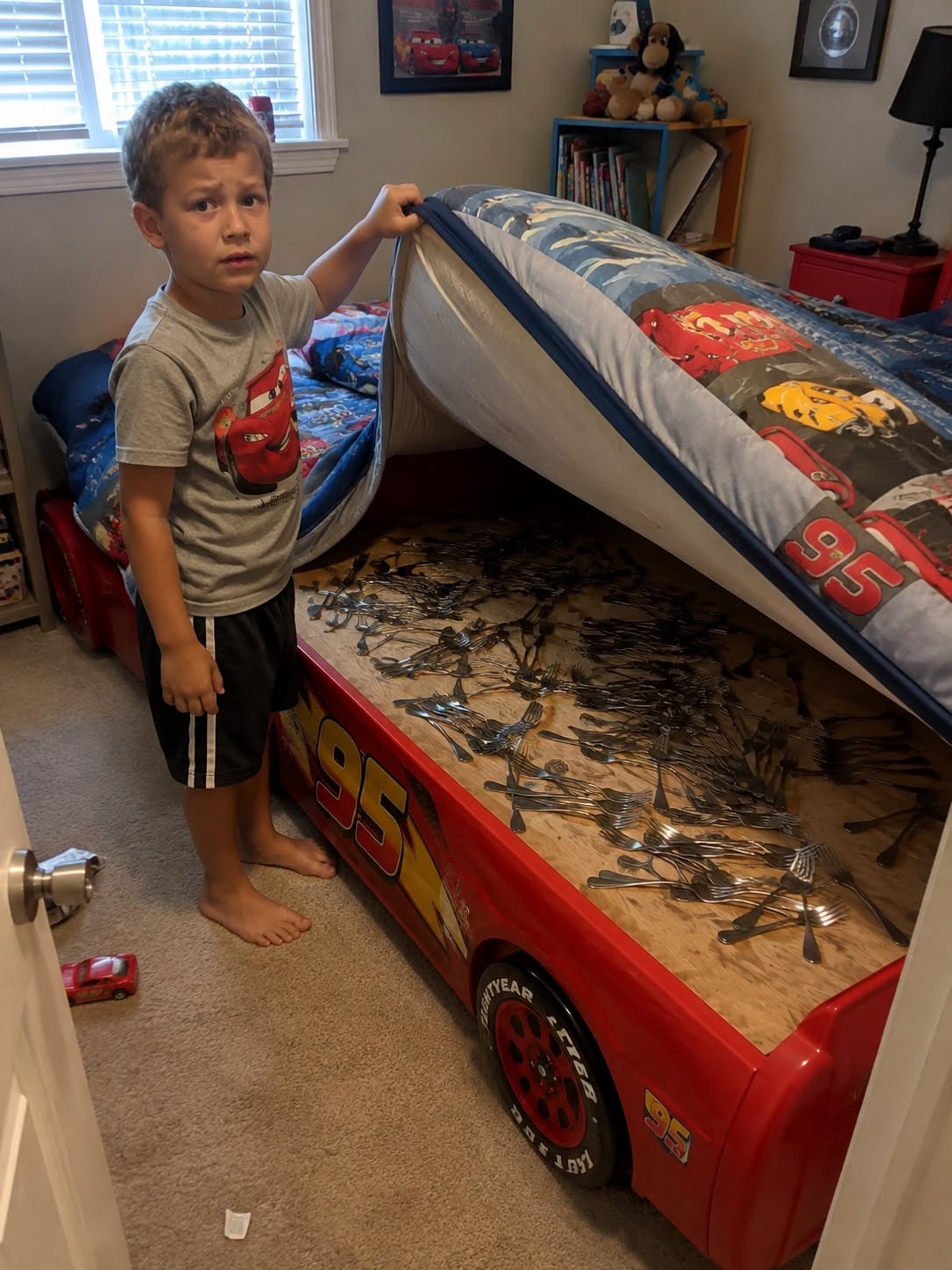
There is no horror quite like watching your young child weep in terror because a secret is about to be discovered. My hands shook as I gently unclasped his fingers, lifted him off the bed, and set him on the rug. While he stood there in his faded dinosaur pajamas, clutching his chest, I gripped the corner of the fitted sheet and hauled the mattress upward.
They were laid out in immaculate, terrifying rows.
Dozens upon dozens of them. More than fifty pieces of heavy silverware, spanning the entire wooden slatted base of the bed frame. The old wedding forks with their worn handles and the forty-one brand-new stainless steel pieces, arranged side by side with military precision. Every single tine pointed due north toward the headboard; every handle rested along an exact, invisible grid. It wasn’t the messy hoard of a toddler stashing stolen toys. It was an altar. It had been laid out with a devastating, sacred reverence.
Alex collapsed to his knees beside my legs, wailing into his hands. “Please don’t take them! Me and Daddy need them! Please, Mommy!”
I fell back onto my knees, my breath catching in my throat as I stared from the silver grid to my weeping son. “Alex… why do you and Daddy need forks under your bed? You have to tell me.”
“Daddy said,” he gasped, tears and snot running down his chin. “Daddy said it’s the most important secret. He said I couldn’t tell anybody in the world. Especially not you!”
“Baby, look at me,” I pleaded, pulling him into my lap, my own voice cracking. “I am your mother. You can tell me anything. I love you so much. Why did Daddy tell you to hide them from me?”
“Because it’s his secret!” he cried, burying his wet face into my neck. “I pinky promised Daddy! I promised!”
I couldn’t torture him any longer. The burden was suffocating him, and it was never his to bear. I pulled the heavy quilt up, gathered him into my arms, and rocked him until his ragged sobs softened into exhausted hiccups. I didn’t touch a single fork. I couldn’t bring myself to dismantle whatever fragile structure was keeping him together. I smoothed his sweaty hair until his eyes finally rolled shut in sleep, then backed out of the room and clicked the door shut.
Standing in the dark hallway, my hands trembling violently, I hit Brandon’s speed dial.
He answered after three rings, his voice strained and brittle. “Cece? I was just about to call—”
“Care to explain,” I whispered, my voice shaking with cold fury, “why there are over fifty forks arranged in perfect rows under our son’s mattress?”
Dead silence.
“I asked you all week, Brandon. I asked you to your face, and you told me not to spiral over silverware. You looked right at me and lied.”
A ragged, shuddering exhale came over the line. “Cece… it’s just a game. It’s nothing bad, I swear.”
“A game? A game that makes our five-year-old sob until he can’t breathe because he was ordered to keep it a secret from his own mother? What game is that, Brandon?”
“Treasure Knights,” he stammered, the words tumbling out too fast. “We were playing knights. The forks are silver swords to protect the castle while I’m away working. That’s all it was. A game to make bedtime easier.”
I pressed my forehead against the drywall, closing my eyes. “Why did you tell him especially not to tell me?”
“Cece, please…”
“Why, Brandon? Why make him swear on his life to hide it from me?”
He let out a broken breath. “Because… because my hours got cut. Two months ago. The company slashed overtime, and we were falling behind, and I didn’t want you panicking about money. I felt like garbage coming home late with nothing to show for it, so I invented the game to distract him. That’s the truth, Cece. I swear it on everything.”
His voice had the hollow ring of a half-truth—a story built to cover a far deeper hole.
“How bad is the money?” I asked.
“We’ll talk Sunday,” he pleaded, his voice cracking into something pathetic. “I’m in my motel room, I have a six-o’clock crew call. Please, Cece, just wait until Sunday so I can look you in the eye.”
“No, Brandon, you tell me—”
“Please, Cece. I’m begging you.”
He had never begged me for anything in seven years. The raw desperation in his tone stopped me cold.
“Sunday,” I said coldly. “Every single detail. No more games.”
I severed the call. The silence of the house pressed down on me like lead—the refrigerator humming, the floorboards settling, the familiar walls suddenly feeling like a constructed theatrical set hiding an ugly reality.
I turned on my heel, walked straight into our bedroom, and did something I had never done in our entire relationship: I began tearing apart my husband’s side of the closet.
Trust had been the quiet concrete beneath our marriage; I had never checked his pockets, scanned his texts, or doubted his whereabouts. But that foundation had turned to dust. I combed through his wardrobe with methodical, frantic precision—checking every jacket lining, feeling behind the hanging suits, and moving the stacks of denim. On the very top shelf, wedged behind an old shoebox containing his winter boots, my fingers hit heavy cardstock.
I dragged it down. It was a thick manila folder, dense with papers and containing a hard, rectangular weight. I carried it under the bedside lamp and opened the clasp.
Inside lay three months of credit card statements, stamped in violent red ink: FINAL NOTICE — PAST DUE. Balances totaling tens of thousands of dollars. Beneath the statements lay a cheap, unregistered black flip phone—a prepaid burner bought with cash from a convenience store.
And beneath the phone lay a printed application for a tiny, run-down studio apartment on the industrial outskirts of town. On the signature line, dated two weeks prior, was Brandon’s crisp, familiar handwriting.
My stomach dropped through the floor. A hidden burner phone. A secret bachelor apartment across town. Piles of concealed debt. Two months of lies about working late. And an elaborate psychological game to train our son to keep secrets from his mother.
My world shattered into jagged, unmistakable pieces.
I dialed my sister Marion, my hands shaking so hard I dropped the phone twice onto the duvet. She picked up on the second ring, her voice groggy.
“Cece? What’s happened?”
“Brandon’s leaving us,” I choked out. “He has another phone. He’s renting an apartment across town.”
I heard the rustle of sheets as she bolted upright. “What? Start from the beginning. Tell me everything.”
I poured out the entire nightmare: the missing forks, Alex’s terror, Brandon’s fake overtime, the burner phone in the closet, and the lease application.
“Oh, God, Cece,” Marion said, her voice turning hard and fierce with protective anger. “A second phone and a lease? You know what that is. We both know what that is.”
“He told me he lost his overtime hours—”
“That’s the script!” she snapped. “That is the exact lie Danny fed me for six months before I caught him with Stephanie. The company’s restructuring. I’m working late. It’s always overtime, right up until they move into an apartment with someone else. He’s hiding assets and setting up an exit ramp. Do not call him. Call a divorce attorney first thing tomorrow morning and freeze the accounts.”
I hung up feeling physically ill. Marion’s fury had crystallized my worst terror into absolute certainty. The betrayal burned through every ounce of restraint I had left.
I grabbed my phone, opened my text thread with Brandon, and typed out twelve words with frozen fingers:
I found the lease application and the burner phone. Do not come home.
I hit send.
The phone rang four seconds later. Brandon’s name flashed across the glass. I let it ring until the final vibrate, then swiped the screen.
He wasn’t speaking; he was sobbing. A deep, guttural sound of total devastation I had never heard come from him—not even when his father died.
“Cece, please!” he choked out, gasping for air. “Do not do this! It is not what you think! I swear on Alex’s life, it’s not what you think!”
“You signed a lease on an apartment, Brandon! You bought a secret phone! What else could it possibly be?”
“Please just let me come home! Don’t end our marriage over the phone in the dark! Let me look you in the eyes!”
“Why should I believe a single word you say?”
“Because I love you!” he wept openly. “I love you and Alex more than my own life! I know how it looks, but I am begging you, please let me come home on Sunday!”
I couldn’t listen to him fall apart. I severed the connection, dropped the phone onto the rug, slid down the wall, and buried my face in my knees, letting the ugly, suffocating sobs tear through my chest.
A soft creak echoed in the hallway.
I looked up through blurred vision. Alex was standing in the doorway in his dinosaur pajamas, his bedhead sticking out wildly on one side. In his right hand, gripped tightly like a dagger, was a single stainless steel fork.
“Mommy?” he whispered, his eyes huge with concern. “Why are you crying?”
“I’m okay, sweetie,” I lied, wiping my wet cheeks. “Go back to bed, baby.”
He didn’t move toward his room. Instead, he padded quietly across the floor, sat down cross-legged beside me, and pressed his small, warm shoulder against my arm. He looked at the fork in his fist, turned it over, and laid it gently in my lap.
“You can have this one,” he whispered.
“Alex… Mommy doesn’t need a fork.”
“Daddy said the forks are promises so you won’t be alone when he has to go away.”
The breath left my lungs. “What did you say?”
Alex looked up at me, his dark eyes brimming with absolute sincerity. “Daddy said every fork under the bed is a promise that he’s coming back. He said if he ever gets lost or has to go away for a really long time, we have to keep the promises safe under the mattress so the magic works. He said I was supposed to give you half of them so you wouldn’t feel alone.” His little chin began to tremble. “But I kept them all in my room because I was scared. I forgot to share the promises with Mommy.”
He burst into tears, wrapping his arms around my waist, terrified that my heartbreak was his fault for hoarding the silver.
I pulled my son into my chest, holding him so hard he gasped, burying my face in his hair while the truth crashed over me like a tidal wave.
I had assembled the entirely wrong tragedy.
A man planning an escape to another woman does not turn kitchen utensils into protective talismans for his child. A man walking out on his family does not spend his nights building an elaborate mythology to reassure his five-year-old that his father will always return. Whatever the burner phone was, whatever the apartment represented, it wasn’t betrayal. It was something far darker, born of an agonizing, solitary desperation.
I reached for my phone, wiped the tears from the screen, and sent three words:
Come home Sunday.
Those forty-eight hours were the longest of my life. I didn’t call Marion back; she had viewed my marriage through the scarred lens of her own divorce, offering the easy certainty of anger to replace the terror of the unknown. But she hadn’t seen our son hand me a fork on the floor at midnight.
I moved through the weekend in a trance. Alex, freed from the crushing weight of his secret, blossomed back into his chatty self. Over lunch on Saturday, he happily informed me that sharks existed before trees, clutching his one silver fork beside his plate like a badge of honor. But at night, I lay awake in our empty bed, turning that piece of cold steel over and over in my fingers, terrified of the reckoning Sunday would bring.
When Brandon’s truck finally pulled into the gravel driveway on Sunday night, I was sitting on the living room sofa with the manila folder resting on the coffee table.
He walked through the door looking like a ghost—pale, hollow-eyed, his shoulders slumped as if his spine had snapped. He saw the folder, dropped his duffel bag, and sank onto the opposite edge of the couch.
“Tell me everything,” I said quietly. “No lies.”
He covered his face with his calloused hands. “I got laid off two months ago, Cece. The entire commercial framing division was shuttered overnight.”
The room seemed to tilt. “Two months?”
“You gave up your career so you could raise Alex,” he sobbed, the tears leaking through his fingers. “I promised you on our wedding day that I would carry the weight. That money was my job so you could be his mother. And I failed. I lost everything, and I couldn’t bear to look at you and say the words out loud.”
“Where have you been going every morning, Brandon?”
“The public library,” he choked out. “Filling out hundreds of applications online. Standing outside supply yards at five in the morning for day labor. Hauling drywall for cash, unloading freight trailers overnight. That’s why I was so dirty and exhausted when I came home. I was killing myself trying to make the mortgage payment before you noticed the bank accounts draining.”
I pointed to the folder. “And the burner phone?”
“It was for the day-labor boards and Craigslist gigs,” he whispered. “Foremen text at three in the morning when a spot opens up. If my normal phone kept buzzing all night, you would have seen it. I couldn’t let you find out what a failure I was.”
“And the studio apartment?”
Brandon looked at me, his eyes completely bloodshot, his voice breaking into pieces. “That was my emergency plan if the foreclosure notice came. I thought… if I couldn’t find a real job and we lost the house, I could move into that cheap room, work three night shifts, and send every dollar to you. You and Alex could rent a nice townhouse near his school. I thought if I ruined our lives, I should be the only one who had to live in the wreckage. I wasn’t leaving you for someone else, Cece. I was planning how to disappear so my failure wouldn’t drag you down.”
I stared at him, tears streaming down my face. Everything Marion had interpreted as selfish cruelty was actually a man poisoning himself with toxic, solitary shame.
“And the forks under his bed?” I asked softly.
He completely broke down, his head dropping to his knees. “Because every morning I stood in parking lots getting turned away, I felt like I was disappearing. I was terrified that one day I wouldn’t be able to provide, that you’d look at me the way my mother looked at my deadbeat dad, and you’d realize I was worthless. So I told Alex that every fork under his bed was a promise that Daddy would always come home. I needed him to believe I was coming back… because I wasn’t sure I could survive the shame myself.”
I slipped off the sofa onto the rug, crawled to his knees, and pulled his tear-stained face into my hands.
“Brandon, look at me,” I demanded. “The money is just numbers. We can sell things, we can downsize, I can go back to work tomorrow. But how could you ever think my love was conditional on a paycheck? How could you believe that losing a job made you disposable to this family?”
He collapsed against my shoulder, weeping with the raw, unburdened relief of a man who had finally put down a boulder he had been carrying alone up a mountain. We sat on the floor for hours in the dark, laying every hidden terror out in the open, unmaking the lies, and rebuilding the real promise of marriage: that love is not a transaction, and you never have to suffer alone.
The next morning, the three of us gathered in Alex’s bedroom. Together, we lifted the mattress. Brandon gently explained to Alex that the knights didn’t need their silver swords anymore—the castle was safe, Daddy was home for good, and the biggest promise of all was that our family would never hold secrets again.
Alex listened gravely, nodded, and helped us gather the forks into a laundry basket. But as we finished, he reached out, snatched one shiny fork from the pile, and tucked it securely beneath his pillow.
“Just in case,” he declared solemnly.
Brandon let out a wet, genuine laugh, pulling us both into his arms, and I didn’t stop our son. Some promises are worth keeping close, if only to remind you of the storm you survived.
It took a grueling year to dig ourselves out of the debt, but we survived. The forks are back in the kitchen drawer, save for the single talisman resting under Alex’s pillow. But what remains with me isn’t the memory of the panic or the lies. It is the image of my five-year-old boy walking through the darkness with a piece of steel in his hand, giving away his only protection because he couldn’t bear to see his mother weep. He taught us both that real love isn’t something you prove through silent suffering; it is a promise you place openly in the hands of the person you love, tines up, in the light where everyone can see it.