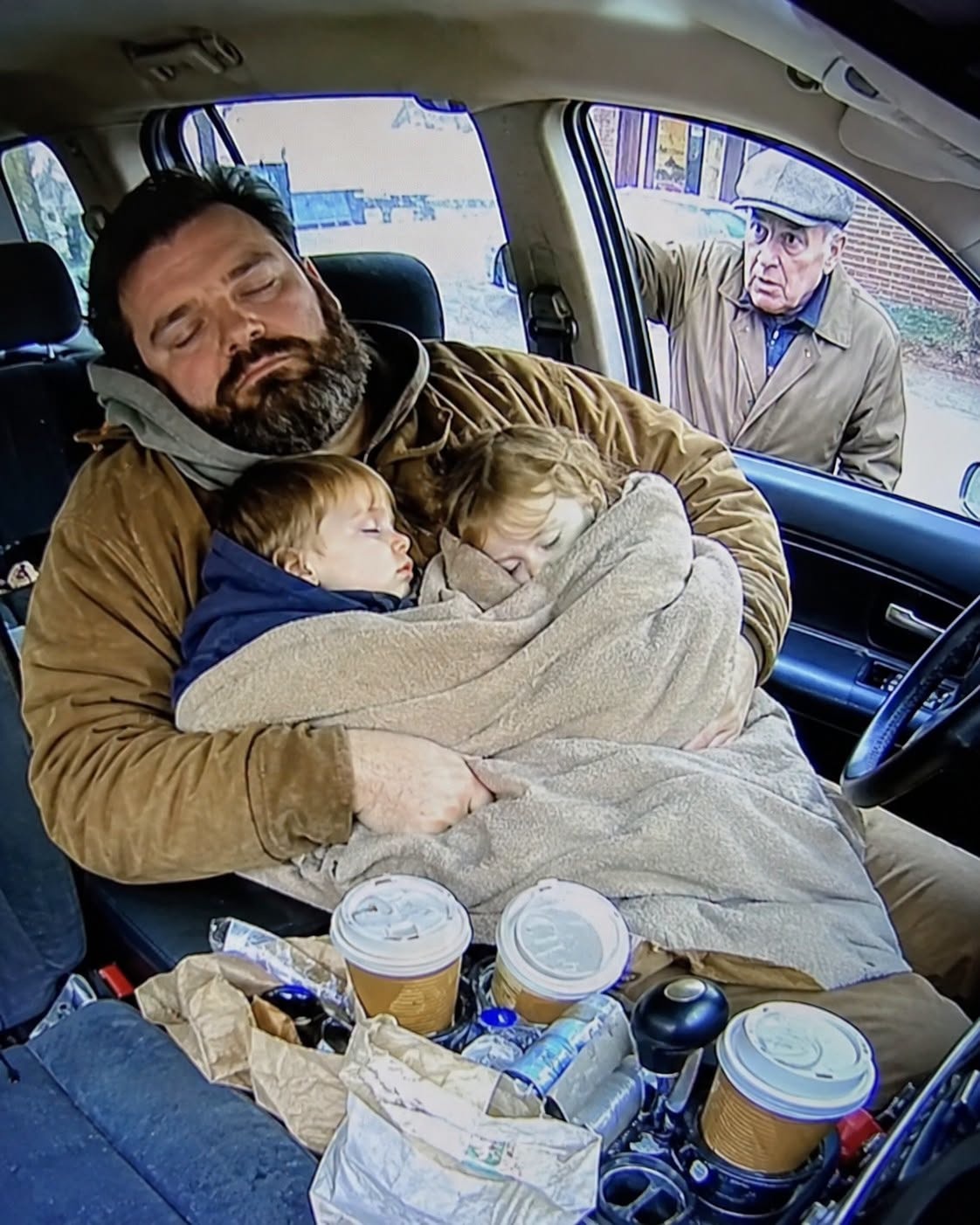
The freezing March wind whipped across the vast asphalt of Toronto Pearson’s long-term parking lot, biting straight through my heavy wool coat. I hitched my carry-on bag over my shoulder, adjusting my scarf against the damp Ontario chill. I had caught the red-eye out of Vancouver on pure adrenaline and stale coffee, carrying a wrapped watch in my pocket. Today was my son Michael’s thirty-second birthday. I had rehearsed the scene a dozen times during the four-hour flight: knocking on his front door, watching his exhausted expression melt into disbelief, and enduring the chaotic, simultaneous tackle of my five-year-old twin grandsons, Nathan and Oliver.
It was supposed to be a morning of celebration.
Cutting through the endless lanes toward the car rental shuttles, an unusual glimmer caught my eye. In the distant, discounted rows near the perimeter fence sat a battered silver Honda Civic. What stopped me wasn’t the make—it was the glass. Every window was frosted white with thick interior condensation, the unmistakable signature of warm human breath trapped for hours inside a freezing cabin.
A knot tightened violently in my gut. As I stepped closer, my pulse spiked. I recognized the dented bumper and the personalized plate frame.
I hurried toward the driver’s side, my heart hammering against my ribs. I shielded my eyes from the overcast glare and pressed close to the glass.
The breath went straight out of my lungs.
It was Michael.
He was slumped sideways against the driver’s door, shivering in his winter parka. But the backseat wrecked me completely. Buried beneath an old moving blanket, sandwiched between cardboard boxes, loose laundry, and crushed fast-food bags, lay Nathan and Oliver. My five-year-old grandsons were huddled together for warmth like two puppies abandoned in the cold.
A wave of white-hot panic surged through me. I hammered my fist against the driver’s window.
Michael bolted upright, his eyes wild with the primal terror of a cornered man. He flailed for a second, rubbing frantically at his blurry eyes before focusing on my face through the glass. The panic on his face instantly collapsed, replaced by something infinitely worse—a crushing, humiliating shame I had never seen in him.
He unlocked the latch and pushed the door open. A wall of stale, hopeless air escaped the cabin.
“Dad?” His voice was a sandpaper rasp. “What… what are you doing in Toronto?”
“What am I doing?” My voice shook with fury and heartbreak. “Michael, what is happening here? Where is your home? Where is Jennifer? Why in God’s name are you living out of a sedan with my grandsons in freezing weather?”
He couldn’t meet my eyes. He stared down at his salt-stained boots, jaw trembling. “It’s… complicated.”
“Complicated?” I shouted, the wind whipping my words across the asphalt. “You are sleeping in an airport parking lot! That isn’t complicated, Michael. That is a catastrophe!”
The commotion stirred the back seat. Nathan sat up, knuckling sleep from his red eyelids, his breath puffing white in the frigid car. He squinted at me through the gap in the front seats.
“Grandpa?”
Hearing that fragile little voice broke through the shock, crystallizing my panic into cold, absolute resolve.
“Morning, buddy,” I said, forcing my face into the warmest smile I could muster. I reached into the back, squeezing his tiny foot through the blanket. “How about you and Oliver come inside with Grandpa and get some hot pancakes? Your dad and I have some grown-up business to handle.”
Michael finally looked up. His eyes were bloodshot, his cheekbones sunken and hollow. The bright, ambitious young man I raised had vanished under a shadow of sheer ruin.
“Okay,” he whispered, his chin trembling. “Okay.”
Ten minutes later, we were in a corner booth at the terminal’s Tim Hortons. The boys tore into warm breakfast sandwiches and hash browns, blissfully oblivious to the stakes, while Michael cradled a black coffee with shaking hands.
“Start from the beginning,” I commanded quietly. “Leave nothing out.”
Michael stared into the dark surface of his cup. “Jennifer filed three months ago. But she didn’t just leave, Dad. She took every single thing. The house, the business accounts, the investments. All of it.”
I leaned forward. “The house was deeded in both your names. The startup was a joint venture.”
“She brought me paperwork six months ago,” he whispered, his voice cracking. “Said our corporate structure left us vulnerable to supplier lawsuits. She convinced me to sign the deed over to her name temporarily to shelter our personal assets. I trusted my wife. I signed the transfer.”
He took a ragged breath. “A week later, I came home from a job site to find the deadbolts replaced. A process server handed me a restraining order on the sidewalk. Her lawyer told the judge I was manic, abusive, and making violent threats against the family.”
“That’s an outright lie!” I hissed. “You don’t have an aggressive bone in your body. You’re the man who catches wasps in cups to let them outside!”
“It didn’t matter,” Michael said, tears spilling over his lower lids. “She fabricated text logs. Her parents testified under oath that they witnessed me having public breakdowns. Her family carries weight in this city, Dad. The judge granted the temporary order on the spot.”
“And the business capital?” I asked, cold dread pooling in my stomach. “The hundred and fifty thousand dollars I wired you for operating costs?”
Michael looked away, staring blankly out at the runways. “She managed the books. The afternoon before serving me, she transferred the entire balance into an account held by her father, Douglas. She labeled it as repayment for an unwritten seed loan. I was locked out of my corporate email and bank portals overnight.”
“And custody?”
“The temporary hearing was two weeks ago. I lost,” he choked out. “The court gave me supervised visitation twice a week. The judge ruled that until I could provide a verifiable lease and proof of steady income, Jennifer retains full physical custody. But I have no cash for a security deposit. She called my clients, told them I had suffered a psychotic break, and ruined my consulting contracts.”
He gestured vaguely toward the terminal doors. “I’ve been taking cash-in-hand framing gigs, but it barely covers formula, diapers, and gas. I shower at the community center. The boys think we’re on a prolonged camping trip. When I get my visitation window, I don’t have an apartment, so we sleep in the car or walk through malls.”
“Where do the supervised visits happen?”
“At Douglas and Patricia’s estate,” Michael said, his jaw clenching in bitter humiliation. “Her mother sits across the living room with a legal pad. Every time I discipline them, every time I hug them, she scribbles notes. They’re building a dossier to terminate my parental rights entirely.”
A cold, methodical rage settled deep inside me. This wasn’t a bitter divorce; it was a premeditated corporate takeover and the deliberate destruction of a father.
“Gather the boys,” I said, my voice hardening into iron. “We’re checking into a two-bedroom suite downtown. We’re buying you a tailored suit, getting you a real meal, and hiring the best legal muscle in the province.”
“Dad, you don’t understand,” Michael pleaded, panicked. “Douglas Whitmore is worth tens of millions. He owns half the commercial real estate in the GTA. His legal team will bury you.”
I reached across the table and clamped a hand over his wrist. “They can try. But they forgot one fundamental fact: you aren’t an orphan.”
By nightfall, the boys were asleep in warm hotel beds. While Michael slept soundly on the sofa for the first time in ninety days, I opened my laptop and went to work. Three decades running an industrial contracting firm had left me with deep resources, powerful contacts, and zero patience for predators.
My first call went to Paul Chen, my senior corporate counsel in Vancouver.
“Paul,” I said without preamble. “I need the most ferocious, uncompromising family litigator in Ontario. I don’t want a negotiator. I want an apex predator.”
Paul listened in grim silence as I detailed the fraudulent asset transfers, the manufactured affidavits, and the forced homelessness.
“James,” Paul said, his voice deadly serious. “This isn’t just a bitter custody fight. This is coordinated wire fraud and extortion. You need Rebecca Hart. She charges an exorbitant retainer, but she tears crooked developers apart for breakfast.”
“Retain her tonight,” I replied. “Double whatever she asks.”
The next morning, we sat across from Rebecca Hart in a high-rise office overlooking the Toronto skyline. Rebecca was sharp, impeccably dressed, and radiated the quiet, lethal confidence of an attorney who had never lost a case she cared about.
“Give me every single document, every timestamp, and every text,” Rebecca commanded, tapping a digital pen against her tablet. “The devil lives in the details, and that’s where we are going to bury them.”
Michael laid out the timeline: the fraudulent tax documents, the fabricated outbursts, the sudden lockouts, and the humiliating surveillance by his mother-in-law.
Rebecca leaned back, her eyes narrowing. “This is a classic parental alienation and financial starvation strategy. They manufacture a domestic crisis, strip the target of liquidity, and force a default judgment when he can’t afford legal representation. It’s monstrous, but highly calculated.”
“Can we defeat it?” Michael asked quietly.
“We aren’t just going to defeat it; we’re going to prosecute it,” Rebecca replied coolly. “First, we need to completely destroy their character assassination. Did you seek any medical or mental health support over the past year?”
“I saw a licensed psychologist, Dr. Patel, for six months,” Michael admitted. “Not for instability—just to manage the stress of launching the company.”
A sharp smile crossed Rebecca’s face. “Flawless. Contemporary therapy records showing proactive stress management completely dismantle their narrative of erratic behavior. Next, we run a forensic audit on the company books. If Jennifer Whitmore funneled corporate capital into her father’s private accounts, we have criminal fraud.”
She looked directly at me. “Mr. Reeves, this will get vicious. They will sling mud in open court.”
“Let them sling it,” I said. “I have enough money to clean the street.”
Over the next month, I went on the offensive. I leased a furnished three-bedroom townhouse in Mississauga, enrolled the twins in a private preparatory academy, and secured Michael an executive consulting role with a trusted colleague’s commercial firm.
While Michael rebuilt his life, I used my old connections to dig into Douglas Whitmore’s empire. A retired investigator friend pulled public filings, uncovering a trail of sealed settlements, suspicious corporate loans, and aggressive tax shelters.
Meanwhile, Rebecca hired Martin Woo, a forensic accountant whose quiet demeanor masked an uncanny ability to track hidden money. Three weeks into the audit, Martin presented his findings in Rebecca’s boardroom.
“The trail is blatant,” Martin said, tapping a multi-tiered flow chart on the projector. “The initial $150,000 investment from your father was wired directly to an offshore shell company controlled by Douglas Whitmore, flagged as an unverified ‘consulting retainer.’ Over the past twelve months, Jennifer drained an additional $130,000 in operating capital through fake supplier invoices. In total, she embezzled $280,000 from the marital business.”
Michael sat frozen, staring at the numbers. “She was robbing the company while I was working eighteen-hour days on the floor.”
“It gets better,” Rebecca said, her smile razor-thin. “Ontario operates under one-party consent for audio recordings. Michael, during your supervised visits with Patricia, did you record the interactions as I instructed?”
Michael pulled three flash drives from his jacket. “Every single minute.”
The emergency custody trial was set for late July in Ontario Superior Court. The courtroom was cold, sterile, and heavy with tension.
Jennifer sat at the opposing table flanked by her parents and Trevor Harding, a high-priced trial lawyer with slicked-back hair and a smug grin. Douglas Whitmore sat behind them in a bespoke suit, radiating the quiet arrogance of a man who believed wealth granted total immunity.
Michael sat between Rebecca and me, dressed in a sharp navy suit, his back straight and his eyes clear.
Justice Margaret Holloway, a veteran judge known for her zero-tolerance courtroom demeanor, presided.
Harding opened with theatrical outrage, painting Michael as a destitute, unstable man living off his father’s charity, wholly unfit to raise children.
Rebecca stood up calmly. “Your Honor, let us examine the supposed evidence of my client’s instability. Mrs. Whitmore’s mother, Patricia, submitted sworn affidavits claiming the children were terrified of their father during court-ordered visits. We would like to enter Exhibit D into evidence.”
Rebecca signaled the clerk, and an audio file played over the courtroom speakers.
The room filled with the unmistakable sound of children’s pure, joyful laughter.
“Look, Daddy! I made the bridge stand up!” Oliver’s bright voice chimed.
“Great engineering, buddy. Keep your hands steady,” Michael’s voice answered, calm, affectionate, and patient.
“I love you, Daddy. When do we get to sleep over at your new house?” Nathan asked.
Then, Patricia’s sharp, abrasive voice cut through the recording: “Michael, stop hovering over the boy. You’re overwhelming him.”
“Patricia, I’m literally helping him tie his sneaker,” Michael answered evenly.
“I’m documenting this tone as hostile aggression,” Patricia snapped back.
The courtroom fell dead silent. Justice Holloway peered over her glasses, her eyes boring into Patricia Whitmore, who turned pale.
“The audio proves that the grandmother’s affidavits are perjured fabrications designed to manipulate this court,” Rebecca stated fiercely.
“Now, let us turn to the marital estate.” Rebecca called Jennifer to the stand.
Jennifer walked up nervously, smoothing her designer skirt, her confident facade beginning to crumble.
“Mrs. Reeves,” Rebecca began, holding up the forensic binder. “You testified under oath that the $150,000 transfer to your father was repayment for a startup loan. Where is the signed promissory note?”
“It… it was an informal family understanding,” Jennifer stammered.
“An informal understanding involving corporate capital?” Rebecca pressed. “And the additional $130,000 you routed through shell entities over the subsequent year? Was that also an informal understanding?”
“I don’t recall the specific ledger details—”
“Our forensic accountant does,” Rebecca slammed the thick audit onto the podium. “Every dollar has been traced directly into bank accounts registered to Douglas Whitmore. Furthermore, digital subpoena results show that the threatening text messages you submitted as evidence of domestic abuse were generated on a home desktop via graphic editing software. The cellular carriers have zero record of them.”
“Objection!” Harding barked, leaping to his feet.
“Sit down, Mr. Harding,” Justice Holloway commanded, her voice like cracking ice. She turned her piercing gaze onto Jennifer. “Mrs. Reeves, did you manufacture fabricated digital evidence and submit it to this court?”
Jennifer looked wildly at her lawyer, then at her father. Douglas Whitmore looked away, refusing to make eye contact with his cornered daughter.
“I… I was protecting my children,” Jennifer broke down, sobbing hysterically.
“By framing their father and committing grand larceny?” Rebecca asked coldly.
Justice Holloway removed her glasses and rubbed her temples in disgust. When she looked up, her expression was merciless.
“In twenty-two years on this bench, I have rarely witnessed such a malicious, calculated conspiracy to destroy a parent,” Justice Holloway announced, her voice echoing through the chamber. “The evidence of systematic fraud, manufactured evidence, and perjury is overwhelming.”
She raised the wooden gavel.
“I am ordering the immediate and permanent revocation of the existing custody order. Full sole physical and legal custody of Nathan and Oliver Reeves is awarded to their father, Michael Reeves, effective immediately.”
Jennifer shrieked in horror.
“Mrs. Reeves will have limited, court-supervised access every other weekend at a designated municipal center at her own expense,” Justice Holloway continued. “Furthermore, Jennifer Whitmore and Douglas Whitmore are jointly ordered to return the sum of $280,000 to the petitioner within forty-five days, along with full legal fees. Finally, I am forwarding this entire evidentiary file directly to the Crown Attorney for criminal prosecution regarding fraud, embezzlement, and perjury.”
The gavel slammed down with the finality of a gunshot. “Court is adjourned.”
Michael’s legs gave out, and I caught him under his arms, holding him upright as he buried his face in my shoulder, weeping with the overwhelming, ragged relief of a man pulled from a sinking ship.
“It’s over, son,” I whispered. “It’s finally over.”
When the double doors opened to the hallway, Nathan and Oliver spotted us from the waiting room.
“Daddy!”
They ran across the marble floor, throwing themselves into Michael’s open arms. He dropped to his knees in his new suit, wrapping his arms around them both, burying his face in their hair as joyful tears streamed down his cheeks.
Douglas Whitmore hurried past us toward the elevators, his face purple with rage as he shouted into his phone, while Jennifer trailed behind him, a broken figure realizing the full cost of her cruelty.
Oliver reached out and caught my hand, tugging me down. “Grandpa, are we going to our real home now?”
“Yes, buddy,” I replied, swallowing the hard lump in my throat. “We’re all going home.”
Six months later, the justice system finished what began in that courtroom. The Crown Attorney charged Douglas Whitmore with money laundering and corporate fraud, leading to heavy fines and public disgrace. Jennifer pled guilty to perjury and fraud, receiving a suspended sentence, probation, and mandatory financial restitution. She remains an infrequent, supervised ghost in the twins’ lives.
Michael used the recovered funds to establish a thriving software consultancy, working alongside partners who respect his integrity.
I decided not to return to Vancouver. I bought a home five minutes down the road from Michael and the boys in Mississauga.
One warm autumn evening, Michael and I sat on the backyard patio, watching the sunset cast long golden shadows across the lawn. In the living room, the twins’ bright laughter echoed through the open sliding doors.
Michael took a sip of his beer and looked across at me. “I don’t think I ever told you… if you hadn’t knocked on that car window in the freezing cold, Dad… I don’t think I would have survived the winter.”
“You would have,” I replied gently. “You’re stronger than you think.”
“No,” Michael said, his eyes welling with deep gratitude. “I was drowning. You saved my life, and you saved my boys.”
“That’s what fathers do,” I smiled, reaching over to squeeze his shoulder. “We stand watch.”
Inside the house, Nathan’s voice rang out: “Grandpa! Oliver is knocking over the Jenga blocks! Come help me save the tower!”
I set my glass down on the table and stood up. “Duty calls.”
Michael laughed, the sound warm, easy, and entirely free.
I walked inside and sat on the floor beside my grandsons, helping them stack the wooden pieces high and true, knowing that no matter what storm blew against our family, the foundation was unbreakable.