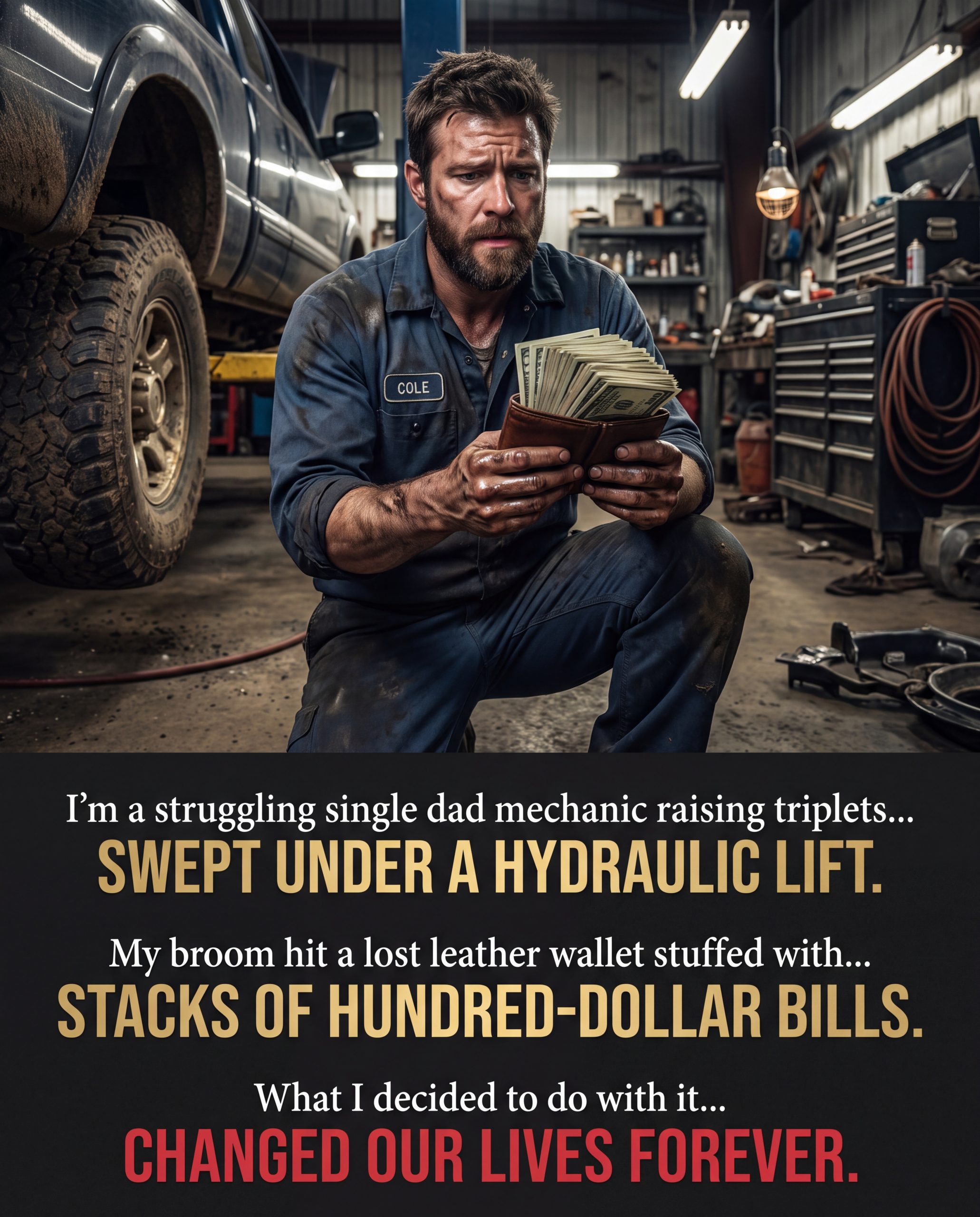
I’m Cole, thirty-four, and for the last four years, my life has smelled like motor oil, degreaser, and baby formula.
I work twelve-hour shifts as an auto mechanic at a busy independent repair shop on the outskirts of town. My hands are permanently stained with grease, my back aches by midday, and no matter how much overtime I put in, my paycheck evaporates the moment it hits my account.
Ever since my ex-wife walked out when our triplets were barely six months old—whispering that she wasn’t built for motherhood—I’ve been running a four-person household completely on my own. Lucas, Noah, and Daisy are four now: bright, boundless balls of energy who think their dad is a superhero, even when their dad is wondering how he’s going to keep the power on next month.
Last Tuesday was brutal. A hydraulic line burst in the morning, parts arrived four hours late, and two customers spent twenty minutes screaming in my face over repair delays I couldn’t control. By 7:30 PM, the garage was finally silent.
Exhausted, I grabbed a heavy shop broom to sweep the bay beneath lift number four.
Near the back tire of a lifted pickup, the bristles hit something solid with a soft thud.
I looked down. Lying in a puddle of water and dried oil was a thick, weathered dark-brown leather wallet.
I picked it up, expecting a couple of maxed-out credit cards and a driver’s license. But when I flipped the billfold open, the breath violently left my lungs.
Packed inside the center divider was a thick stack of hundred-dollar bills bound with a rubber band.
I didn’t count it, but there was easily seven or eight thousand dollars in cash.
The garage seemed to fade into complete silence. My pulse hammered in my ears. In an instant, every desperate worry in my life flashed before my eyes: the final disconnect notice from the electric company sitting on my counter, the worn-out tires on my truck, the three pairs of shoes my kids had already outgrown, and the grinding stress of living paycheck to paycheck.
There were no security cameras in the rear bay. No one was in the building. No one had seen me sweep that stall.
It would have solved everything in a single second.
I stood there in the empty shop for ten agonizing minutes, staring down at the leather billfold in my trembling, grease-stained hands.
Then, my thumb caught the plastic sleeve of the ID slot.
The driver’s license belonged to a seventy-eight-year-old man named Arthur Pendelton. His address was an older neighborhood three miles down the road. Stuffed behind his license were two worn, creased wallet-sized photographs of a smiling woman and a young girl from decades ago.
The temptation vanished instantly, replaced by a deep wave of shame for even considering it. I couldn’t look my three children in the eyes and teach them about honor if their dinner was bought with an old man’s ruin.
That evening, after getting the triplets bathed, fed, and tucked into bed while my sister watched the monitor from the living room, I drove out to Arthur’s address.
I walked up the creaky wooden porch steps and knocked gently.
When the front door opened, an elderly man with silver hair and hollow, red-rimmed eyes looked at me through the screen.
“Mr. Pendelton?” I asked. “Did you bring your sedan to Miller’s Auto this afternoon?”
Before he could answer, I pulled the leather wallet from my jacket pocket and held it out.
Arthur’s entire body began to shake. He pushed open the screen door with trembling hands, took the wallet, and collapsed onto the porch bench, sobbing openly.
Between choked breaths, he told me the money was his entire monthly pension withdrawal and personal emergency fund—all the cash he had left in the world. But more importantly, those faded photographs were the only surviving pictures of his late wife and daughter, who had passed away years earlier.
He frantically pulled out several hundred-dollar bills and tried to shove them into my hands.
I took a step back, placed a hand over his, and shook my head. “Keep it, Mr. Pendelton. Just take care of yourself. I’m just glad it’s back where it belongs.”
I drove home that night with an empty bank account, but a clear conscience. I thought that was where the story ended.
At 7:00 AM the next morning, I was in the kitchen pouring cereal into three colorful plastic bowls while the triplets chased each other in their pajamas.
A sudden, thunderous knock rattled the front door.
I opened it, expecting a delivery.
Standing on my porch was a uniformed county sheriff, his expression stern and unreadable, his squad car parked in my driveway with lights idling.
“Cole Daniels?” the sheriff asked, his voice booming.
My stomach plummeted straight to the floor. My mind raced into a panic. Did Arthur accuse me of stealing something from the wallet? Did someone claim I took part of the cash?
“Yes, sir,” I choked out, my heart racing. “Is there a problem?”
The sheriff stared at me for three long, agonizing seconds.
“Mr. Daniels,” he said firmly. “I need you to step outside right now.”
The sheriff wasn’t there to arrest me. Standing beside the cruiser was Arthur Pendelton, accompanied by the town mayor. Arthur had gone straight to the sheriff’s station at sunrise to report that a local mechanic had saved his life, his savings, and his family memories. The county had arranged a community grant to completely cover my children’s daycare costs for the next two years, along with an official letter of commendation.
Six months later, Arthur is a regular at our dinner table, happily reading bedtime stories to three toddlers who proudly call him Grandpa Artie. We were two broken households trying to survive on our own—until one honest choice built a family none of us saw coming.