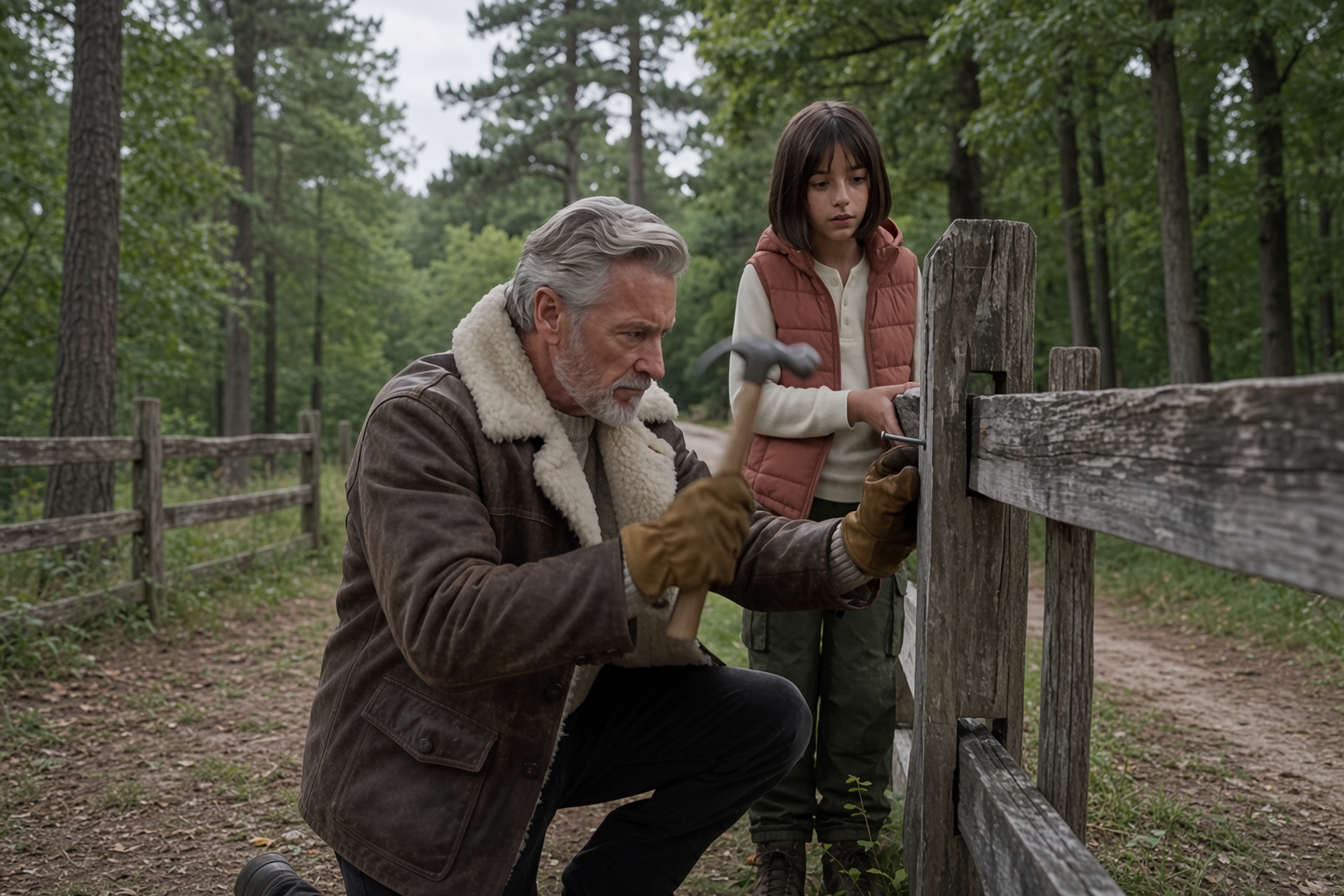
When an off-grid grandfather hits the glowing red button inside his stone cabin, he unleashes an ancient contingency to save his granddaughter from the shadow of his past.
THE CLICK
Arthur pressed his palm hard into the red mushroom switch.
The button yielded with a heavy mechanical click that seemed to echo inside the very bones of the stone wall.
For a second, there was total silence.
Then, deep within the framing of the cabin, the counterweights dropped.
High-tensile steel cables whined inside the stone mortar joints, groaning under immense tension.
A four-inch slab of solid structural armor dropped inside the hollow core of the timber front door with a thunderous boom that shook dust from the ceiling rafters.
At every window along the ground floor, three-eighths-inch manganese steel shutters slammed down from concealed lintels.
Thud. Thud. Thud. Thud.
The daylight vanished instantly.
The hallway plunged into twilight, lit only by the faint amber glow of the sconce and the steady crimson halo encircling the pressed button.
Outside, the porch groaned under the weight of combat boots.
A heavy pneumatic ram struck the exterior wood of the front door.
Crack.
The white pine outer skin shattered into jagged splinters, but behind it, the solid armor plate didn’t even ring.
It absorbed the kinetic blow with a dull, dead thud.
“Grandpa!” Maya cried out, her small hands clutching the rough wool of his shearling coat.
“I have you, Maya,” Arthur whispered, his voice low and gravelly, stripped of panic. “I have you.”
“Who are they?” she sobbed against his chest. “Why are they here?”
“They are here for what is in my head,” Arthur said. “And they will not touch you. Ever.”
Another ram strike slammed against the door plate, followed by the muffled hiss of an acetylene torch being struck on the stone porch.
Arthur checked the tactical mechanical watch on his wrist: ninety seconds before the seals began to heat.
“Time to go to ground,” he said.
THE STONE HEARTH
Arthur grabbed Maya’s wrist gently and led her down the dark corridor toward the great room.
His boots moved without sound across the tongue-and-groove pine flooring.
The air in the house was already cooling, trapped behind the airtight steel shutters.
He reached into the pocket of his shearling coat, pulled out a miniature brass key, and stepped directly to the massive river-rock fireplace.
Set into the third mortar line from the left was a flush iron screw.
Arthur inserted the key, gave it a quarter turn clockwise, and leaned his shoulder against the central keystone of the hearth.
With a grinding sigh of balanced masonry, a four-foot section of the stone backing swung inward on heavy grease-packed pivot bearings.
A cool draft of subterranean air rushed up to meet them, carrying the mineral tang of limestone and damp shale.
“Down the ladder,” Arthur said, pointing a low-beam amber penlight into the black shaft. “Keep three points of contact on the rungs. Do not skip a step.”
Maya looked down into the dark.
Her chin trembled, but she wiped her sleeve across her wet nose and turned around.
Her small hiking boots found the first welded steel rung.
“I’m on,” she whispered, her voice shaking but steadying.
“Good girl. Count ten rungs down, then step back onto the flat floor.”
Above them, on the stone porch, a muffled explosion cracked against the steel shutters of the living room window.
The blast wave vibrated the floor joists under Arthur’s boots.
They were using shape charges.
They were not here to negotiate.
Arthur swung himself into the opening, reached out with his left hand, and caught the balance counterweight.
He pulled the river-rock hearth closed until the magnetic latch clicked home.
THE CELLAR BENEATH THE ROCK
The ladder ended eight feet down on a poured concrete pad.
Maya stood in the circle of the penlight beam, her arms wrapped around her orange puffer vest.
Arthur reached overhead and pulled a pull-chain.
A string of low-wattage 12-volt amber diodes flickered to life along the ceiling timbers, powered by a bank of deep-cycle marine batteries tucked into the corner.
The space was twenty feet square, dry, and cool.
It was not a root cellar.
Lined along the walls were modular grey composite crates, sealed five-gallon water drums, and dry ration packs stacked three high.
On a workbench of heavy butcher block sat three spare magazines, a clean lever-action carbine chambered in heavy rimmed lead, and a canvas field pack with padded shoulder straps.
Arthur stripped off his worn tan work gloves, tossing them onto the bench.
Underneath the workbench sat a secondary radio transponder, silent and unlit.
“Take off the vest, Maya,” Arthur said quietly as he picked up the field pack.
“My vest?” she asked, looking down at the bright terracotta cloth.
“It reflects light in the timber,” he said. “The woods are grey and dark green today. Orange is an invitation.”
She pulled the zipper down, sliding the quilted vest off, standing in her cream waffle henley and olive cargo pants.
Arthur reached into a locker, pulled out an olive-drab wool hunting sweater with reinforced shoulders, and slipped it over her head.
The sleeves were three inches too long; he rolled the cuffs back twice until her hands were clear.
“Better,” he said. “Now put these in your pocket.”
He handed her two wrapped energy bars and a small whistle carved from solid brass.
“If we get separated, you do not call my name,” Arthur said, holding her gaze with his grey eyes. “Voices carry up ridges. You blow three short bursts on that brass. Only three. Then you hide under pine boughs and wait for me.”
“Are we leaving the cabin?” Maya asked, tears welling again. “Forever?”
Arthur paused, his hand resting on the receiver of the lever rifle.
“Things are just things, Maya,” he said softly. “The cabin kept us safe until today. Now it is a trap.”
THE CONDUIT
At the back of the underground cellar, behind a stack of cordwood, sat a circular opening two feet across.
It was the entrance to a corrugated steel culvert that had been installed when the house foundation was excavated twelve years ago.
It sloped gently downhill, draining sub-surface runoff toward the deep ravine three hundred yards south of the orchard.
“Crawling now,” Arthur said. “Knees and elbows. Push your pack ahead of you.”
Maya nodded, dropped onto her knees, and slid headfirst into the ribbed steel tube.
The cold metal rang softly under the fabric of her pants.
Arthur racked the lever on the carbine, sliding a round into the chamber, and placed the hammer on the safety notch.
He slid the rifle into a padded scabbard slung across his back, grabbed the heavy canvas pack, and crawled in after her.
He reached behind him with a tethered hook, dragging an insulated round plug into the mouth of the culvert to seal off the draft and block any light.
Darkness closed in, heavy and absolute, broken only by the dim red beam from Arthur’s penlight clipped to his collar.
The air in the culvert tasted of zinc and damp clay.
Every few yards, a trickle of icy rainwater seeped through the corrugated seams, soaking into the knees of Arthur’s trousers.
Ahead of him, Maya kept a steady, crawling pace.
“Doing great, Maya,” he whispered. “Keep the rhythm. Don’t look up, just watch the bottom of the tube.”
“I can hear them,” she whispered back, her voice bouncing strangely in the curved metal. “Above us.”
Arthur stopped moving, bracing his palms against the steel ridges.
Through the earth and the metal conduit, the deep, rhythmic thrum of ATV engines pulsed downward.
The vehicles were circling the perimeter of the stone cabin, their heavy knobby tires churning the gravel lane and tearing across the turf of the front yard.
Then came the sharp, unmistakable chatter of automatic gunfire.
They were firing blind through the timber exterior walls, testing for soft spots behind the steel cladding.
“Keep moving,” Arthur urged. “They are wasting ammunition on empty rooms.”
THE OUTLET
The pipe terminated at a limestone ledge five feet above the rocky bed of the southern draw.
The mouth was masked by a tangled curtain of wild blackberry brambles and hanging cedar branches.
Maya stopped at the threshold, the grey mist of the afternoon blowing against her cheeks.
“Stay down,” Arthur murmured, sliding past her shoulder.
He parted the thorny branches with gloved hands, peering through the gap.
The draw was choked with mist and rotting leaves, the steep earthen banks carpeted with sword ferns and towering spruce trees.
High above, through the trees, a plume of grey-blue smoke was rising from the cabin roof.
They had ignited the shake shingles.
The smell of burning cedar drifted down on the damp breeze, sharp and sweet.
Arthur scanned the ridge to the west.
One of the three black ATVs was positioned on the logging track three hundred yards uphill, its engine idling with a wet gargle.
The rider sat upright in the saddle, wearing a matte black helmet and body armor, binoculars raised toward the river valley below.
“He’s covering the road,” Arthur murmured. “That means they haven’t sent anyone down the draw yet.”
He dropped from the culvert into the soft silt of the creek bed, catching his weight on bent knees.
He turned and held out his arms.
“Jump, Maya.”
She slid down into his grip, and he lowered her silently to the wet stones.
“Step on the rocks,” Arthur whispered. “Water washes mud off boots. Mud leaves tracks that stay for days.”
THE DRAW
They moved down the winding bed of the draw like shadows through the spruce.
The limestone walls rose twelve feet on either side, cutting off the wind and dampening the roar of the engines behind them.
Arthur kept his left hand touching Maya’s shoulder, guiding her through the deep pools of dark mountain water.
The rain was beginning to fall in earnest now—a steady, cold October mist that beaded on the wool of his coat and ran in clean lines down Maya’s hair.
“Who are they, Grandpa?” she asked, her breathing ragged from the pace. “Are they the police?”
“No,” Arthur said firmly. “They are not the police. They wear tactical gear, but there is no law in what they do.”
“Then who?”
“Men who work for a firm called Caldera,” Arthur said, the name tasting like ash on his tongue. “A private logistics company. Years ago, before you were born, I was an auditor for their maritime contracts.”
“You did taxes?”
“I found things they did not want found,” Arthur said simply. “Bills of lading for weapons shipments that were never recorded. Offshore holding accounts that bought silence from local judges. And when your mother tried to deliver those files to an independent magistrate, they forced her car off the highway.”
Maya stopped on a flat river stone, turning her pale face up toward him.
“My mother didn’t die in an accident?”
Arthur’s throat tightened.
He had promised himself he would keep the truth from her until she was eighteen.
He had promised himself the lie would protect her from the weight of vengeance.
Now the wolves were in the garden, and lies were a luxury neither of them could afford.
“No, sweetheart,” Arthur said, his hand resting gently against her cold cheek. “It was not an accident. And for eight years, I have kept the ledger they killed her for hidden in the walls of that stone house.”
“Did they get it?” she whispered, horror widening her brown eyes.
Arthur unbuttoned the front of his shearling coat, reached into the heavy wool lining beneath his ribs, and touched the cold edge of a five-inch titanium casing sewn into the seam.
“No,” Arthur said. “They got a house full of empty furniture and steel shutters.”
THE PATROL
A branch snapped fifty yards up the bank of the draw.
Arthur’s hand moved instantly, pressing Maya down behind a rotting spruce log covered in thick velvet moss.
He dropped down beside her, drawing the carbine from his back with a smooth, soundless pull.
The heavy hammer was already thumbed back.
Through the wet fronds of fern, Arthur saw the black boots first.
Vibram lugs digging into the damp grey clay.
A Caldera operator was walking the ridge above the wash, his weapon held at the low-ready across his chest.
He wore all-black tactical trousers, a high-collared waterproof shell, and a black ballistic helmet with a tinted visor.
On his right shoulder was a velcro patch: a stylized grey volcano inside a black octagon.
Caldera Tactical.
The man paused, raising his left hand to his helmet audio link.
“Sweeper Two,” the operator spoke, his voice clipped and flat through an integrated microphone. “Sign on the south trail is cold. Cabin interior is fully locked behind structural armor plates. Team One is preparing a thermite lance for the door frame.”
A static chirp answered him from the radio, too faint for Arthur to make out the words.
“Understood,” the operator said. “If the old man and the girl are inside, they’ll cook. If they went into the crawlspace, the gas seals will get them. Moving to check the lower drainage outlet.”
The man turned his head toward the draw.
He took two deliberate steps down the embankment, sliding slightly on the wet needles.
His rifle barrel swept the ferns.
Ten feet from where Arthur and Maya lay buried in the moss, the operator stopped.
He reached down to inspect a broken alder sapling that had snapped under the weight of the rain.
Arthur’s finger rested alongside the trigger guard of the carbine.
He didn’t want to fire.
A gunshot in this narrow valley would echo for four miles, pulling the remaining two ATVs and the transport vehicle directly onto their position like hornets to a split hive.
Beside him, Maya lay frozen, her face pressed against the pine needles, her small hand clutching the brass whistle in her pocket.
A drop of rain dripped from the brim of the operator’s helmet, splashing onto his black rifle scope.
He wiped it with his thumb, grunted into his radio, and turned back toward the ridge.
“Nothing down here,” the man said. “Just scrub and run-off. Returning to the perimeter.”
His boots crunched back up the slope, the sound fading into the steady drum of the falling rain.
Arthur waited three full minutes, his eyes fixed on the ridgeline.
“Up,” he whispered. “Slowly.”
THE TIMBER TRAIN
They left the creek bed half a mile downstream, where the water emptied into a broad, silty flat overgrown with young willows.
Here, the valley opened up, bordered on the eastern side by the rusted tracks of the abandoned Northern Logging line.
The rails were orange with oxidation, disappearing into a tunnel of dense brush that had not seen a locomotive in forty years.
Arthur knew the track led directly toward the Black River gorge.
Four miles down the grade sat the old timber sorting depot—a collection of collapsed corrugated barns, an old switching yard, and the repair siding of Walter Briggs.
“Can you run, Maya?” Arthur asked, adjusting the pack straps on his shoulders.
“My knees are cold,” she said honestly, shivering in the oversized hunting sweater. “But I can run.”
“We move along the ties,” Arthur said. “Keep your eyes on your footing. The wood is slick with rot.”
They ran in short, three-minute intervals, jogging until Maya’s breath came in ragged wheezes, then walking fifty yards to recover.
Arthur’s left knee—an old joint reconstruction from his days on merchant freight decks—burned with a steady, dull fire.
He ignored it.
The forest on either side of the track was silent, save for the rain.
Every fifty yards, Arthur looked back over his shoulder.
The smoke from the stone cabin had thinned, smothered by the cold mountain downpour, leaving only a greasy smear against the grey sky.
They would have the front door breached by now.
They would find the empty rooms, the severed power lines, and the welded mouth of the steel culvert.
And then they would mount the ATVs and look at the topography.
THE DEPOT
The sorting depot emerged from the mist like the skeleton of an industrial beast.
Rusted iron gantries hung over the overgrown tracks, wrapped in thick curtains of wild grapevines.
Two rusted flatbed rail cars sat permanently derailed on a siding, their oak decking rotted through to expose the iron wheel bogies.
Beyond the rail cars stood a massive pole barn clad in faded green sheet metal.
A stovepipe protruded from the corrugated roof, sending a pale thread of wood smoke curling into the rainy air.
Walt was home.
Arthur stepped off the railway ties, pulling Maya behind the rusty hulk of an ancient tracked crane.
He raised his right hand to his mouth, cupped his fingers, and produced two sharp, distinct whistles mimicking the territorial call of an osprey.
He waited ten seconds, then gave a single, dropping trill.
From inside the pole barn, the dull rhythmic clatter of an impact wrench stopped abruptly.
A side door made of unpainted plywood cracked open three inches.
A weathered face with thick spectacles and a shock of greasy white hair appeared in the gap.
“Arthur?” a voice rasped from the gloom.
“It’s me, Walt,” Arthur called out softly. “I have Maya with me.”
The plywood door swung wide.
Walter Briggs stood in the opening, wearing oil-stained canvas overalls and holding an old double-barreled ten-gauge shotgun crooked in his left arm.
“Get in here,” Walt hissed, sweeping his gaze across the empty rail siding. “Get inside before the sky sees you.”
THE BARN
The barn smelled of gear oil, transmission fluid, and seasoned birch burning in a fifty-five-gallon drum stove.
In the center of the concrete bay sat a 1982 four-wheel-drive flatbed truck, stripped down to its bare iron frame, its rebuilt inline-six diesel engine resting clean between the chassis rails.
Tires, hydraulic rams, and crates of tractor spares lined the walls.
Walt slammed the plywood door, dropped a two-by-four timber bar into iron brackets, and turned around.
He looked at Maya, his rheumy eyes softening behind the thick lenses.
“Lord above, Arthur,” Walt murmured, setting the heavy shotgun down on a greasy oil drum. “She looks just like Valerie.”
“She has her mother’s jaw,” Arthur said, unhooking the pack from his shoulders. “We need transport, Walt. They took the cabin.”
Walt’s face tightened, the lines around his mouth deepening into hard grooves.
“Caldera?”
“Three ATVs, full tactical kit,” Arthur said. “They brought shape charges and thermite. They came down the north lane fifteen minutes after two.”
“How did they find you?” Walt asked, moving toward the wood stove and picking up an old tin kettle. “You haven’t touched a banking machine or a registry office in seven years.”
“A satellite audit,” Arthur said, pulling off his damp shearling coat and hanging it over a wooden crate near the heat. “Someone sold access to the high-resolution survey sweeps. They matched the chimney heat signature against the tax parcel maps.”
Walt poured steaming black coffee into three chipped mugs, handing one to Arthur and sliding another, laced heavy with condensed milk, across the table to Maya.
“Here, little bird,” Walt said kindly. “Drink that. It’ll put the heat back in your bones.”
Maya took the mug with two hands, letting the steam warm her nose before taking a small, cautious sip.
“Thank you, Mr. Briggs,” she said softly.
“Just Walt, kiddo,” the old mechanic said. He turned back to Arthur. “The flatbed runs. I timed the injectors yesterday. But the bridge at Cutter’s Crossing is out. Washed away in the spring thaw. The only way out of this valley now is the old rail road to the river landing, or the river itself.”
“The river is running high with the rain,” Arthur said, looking out through a cracked window pane at the grey downpour.
“High means fast,” Walt countered. “Fast means twenty minutes to the county line. I’ve got the flat-bottom aluminum jet boat sitting on the trailer in the lower bay. Thirty-gallon tank, inboard pump, draft of four inches.”
Arthur considered it.
The river was treacherous in the rain, choked with deadfall and sweeping through the narrow rock cut of Devil’s Gate.
But the water left no tire tracks.
The water had no thermal scent.
“Can the pump clear the gravel bars?” Arthur asked.
“She’ll chew through silt and spit pebbles,” Walt said. “I built the impeller out of hardened stainless. But we have to hitch the trailer to the tractor and drag her down the slipway.”
THE SURGE
Before Arthur could answer, the glass in the upper skylights rattled.
The low, guttural roar of high-displacement ATV engines echoed across the gravel apron outside the barn.
Arthur moved in a blur, his hand catching the receiver of the lever rifle on the table.
He swept Maya behind the heavy cast-iron engine block of the flatbed truck.
“Down, Maya,” he commanded in a dead whisper. “Behind the iron.”
Walt snatched up his ten-gauge, moving toward the small viewing slit cut into the side door.
“Two of ’em,” Walt muttered, peering out into the rain. “The black quad bikes. They followed the rail line, Arthur. They saw your footprints in the cinders.”
Arthur moved to the opposite corner of the barn, looking through a gap in the sheet metal siding.
The two ATVs were circling thirty yards away, their quad LED headlights casting harsh, blue-white beams through the pouring rain.
The riders had dismounted.
Both men were moving in tactical bounds, utilizing the rusted rail cars for cover, their carbines raised and searching the barn’s frontage.
They knew someone was inside.
The smell of wood smoke from the chimney was unmistakable in the damp air.
“They’re going to breach the slipway doors,” Walt whispered, his knuckles white on the varnished stock of the shotgun.
“Don’t shoot until they cross the threshold,” Arthur said. “If you fire outside, you reveal your position through the sheet metal. The iron siding won’t stop their rounds.”
From outside, an amplified voice cut through the drumming rain.
“Arthur Vance!”
The voice was cold, flat, and projected through a vehicular loudhailer.
“We know you are inside the workshop. We have the perimeter locked. The girl is not our primary objective, Arthur. Surrender the physical ledger and the master keys, and you both walk out to the county road.”
Maya looked up at Arthur from behind the engine block, her fingers digging into the wool of the hunting sweater.
“Is that true, Grandpa?” she whispered, her voice barely audible over the rain. “Will they let us go?”
Arthur looked down at her with a bitter, sorrowful smile.
“They killed three state auditors in their beds, Maya,” Arthur said quietly. “They don’t leave witnesses. Especially not you.”
THE BREACH
The lower slipway door—a pair of heavy corrugated roll-up shutters—rattled violently as a steel tow cable tightened from outside.
One of the ATVs was winching the door off its tracks.
The sheet metal shrieked as the bottom mounting bolts tore free from the concrete foundation.
A two-foot gap opened at the base, letting in a flood of cold rainwater and the blinding glare of high-intensity halogen work lights.
A tear-gas canister came skittering across the wet concrete floor, hissing white, toxic smoke.
“Masks!” Walt shouted, coughing as the acrid chemical hit his throat.
Arthur pulled a clean rag from his pack, doused it with cold coffee from the mug on the table, and pressed it firmly over Maya’s mouth and nose.
“Breathe through this,” Arthur ordered. “Do not open your eyes wide. Squint.”
The first operator came rolling under the torn shutter, rifle raised, sweeping the bay.
Walt didn’t hesitate.
The old mechanic stepped from behind the oil drum and pulled the front trigger of the ten-gauge.
The massive blast of heavy magnum buckshot tore through the smoky gloom with the roar of an artillery piece.
The operator was hurled backward against the crumpled metal of the door, his ceramic chest plate cracked and ruined by the kinetic impact, his rifle clattering across the wet floor.
The second operator fired from the darkness outside the gap.
A burst of automatic fire stitched across the barn wall, punching clean holes through the sheet metal.
Sparks showered from the overhead wiring conduit.
Walt cried out, stumbling backward against the wood stove as a round caught him high in the right shoulder.
The ten-gauge slipped from his bloody fingers and hit the concrete.
“Walt!” Arthur moved, levering a fresh round into the chamber of his carbine.
He leaned around the tire of the flatbed, acquired the silhouette of the second operator kneeling by the winch cable outside, and squeezed the trigger.
The lever-action bucked against his shoulder.
The heavy lead round struck the winch housing of the exterior ATV, severing the high-pressure hydraulic line with a sharp hiss of pressurized fluid.
The cable snapped with the sound of a pistol shot, whipping back and catching the second operator across the thigh, knocking him down into the muddy gravel.
THE ENGINE
Arthur dragged Walt back behind the iron bulk of the flatbed truck.
The old mechanic was pale, blood soaking through the bib of his canvas overalls, his breath coming in wet, shallow gasps.
“I’m all right… damn it,” Walt wheezed, clutching his shoulder. “Just a graze… clipped the meat.”
“You’re bleeding heavy, Walt,” Arthur said, tearing a strip of clean cotton from a shop towel and pressing it into the wound.
“Forget me, Arthur,” Walt coughed, pointing his greasy wrench toward the lower bay. “The boat… she’s on the wooden launch skids behind the curtain. The slipway leads straight into the river eddy.”
“We take you with us,” Arthur said.
“Three people… the jet pump won’t clear the shallow flats with that much displacement,” Walt whispered, his eyes clear and resolute behind his spectacles. “You know the displacement curves, Arthur. You ran the river charts.”
Arthur’s jaw tightened.
He knew the river.
In flood stage, the rocks at Devil’s Gate required maximum speed and minimum draft to skim over the submerged boulders.
Every fifty pounds was the difference between planning across the surface or cracking the hull on granite.
“I can hold the door,” Walt said, reaching out with his good hand to drag the fallen ten-gauge toward him. “I’ve got three shells left in the box. I can keep them out of this bay for five minutes.”
“Walt—”
“Take the girl, Arthur!” the old man shouted, his voice cracking with sudden, fierce authority. “Valerie died so that child could have a life. Don’t you waste it in this barn!”
Maya leaned over, tears streaming from her irritated eyes, and caught Walt’s greasy hand.
“Thank you, Walt,” she sobbed.
The old mechanic managed a faint, bloody grin.
“You run fast, little bird,” he whispered. “Don’t let them catch you.”
THE JET BOAT
Arthur pulled Maya into the dark recess of the lower bay.
Behind a heavy canvas drop-cloth sat the jet boat—an eighteen-foot hull of welded marine aluminum, low-slung, with a reinforced intake grill beneath the stern.
The boat sat on greased timber skids that sloped twenty yards down into the foaming, coffee-colored current of the Black River.
Arthur threw their packs into the bow, lifted Maya over the gunwale, and dropped her onto the low aluminum bench seat.
“Put your head down below the coaming,” Arthur said. “Hold the grab handles.”
He reached to the dash, flipped the master toggle switch, and slammed the starter button.
The inboard V6 engine cranked twice, caught, and roared to life with a deep, hollow rumble that vibrated through the metal hull.
Water began churning through the cooling jacket, spraying from the stern exhaust ports.
Behind them, in the main bay, the ten-gauge roared once.
A second later, a volley of automatic fire replied, tearing through the wooden partition walls.
Then, silence.
Arthur reached for the release lever on the timber slipway cradle.
He hauled back on the iron bar with all his strength.
The release dog disengaged with a metallic clink.
The heavy aluminum hull slid down the greased skids, picking up speed, and hit the swollen waters of the Black River with a tremendous, freezing splash.
THE GORGE
The current caught them instantly.
The river was a brown, surging torrent, swollen with three days of mountain rain and choked with foam and drifting timber.
Arthur slammed the throttle forward.
The jet pump bit into the water, its impellers screaming as they sucked hundreds of gallons a minute through the intake and blasted it through the steerable rear nozzle.
The boat rose onto plane, the bow cutting cleanly through the rolling chop.
Above on the bluff, two hundred feet over the water, the third black ATV appeared at the edge of the tree line.
The rider jumped off, unslung a heavy bolt-action rifle with a large optical scope, and dropped into a prone shooting position on the rock.
Crack.
The shot was lost in the roar of the river, but a neat, round hole appeared in the aluminum deck three inches from Arthur’s right boot.
Arthur yanked the steering helm hard to port.
The jet boat banked violently, throwing a six-foot wall of spray into the air as it entered the narrow limestone cut of the gorge.
The sheer rock walls rose ninety feet straight out of the water on both sides, blocking the sniper’s line of sight.
The light died instantly, swallowed by the dark rock and the hanging mist.
“Hold on, Maya!” Arthur yelled over the scream of the engine.
Ahead of them lay the boiling whitewater of Devil’s Gate.
THE RAPIDS
The river narrowed from sixty yards to twenty, forced through a natural throat of fractured black basalt.
Huge standing waves stood four feet high, crested with grey foam.
Submerged boulders created violent hydraulic boils that threatened to spin the light aluminum boat sideways and flip it against the canyon walls.
Arthur kept his feet wide, knees bent, working the throttle with his right hand and the helm with his left.
He didn’t fight the current; he rode the high crest of the primary surge, using the engine’s thrust to steer through the seams of flat water between the hydraulics.
A submerged spruce trunk, roots clawing like an iron rake, surged out of the foam directly ahead.
Arthur cut the throttle for a split second to drop the bow, spun the wheel, and hammered the power.
The jet nozzle dug in.
The hull slid sideways, clearing the timber by six inches, the aluminum side scraping against the bark with a screech that set his teeth on edge.
Cold river spray drenched them completely, soaking Arthur’s hair and running inside the collar of his sweater.
Maya lay flat against the floorboards, her arms wrapped around the welded support ribs, her eyes squeezed shut, bracing against every slam of the hull.
The boat crested the final ledge of the drop, falling three feet into the deep, swirling pool below the gorge.
The hull slammed down flat, vibrating every bolt in the dashboard.
The water calmed.
The river widened into a slow, dark bend bordered by alder flats and gravel bars.
They had cleared the gorge.
Behind them, the canyon stood empty, veiled in the grey curtain of the unending rain.
THE TRANSIT
For ten miles, they drifted and ran at quarter-throttle, hugging the dense foliage of the southern riverbank.
Arthur monitored the tree line continuously, the carbine resting across his knees.
He knew Caldera’s logistical network.
They would have a satellite command hub stationed somewhere near the county airfield, monitoring the regional emergency channels and cell towers.
They would realize the river was the only viable exit corridor once they found the empty slipway in Walt’s barn.
They would have spotter aircraft up if the ceiling lifted.
Fortunately, the overcast stayed low, dragging thick grey clouds through the crowns of the hemlocks.
“Grandpa?” Maya’s voice was small, shivering.
Arthur looked down at her.
Her lips were pale blue, her teeth chattering uncontrollably under the soaked wool sweater.
Hypothermia was setting in.
He reached into the dry pack, pulled out an emergency space blanket, and wrapped the metallic foil tightly around her shoulders, tucking it beneath her chin.
“Keep the heat in, little bird,” Arthur said gently. “We have two miles to the river town. Then we get dry clothes and hot soup.”
“Is Walt… did he make it?”
Arthur looked downriver, watching a pair of mallards take flight from the reeds.
“Walt did what an old friend does,” Arthur said, his voice thick with unspent grief. “He held the line so we could live. We will not let his work be for nothing.”
THE LANDING
The outskirts of Oakhaven appeared through the mist at four in the afternoon.
It was an old mill town, half-decayed, with abandoned gravel docks and rotting timber piers along the riverfront.
Arthur cut the boat’s engine two hundred yards upstream, letting the slow current carry the aluminum hull into the weed-choked slip of an old municipal water-intake plant.
The hull scraped into the soft mud beneath a concrete retaining wall.
Arthur stepped over the side into knee-deep water, hauled the bow line onto the bank, and cleated it off to a rusted iron pipe.
He lifted Maya out of the boat, carrying her small, shivering frame up the steep concrete steps leading to the service road above.
The town was quiet, draped in the grey gloom of late Sunday afternoon.
A few pickup trucks sat parked outside a low brick diner down the street, their exhausts pluming white in the chill air.
Across the road stood a small, two-story municipal building of red brick and weathered mortar:
TOWN OF OAKHAVEN – MAGISTRATE & MUNICIPAL ARCHIVE.
Above the door, a low-voltage security camera hung from a conduit, its red recording diode blinking slowly.
Civilian territory.
Public ground.
Arthur set Maya on her feet on the dry sidewalk beneath the building’s broad slate eaves.
“Stay behind me,” he said, checking the titanium casing sewn into the lining of his coat. “We are going to see a man who remembers what the law looks like.”
THE MAGISTRATE
Arthur pushed open the heavy oak doors of the municipal building.
The lobby smelled of radiator steam, floor wax, and centuries of yellowing legal parchment.
Behind a high counter of varnished mahogany sat a clerk—a woman in her sixties with grey hair pulled into a tight bun, her reading glasses hanging from a beaded chain around her neck.
She looked up, startled by the sight of the tall, grey-bearded man in a soaked shearling coat, carrying a shivering child wrapped in silver foil.
“Mister, we’re closed for public filings on Sunday,” she began, her voice hesitant.
“I am not here for a filing, Martha,” Arthur said, his voice quiet, resonant, and steady.
The woman froze.
She pushed her glasses onto her nose, staring at his face, her eyes widening behind the lenses.
“Arthur?” she whispered, her hand going to her throat. “Arthur Vance? We… they said you died in the rail fire in the capital eight years ago.”
“I was indisposed, Martha,” Arthur said. “Is Judge Cole in his chambers?”
“He’s… he’s upstairs preparing the circuit docket for Monday,” she stammered. “Arthur, there were men here three days ago. Men in suits with private security credentials. They were asking for land transfers under your family’s name.”
“I know,” Arthur said. “Call him down. Now.”
THE CHAMBERS
Five minutes later, Arthur and Maya sat in the warm, wood-paneled chambers of Circuit Magistrate Harlan Cole.
A cast-iron radiator hissed contentedly in the corner, throwing out dry, welcome heat.
Maya was wrapped in a dry flannel quilt taken from the judge’s daybed, sipping hot tea from a porcelain cup, the color finally returning to her cheeks.
Judge Cole sat behind a massive roll-top oak desk, his white hair disheveled, his shirtsleeves rolled up to his forearms.
He had known Arthur since they were boys hauling timber together on the river barges.
On the blotter between them sat the titanium casing Arthur had cut from the lining of his coat with a pocketknife.
Inside lay two high-capacity encrypted solid-state drives, sealed in waterproof silicone wax.
“They burned my home, Harlan,” Arthur said, his voice flat and steady. “They killed Walter Briggs at the timber depot an hour ago.”
Harlan Cole closed his eyes, his weathered hands tightening into fists on the desk blotter.
“Walt?” the judge whispered. “Sweet Lord. They killed Walt?”
“They will be in this town within thirty minutes,” Arthur continued. “They have three tactical units operating under private corporate charters. They have satellite access and local communications taps.”
“They don’t have jurisdiction here,” Harlan said, his voice shaking with sudden, fierce anger. “This is an independent municipal court of record. I hold the state seal.”
“A piece of bronze doesn’t stop five-point-five-six millimeter rounds, Harlan,” Arthur said. “The only thing that stops Caldera is sunlight. Total, blinding, unredacted sunlight.”
“What’s on these drives, Arthur?”
Arthur leaned forward, placing his palm flat over the metal casings.
“Every bill of lading from the Gulf ports for the last nine years,” Arthur said. “Every shell corporation used to funnel weapons into illegal private contracts. The private bank accounts of twelve state senators and four circuit prosecutors who took retainers to look the other way. And the audio recording of Julian Drake authorizing the strike on Valerie’s vehicle.”
Harlan looked at the drives, then looked at Maya, who was watching them silently over the rim of her tea cup.
“If I sign an emergency federal disclosure warrant and plug this into the state administrative network,” Harlan said slowly, “it bypasses the regional filters. It goes straight to the supreme judicial repository and seventy-two independent media wire services simultaneously.”
“Do it,” Arthur said.
“They will destroy you, Arthur,” Harlan warned. “They will use every lawyer they own to drag your name through the mud. You will spend the rest of your life in courtrooms, safehouses, and deposition rooms.”
Arthur looked across the room at his granddaughter.
“I have spent eight years hiding in the woods, Harlan,” Arthur said softly. “I am tired of hiding. Plug it in.”
THE WIRE
Judge Cole unlocked an iron wall safe behind his desk, pulling out a heavy, government-issue encrypted terminal with an optical fiber uplink.
He broke the silicone wax from the first drive with a pocketknife, inserting the drive into the side port.
The terminal chimed—a clean, high-pitched digital tone that sounded alien in the quiet, dusty room.
Lines of blue cryptographic text scrolled across the green phosphor screen.
“System prompt,” Harlan read aloud, his fingers hovering over the mechanical keyboard. “Enter authorization cipher.”
Arthur leaned over the desk.
His fingers, scarred from years of manual labor and wood-chopping, moved across the keys without hesitation.
He typed nine characters:
V-A-L-E-R-I-E-0-8.
Enter.
The terminal hesitated for two seconds.
Then a green progress bar snapped across the display:
ARCHIVE UNLOCKED.
INITIALIZING REPLICATED UPLINK TO 14 JUDICIAL HUBS AND 88 PUBLIC PRESS TERMINALS.
DATA PACKET: 4.8 GIGABYTES.
UPLOAD RATE: MAXIMUM BANDWIDTH.
A low hum emanated from the terminal’s internal cooling fan as the fiber line began pushing the unredacted files into the global network.
“Twenty seconds to complete transmission,” Harlan whispered, his eyes wide as he watched the directory trees populate the screen. “Look at these accounts… my God, Arthur. They weren’t just buying security contracts. They were buying the whole state judiciary.”
THE HEADLIGHTS
Through the tall lace curtains of the judge’s office window, two intense beams of halogen light swept across the brick facade of the building.
Arthur stepped to the edge of the window, keeping his body behind the heavy velvet drape.
Down on the street, two black SUVs with dark tinted windows and heavy steel brush guards rolled slowly to the curb.
The engines didn’t shut down; they idled with a deep, predatory rumble that rattled the glass panes.
The doors opened simultaneously.
Four men in civilian heavy coats, their tactical vests partially concealed beneath dark wool, stepped onto the wet asphalt.
They did not carry rifles in the open; they carried compact submachine guns pressed tight against their ribs under their coats.
Professional.
Discreet.
The lead man looked up at the second-story window of the magistrate’s chambers, his face pale and sharp under the streetlamps.
It was Douglas Vance—Arthur’s second cousin, and the chief operating officer of Caldera’s tactical assets.
“They’re here,” Arthur said calmly.
He turned to Harlan Cole.
“Did the upload clear?”
The terminal gave a single, cheerful beep:
TRANSMISSION COMPLETE.
102 RECEPTORS CONFIRMED.
ARCHIVE MIRRORED PUBLICLY.
“It’s gone,” Harlan said, his face pale as paper. “It’s on every news wire from here to the coast. It cannot be recalled.”
“Take Maya,” Arthur said, reaching down and taking the lever-action carbine from beside the desk. “Go through the records vault in the basement. It leads to the town firehouse. Lock the vault door behind you.”
“Grandpa, no!” Maya cried out, throwing the quilt aside and lunging toward him. “You come with us! You promised!”
Arthur dropped to one knee, catching her small shoulders in his hands.
“I promised I would keep you safe, Maya,” he said, his voice cracked with an emotion he had buried for a decade. “And I have. The files are out. The world knows the truth about your mother now. But those men on the street don’t know the files have cleared yet. I have to buy you three minutes to reach the firehouse.”
“I don’t care about the files!” she cried, tears pouring down her cheeks. “I care about you!”
Arthur pulled the small brass whistle from his pocket and pressed it into her hand, curling her small fingers around it.
“Three short bursts,” he whispered, kissing her forehead. “When the noise stops. Now go with Harlan.”
Harlan Cole took the girl’s hand firmly.
“Come on, sweetheart,” the old judge said, his own eyes bright with tears. “Let your grandfather do his work.”
Maya looked back once, her face twisted in heartbreak, before Harlan pulled her through the heavy oak door leading to the rear stairwell.
THE THRESHOLD
Arthur stood alone in the quiet chambers.
He unbuttoned his shearling coat, letting it fall to the floorboards.
He stood in his cream cable-knit sweater, his boots planted shoulder-width apart on the polished oak floor.
He racked the lever of the carbine, feeling the smooth, oiled mechanical slide seat a heavy lead round into the steel breech.
Downstairs, the front oak doors of the municipal building splintered open with a violent crash.
Heavy footsteps pounded up the wide wooden staircase.
Four men.
Controlled, tactical movement.
No shouting.
They reached the landing outside the judge’s office.
The frosted glass door was kicked off its hinges, crashing inward across the floorboards in a shower of glittering shards.
Douglas Vance stepped through the opening first, a silenced nine-millimeter pistol held in a two-handed combat grip.
Behind him stood three operators, their weapons leveled at Arthur’s chest.
“Hello, Uncle Arthur,” Douglas said, his voice smooth, cultured, and devoid of heat. “You made a very long run for an old man with bad knees.”
“Hello, Douglas,” Arthur said, keeping the carbine resting across his forearm, pointed at the floorboards. “You always were too fond of expensive suits.”
Douglas glanced at the glowing terminal on the desk, then back at Arthur.
“Where is the girl?”
“She is far away from you,” Arthur said. “And she knows who killed her mother.”
Douglas smiled—a thin, cold smirk that didn’t reach his eyes.
“It doesn’t matter what she knows, Arthur. She’s eight years old. Nobody listens to children. Now step away from the desk and give me the hard drives.”
“Look at the screen, Douglas,” Arthur said quietly.
Douglas’s eyes flicked to the green phosphor terminal for a fraction of a second.
He saw the line of green text:
102 RECEPTORS CONFIRMED.
TRANSMISSION COMPLETE.
The smirk vanished from Douglas Vance’s face, replaced by a sudden, sickening realization that turned his skin the color of wet chalk.
“What did you do?” Douglas hissed.
“I told the truth,” Arthur said. “Every bank account. Every shipment. Every burial site in the pine flats. Your board of directors is watching it on the evening news right now.”
For three long seconds, the room hung in absolute stillness.
Outside on the street, the distant wail of sirens began to rise—not one or two, but a chorus of them, converging from the state highway and the county seat.
State police cruisers.
County sheriff deputies.
The automated emergency broadcast had tripped every judicial alert within forty miles.
Douglas’s hand tightened on the grip of his pistol.
“Kill him,” Douglas ordered his men. “Burn the office.”
THE RECKONING
Arthur didn’t wait.
He dropped his shoulder, diving behind the solid oak roll-top desk just as the room erupted in a storm of gunfire.
Rounds tore through the mahogany paneling, shattering law books, shredding curtains, and showering the air with white plaster dust.
Arthur rolled onto his back, brought the lever carbine up over the corner of the desk, and fired twice.
The heavy lead rounds hammered into the shoulder of the lead operator, spinning him around and knocking him flat into the hallway.
Douglas fired three rapid shots through the top of the desk, the bullets biting through the solid oak inches from Arthur’s head.
Arthur levered a fresh cartridge, rose from his crouch, and fired directly through the wooden partition.
The round struck Douglas’s weapon, shearing the slide and sending the crushed steel flying from his hand in a spray of sparks.
Douglas stumbled backward into the doorframe, clutching his shattered fingers with a scream of agony.
“Fall back!” Douglas shrieked to his remaining two men. “Get to the vehicles! Fall back!”
The operators grabbed their wounded leader, dragging him backward down the stairs as the sound of sirens flooded the street outside.
Arthur stepped out from behind the desk, coughing in the thick haze of cordite and pulverized plaster.
His left side burned—a bullet had grazed his ribs, tearing through his sweater and leaving a deep, bloody groove across his flank.
He ignored the pain.
He walked to the window, the carbine held in one hand, looking down into the street.
Four state police cruisers, their red and blue lights painting the wet brick buildings in flashing crimson, had boxed in the two black SUVs at the curb.
State troopers in high-visibility slickers stood behind their open car doors, shotguns and service rifles trained on the Caldera operators.
“Drop your weapons!” an officer’s voice boomed through an acoustic bullhorn. “Hands on your heads! Down on the pavement! Now!”
Douglas Vance, kneeling in the rain beside his SUV, clutching his bloody hand, slowly raised his other arm into the air.
The remaining operators dropped their submachine guns onto the wet asphalt and dropped to their knees.
The wolves had run out of ground.
THE WHISTLE
Arthur turned away from the window.
The building was silent now, save for the hiss of the shattered radiator and the distant chatter of police radios from the street.
He walked slowly out of the office, his boots crunching on broken glass, and moved down the rear corridor toward the records vault.
He descended the narrow iron stairs into the cool gloom of the basement.
At the far end of the corridor, the heavy steel door of the vault stood closed.
Arthur stood in the center of the concrete hallway, his hand resting on the handrail, his breath coming in slow, ragged wheezes.
He reached into his pocket, pulled out the brass whistle he had carried for twelve years, and blew three short, clean bursts:
Tweet. Tweet. Tweet.
The sound echoed off the damp concrete walls and died into silence.
For five seconds, nothing moved.
Then, from the other side of the vault door, came the sound of heavy iron tumblers turning.
The door swung outward on its oiled hinges.
Harlan Cole stepped out first, his face lined with relief.
And behind him came Maya.
She took one look at Arthur—at the blood on his side, the plaster in his grey hair, and the carbine resting in his hand—and she ran.
She threw herself against his legs, wrapping her small arms around his waist with all the strength in her body, burying her face into his wool sweater.
“You came back,” she sobbed, her whole body shaking against him. “You came back.”
Arthur dropped the carbine to the concrete floor, sank down onto his knees, and wrapped his arms around her, pulling her tight against his chest.
“I told you, little bird,” Arthur whispered into her wet hair, his own eyes burning with tears. “I am not going anywhere.”
THE CLINIC
By midnight, the storm had passed over the valley, leaving the night sky clear, black, and filled with cold, distant stars.
Arthur sat on the edge of an examination table in the small municipal clinic three doors down from the courthouse.
A county doctor had cleaned and stitched the graze on his ribs, wrapping his torso in clean white elastic bandages.
His face was washed clean of soot and plaster, though the deep lines around his eyes seemed etched permanently into the bone.
Maya was asleep on an adjoining cot, wrapped in two warm flannel blankets, her small hands curled loosely beneath her chin.
On a small television mounted in the corner of the clinic waiting room, a late-night special report was broadcasting live from the state capital.
The screen showed footage of Caldera’s corporate headquarters surrounded by federal marshals and state investigators.
Subpoenas, warrants, and seizing of corporate accounts were scrolling across the bottom ticker in continuous, yellow text.
The names of the corrupt judges, the offshore shell trusts, and the internal memos authorizing the strike on Valerie Vance were displayed in broad, unforgiving clarity.
Judge Harlan Cole stepped into the room, holding two paper cups of steaming black tea.
He handed one to Arthur and leaned against the counter, watching the television screen.
“Douglas is in a federal holding cell in the county seat,” Harlan said quietly. “He started talking an hour ago to save his own neck. The whole syndicate is coming down, Arthur. By tomorrow morning, there won’t be a stone left standing in that company.”
Arthur took a sip of the hot tea, feeling the warmth spread into his tired chest.
“What about the house?” Arthur asked.
Harlan shook his head slowly.
“The roof burned through before the volunteer brigade could reach the ridge,” Harlan said. “The stone walls are still there. The foundation is solid. But the timber is gone.”
Arthur looked across the room at Maya, listening to the soft, rhythmic sound of her breathing.
“The wood doesn’t matter,” Arthur said. “We can cut new timber.”
THE NEW GROUND
Three weeks later, the morning air was crisp with the first hard frost of November.
The gravel road leading up the north ridge was quiet, the ruts left by the black ATVs smoothed over by weeks of rain and the heavy tires of county cleanup trucks.
Arthur stood on the blackened foundation of the stone cabin, wearing a new canvas coat with a shearling collar, his breath pluming white in the cold air.
Beside him, Maya held a flat carpenter’s pencil and a fresh two-by-four framing stud.
The stone hearth still stood tall and proud in the center of the ruins, its river rocks blackened with soot but undamaged by the fire.
Behind them, parked on the cleared gravel pad, sat an old green pickup truck borrowed from Harlan Cole’s cousin, its bed loaded with fresh, fragrant planks of rough-sawn Douglas fir.
“Are we building it the same?” Maya asked, looking up at the charred stone chimney.
Arthur knelt down beside her, his hand resting on the rough timber in her hands.
“No,” Arthur said. “Not the same.”
“Why not?”
“Because we don’t need steel shutters anymore, Maya,” Arthur said, his eyes bright in the morning sun. “We are going to build big windows. Windows that face the sunrise. Windows that let the light all the way through the house.”
Maya looked at the stone foundation, then down at the timber, a small, tentative smile touching her lips.
“Can we build a porch?” she asked. “A big one with steps?”
“A wide porch,” Arthur nodded. “With stone steps and a rail for fixing.”
She set the framing timber against the stone footing, holding it steady with both hands just like she had done by the fence on that October afternoon.
Arthur pulled a framing hammer from his leather belt, tapped a bright galvanized nail into the wood, and looked at his granddaughter.
“Hold it steady, little bird,” Arthur said.
“Holding it steady, Grandpa,” she answered.
Arthur swung the hammer.
The sound of iron on steel rang out across the quiet valley, clean, clear, and unhidden, carrying all the way to the pine ridges and rising into the wide, open sky.
—
DISCLAIMER
This is an original work of fiction intended solely for entertainment purposes. All characters, names, tactical units, private security organizations, municipal entities, events, and dialogue are entirely products of the author’s imagination or are used fictitiously. Any resemblance to actual persons, living or dead, or to real-world corporate entities, government departments, military forces, or official legal procedures is purely coincidental. This text does not provide real-world tactical advice, emergency protocol instruction, or factual legal reporting.