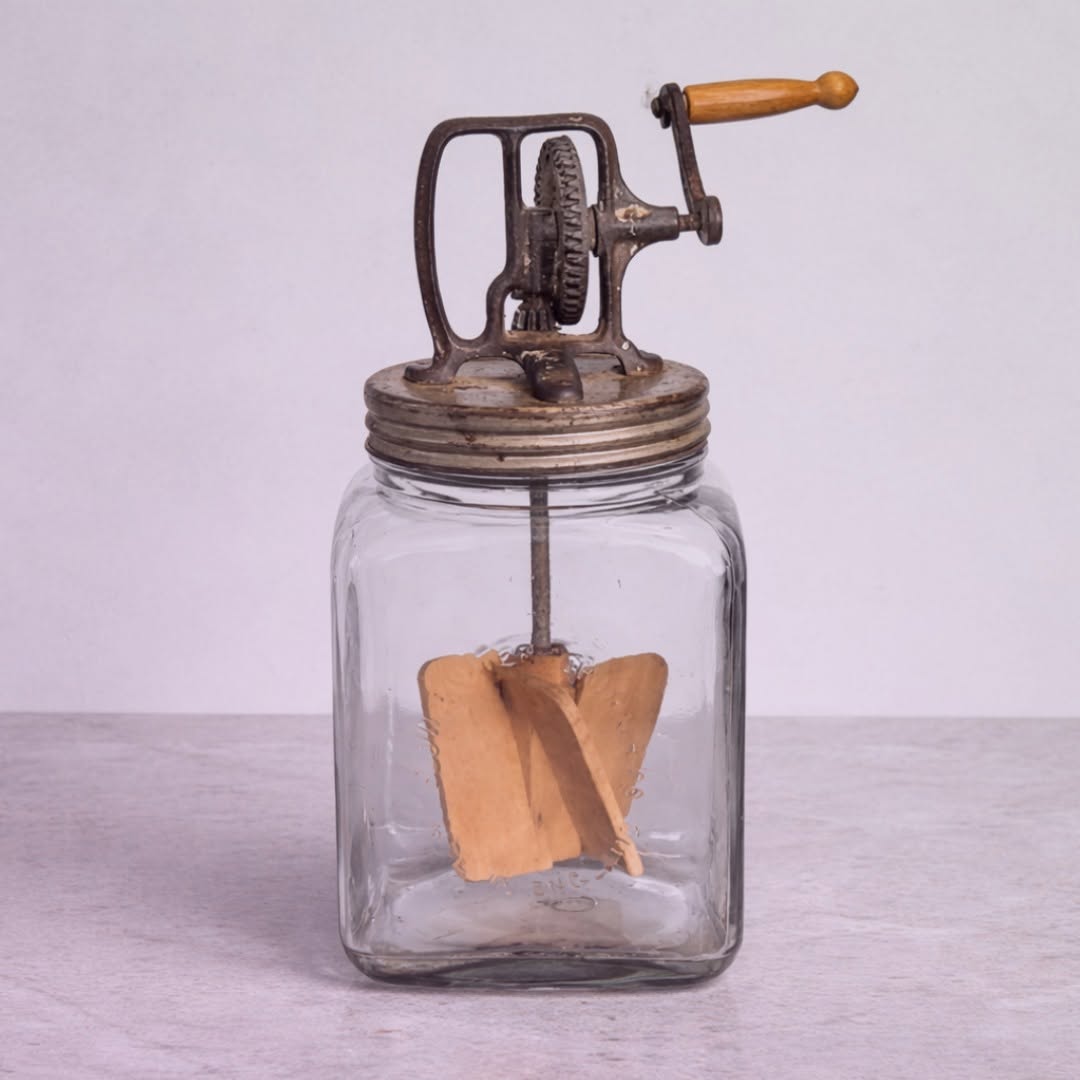
That little glass jar with a wooden handle looks almost too simple to matter. Then you notice the gears.
A wartime butter churn is the kind of old kitchen tool that makes you stop scrolling because it turns a familiar grocery-store staple into something you could make by hand. The Tweed Butter Churn, dated around 1940–1945, is a compact example of the equipment once used to process cream at home, without an electric appliance humming on the counter.
Why This Old Butter Churn Is So Interesting
Today, most people reach for a supermarket package of butter and never think about the steps behind it. In the 1940s, however, home food preparation could involve much more hands-on work.
A small hand-operated churn gave a household a way to agitate cream until the butterfat separated from the liquid. It was practical, mechanical, and surprisingly clever for such a modest kitchen object.
The Gears Tell the Story
The most fascinating part may be the mechanism sitting above the jar. Instead of an electric motor, the churn uses a wooden handle connected to a simple gear train.
Turn the handle and the gears transfer that movement down to a vertical rod inside the jar. Wooden flanges attached to the rod then agitate the cream.
That basic setup is easy to understand, yet it solves a real kitchen problem with very few parts. No buttons. No power cord. Just a handle, gears, a rod, and repeated motion.
How a Hand Butter Churn Actually Works
The process starts with cream rather than finished butter. Once the cream is placed inside the jar, the lid and mechanism are secured.
Next comes the repetitive part. Turning the wooden handle rotates the gears, which spin the internal rod and flanges. Continued agitation causes the butterfat to gather into butter while the remaining liquid separates away.
Eventually, the mixture changes noticeably. Instead of looking like smooth cream, it becomes a mass of butter surrounded by liquid.
What Happened After Churning?
The finished butter would typically need to be gathered and worked so that excess liquid was removed.
That detail is missing from many quick descriptions of antique churns, but it matters. The churn explains how the butter formed; the handling afterward explains how a usable kitchen ingredient was prepared.
For a modern demonstration, food-safe equipment should be used rather than an old collectible with corrosion, damaged wood, or uncertain surface treatments.
Glass, Wood, and Metal: A Clever Combination
The construction is another reason this little appliance is worth a second look. The glass jar acts as the container, while the metal lid supports the operating mechanism.
The wooden handle provides a comfortable grip for repeated turning. Meanwhile, the cog wheels convert that hand movement into rotation inside the jar.
The vertical rod connects the upper mechanism to the wooden flanges. Those flanges do the actual agitating, repeatedly moving through the cream as the handle turns.
Why the Glass Jar Matters
Glass offered a useful advantage: you could see what was happening inside. That makes the churn easier to monitor than a completely enclosed container.
For collectors, the transparent jar also preserves the visual relationship between the lid, rod, and internal paddles. You can see why the mechanism was built the way it was.
Is That Rust a Problem?
If you have found one of these old churns in an attic, barn, estate sale, or kitchen collection, resist the urge to start scrubbing immediately.
Heavy rust, worn metal, and aged wood can tell you a lot about storage and use. More importantly, an antique intended for display should not automatically be treated as food-safe just because it once held cream.
Cleaning vs. Preserving an Antique
For a collectible, gentle dust removal is usually a safer starting point than aggressive polishing. Photograph the object first, including the gears, handle, lid, jar, and any marks or labels.
Then check for cracks, missing fasteners, loose gears, damaged wood, and corrosion. If the metal is heavily deteriorated, forcing the mechanism to move can cause more damage.
If the goal is actually making butter, use a modern food-safe butter churn or a clean, purpose-built kitchen method. Keep the antique as a display piece.
Pro Tip: Never assume an old food-processing tool is sanitary simply because it looks intact. Age, corrosion, old finishes, and hidden residue can make a collectible unsuitable for food preparation.
What Makes This Churn Collectible?
Original parts, recognizable mechanisms, readable markings, overall condition, and provenance can all affect collector interest.
A complete churn with its original glass jar, lid, handle, gears, rod, and flanges can be especially useful for showing how the appliance worked. A damaged example can still be historically interesting, but missing components may make the mechanism harder to understand.
Condition matters too. Heavy corrosion may reduce practical value, yet it can also preserve evidence of the object’s working life.
If you are researching one for an antique kitchen display, record its measurements and photograph every side before making repairs. Look for maker names, patent information, stamped numbers, and unusual construction details.
What About the Measurements?
The reported dimensions for this example are approximately 136.5 mm high, 145 mm wide, and 560 mm deep. Those figures should be checked carefully against the physical object because antique listings sometimes measure projecting parts, handles, or mechanisms differently.
That is a small but important lesson for antique research: measurements without a clear method can be misleading. A photograph beside a ruler or measuring tape can make future identification much easier.
Could You Use One Today?
Technically, the mechanism demonstrates a perfectly understandable way to churn cream. Practically, an unrestored 1940s example is better viewed as a historical artifact than as a kitchen appliance.
Modern food-safe churns are easier to clean, easier to inspect, and designed for repeated food contact. They also remove the uncertainty surrounding old rusted metal, aged wood, seals, and finishes.
Still, watching an antique churn work can be a fantastic way to understand how much effort once went into ordinary kitchen tasks. Something as routine as spreading butter on toast could begin with a surprisingly physical process.
Before You Pass One Up
The next time you see a strange glass jar with gears at a flea market, don’t dismiss it as junk. That odd little machine may be a snapshot of everyday kitchen life from another era.
The Tweed Butter Churn shows how a few basic materials could turn hand power into useful food preparation. Its glass body, wooden handle, metal gears, and internal paddles make the process visible in a way many modern appliances hide.
And that is the real charm of an old butter churn. It is not merely an outdated gadget. It is a compact lesson in mechanical design, household history, and the amount of hands-on work that once happened behind an ordinary kitchen table.
If you own a similar butter churn, check the maker’s marks, photograph the mechanism, measure it carefully, and preserve its original parts before attempting restoration. You may have more than an old kitchen tool—you may have a small piece of domestic history.