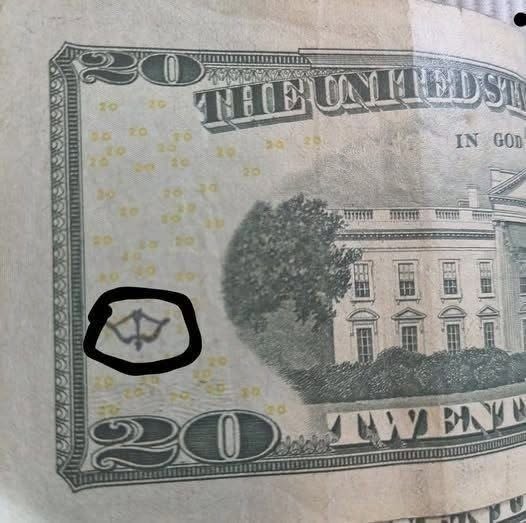
Why Do Some Dollar Bills Have Strange Marks?
If you have ever pulled a $1, $5, or $20 bill from your wallet and noticed a tiny symbol, stamp, initials, or doodle that clearly did not come from the U.S. government, you may have wondered what happened to it. These marks can look mysterious, but they are not automatically signs that your money is fake. In some cases, they are evidence of how a banknote was handled, checked, or passed through different hands.
What Are Chop Marks on Money?
The term “chop mark” is most strongly associated with coins, especially silver trade coins that circulated through Asian markets. Merchants used small counterstamps to indicate that a coin had been examined for authenticity, weight, or metal content. Historical examples appear on Spanish 8 reales and U.S. Trade dollars.
That distinction matters. A modern scribble, rubber stamp, or tiny symbol on a U.S. Federal Reserve Note should not automatically be called a traditional chop mark. The competitor article blurs these two ideas, making an interesting bit of numismatic history sound more universal than the evidence supports.
So why might a U.S. bill carry a strange mark? The answer depends on what the mark looks like, where it sits, and whether it is ink, writing, a stamp, or part of the printed design.
The Story Behind Traditional Chop Marks
Long before today’s sophisticated counterfeit-detection systems, merchants needed practical ways to decide whether unfamiliar coins could be trusted. In East Asian trade, merchants sometimes applied their own small stamps after testing silver coins. Over time, a single coin could collect several marks from different businesses.
This created a fascinating visual record. A heavily chopmarked coin can look almost covered in tiny symbols, with each mark representing another point in its trading life.
The U.S. Trade dollar became one of the coins associated with this practice. It was designed for international trade and circulated heavily in Asia, where merchants were already familiar with counterstamping.
In other words, the story is less about secret symbols on American paper money and more about the long history of trust, testing, and international commerce.
Why Would Someone Mark a Dollar Bill?
Not every unusual mark has the same explanation. A note might have been stamped for a business promotion, marked by a collector, signed as a souvenir, altered as part of an art project, or simply written on by an ordinary person.
There is another possibility: a mark may have been added during handling outside the normal U.S. currency system. Foreign exchange businesses, cash handlers, and private individuals have all had reasons to identify or annotate notes.
However, it is risky to look at a random star or pair of initials and declare, “That is a chop mark.” Without provenance, there may be no reliable way to determine who made the mark or why.
Can a Mark Make a Dollar Bill Worth More?
Usually, a mark does not turn an ordinary Federal Reserve Note into a valuable collectible. In fact, writing, stains, folds, stamps, and other damage can make a note less desirable to collectors who want crisp, clean examples.
There are exceptions. Collectors sometimes pay attention to unusual errors, rare serial numbers, historical associations, or documented pieces with interesting provenance. The key word is documented.
A strange-looking mark by itself is not proof that you have found a rare bill worth hundreds of dollars.
If you think a note might be collectible, avoid cleaning it, erasing the writing, trimming the edges, or trying to improve its appearance. Those DIY fixes can cause more damage than the original mark.
Are Marked U.S. Bills Still Legal Tender?
A small mark does not automatically cancel the value of a U.S. banknote. Federal law addresses mutilation of currency when it is done with the intent to render the note unfit to be reissued. The U.S. Currency Education Program points to 18 U.S.C. §333 for the relevant rule.
That is very different from saying that every marked bill is guaranteed to be accepted everywhere. A badly damaged, heavily soiled, or questionable note can create practical problems for banks, cash-handling equipment, or businesses.
The Federal Reserve explains that currency that is badly soiled, dirty, defaced, torn, or worn but clearly more than half intact can generally be handled through normal banking channels. More severely damaged notes may require special examination before an exchange is made.
So, if you find a little ink stamp on a bill, there is no reason to panic.
What Those Tiny Symbols Can Tell You
The most interesting part of a marked note is often the mystery surrounding it.
Look closely. Is the mark printed in ink? Is it a handwritten signature? Does it repeat several times? Is it near an edge, over a portrait, or beside a serial number? Does it resemble a business logo?
Those clues can help narrow down what happened, but they cannot always provide a definite answer.
For collectors, context matters enormously. A photograph of the note, information about where it was obtained, and any documentation from an earlier owner can be far more useful than the symbol itself.
A Quick Checklist Before You Spend It
Before treating a strange-looking bill as either worthless or a hidden jackpot, check these basics:
- Confirm the denomination and serial numbers.
- Look for obvious tears, missing sections, or severe damage.
- Note whether the unusual mark is ink, pencil, stamp, or part of the printed design.
- Compare it with a normal note of the same denomination.
- Do not scrub, erase, bleach, or otherwise alter the bill.
- If you suspect a genuine printing error or significant collectible feature, have it examined by a reputable currency or numismatic professional.
These simple steps can save you from turning an interesting find into a damaged one.
Common Mistakes People Make
The biggest mistake is assuming that every strange symbol has a secret financial meaning. Social media posts often make ordinary currency markings sound like hidden collector codes, but appearance alone is not enough.
Another mistake is confusing a chopmarked coin with a marked paper note. Traditional chopmarks have a well-established history in coin collecting, while random markings on Federal Reserve Notes can have many unrelated causes.
Finally, do not assume that a marked bill is counterfeit simply because it looks unusual. Modern U.S. notes contain specific security features, and authenticity should be judged using those features rather than one unexplained stamp or doodle.
The Real Story Is More Interesting
A strange mark on a dollar bill can certainly make you pause. But the best story may not be that you discovered a secret code.
Sometimes, it is simply a reminder that cash moves constantly from person to person, store to store, bank to bank, and country to country. Traditional chopmarks offer a window into an older world in which merchants physically marked coins after checking them. Modern marked notes can have much more ordinary explanations.
So the next time you spot an odd symbol on a U.S. dollar bill, take a second look. Don’t automatically call it a chop mark, and don’t automatically assume it is valuable. Instead, treat it as a small mystery—and remember that the history of money is often written not only in official designs, but also in the traces left behind by the people who handled it.