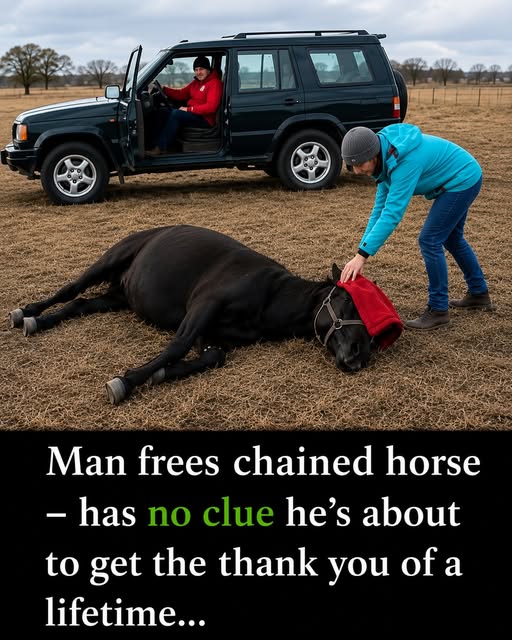
Vet Frees Chained Horse—Then Another Horse Appears
Most rescue stories end when the animal is safe. This one gets more interesting from there. The story of a chained horse in Romania’s Danube Delta has a striking final moment, but the real lesson is much bigger: freeing one animal can expose an entire problem involving veterinary care, horse behavior, population management, and protected land.
The widely shared rescue involving veterinarian Ovidiu Roșu took place in the Letea area, where free-roaming horses have lived for generations. A metal chain had restricted one horse’s movement, creating a serious welfare concern. Roșu and his team approached carefully, immobilized the animal, and removed the restraint.
Then another horse walked over.
The animal came close to Roșu and made physical contact with him. Online viewers quickly turned that moment into a touching story about a horse saying thank you. It certainly looks emotional. However, there is an important difference between what a camera captures and what we can know about an animal’s thoughts.
The Chained Horse Was Only the Beginning
A metal restraint can become dangerous when it limits how an animal moves, especially around the legs. Unpadded chains may rub, pinch, or create injuries, while a frightened horse can make any attempt at removal unpredictable.
That is why this was not a simple “grab some cutters and set the horse free” situation. A free-roaming horse is strong, fast, and accustomed to making its own decisions. Veterinary immobilization allowed the team to work with far less risk to the horse and the people nearby.
Pro Tip: If you ever see a free-roaming horse wearing a restraint, do not try to remove it yourself. Keep your distance, avoid startling the animal, and contact the appropriate local animal-welfare or veterinary authority.
For everyday horse owners, the same principle applies on a smaller scale: restraints should be fitted and checked regularly, and damaged or overly tight equipment should never be ignored.
So, Did the Horse Really Say “Thank You”?
This is the part that made the rescue explode online.
After the restrained horse was freed, another horse approached Roșu and touched him. The scene is easy to read as affection or gratitude, especially when viewed through a human lens.
But animal behavior is rarely that simple.
Horses communicate through posture, movement, distance, vocalizations, and physical contact. A nuzzle or close approach can happen in different social situations. It may reflect curiosity, recognition, social interest, or a response to what just happened around the herd.
We cannot look at a short video and know exactly what the horse intended.
That does not make the moment less beautiful. In fact, the uncertainty makes it more interesting. The camera captured something real: a horse approached a veterinarian immediately after another horse had been released.
That is enough.
Why These Romanian Horses Are Called “Wild”
The horses living around Letea are often described as wild horses, but “free-roaming” or “semi-feral” is usually more precise.
Their history is tied to people. Horses have lived in the Danube Delta for centuries, and the population expanded after Romania’s communist system collapsed in 1989. Changes in agriculture and the disappearance of some traditional horse-keeping practices left animals roaming more freely.
Over time, the herd grew.
That created a complicated situation. The horses needed protection from neglect and harmful practices, yet their increasing numbers also raised concerns about grazing pressure in a sensitive protected environment.
So this was never simply a story about rescuing horses from people.
It was also a story about what happens when animal welfare and conservation collide.
The Letea Horse Problem Has Two Sides
Imagine trying to manage a large population of strong animals living across open terrain. You cannot simply treat every horse like a domestic animal in a stable.
Veterinarians may need specialized field equipment, experienced handlers, safe immobilization methods, identification systems, and repeat visits. At the same time, conservation teams have to think about vegetation, available forage, habitat pressure, and the health of the wider ecosystem.
That creates difficult choices.
Removing too many horses can raise major animal-welfare concerns. Doing nothing can allow the population to increase beyond what the habitat can comfortably support.
The better question is not “horses or nature?” It is how both can be managed responsibly.
What Happened After the 2011 Crisis?
The issue became especially serious in 2011, when dozens of horses were rounded up and faced transport to a slaughterhouse. Animal-welfare intervention stopped the transport, and more than 40 rescued horses were eventually returned to the Danube Delta after rehabilitation.
That event helped push the discussion toward long-term population management.
Beginning in 2012, veterinary teams used immunocontraception, including porcine zona pellucida, or pZP, to reduce fertility in mares. Unlike permanent sterilization, this approach can temporarily reduce fertility and therefore requires ongoing monitoring and follow-up.
That detail matters.
Population control is not a one-afternoon project. Veterinary teams have to identify animals, provide treatment, monitor results, and return when additional care is needed. Meanwhile, sick or injured horses may still require individual veterinary attention.
Pro Tip: When evaluating a wildlife-management program, look beyond the headline number of animals treated. Ask whether the program includes follow-up care, population tracking, habitat monitoring, and a plan for future seasons.
Why Veterinary Fieldwork Is So Different
A domestic horse may be familiar with people, a stable, a halter, and routine veterinary handling. A semi-feral horse may have none of those advantages.
That changes everything.
Field veterinarians must consider terrain, weather, herd behavior, escape routes, distance from equipment, and the animal’s reaction to people. Chemical immobilization can make treatment possible, but it also requires careful veterinary judgment and monitoring.
Roșu’s work in the Danube Delta extended well beyond the viral rescue. His involvement included field immobilization, health checks, and fertility-control procedures. Scientific research has also examined chemical immobilization methods for feral horses in Romania.
In other words, the dramatic clip was only a few seconds of a much larger job.
The Rescue Hack You Should Not Copy
Viral animal videos can create a dangerous illusion: if a professional can approach an animal, perhaps anyone can.
Please do not copy that part.
A free-roaming horse may appear calm one second and react quickly the next. Standing behind it, getting between herd members, grabbing a chain, or trying to corner an animal can put both the person and horse at risk.
If you encounter a restrained, injured, or distressed horse, observe from a safe distance and contact trained professionals.
Also, resist the temptation to feed free-roaming animals for a better photograph. Feeding can change natural behavior and encourage animals to approach people, which may create problems later.
There Is a Bigger Story Behind the Viral Clip
The most shareable part of the video is the moment after the rescue. The most important part may be everything nobody sees.
Long-term animal welfare requires routine work: veterinary treatment, fertility control, monitoring, seasonal support, and cooperation between organizations and authorities.
FOUR PAWS became heavily involved with the Romanian horse population over many years. The organization has said that from 2025 it handed its equine programs in Romania and Jordan over to the relevant authorities.
That transition highlights an important point. A rescue organization can help build systems and provide expertise, but lasting management eventually depends on local institutions having the people, funding, equipment, and knowledge to continue the work.
What This Story Teaches Us About Animal Rescues
There are really three stories inside this one.
First, there is the individual horse that needed help. Its chain restricted movement, and trained veterinary intervention gave the animal a safer outcome.
Second, there is the herd. The horses live socially and respond to changes around them, but we should be careful about assigning human emotions to every interaction.
Third, there is the habitat. The Danube Delta is a sensitive environment, so responsible horse management has to consider more than the welfare of individual animals.
Those three pieces cannot be separated easily.
That is why the rescue remains memorable. It is emotional without requiring an invented conversation between a horse and a veterinarian.
Final Thoughts on the Chained Horse Rescue
The story of the chained horse in Romania is moving because the basic facts are already powerful. A veterinarian found a free-roaming horse whose movement had been restricted by metal, used professional methods to make the intervention safer, and helped remove the restraint.
Then another horse approached him.
Was it gratitude? We cannot say for certain. Was it a memorable moment? Absolutely.
More importantly, the rescue points toward a much larger issue. The Letea horses need responsible care, while the surrounding habitat needs responsible management. Veterinary treatment, fertility control, monitoring, and local oversight all have a role.
So the next time a short animal-rescue clip makes you stop scrolling, watch the moment—but look for the story behind it, too. In this case, the real story is not only about a chain coming off a horse. It is about what happens when animal welfare, veterinary medicine, and conservation meet in the same place.