One: The Marble Face
Judge Henderson had presided over four thousand three hundred cases in twenty-two years.
He knew this because his secretary, Dolores, had calculated it on the day of his twentieth anniversary at the courthouse. She had written the number on a card with a blue pen and left it on his desk. 4,300. He had looked at it for a moment, then slid it into the top drawer—the place where he kept the things he didn’t know exactly what to do with.
In over two decades on the bench, Henderson had developed what his ex-wife used to call “the marble face.” It was the rare, disciplined ability to listen to anything—the most horrific crimes, the most devastating losses—without a single muscle revealing his inner thoughts. He had once explained to a younger magistrate that it wasn’t coldness; it was a service to justice. A witness who saw sympathy responded differently from a witness who saw skepticism.
He had held that mask through four thousand three hundred cases.
He held it for exactly four minutes and seventeen seconds of case four thousand three hundred and one.
The file on his desk was a guardianship case. Two children who had lost both parents within six months. The system had found no viable relatives. The foster care system was flagged as the inevitable next step.
Judge Henderson had read the file that morning with his coffee. He had thought: routine case.
Two: What the File Didn’t Say
The file didn’t say that fifteen-year-old Maya had been acting as a mother since she was twelve.
It didn’t mention that her little brother, Leo, who was seven, only ate when Maya cooked. It didn’t mention the specific routine they had built to survive the quiet house after their mother died—how Maya would sit with him every night, reading from a worn book about space, explaining how light from distant stars takes millions of years to reach Earth. “So even when stars are gone, Leo, you can still see their light,” she had told him.
The file didn’t mention that Leo had stopped speaking to anyone else. He only spoke to Maya.
The guardianship lawyer, a stern but deeply empathetic barrister named Arthur Vance, had prepared Maya for the hearing. He told her to be calm, to let the system work, and to speak clearly. But Vance didn’t know what was about to happen.
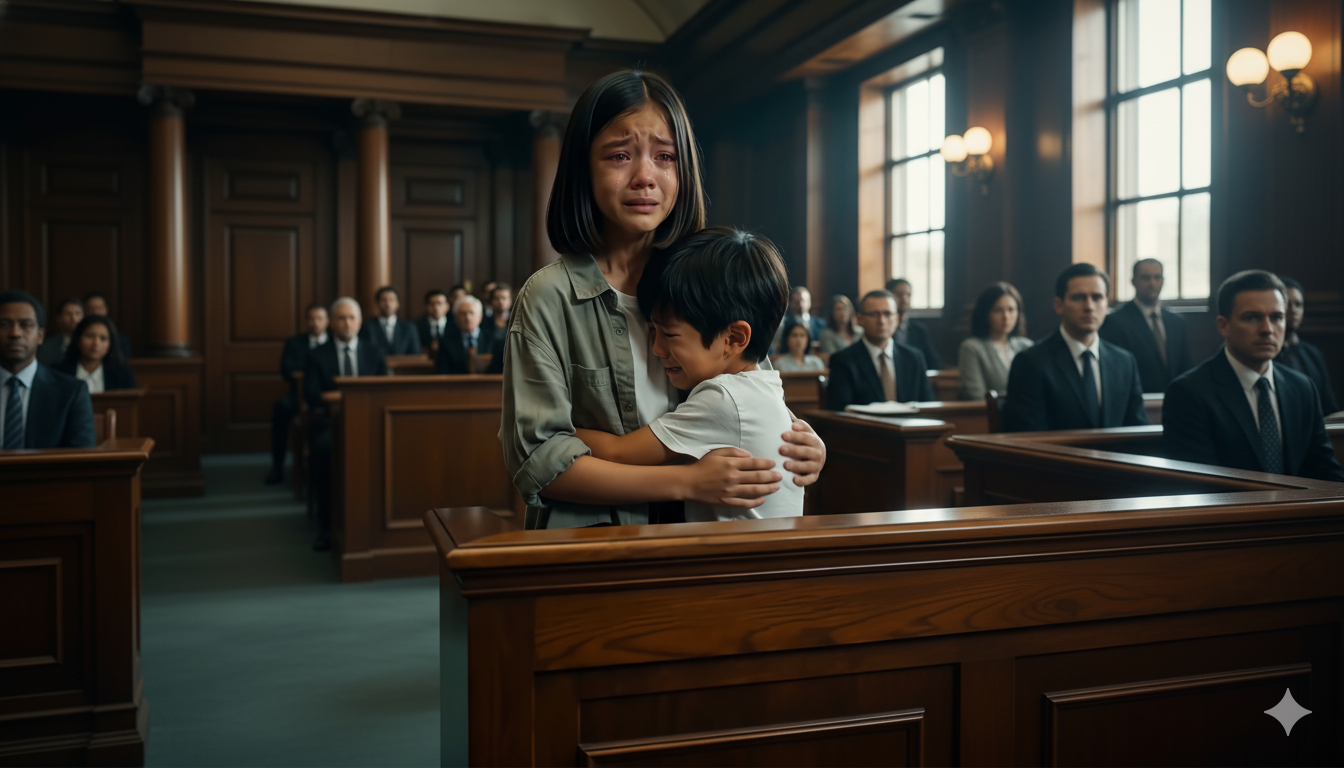
The courtroom was quiet, bathed in the heavy, timeless glow of dark wood panels. In the gallery sat a few observers, including a young social worker named Mei, who had seen hundreds of these broken families pass through the system.
Maya stood at the wooden defense box.
And then, breaking all courtroom protocol, little Leo stood up with her.
Three: The Cry in the Courtroom
Leo didn’t stay in his seat. He walked right up to his sister, wrapping his small arms tightly around her waist, burying his face into her side. He began to cry—not throwing a tantrum, but weeping with the heavy, silent, exhausting grief of a child who knows his entire world hangs in the balance.
Maya held him against her, her fingers gripping his white T-shirt. She looked up at the bench.
The marble face of Judge Henderson looked down at them. Arthur Vance sat at the bar, his eyes fixed on the children, his expression tight with a sudden, unprofessional ache.
Maya breathed in, her chest heaving, tears streaming freely down her face, turning her eyes a raw, sorrowful red. She didn’t use legal terms. She didn’t have a speech memorized.
“I don’t have parents,” she gasped out, her voice breaking, a heavy sob escaping her throat. She looked directly into the eyes of the judge. “But I can still take care of him.”
The words hung in the quiet air of the courtroom.
Four: The Crack in the Marble
In the gallery, Mei, the social worker, covered her mouth with a trembling hand. Tears spilled over her fingers. She had entered the room expecting a routine placement hearing, but she was watching something else entirely: raw, unfiltered love fighting against a cold bureaucratic machine.
Arthur Vance closed his legal pad. There was nothing more to argue. The defense rested on the shoulders of a fifteen-year-old girl.
Judge Henderson did not blink. But for the first time in twenty-two years, the marble cracked. His jaw tightened. A heavy, somber shadow crossed his eyes. He looked at Maya’s red, tear-stained face, and then down at Leo’s tightly clenched hands.
Four thousand three hundred cases. And it took a child’s sob to break the mask.
“We will take a fifteen-minute recess,” the judge said, his voice lower and rougher than usual.
Five: The Light of the Star
When the court resumed, Judge Henderson did not look at the social services paperwork. He looked at Maya.
“The system is built on rules, Miss Fuentes,” Henderson said, the courtroom dead silent. “It is built on age limits, financial brackets, and legal definitions. But the law also allows for equity. It allows a judge to see what a file cannot capture.”
He looked at Leo, who had finally stopped crying, though he still gripped Maya’s jacket.
“The court notes the exceptional maturity of the sibling. The court also notes that the foster family selected by Mr. Vance has agreed to a co-living arrangement where Maya will retain practical custody under their roof. This court approves the joint placement. No separation.”
The gavel struck. The sound echoed like relief.
Six months later, the review hearing was short. It took only ten minutes. Outside the courthouse, under a crisp winter sky, Leo held Maya’s hand as they walked down the stone steps.
“Maya?” Leo asked, looking up.
“Yeah, Leo?”
“Are we still bright?”
Maya smiled, wiping a bit of winter wind from her eye, looking down at the little boy who was her entire life.
“Yeah, Leo,” she said, squeezing his hand. “We’re still bright. The light takes a long time to fade.”
Disclaimer: The video you watched and the story you just read is a fictional cinematic story created for entertainment purposes only. All characters and events are imaginary. It does not depict any real people or actual events.