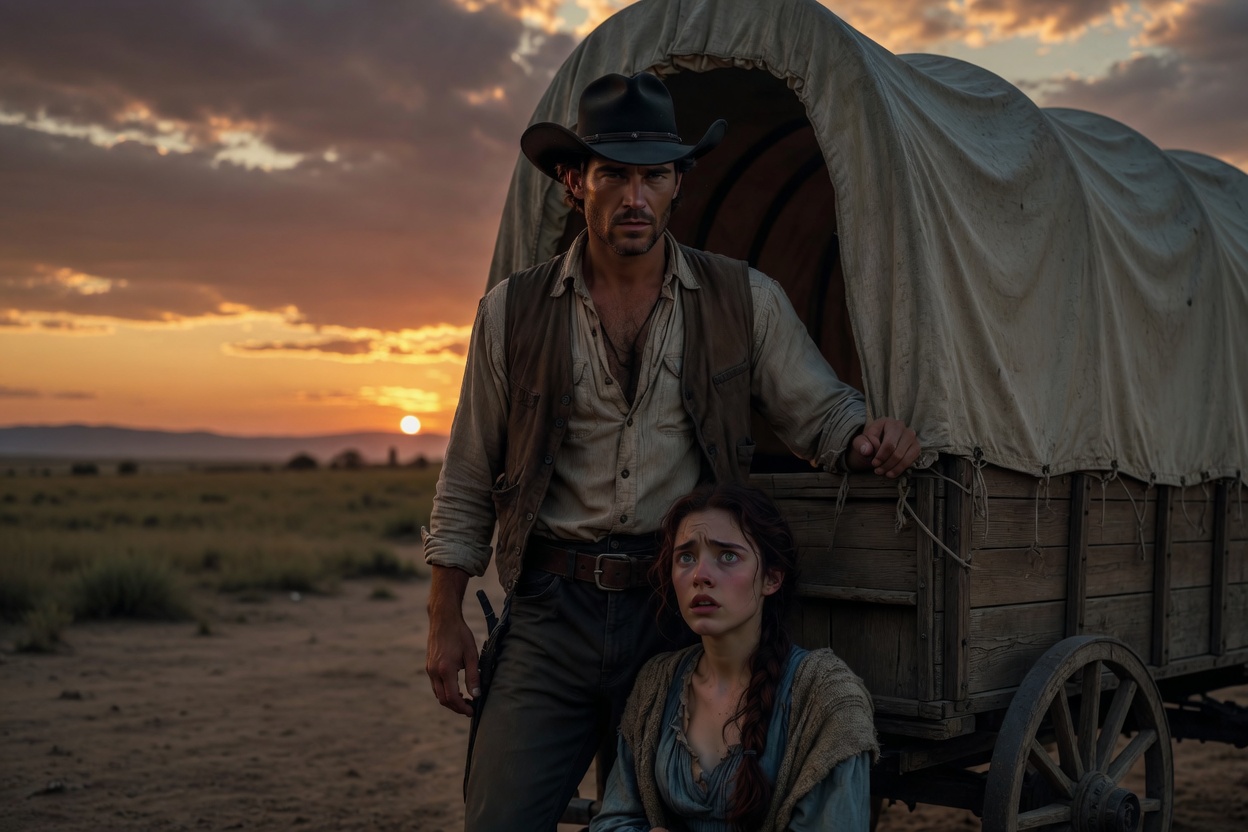
The trail stretched long and empty that late afternoon, the kind of silence that usually brought Elias Thorne peace. Golden light bled across the rugged hills, painting the dust in warm amber as his old covered wagon creaked forward, pulled by two steady horses. For years he had lived this way—alone on the edge of the frontier, no wife, no family left after the fever took them. Just the land, his rifle, and the quiet rhythm of survival.
Until she appeared.
At first she was a frantic shadow against the horizon, skirts flying, boots kicking up dirt as she ran like death itself chased her. Elias pulled the reins. His horses slowed. Before he could call out, she reached the wagon, hands trembling as she clutched the weathered wood.
“Please,” she gasped, voice raw and breaking. “Hide me in your wagon… before they find me. I beg you.”
Elias studied her—unconventionally beautiful even in terror. Clara Whitmore was a 28-year-old woman with striking features: sharp cheekbones dusted with freckles, wide emerald-green eyes filled with raw panic, long dark auburn hair escaping a loose braid, wearing a torn blue calico dress with a faded wool shawl clutched tightly around her shoulders. Her hands were scraped and bleeding.
He glanced down the empty trail, then back at her desperate face. “Who’s chasing you?”
“No time,” she whispered, tears cutting clean lines through the dust on her cheeks. “My in-laws… they’re cruel. They’ll drag me back and make me suffer.”
Something in her eyes—pure, animal fear—hit him hard. Without another word, Elias climbed down, lifted the heavy canvas flap at the back of the wagon, and nodded. “Get in. Stay low.”
She didn’t hesitate. The moment she disappeared inside, the sound of hooves erupted. Three riders crested the hill, dust swirling behind them like a storm. Hard men with cold eyes and rifles across their saddles. They reined in hard beside his wagon.
“You see a woman come this way?” the lead rider barked.
Elias leaned casually against the wagon wheel, arms crossed, his own weathered face unreadable. Tall and broad-shouldered at 42, with salt-and-pepper stubble, piercing steel-gray eyes, and a strong jaw, he wore a faded chambray shirt under a worn leather vest, dark trousers, and a dusty black cowboy hat. “Folks pass through. Didn’t notice much.”
The riders glared, suspicious. One tried to peer into the wagon. Elias shifted, blocking the view with his body. Tension crackled in the air like dry lightning. After a long, dangerous pause, the men rode off with a warning.
Only when the dust settled did Elias lift the canvas again. Clara emerged shaking. “Thank you… I’m Clara.”
“Elias,” he replied simply. He studied her for a long moment. “You ride with me now. My place isn’t far.”
The homestead sat nestled in a hidden valley surrounded by cottonwoods and rocky ridges—a modest but solid cabin, barn, and corral. Inside, the warmth of the fire and simple stew felt like another world to her. As night fell, Clara finally told her full story while Elias listened, jaw tight.
Her husband had died the previous winter. His brothers and mother then claimed everything—her home, her small inheritance, even her freedom. They locked her in, forced her to work like a servant, and planned to marry her off to the youngest brother to keep the land in the family. She was property to them. Nothing more.
“I ran at dawn,” she said, voice thick with emotion. “I’d rather die out here than live like that another day.”
Elias’s hands clenched into fists. “You’re not going back. Not while I’m breathing.”
That night she slept in safety for the first time in months. Elias stayed awake by the window, rifle across his lap.
Dawn brought trouble. The three riders returned, bolder this time, horses trampling the yard. Guns already drawn. “We know she’s here!” one shouted. “Hand her over.”
Clara watched from the doorway, heart hammering. Elias stepped out, calm but immovable, positioning himself between her and the barrels. “She’s not yours to take.”
“You don’t want this fight, farmer.”
Elias’s voice dropped low and steady. “Funny. Neither do I. But I won’t let you touch her.”
The standoff stretched, dust swirling, tension thick enough to choke on. The riders finally backed off with threats, but everyone knew they’d return.
In the days and weeks that followed, something profound shifted on that quiet homestead. Clara, once broken and skittish, began to bloom. She learned to tend the garden, care for the horses, and laugh again—small, hesitant laughs that grew stronger each day. Elias never pushed. He simply offered steady presence, respect, and protection.
One golden evening on the porch, she turned to him. “Why risk everything for a stranger?”
He looked out over the land, then met her emerald eyes. “Because no one should own another person. And because the moment I saw you running… I knew you were worth standing for.”
Clara’s eyes filled with tears, but this time they were different—grateful, warm, hopeful. She had found not just safety, but a man who saw her as a person, not property.
Winter came and went without further trouble. Spring brought new life to the valley… and to them. Clara chose to stay. Elias chose to build a future with her. The riders never returned after that final warning Elias delivered with cold finality.
Years later, travelers still spoke of the lone wagon on the frontier trail, the desperate woman who begged for hiding, and the quiet, unbreakable man who didn’t just give her shelter—he gave her freedom, dignity, and eventually love.
A single act of courage on a dusty road had rewritten two destinies.
Disclaimer: This video is a fictional cinematic story created for entertainment purposes only. All characters and events are imaginary. It does not depict any real people or actual events.