It was September of 1876, and in his 5 years living alone in these Nevada mountains above Yarington, he had never heard anything quite like it.
The sound was pure and ethereal. A woman’s voice threading through the trees with a melody that made his chest tighten in a way he could not explain.
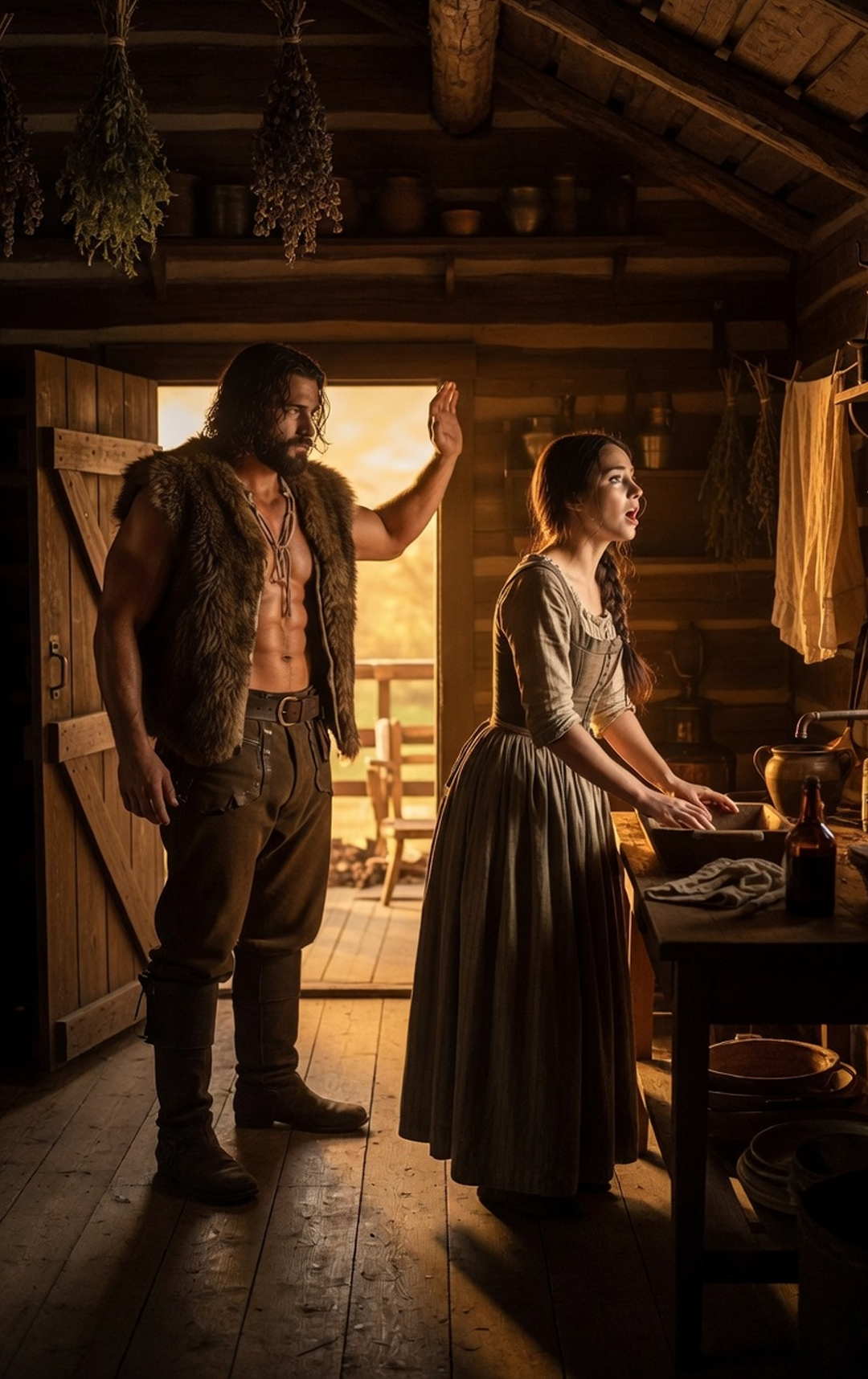
Fletcher was not a man given to sentiment. At 28, he stood well over 6 ft with shoulders broad enough to carry a fullgrown deer without strain, his dark hair falling past his collar in waves he rarely bothered to trim.
His arms were corded with muscle from years of swinging an axe and hauling water, his hands calloused and scarred.
He had come to these mountains to escape the noise and expectations of civilization, and he had been content in his solitude.
But that voice, that impossibly beautiful voice, pulled at something buried deep inside him. He wiped the blood from his hands on his leather breaches and moved silently through the underbrush, his moccasins making no sound on the forest floor.
The years had taught him to move like a shadow, and he used every bit of that skill now as he followed the sound.
The voice grew clearer as he approached, rising and falling with a heartbreaking sweetness that spoke of loneliness and longing.
When he finally caught sight of her, she was sitting on a fallen log beside a small creek, her back to him, her dark hair tumbling down past her waist.
She wore a simple calico dress that had seen better days, the hem muddy and torn.
Her feet were bare, dangling just above the water, and her entire body seemed to pour itself into the song.
Fletcher stood there for what might have been minutes or hours. He could not tell.
He was transfixed. Then a twig snapped beneath his boot, and the singing stopped abruptly.
The woman spun around, her eyes going wide with terror. She scrambled to her feet, nearly falling into the creek in her haste.
“Wait,” Fletcher said, holding up his hands. “I am not going to hurt you.” But she was already running, crashing through the brush with none of the grace her voice had possessed.
Fletcher cursed under his breath and followed, not because he wanted to frighten her further, but because something in her panic alarmed him.
A woman alone in these woods, clearly terrified, was a woman in trouble. He caught up to her easily, his longer legs and knowledge of the terrain giving him the advantage.
When he stepped out from behind a pine tree directly in her path, she let out a small cry and fell backward, landing hard on the ground.
“Please,” she gasped, scooting away from him. “Please, just leave me alone.” Fletcher crouched down slowly, keeping his distance.
Up close, he could see she was young, probably no more than 22 or 23.
Her face was beautiful despite the fear etched across it with high cheekbones and eyes the color of warm honey.
But it was the bruises that made his jaw tighten. Fading yellow marks on her arms and what looked like an old cut on her temple.
“I am not going to hurt you,” he repeated, keeping his voice as gentle as he could manage.
“My name is Fletcher Cain. I have a cabin about 2 mi north of here.
I was hunting when I heard you singing. At the mention of her singing, her face went pale.
You heard me? Yes, madam. You have the most beautiful voice I have ever heard.
She shook her head violently. No, no, you cannot tell anyone. Please, you have to promise you will not tell anyone.
The desperation in her voice confused him. Tell anyone [clears throat] what? That you can sing, please.
Tears were streaming down her face now. He will find me if anyone knows. He always said my voice would give me away.
I should not have been singing. I just thought I was alone and I forgot.
And who will find you? Fletcher interrupted gently. Who are you running from? She pressed her lips together and looked away, clearly debating whether to trust him.
Finally, she spoke in a voice barely above a whisper. My husband. Fletcher felt something cold settle in his stomach.
Of course, she was married, a woman that beautiful would be. “He hurt you?” He said.
“It was not a question.” She nodded slowly. “I ran away 3 weeks ago. I have been living in the woods, foraging, trying to get far enough away that he could not find me.
He is a powerful man in Carson City, a banker with connections. He told me if I ever tried to leave, he would hunt me down and kill me, and he would, too.
I have seen what he is capable of. Fletcher was not a violent man by nature, but in that moment, he wanted nothing more than to find this husband and show him what it felt like to be on the receiving end of brutality.
Instead, he kept his voice calm. “You cannot stay out here alone. Winter will be coming in a few months and these mountains get deadly cold.
Come back to my cabin. I will give you shelter and I promise I will not let anyone hurt you.
Why would you help me? She asked, searching his face with those honeycoled eyes. Because it is the right thing to do, Fletcher said simply.
And because no one should have to live in fear like that. She studied him for a long moment, then seemed to come to some internal decision.
“My name is Annabelle,” she said quietly. “Anabel Owens. That was my name before I married.”
“I will not use his name anymore.” “Well, Miss Owens,” Fletcher said, deliberately using the unmarried form of address.
“Why do you not let me help you up, and we can go somewhere safe?”
She took his offered hand hesitantly, and he pulled her to her feet with such ease that she looked startled.
Fletcher was used to that reaction. His strength often caught people off guard. He led her back through the woods to where he had left the elk, quickly finished his work, and hoisted the animal across his shoulders as though it weighed nothing.
Annabelle watched with wide eyes, but said nothing. The walk to his cabin took the better part of an hour.
Fletcher kept up a steady stream of gentle conversation, pointing out landmarks and telling her about the mountain, trying to ease her obvious nervousness.
By the time they reached the sturdy log structure he had built with his own hands, some of the terror had left her face, replaced by exhausted weariness.
The cabin was simple but well-made, with a stone fireplace, a sleeping loft, and windows that let in the afternoon light.
Fletcher had built furniture from pine, including a table, chairs, and a bed frame stuffed with evergreen boughs and furs.
It smelled of wood smoke and leather, and the dried herbs he kept hanging from the rafters.
It is not much, Fletcher said, suddenly aware of how rough his home must seem to a woman from the city.
But it is warm and dry. You can have the loft. I will sleep down here.
Annabelle turned in a slow circle, taking it all in. It is wonderful, she said, and she sounded like she meant it.
I have been sleeping on the ground for 3 weeks. This looks like a palace.
Fletcher felt an unexpected warmth in his chest at her words. You must be hungry.
Let me cook something. Over the next few hours, Fletcher prepared a meal while Annabelle sat at the table and slowly began to relax.
He made venison stew with vegetables from his garden and biscuits cooked in his Dutch oven.
When he set the bowl in front of her, she ate with the desperate hunger of someone who had been starving.
He refilled her bowl twice without comment. After dinner, as the sun set and painted the mountains gold and purple, Fletcher built up the fire and made them both coffee.
They sat in companionable silence for a while before Annabelle finally spoke. “Why do you live out here alone?”
She asked. Fletcher considered the question. “My parents died when I was 19. Kalera outbreak in Sacramento where we were living.
After that, I had no reason to stay in town. I worked as a logger for a few years, saved up money, and came out here to build this place.
I like the quiet. I like being able to see for miles and not having to worry about what anyone thinks of me.
Do you ever get lonely? He looked at her across the firelight. Sometimes, but I figure lonely is better than being around people who make you feel small.
I grew up never quite fitting in anywhere. Too big, too quiet, too different. Out here, I can just be myself.
Annabelle nodded slowly. I understand that my husband never wanted me to be myself. He wanted me to be silent and obedient and invisible.
The only time I felt like I could breathe was when I sang, but he hated it.
He said my voice was too loud, too attention-seeking. Eventually, he forbade me from singing at all, even when I was alone.
He would hit me if he caught me humming. Fletcher’s hands tightened on his coffee cup.
How long were you married to him? 2 years. It felt like a lifetime. She stared into the fire.
My parents arranged the marriage. They were struggling financially, and he offered them a substantial sum.
I was 20 when we married. I did not realize what kind of man he was until it was too late.
“You are safe now,” Fletcher said firmly. I give you my word, Annabelle. He will not find you here, and if he does, he will have to go through me first.
She looked at him with tears in her eyes. Why are you being so kind to me?
You do not even know me. Maybe not yet, Fletcher said. But I would like to if you will let me.
That night, Annabelle climbed the ladder to the loft while Fletcher made himself a bed on the floor by the fire.
He lay awake for a long time, listening to the sounds of her breathing above him, and wondering what he had gotten himself into.
He had come to these mountains for solitude. And now there was a woman in his home, a married woman, technically, though he refused to think of her that way.
A woman with a voice like an angel and eyes that held more pain than anyone so young should carry.
In the loft, Annabelle lay on the comfortable bed and stared at the rough hune rafters above her.
For the first time in months, she felt safe. There was something solid and unshakable about Fletcher Cain.
He was a mountain of a man, all muscle and quiet strength, but there was gentleness in the way he moved around her, as though he was afraid his size might frighten her.
And perhaps it should have. Her husband had been a large man, too, and he had used that size to hurt her.
But when Fletcher looked at her, there was no cruelty in his eyes, only a deep kindness that made her want to weep.
The next morning, Fletcher woke before dawn, as was his habit. He moved quietly, not wanting to wake Annabelle, and went outside to tend to his chores.
He had chickens that needed feeding, a garden that needed watering, and wood that needed chopping.
He was splitting logs when Annabelle emerged from the cabin, her hair braided loosely over one shoulder.
She had washed her face and dress as best she could, and in the morning light she looked younger and less haunted.
“Good morning,” she said softly. Fletcher buried the axe in the chopping block and wiped sweat from his forehead.
Morning. Did you sleep well? Better than I have in a long time. She looked around at the clearing at the garden and the chicken coupe and the small barn where Fletcher kept his two horses.
This is a beautiful place. Thank you. It has taken me years to build it all up.
He gestured toward the cabin. There is coffee on the stove if you want some.
I will be in shortly to make breakfast. But Annabelle shook her head. Let me make breakfast.
It is the least I can do to repay your kindness. Fletcher wanted to argue that she owed him nothing, but something in her expression told him she needed to do this, needed to feel useful.
So he nodded and went back to chopping wood while she disappeared inside. When he came in 30 minutes later, the cabin smelled of frying bacon and fresh biscuits.
Annabelle had set the table and even picked wild flowers to put in a jar.
It was such a simple thing, but it transformed the space into something warmer, something that felt less like a hermit’s dwelling and more like a home.
They ate together, and Fletcher found himself watching her when he thought she was not looking.
The way the morning light caught in her dark hair. The delicate curve of her jaw.
The way her eyes crinkled slightly when she smiled, which was rare but devastating when it happened.
After breakfast, Fletcher went back outside to work, and Annabelle cleaned up. She found herself humming without thinking about it, and then stopped abruptly, old fear rising in her throat.
But then she remembered that Fletcher was not her husband. He had called her voice beautiful.
He had asked her, however unintentionally, to sing by not forbidding it. Slowly, carefully, she started humming again.
Then, even more quietly, she began to sing. She was so focused on the washing up that she did not hear Fletcher come back inside.
He stood in the doorway, arrested once again by the sound of her voice. This time the song was different, less sad, though still tinged with melancholy.
It spoke of hope and new beginnings, and Fletcher felt something shift in his chest.
When Annabelle turned and saw him standing there, she froze. “I am sorry. I know I should not know,” Fletcher said quickly.
“Please do not apologize. I told you yesterday you have the most beautiful voice I have ever heard.
I could listen to you sing all day. She looked at him uncertainly. You really mean that?
I do not say things I do not mean, Fletcher said. In fact, I would like to hear you sing more every day if you are willing.
I think you need to sing, Annabelle. I think it is part of who you are, and you should not have to hide it.
Tears welled up in her eyes. No one has ever said anything like that to me before.
Then they were fools,” Fletcher said bluntly. Over the following days, a routine developed. Fletcher would wake early and do his outside chores while Annabelle made breakfast.
They would eat together, and then Fletcher would work on various projects while Annabelle helped with the garden, the cooking, and the endless tasks that came with living off the land.
And every day Fletcher would ask her to sing. At first she was hesitant, her voice soft and uncertain, but gradually as she realized he truly meant what he said, she grew bolder.
She sang while she cooked. She sang while she tended the garden. She sang in the evenings as they sat by the fire.
Fletcher found himself arranging his work so he could stay within earshot of her voice.
He would chop wood slower than necessary or fix the fence line that did not really need fixing just so he could hear her sing.
And Annabelle, for her part, began to blossom. The fear slowly left her eyes, replaced by something tentative but real.
Joy. Two weeks after Annabelle had arrived, Fletcher was working on replacing some shingles on the cabin roof when she called up to him.
Fletcher, I was thinking I might go down to the creek to wash some clothes.
Is that safe? He climbed down the ladder immediately. I will come with you. I do not want you going anywhere alone yet.
Not until we are sure no one is looking for you in this area. They walked down to the creek together, Fletcher carrying the basket of clothes, while Annabelle carried the soap she had made from ashes and animal fat.
The day was warm for late September. The sky a brilliant blue overhead. While Annabelle washed clothes, Fletcher sat on a nearby boulder, his rifle across his knees, keeping watch, but his eyes kept drifting to her.
The way the sun caught the water droplets on her hands, the concentration on her face as she scrubbed, the loose tendrils of hair that had escaped her braid and curled around her face in the humidity.
“Will you sing?” He asked suddenly. She looked up surprised, then smiled. That smile did something to his insides.
“What would you like to hear?” “Anything? Everything.” “I just want to hear your voice.”
So Annabelle sang. She sang old ballads and church hymns and songs her mother had taught her as a child.
Her voice echoed off the canyon walls, pure and clear and utterly captivating. Fletcher sat there and felt something he had not felt in years.
Contentment. More than contentment, happiness. When she finished the washing and spread the clothes on bushes to dry, she came and sat beside him on the boulder.
They were close enough that he could smell the lavender soap she had used that morning.
Could see the pulse beating in her throat. “Thank you,” she said softly, “for what?
For giving me back my voice, for making me feel like it is okay to be myself.”
She turned to look at him, and there was something in her eyes that made his breath catch.
“I have not felt this free in years, Fletcher. Maybe ever. You deserve to be free,” he said, his voice rougher than usual.
“You deserve to be happy.” “So do you,” she said. And before he could think better of it, Fletcher reached out and tucked one of those loose curls behind her ear.
His fingers brushed her cheek, and she did not pull away. Instead, she leaned into his touch, her eyes drifting closed.
Fletcher pulled his hand back quickly, suddenly aware of what he was doing. We should get back,” he said, standing abruptly.
“I have more work to do before dark. If Annabelle was disappointed by his retreat, she did not show it.”
She simply nodded and helped him gather the basket of wet clothes. But as they walked back to the cabin, Fletcher could not stop thinking about the warmth of her skin beneath his fingers, or the way she had leaned into his touch as though she had been starving for gentleness.
That night after dinner they sat by the fire as usual, but something had shifted between them.
The air felt charged, heavy with things unsaid. Finally, Annabelle broke the silence. Can I ask you something?
Of course. Have you ever been in love? Fletcher was quiet for a long moment.
I thought I was once. There was a girl in Sacramento before my parents died.
Mary, her name was. She was pretty and kind and I thought maybe we might have a future together.
But after my parents passed and I told her I was planning to leave the city, she made it clear she had no interest in that kind of life.
She wanted comfort and society. I could not give her those things. So that was the end of it.
Did it hurt at the time? Yes. But looking back, I do not think what I felt for her was real love.
I think I was young and lonely and she paid attention to me. Real love is supposed to be deeper than that, more lasting.
He looked at Annabelle across the firelight. What about you? Before your husband, was there anyone?
[clears throat] She shook her head. I was too young. My parents kept me sheltered and then they married me off before I had a chance to meet anyone else.
Sometimes I wonder what it would have been like to choose for myself, to fall in love with someone who actually cared about me.
You will have that chance now, Fletcher said. Once enough time has passed and we are sure you are safe, you can go wherever you want.
Build whatever life you want. But even as he said the words, something inside him rebelled at the thought of Annabelle leaving.
She had only been here a few weeks, but already the cabin felt empty when she was not in it.
Already he found himself listening for her voice, looking for her smile, counting the hours until they would sit by the fire together again.
As October arrived and the aspens turned gold on the mountain sides, Fletcher and Annabelle fell into a deeper rhythm.
He taught her how to shoot, how to track animals, how to read the weather in the clouds.
She taught him songs from her childhood and showed him how to make proper bread instead of the dense biscuits he had been living on for years.
They worked side by side preparing for winter, preserving food and chopping firewood and chinking the gaps in the cabin walls.
And every day, without fail, Fletcher made sure Annabelle sang. It became a sacred ritual between them.
Sometimes he would request specific songs. Other times he would simply say, “Sing for me.”
And she would choose. Her voice grew stronger, more confident. She no longer flinched when she started to sing.
No longer looked around nervously as though expecting to be punished. Instead, she sang with her whole heart, and Fletcher absorbed every note like a man dying of thirst.
One evening in mid-occtober, as the first snow began to fall outside, they were sitting closer than usual by the fire.
Fletcher [snorts] had been repairing a leather harness while Annabelle mended one of his shirts.
The domestic intimacy of the scene was not lost on either of them. “I have been thinking,” Annabelle said hesitantly, “About my husband, about the fact that I am still legally married to him.”
Fletcher’s hand stilled on the leather. What about it? I want to be free of him.
Truly free. Not just physically, but legally. I want a divorce. That is a complicated process, Fletcher said carefully.
Especially for a woman, you would need grounds and you would have to go through the courts.
That means exposure. It means he would know where you are. I know, Annabelle said.
But I cannot spend the rest of my life hiding. I cannot build a real future while I am still tied to him.
She looked up at Fletcher and there was steel in her gaze. I want to reclaim my life, all of it, not just pieces.
Fletcher felt a surge of pride at her courage. Then we will figure out how to do it.
We will find a lawyer, someone discreet, who can help, and I will be with you every step of the way.
You would do that for me, Annabelle, Fletcher said, setting aside the harness and turning to face her fully.
I would do just about anything for you. I hope you know that by now.
She set down her mending, and when she looked at him, there were tears in her eyes.
I do know it, and I need you to know that eye. She stopped, seeming to struggle with the words.
I care about you, Fletcher, more than I probably should given the circumstances, but I cannot help it.
You have shown me more kindness in two months than anyone ever has. You have given me back my voice, my strength, my sense of self, and I I love you, Fletcher [snorts] interrupted, the words bursting out of him before he could stop them.
I am sorry. I know the timing is terrible and you are still dealing with so much, but I love you, Annabelle.
I think I started falling in love with you the moment I heard you singing in the woods, and it has only grown stronger every day since.
Annabelle was staring at him, her lips slightly parted in shock. For a terrible moment, Fletcher thought he had made a devastating mistake.
Then she was moving, closing the distance between them, and her hands were framing his face.
“I love you, too,” she whispered. “I was so afraid to say it, afraid it was too soon or wrong somehow, but I love you, Fletcher Cain.
You have saved me in every way a person can be saved.” He pulled her into his arms, careful of his strength, and held her close.
She fit against him perfectly, her head tucked under his chin. They stayed like that for a long time, the fire crackling beside them, the snow falling softly outside.
When Fletcher finally pulled back enough to look at her, he saw everything he felt reflected in her eyes.
“I want to kiss you,” he said. “But only if you want that, too.” “I need you to know you do not owe me anything, Annabelle.
Not for giving you shelter or helping you. I need you to be sure.” I am sure,” she said, and she pulled his face down to hers.
The kiss was gentle at first, tentative, both of them afraid to push too fast.
But then Annabelle made a small sound in the back of her throat and pressed closer, and Fletcher felt the last of his restraint crumble.
He kissed her more deeply, pouring all of his feelings into it. All of the longing and tenderness and fierce protectiveness he felt for this woman who had stumbled into his life and changed everything.
When they finally broke apart, both breathing hard, Annabelle was smiling. Really, truly smiling in a way he had never seen before.
It transformed her face, made her look years younger. “I have never been kissed like that,” she said, her voice full of wonder, like I was something precious.
You are precious,” Fletcher said, tracing the line of her jaw with his thumb. “You are the most precious thing in the world to me.”
They spent the rest of the evening wrapped in each other’s arms, talking softly and stealing kisses.
Fletcher told her about his dreams for the future, about possibly expanding the cabin or starting a small horse breeding operation.
Annabelle told him about her childhood, about the parents she had loved despite their decision to marry her off, about the brother who had died of fever when she was 10.
They shared pieces of themselves they had never shown anyone else. Later, when it was time for bed, Annabelle climbed the ladder to the loft as usual, but she paused at the top and looked back down at Fletcher.
“Would you hold me tonight?” She asked softly. Just hold me. I have felt safe here, but I think I would feel even safer in your arms.
Fletcher climbed the ladder without hesitation. They lay down together on the bed, and he wrapped his arms around her, pulling her back against his chest.
She sighed and relaxed into him completely, her hand coming up to cover his where it rested against her stomach.
“Sing for me,” Fletcher murmured against her hair. Just one song before you sleep. So Annabelle sang, her voice soft and intimate in the darkness.
She sang a lullaby. She vaguely remembered her mother singing about stars and moonlight and safety.
Fletcher listened with his eyes closed, feeling her voice vibrate through her body into his.
And when she finished and drifted off to sleep, he lay awake a while longer, marveling at the miracle of having her here in his arms in his life.
The weeks that followed were the happiest Fletcher had ever known. He and Annabelle fell into their new roles as lovers with surprising ease.
They were affectionate but careful, both aware that Annabelle needed time to heal from her past trauma.
Fletcher never pushed for more than she was ready to give, content to hold her at night and steal kisses during the day.
And Annabelle bloomed under his patient devotion, growing more confident and playful. She sang constantly now, filling the cabin and the surrounding woods with music.
Fletcher thought he would never tire of it. He would stop whatever he was doing just to listen, and Annabelle would catch him staring at her with such open adoration that it made her blush.
In early November, they made the journey down to Yarington. It was Annabelle’s first time leaving the mountain since she had arrived, and she was nervous.
Fletcher stayed close to her side, his presence a solid comfort. They kept their heads down and moved quickly through town, not wanting to draw attention.
Fletcher introduced Annabelle to the few people they encountered as his wife, and she did not correct him.
The lie felt more true than her actual marriage ever had. They found a lawyer, an older man named Samuel Harris, who had a reputation for discretion.
In his dusty office above the general store, Annabelle told her story. Fletcher sat beside her, holding her hand, lending her strength.
Harris listened without judgment, his face growing grimmer as the tale unfolded. “I can help you,” he said when she finished.
“But I want to be honest about what you are facing. Divorce is difficult under the best circumstances, and for a woman to obtain one against her husband’s wishes is even harder.
You will need evidence of cruelty and you will need to be prepared for him to fight it.
Men like your husband do not like losing control. I have scars, Annabelle said quietly.
Would those count as evidence? They would help, Harris said. And if we can find witnesses, people who saw the abuse or heard about it, that would strengthen your case considerably.
Fletcher [snorts] leaned forward. What are the chances of success in a fair court with a fair judge?
I would say good, but judges can be bought, and a man with connections can make things very difficult.
Harris looked at Annabelle with sympathy. I do not want to discourage you, my dear.
I just want you to know what you are up against. I understand, Annabelle said, squaring her shoulders.
But I have to try. I cannot move forward with my life until I am free of him.
They left the lawyer’s office with a plan. Harris would discreetly gather information about Annabelle’s husband, looking for any other complaints or incidents that might help their case.
In the meantime, Annabelle and Fletcher would stay low and wait. It was not a perfect solution, but it was something.
On the ride back up the mountain, Annabelle was quiet. Fletcher could feel the tension in her body where she sat in front of him on his horse, tucked against his chest.
“Talk to me,” he said softly. “What are you thinking? I am thinking about how long this could take.
Months, maybe years.” “And I am thinking about how unfair it is that I have to go through all of this just to escape a man who hurt me.”
She turned her head to look up at him. “I am also thinking about how lucky I am to have you.
I could not do this alone, Fletcher. You are not alone, he said firmly. And you never will be again.
Not if I have anything to say about it. She smiled, some of the tension leaving her shoulders.
Will you still want me when I am old and gray and my voice is not as pretty?
I will want you when we are both old and gray and cannot remember each other’s names, Fletcher said.
This is not about your voice, Annabelle. It is about you, all of you, and I am not going anywhere.
That night, back at the cabin, they made love for the first time. It was slow and tender, both of them taking their time learning each other.
Fletcher was endlessly gentle, always checking to make sure she was comfortable, that she wanted this.
And Annabelle, who had only ever known her husband’s rough and selfish touch, discovered what it meant to be cherished.
Afterward she cried, but they were tears of relief and joy. Fletcher held her close and murmured promises into her hair, promises of forever and safety and love.
Winter settled over the mountains in earnest after that. Snow piled high around the cabin, and the days grew short and cold.
But inside Fletcher and Annabelle created their own warmth. They spent long evenings by the fire, reading aloud from Fletcher’s small collection of books or just talking.
They cooked together, cleaned together, survived the harsh weather together. And every day Annabelle sang.
Her voice echoing through the cabin was the most beautiful sound Fletcher had ever heard, better than any symphony or opera.
It was the sound of healing, of freedom, of love. On Christmas morning, Fletcher presented Annabelle with a gift he had been working on in secret.
It was a small wooden music box he had carved himself with intricate patterns on the lid and a simple mechanism inside that played a melody when wounded.
“I know it is not much,” he said as she opened it with trembling hands.
And it probably does not sound half as good as your voice, but I wanted you to have something to remind you that your music matters, that you matter.”
Annabelle burst into tears and threw her arms around his neck. It is the most beautiful gift anyone has ever given me.
Thank you, Fletcher. Thank you for everything. They spent Christmas Day snowed in, making love and eating a special meal Fletcher had prepared.
They sang carols together. Annabelle’s voice carrying the melody while Fletcher’s deep bass provided harmony.
And when night fell and they lay in bed together, Annabelle rested her head on Fletcher’s broad chest and listened to the steady beat of his heart.
“I want to marry you,” she said softly. “As soon as I am free, I want to become your wife for real, not just pretend.”
Fletcher’s arms tightened around her. Nothing would make me happier. I want to spend the rest of my life with you, Annabelle.
I want to build a family with you. Grow old with you. I want to hear you sing every single day until we are both too old to remember the words.
She laughed, the sound light and joyful. Then that is what we will do. Winter turned to spring, and with the melting snow came news.
Samuel Harris sent word through a supply rider that he had made progress on the divorce case.
He had found several witnesses in Carson City who were willing to testify about Annabelle’s husband’s violent temper, including a former household servant who had seen the abuse firsthand.
More importantly, Harris had discovered that Annabelle’s husband had been questioned in connection with the disappearance of his first wife, though nothing had ever been proven.
It was not concrete evidence, but it painted a picture of a dangerous man. The trial was set for late May in Carson City.
Annabelle would have to appear in person to testify, which filled both her and Fletcher with dread.
It meant exposure meant facing her husband again after months of safety. But there was no way around it.
As the date approached, Fletcher began preparing. He rode down to Yarrington and purchased a new set of clothes for both of them.
Wanting Annabelle to look respectable and cared for when she appeared in court, he also bought a new rifle and spent hours practicing his [clears throat] aim.
If Annabelle’s husband tried anything, Fletcher wanted to be ready. The night before they were to leave for Carson City, Annabelle was too nervous to eat.
She paced the cabin, her hands twisting together, her breath coming in short gasps. “What if the judge does not believe me?”
She asked. “What if my husband convinces everyone that I am lying? What if he takes me back?”
Fletcher caught her midpace and pulled her into his arms. “Listen to me,” he said, his voice steady and sure.
“None of that is going to happen. You are going to walk into that courtroom with your head held high, and you are going to tell the truth, and I am going to be right there beside you the entire time.
If anyone tries to hurt you or intimidate you, they will have to go through me first.”
“Do you understand?” She nodded against his chest, some of the panic receding. I am so afraid, Fletcher.
I know, sweetheart, but you are also brave. You ran away from a man who terrified you and survived alone in the wilderness.
You have already done the hard part. This is just finishing what you started. “Will you ask me to sing?”
She whispered. “I think it might calm me down.” So Fletcher led her to the rocking chair he had made, sat down, and pulled her onto his lap.
She curled into him like a child, seeking comfort, and he stroked her hair with his large, calloused hands.
“Sing for me,” he said softly. “Sing the song you were singing the first day I found you.”
Annabelle closed her eyes and began to sing. Her voice was shaky at first, thin with fear, but as she lost herself in the melody, it grew stronger.
The song was about a bird that had been caged, finally spreading its wings and flying free.
As she sang, Fletcher felt her body relax against his, felt her breathing even out.
By the time she reached the final verse, she was calm again, centered. “Better,” he asked when she finished.
“Better,” she confirmed. Thank you. They made love that night with a desperate intensity, both of them needing the physical reassurance of each other’s presence.
Afterward, they lay tangled together, neither one sleeping, both knowing that tomorrow could change everything.
The journey to Carson City took two days. They rode together on Fletcher’s strongest horse, camping one night under the stars.
Annabelle was quiet most of the trip, lost in her own thoughts, but Fletcher kept up a steady stream of gentle conversation, trying to distract her from her fear.
When they finally reached Carson City in the late afternoon of the second day, Annabelle stiffened in the saddle.
This had been her prison for 2 years, and returning felt like walking back into a nightmare.
But Fletcher’s arms were solid around her, and she focused on that, on the safety of his presence.
They found a small boarding house on the edge of town and took a room.
Samuel Harris met them there that evening to go over the strategy for the trial, which was scheduled for the next morning.
He seemed confident, but cautious, warning them again that nothing was certain. “Your husband has hired a very expensive lawyer,” Harris told them.
And he has been spreading rumors around town that you ran off with another man, that you are mentally unstable, that you are trying to steal his money.
“He is doing everything he can to discredit you before you even take the stand.”
“Let him say what he wants,” Annabelle said, her voice steadier than she felt. “I know the truth, and so will the judge once he hears my testimony.”
That night, Fletcher held Annabelle close, and did not sleep. He listened to her breathing, felt her heart beating against his side, and prayed to a god he had not spoken to in years.
He prayed for justice. He prayed for Annabelle’s freedom. He prayed for the strength to protect her from whatever came next.
When dawn broke, they dressed in their new clothes and walked to the courthouse hand in hand.
A crowd had gathered curious towns people eager for drama. Annabelle kept her eyes forward, refusing to be intimidated.
And then she saw him. Her husband stood on the courthouse steps, a tall man with silver hair and cold eyes.
When he saw Annabelle, his face twisted with rage. “You lying whore!” He shouted, starting toward her.
“How dare you show your face here after what you have done?” Fletcher stepped in front of Annabelle, blocking the man’s path.
He did not say a word, just stood there with his massive arms crossed, his expression glacial.
Annabelle’s husband stopped short, clearly recognizing that he had met someone who would not back down.
“You must be the fool she ran off with,” the husband sneered. “Do you have any idea what you have gotten yourself into?
She is insane, you know, completely unstable. I did everything I could to help her, and this is how she repays me.
That is enough, MR. Cross, Samuel Harris said, appearing beside them. “Save your lies for the courtroom.”
They filed inside and the trial began. It was brutal. Annabelle’s husband, whose name was Richard Cross, painted himself as a devoted husband driven to desperation by his wife’s erratic behavior.
His lawyer was slick and practiced, twisting every fact to make Annabelle look like the villain.
But then it was Samuel Harris’s turn, and he called his witnesses. The former servant, a woman named Margaret, testified about the screams she had heard coming from the bedroom, about the bruises she had seen on Annabelle’s arms and face, about the way Richard Cross had threatened her into silence.
A neighbor testified about hearing arguments, about seeing Annabelle with a black eye that she had tried to hide with powder.
A shopkeeper testified that Richard Cross had once grabbed his first wife violently in public, shaking her so hard her teeth rattled.
And then Annabelle took the stand. She was terrified, her hands shaking so badly she had to clasp them together in her lap.
But when Samuel Harris asked her to tell her story, she found her voice. She told the judge everything about the beatings, the threats, the slow erosion of her spirit, about being forbidden to sing, to see friends, to have any life of her own.
About the night Richard had choked her until she nearly passed out, and she had realized she would die if she stayed.
“I know I made a vow,” she said, her voice breaking. I know I promised to stay with him for better or worse, but no one should have to stay in a situation where their life is in danger.
I ran because I wanted to live. And I found someone who taught me what love is supposed to look like.
Someone who is kind and gentle and who would never raise a hand to me.
I am asking this court to set me free so I can have the life I deserve.
When she stepped down from the stand, tears streaming down her face, Fletcher caught her and held her tight.
“You did beautifully,” he whispered. “I am so proud of you.” Richard Cross’s lawyer tried to discredit Annabelle during cross-examination, but she held firm, refusing to let him twist her words.
And when he suggested she had fabricated the abuse to justify running off with Fletcher, she rolled up her sleeve and showed the judge the scars on her forearm from where Richard had burned her with a cigar.
The courtroom went silent. Even Richard’s lawyer seemed shaken. The judge deliberated for what felt like hours, but was probably only 30 minutes.
When he returned, his face was grave. I have heard testimony from both sides, he said, and I have considered the evidence presented.
It is clear to me that Mrs. Cross suffered significant abuse at the hands of her husband.
While divorce is never something to be granted lightly, I cannot in good conscience force a woman to remain married to a man who has shown such cruelty.
The divorce is granted. Mrs. Cross is free to go with no obligation to her former husband.
Furthermore, I am issuing a restraining order. “MR. Cross, if you go anywhere near this woman again, you will be arrested and jailed.
Do I make myself clear?” “Yes, your honor,” Richard said through clenched teeth. Annabelle collapsed in her chair, sobbing with relief.
Fletcher wrapped his arms around her from behind, burying his face in her hair. You are free, he kept saying.
You are finally free. Outside the courthouse, Samuel Harris congratulated them both. That was one of the most clear-cut decisions I have ever seen, he said.
You have your life back now, Miss Owens. Use it well. I will, Annabelle promised.
She turned to Fletcher. Can we leave now? I want to go home. Wherever you want to go, sweetheart, Fletcher said.
They rode out of Carson City that same afternoon, not wanting to spend another night in the town that held so many bad memories.
They rode through the evening and into the night, finally stopping to camp under a brilliant canopy of stars.
Annabelle lay in Fletcher’s arms and felt lighter than she had in years. “We can get married now,” Fletcher said softly.
“Whenever you are ready.” “I am ready now,” Annabelle said. I do not want to wait anymore.
I want to be your wife, Fletcher. I want to start our life together. They were married a week later in Yarington in a simple ceremony at the small church with Samuel Harris and a few towns people as witnesses.
Annabelle wore a blue dress Fletcher had bought her, and she carried wild flowers from the mountain.
When the preacher said, “You may kiss your bride.” Fletcher [snorts] lifted her off her feet and kissed her so thoroughly that the witnesses broke into applause.
That night in their cabin on the mountain, they celebrated by the fire. Fletcher had prepared a special meal, and they ate by candle light, toasting their future with whiskey Fletcher had been saving for a special occasion.
I want to hear you sing, Fletcher said, pulling her onto his lap. I want to hear you sing as my wife.
So Annabelle sang. She sang a song about love and new beginnings, about finding home in another person.
Her voice filled the cabin, and Fletcher listened with his eyes closed, his hands resting on her waist.
When she finished, he looked at her with such love that it took her breath away.
I am the luckiest man alive, he said. We are both lucky, Annabelle corrected. We found each other when we both needed it most.
Life on the mountain settled into a blissful routine. Fletcher expanded the cabin, adding a second room in preparation for the family they both wanted.
Annabelle planted a bigger garden and learned to preserve food for the winter. They worked together, laughed together, loved each other with an intensity that never faded.
Every day without fail, Fletcher asked Annabelle to sing. Sometimes he requested specific songs. Other times he just wanted to hear her voice.
She sang while she cooked, while she worked in the garden, while she mended clothes.
Her voice became as much a part of the mountain as the wind in the pines and the rush of the creek.
In the late summer of 1877, nearly a year after they had first met, Annabelle discovered she was pregnant.
She told Fletcher one evening as they sat on the porch watching the sun set over the valley below.
“I am going to have a baby,” she said softly. “Our baby.” Fletcher’s face went through a series of expressions too quickly to follow before settling on pure joy.
He let out a whoop that probably scared every animal within a mile and picked Annabelle up, spinning her in a circle.
“Careful,” she laughed. “You will make me dizzy.” “I am going to be a father,” Fletcher said, setting her down gently and cradling her face in his hands.
“We are going to have a baby, Annabelle. I I do not even have words.”
“Then just hold me,” she said. So he did. They stood there on the porch as the stars came out.
Fletcher’s large hands resting protectively on Annabelle’s still flat stomach. Both of them marveling at the miracle of new life.
The pregnancy was not easy. Annabelle was sick for the first few months, and Fletcher fredded over her constantly.
He brought her tea and crackers, held her hair when she was ill, and rubbed her feet when they swelled.
As her belly grew, he made sure she did not overwork herself, taking on most of the heavy chores himself.
Through it all, Annabelle continued to sing. Her voice grew even more beautiful during pregnancy, richer and fuller.
She sang to the baby growing inside her, sang the old lullabies her mother had taught her, sang new songs she made up about hope and love and the family they were creating.
Their son was born on a cold February night in 1878. The birth was long and difficult with only Fletcher there to help.
He had never been so frightened in his life, but he stayed calm for Annabelle’s sake, coaching her through the contractions and supporting her when she thought she could not go on.
When the baby finally arrived, pink and squalling and perfect, Fletcher cut the cord with shaking hands and placed the infant on Annabelle’s chest.
“She was crying and laughing at the same time, exhausted, but radiating joy. He is beautiful,” she whispered, touching the baby’s tiny fingers.
“Look at him, Fletcher. We made this perfect little person.” Fletcher was crying too, tears streaming down his rugged face as he looked at his wife and son.
He is perfect, just like his mother. They named him Thomas after Fletcher’s father and called him Tommy.
He had Annabelle’s honeycoled eyes and Fletcher’s dark hair. And from the beginning, he was loved beyond measure.
Fletcher [snorts] was a devoted father, gentle despite his massive size. He could cradle Tommy in one hand and would walk him around the cabin for hours when he was fussy, singing off key lullabibis that made Annabelle laugh.
As Tommy grew, the cabin filled with his laughter and Fletcher’s deep voice and Annabelle’s constant singing.
She sang to Tommy while she nursed him, sang to him while she rocked him to sleep, sang to him while they played, and Fletcher listened to it all with a contentment he had never imagined possible.
When Tommy was 6 months old, they made the trip down to Yarrington for supplies.
The town had grown considerably in the two years since they had first met, and more families had moved into the area.
Annabelle and Fletcher had become known in town as the couple from the mountain, and people greeted them warmly.
In the general store, while Fletcher was loading supplies, a woman approached Annabelle. She was elderly with kind eyes and gray hair.
“Excuse me, dear,” the woman said. “Are you the woman with the beautiful singing voice?
My son was at your wedding and said he had never heard anything like it.”
Annabelle blushed. I do enjoy singing. We are starting a church choir, the woman said.
We would be honored if you would join us. We meet every Sunday afternoon. Annabelle hesitated, looking at Fletcher.
He had finished loading the wagon and had come over to join them. Tommy asleep in his arms.
It is up to you, Fletcher said gently. But I think it would be good for you to have friends to be part of the community.
So Annabelle joined the church choir. Once a week she and Fletcher would make the journey down the mountain so she could attend practice.
She loved it. Loved having other women to talk to loved the sense of belonging and the choir members were amazed by her talent.
Within a few months they had asked her to be the lead soprano and her voice became famous throughout the county.
People would come from miles around to hear the church choir sing, specifically to hear Annabelle, but she never let the attention go to her head.
She remained humble and kind, always quick to credit the other singers and deflect praise, and she always, always came home to Fletcher and Tommy, to the cabin in the mountains that held her heart.
As the years passed, their family grew. A daughter named Rose was born in 1880, followed by another son, Michael, in 1883.
The cabin expanded with each child until it was a sprawling home with multiple bedrooms and a wide porch that wrapped around three sides.
Fletcher built furniture for each child’s room, carved toys, and created a childhood full of love and security.
Annabelle sang to each of her children, taught them harmonies and melodies, and Fletcher every single day asked her to sing for him.
It became a family tradition. In the evenings after the children were in bed, Fletcher and Annabelle would sit by the fire and she would sing while he held her close.
“You ever regret it?” Annabelle asked one night when the children were older and the house was finally quiet.
Giving up your solitude. You were alone for so long and then I came crashing into your life and everything changed.
Fletcher looked at her like she had lost her mind. Regret it, Annabelle. You are the best thing that ever happened to me.
Finding you singing in those woods was the moment my real life began. Everything before that was just waiting.
I feel the same way, she said, resting her head on his shoulder. You saved me, Fletcher, in every way possible.
We saved each other, he corrected. And I would do it all again in a heartbeat.
As their children grew, the story of how their parents met became legendary in the family.
The children would beg to hear it over and over about how their father had been hunting and heard their mother’s voice drifting through the trees.
About how he had found her alone and terrified, but still brave enough to sing.
About how he had taken her in and made sure she knew her voice mattered, that she mattered.
About how they had fallen in love in a cabin in the mountains and built a life together.
Tommy, their eldest, grew into a strong young man, much like his father. He was protective of his mother and siblings, quick to help with chores, and devoted to the mountain that had raised him.
Rose was creative and kind with her mother’s musical talent. She could play the piano Fletcher had managed to get up the mountain when she turned 10, and she and Annabelle would sing duets that brought tears to everyone’s eyes.
Michael was curious and adventurous, always exploring the woods and bringing home creatures he wanted to keep as pets.
Fletcher loved all his children fiercely, but he never forgot that his first love was Annabelle.
He made sure she knew it, too, with small gestures and grand declarations. He would bring her wild flowers.
He would take her dancing at the town socials. He would wake her in the middle of the night just to tell her he loved her.
And he never, not once, in all their years together, failed to ask her to sing.
In 1890, when they had been married for 13 years and knew each other inside and out, Fletcher surprised Annabelle with a gift.
He had commissioned a music teacher from Carson City to come to Yarington twice a month, and he had signed Annabelle up for lessons.
“I know you can already sing beautifully,” he said when she protested the expense. But I thought maybe you would enjoy learning more about music theory, about different styles.
I want you to have every opportunity to develop your gift. Annabelle threw her arms around his neck and kissed him.
You are too good to me. Impossible, Fletcher said. I could never be good enough to you.
The lessons opened up a whole new world for Annabelle. She learned about opera and classical music, about composers and arrangements.
She began writing her own songs, putting words to the melodies that ran constantly through her head.
And Fletcher listened to every single one, his face full of pride and love. When their children were old enough to manage on their own for a few days, Fletcher took Annabelle on a trip.
They rode down to San Francisco, something Annabelle had never experienced. She was wideeyed and excited as they explored the city, taking in the sights and sounds.
Fletcher had saved for months to afford the trip, and he spared no expense in showing her a good time.
On their last night, he took her to the opera house. They sat in the balcony and watched as singers in elaborate costumes performed an Italian opera.
Annabelle was mesmerized, her hand clutching Fletchers the entire time. When they left the theater, she was glowing.
“That was the most incredible thing I have ever seen,” she said. “Thank you, Fletcher.
Thank you for always supporting my love of music, for never making me feel like it is frivolous or silly.”
“Your music is part of who you are,” Fletcher said, pulling her close as they walked back to their hotel.
And I love every part of you.” They made love that night in the fancy hotel room, and Fletcher made Annabelle sing for him even as they moved together.
Her voice mixed with her cries of pleasure created a symphony that Fletcher thought might be the most beautiful sound he had ever heard.
As they lay tangled together afterward, Annabelle traced the scars on Fletcher’s chest and arms, the evidence of his hard life.
Do you remember the first time you asked me to sing for you? She asked.
Of course. It was the day after I found you. You were washing dishes and humming and I came inside and asked you not to apologize to sing more.
I told you I wanted to hear you every day. You have no idea what that meant to me.
Annabelle said, “For 2 years I had been told my voice was a nuisance, that I should be quiet and invisible.
And then you came along and told me I was beautiful, that my voice mattered.
You gave me back a part of myself I thought was lost forever. “You were never lost,” Fletcher said, kissing her forehead.
“You were just waiting to be found, and I am so grateful I was the one who found you.”
They returned to the mountain, renewed and closer than ever. Life continued its rhythm. Winters came and went, Each one faced together.
The children grew and began making their own plans. Tommy talked about becoming a rancher.
Rose dreamed of teaching music. Michael wanted to be a wilderness guide. And through it all, Fletcher and Annabelle remained the center of their family, the anchor that held everything together.
In 1895, when they had been married for 18 years, Fletcher began feeling his age.
He was 47 now, and the years of hard physical labor were catching up with him.
His back achd some mornings, and his hands were stiff, but he never complained. He just worked a little slower, delegated more tasks to Tommy, and made sure he had energy left at the end of the day for Annabelle.
She was 40 years old and more beautiful than ever to Fletcher’s eyes. Her hair had a few strands of silver now, and there were lines around her eyes from years of smiling, but her voice had only grown richer with time, more nuanced and emotional.
When she sang, Fletcher still felt the same awe he had felt that first day in the woods.
One evening, as they sat on their porch watching the sunset, their children all off on their own pursuits, Annabelle turned to Fletcher.
You ever think about the future, about growing old all the time? Fletcher admitted. I think about how I want to spend every remaining day I have with you.
I think about teaching our grandchildren to ride and build things. I think about sitting on this porch when we are 80 and listening to you sing.
You really think my voice will last that long? I know it will, Fletcher said confidently.
Your voice is not just in your throat, Annabelle. It is in your soul, and that will never fade.
She leaned her head on his shoulder, and they sat in comfortable silence as the stars came out one by one.
In 1897, Tommy married a sweet girl named Elizabeth from Yarington, and they built a house on the far side of the property.
Fletcher helped with the construction, pleased to have his son staying close. The following year, Rose got engaged to a music teacher who had moved to the area, a kind man who appreciated her talent.
And Michael left for Montana to work as a guide, promising to write often. Fletcher and Annabelle found themselves alone again, the cabin feeling too large and too quiet.
But they adjusted, taking pleasure in each other’s company the way they had in those early days.
Fletcher still did his chores, though Tommy helped with the heavy work now. Annabelle still tended her garden and cooked and sang.
And every evening, without fail, Fletcher would pull Annabelle into his arms and say, “Sing for me.
Sometimes she sang the old songs from their youth. Other times she sang the new songs she had written.
And sometimes she just hummed, the two of them swaying together in the firelight, needing no words to communicate their love.
In 1900, their first grandchild was born. Tommy and Elizabeth had a daughter, and they named her Annabelle after her grandmother.
Fletcher watched his wife hold the baby and sing to her, and he felt his heart could not possibly hold any more love.
But then Rose had twins, boys named after both their grandfathers, and he discovered his heart could indeed expand further.
As the new century dawned, Fletcher and Annabelle looked back on their life with deep satisfaction.
They had built something beautiful together, a family, a home, a legacy of love and music.
They had survived hardship and come out stronger. They had chosen each other every single day for over two decades, and they would continue choosing each other for however many days they had left.
One autumn evening in 1902, when Fletcher was 54 and Annabelle was 47, they sat on their porch, watching the aspens turn gold, just as they had done countless times before.
But this time, Fletcher took Annabelle’s hand and said something he had been thinking about for weeks.
I want to thank you, he said. For what? For singing that day in the woods.
For being brave enough to let me hear you. For trusting me enough to come home with me.
For loving me even though I am just a rough mountain man with no education or sophistication.
For giving me a family and a purpose and a life worth living. His voice broke slightly.
You are everything to me, Annabelle. You always have been and you always will be.
Annabelle was crying now, tears streaming down her still beautiful face. You are everything to me, too.
You took a broken, terrified woman and helped her become whole again. You gave me the freedom to be myself, to use my voice to live without fear.
You have loved me so well, Fletcher Cain. Better than I ever imagined being loved.
Sing for me, Fletcher whispered, pulling her close. Sing the song you were singing the day I found you.
So Annabelle sang. Her voice rose into the evening air, pure and clear and full of emotion.
She sang about freedom and love and the journey from darkness into light. And Fletcher held her and listened.
Knowing he would never tire of this sound, this moment, this woman, when she finished, they sat in silence as the sun dipped below the mountains and the first stars appeared.
The air was cool, smelling of pine and wood smoke in the coming winter. Somewhere in the distance, a wolf howled.
Inside the cabin, a fire crackled in the hearth, ready to warm them when they went inside.
I love you, Fletcher [snorts] said. I love you too, Annabelle replied. Forever and always.
They went inside eventually, closing the door against the night. And in the warm glow of their home, surrounded by the memories of all the years they had shared, they held each other close.
Outside the mountain stood eternal and unchanging. But inside, two hearts beat as one, joined by a love that had started with a song in the woods and would last until their final breath.
Years continued to pass, marked by the changing seasons and the growing family. Fletcher’s hair went completely gray, then white.
His back became permanently stooped from decades of labor, but his eyes still lit up every time he looked at Annabelle, and his hands, though gnarled with arthritis, were still gentle when they touched her.
Annabelle’s voice remained strong even as her body aged. She sang at every family gathering, every church service, every celebration.
Her grandchildren grew up with her lullabies in their ears and her love in their hearts.
They would tell their own children someday about the grandmother who sang like an angel and the grandfather who loved her so completely that it became the standard against which they measured all other love.
In 1910, on their 33rd wedding anniversary, Fletcher and Annabelle renewed their vows in the same church where they had first married.
All of their children and grandchildren attended along with half the town. Annabelle wore a new dress the color of spring flowers, and Fletcher wore his best suit.
When the preacher asked if they would continue to love and honor each other, they answered together, their voices strong and sure.
Afterward, there was a party that lasted until late in the evening. There was food and dancing and laughter, and when the time came for toasts, Tommy stood up, his voice thick with emotion.
“To my parents,” he said, raising his glass. “Who taught me what real love looks like?
Who showed me that strength comes in many forms and that the greatest gift you can give someone is the freedom to be themselves.
May we all be so lucky as to find what they have found. Everyone cheered and drank and then Rose spoke up.
Mama, will you sing for us, please? The crowd took up the request and Annabelle looked at Fletcher.
He nodded, smiling, and helped her to her feet. She stood in the middle of the room surrounded by everyone she loved and began to sing.
She sang a song she had written herself about a man who found a woman in the woods and saw her not as she appeared but as she truly was.
About how he had given her back her voice and in doing so had given her back her life.
About how love, real love, lifts you up instead of tearing you down. About how two people can find each other in the wilderness and build a home that lasts forever.
By the time she finished, there was not a dry eye in the room. Fletcher pulled her into his arms and kissed her, not caring who was watching, and their family cheered, celebrating not just the anniversary, but the enduring testament of love that Fletcher and Annabelle represented.
As the years continued their steady march, Fletcher and Annabelle aged gracefully together. They celebrated more anniversaries, welcomed more grandchildren, and eventually great grandchildren.
Their cabin became a gathering place for the family, a sanctuary where everyone felt loved and accepted.
Fletcher’s health began to decline in his early 70s. His heart was weak, the doctor said, worn out from a lifetime of hard work.
But he refused to let it slow him down too much. He still worked in his garden.
He still made furniture for his great grandchildren. And he still every single evening asked Annabelle to sing.
On a cold December night in 1920, when Fletcher was 72 and Annabelle was 65, they sat by the fire in their cabin.
Snow was falling outside, blanketing the mountains in white. The house was quiet, just the two of them, the way it had been in the beginning.
“Sing for me,” Fletcher said softly, his voice weaker than it used to be, but still full of love.
Annabelle took his hand and began to sing. She sang all of his favorite songs, pouring every ounce of her love into each note.
And Fletcher listened with his eyes closed, a peaceful smile on his weathered face. When she finished the last song, he opened his eyes and looked at her.
Thank you, he whispered, for everything, for 43 years of singing, of love, of happiness.
You made my life something extraordinary and a bell. Our life,” she corrected, tears streaming down her face because somehow she knew this was goodbye.
“We made it together. I love you,” Fletcher said. “Always, always,” Annabelle echoed. He closed his eyes again, still smiling and never opened them.
He passed peacefully, held in the arms of the woman he had loved for over four decades, her voice the last thing he heard.
Annabelle grieved deeply, but she did not break. Fletcher [snorts] had made her strong enough to survive even his loss.
She continued living in their cabin, tending the land they had built together, singing every day because that was what he would have wanted.
She told stories about him to anyone who would listen, keeping his memory alive. She lived another 12 years, long enough to see her great great grandchildren born.
And when she finally passed in 1932 at the age of 77, it was peacefully in her sleep in the cabin she and Fletcher had made a home.
The family buried her next to Fletcher on a hillside overlooking the valley with a view of the mountains they had both loved.
On her headstone they inscribed a simple epitap. She sang and he listened. Together they built a love that echoes through eternity.
And sometimes on quiet evenings when the wind blows through the pines, people swear they can still hear it.
A woman’s voice, pure and beautiful, singing in the woods. And if you listen very carefully, you might hear a deeper voice underneath, providing harmony.
Two souls reunited in death, still making music together in the mountains they called home.
The cabin still stands, maintained by the family as a reminder of where it all began.
And every year on the anniversary of when Fletcher first heard Annabelle singing in the woods, the family gathers there.
They share a meal, tell stories, and then as the sun sets, someone always sings.
It is tradition. It is remembrance. It is a celebration of the kind of love that refuses to be silenced, that echoes through generations.
That proves that sometimes the greatest love stories begin with the simplest acts of kindness.
A mountain man heard a woman singing alone in the woods. She had been hiding her voice, terrified of being found, of being hurt again.
But he did not hurt her. He protected her. He gave her shelter and safety and love.
And he made her sing not because he demanded it but because he recognized that her voice was too precious to be silenced.
He saw her truly saw her and in being seen she was finally free. That is how love should be.
Not possessive or controlling but liberating. Not silencing but celebrating. Not taking but giving. Fletcher and Annabelle understood that.
They lived it every single day. And their legacy lived on, teaching future generations what it meant to truly love someone.
In the end, their story was simple but profound. Two lonely souls found each other in an unlikely place.
They built a life based on mutual respect, unwavering support, and a love so deep it could weather any storm.
They faced hardships and triumphs, raised a family, grew old together, and left behind a legacy that would never be forgotten.
And through it all, every single day for over 40 years, Fletcher Cain asked his wife to sing.
And Annabelle Cain, who had once been so afraid of her own voice that she had hidden it away, sang with joy and freedom, and the unshakable knowledge that she was loved exactly as she was.
That was the greatest gift Fletcher ever gave her. Not shelter or protection or even his love, though all of those mattered.
The greatest gift was teaching her that her voice had value, that she had value, and that she deserved to be heard, and she was heard.
Her voice rang through the mountains for decades, bringing beauty and joy to everyone who had the privilege of hearing it.
But more than that, her voice became a symbol of survival, of overcoming, of reclaiming what had been taken.
She had been silenced by cruelty, but she found someone who wanted nothing more than to hear her sing.
And in singing, she healed. In singing, she found herself again. In singing, she discovered that she was stronger than she had ever imagined.
Their love story was not perfect. No love story is, but it was real and honest and built on a foundation of genuine care and respect.
It was the kind of love that does not happen by accident, but is chosen, cultivated, and nurtured every single day.
The kind of love that sees you at your worst and still thinks you are wonderful.
The kind of love that encourages you to be yourself fully and completely without reservation or fear.
That is what Fletcher gave Annabelle, and that is what she gave him in return.
They were each other’s home, each other’s safe harbor, each other’s greatest adventure. And when their story ended, as all stories must, they left behind something beautiful.
A family that carried their values forward. A community that remembered their kindness and a legend that would be told and retold, inspiring others to seek the same kind of deep, abiding, transformative love.
So if you ever find yourself in the mountains of Nevada near the old mining town of Yarington, take a moment to listen.
Let the wind carry you to a quiet spot among the pines. And if you are very lucky, you might just hear it.
A voice sweet and clear, singing of love and freedom and new beginnings. And beneath it, almost too low to detect, the steady rhythm of a heart that still beats for her even in death.
Because some loves are too powerful to be contained by mortality. Some loves transcend time and space and the boundaries between this world and whatever comes next.
Fletcher and Annabelle’s love was that kind of love. The kind that changes the very air around it that leaves an imprint on the land itself that becomes part of the mountain story along with the eagles and the pines and the endless sky.
Their story began with a song. It sustained through countless songs and it ended decades later with one final song.
But even in ending it continued because love like that does not die. It transforms.
It becomes something greater than the sum of its parts. It becomes immortal. And so in a cabin on a mountain in Nevada, a love story lives on.
In the beams of the house, in the roots of the trees, in the memories of descendants who never met them, but who feel their presence nonetheless.
Fletcher [snorts] and Annabel Cain, the mountain man and the woman who sang. Two people who found each other in the wilderness and proved that sometimes the greatest adventures begin with a single brave decision to trust, to open your heart, to love completely without holding back, without fear.
They teach us still even now long after they are gone. They teach us that it is never too late to start over.
That you are never too broken to be loved, that your voice, whatever form it takes, deserves to be heard, that kindness is the greatest strength, that love, real love, does not seek to control or diminish, but to uplift and celebrate.
These are the lessons of Fletcher and Annabelle. These are the truths they lived and died proving.
And these truths echo through the mountain. Still, carried on the wind, whispered by the trees, sung by a voice that will never truly be silenced.
A mountain man found her singing alone in the woods. She had been hiding her voice, terrified and alone, but he made her sing daily, not through force or demand, but through love and encouragement.
And in singing she found herself. In singing she healed. In singing, she claimed her freedom and built a life more beautiful than she had ever dared to imagine.
That is their story. That is their legacy. That is the gift they left behind for all of us.
The reminder that no matter how dark our past, no matter how silent we have been forced to be, we all have a voice.
We all deserve to be heard. We all deserve to be loved for exactly who we are.
And somewhere on a mountain in Nevada, two souls rest peacefully, their work done, their love eternal, their story complete.
The mountains stand witness to what they built together. The stars shine down on the land they loved.
And if you listen, if you truly listen with your whole heart, you can still hear them.
Fletcher and Annabelle, Mountain Man and Songbird, still together, still in love, still singing their duet for anyone willing to hear.
Their ending was not an ending at all, but a transformation. From flesh and blood to memory and legend, from two people to an idea, a hope, a promise that love like that exists and is worth fighting for.
They found each other when they both needed it most. They built something lasting and they proved beyond any shadow of doubt that love is the most powerful force in the world.
That is their story told in full with nothing left unsaid. From the moment Fletcher heard that voice drifting through the pines to the moment Annabelle took her last breath decades later, surrounded by the family they had created together.
A complete circle, a life well-lived, a love fully expressed, and a legacy that will endure as long as there are mountains to shelter it and wind to carry its song.