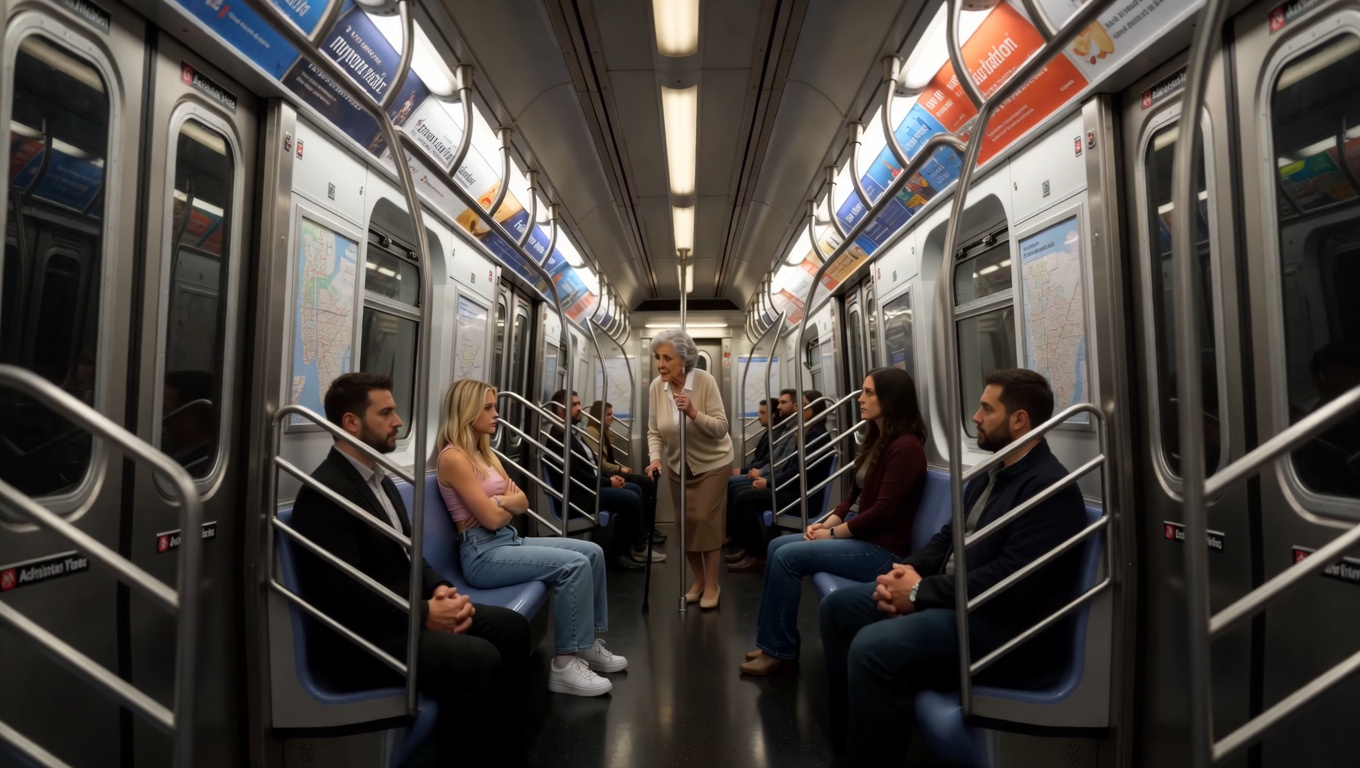
Emma had always believed the world owed her something.
It was 11:47 PM on a Thursday when she collapsed into the priority seat on the downtown train, earbuds in, arms crossed, daring anyone to challenge her. Her feet ached from back-to-back lectures and an evening shift at the campus coffee shop. “I earned this seat,” she told herself.
Then she appeared.
An elderly woman with silver hair pulled into a neat bun, wearing a simple beige cardigan and modest skirt. She moved slowly, one hand gripping the yellow rail for dear life as the train swayed. Her eyes scanned the car politely.
“Excuse me, dear,” the old woman said softly. “May I sit here?”
Emma didn’t even look up at first. “No. This is my seat. I’m exhausted from exams.”
The words left her mouth and immediately felt wrong. The car went quieter. A middle-aged man across the aisle shook his head. A young mother glared. The weight of their judgment pressed down on Emma like a physical force.
She kept her arms crossed, but her cheeks burned.
The elderly woman said nothing more. She simply lowered her head, looking smaller, frailer. The train jerked around a corner and the old woman nearly lost her balance.
That was the moment something cracked inside Emma.
She stood up so fast her bag fell to the floor. “Wait,” she said, her voice shaky. “You can have it. I’m sorry.”
The elderly woman looked surprised, then deeply grateful. As she sat down, she studied Emma with eyes that seemed far sharper than they first appeared.
For the next few stops, neither spoke. But when the train finally slowed at the last station, the old woman reached out and gently took Emma’s hand.
“Come with me, child,” she said. “I have something very important to show you.”
Emma should have said no. She should have gone home to her tiny studio apartment with the leaking ceiling and the eviction notice taped to the door. Instead, something in the woman’s voice made her follow.
They stepped off the train together.
Waiting at the curb wasn’t the expected taxi. A sleek black Maybach idled silently, driver standing at attention. Emma froze.
“What… is this?”
The old woman smiled for the first time — a small, knowing smile. “My name isn’t just Eleanor. It’s Eleanor Whitmore.”
The name hit Emma like a freight train.
Whitmore. As in Whitmore Industries. As in one of the wealthiest families in the state. As in the woman who had quietly donated millions to local universities and hospitals for decades without ever showing her face.
“You’re… that Eleanor Whitmore?”
Eleanor nodded as the driver opened the door. “My late husband and I never had children. I’ve spent years quietly looking for someone who still has a heart in this city. Someone capable of real kindness when no one is forcing them.”
They drove through the city and into the hills where the mansions began. Emma sat in stunned silence as they pulled up to an enormous gated estate with marble columns and perfectly manicured grounds.
Inside, Eleanor led her to a grand sitting room. On the table was a thick folder.
“I’ve been watching people for a long time,” Eleanor said. “Most would have stayed seated. You didn’t. That moment of guilt… that decision to stand up… it told me everything I needed to know.”
She opened the folder.
Inside were documents. A full scholarship to finish her degree with no debt. A trust fund. And most shockingly — a letter naming Emma as a potential heir, with conditions based on character, not blood.
“I’m dying, Emma,” Eleanor said quietly. “I have six months, maybe less. I need someone to carry forward what my husband and I built. Not just the money… but the decency.”
Tears streamed down Emma’s face.
She thought back to that moment on the train — the shame she felt when she refused to move. That single decision had changed the entire course of her life.
Six months later, Eleanor passed peacefully.
Emma stood at the funeral not as a broke college student, but as the new steward of the Whitmore Foundation. She still takes the train sometimes — not because she has to, but to remember where she came from.
And whenever she sees a tired elderly person standing, she always gives up her seat.
Because she now knows… you never know who you’re really sitting across from.