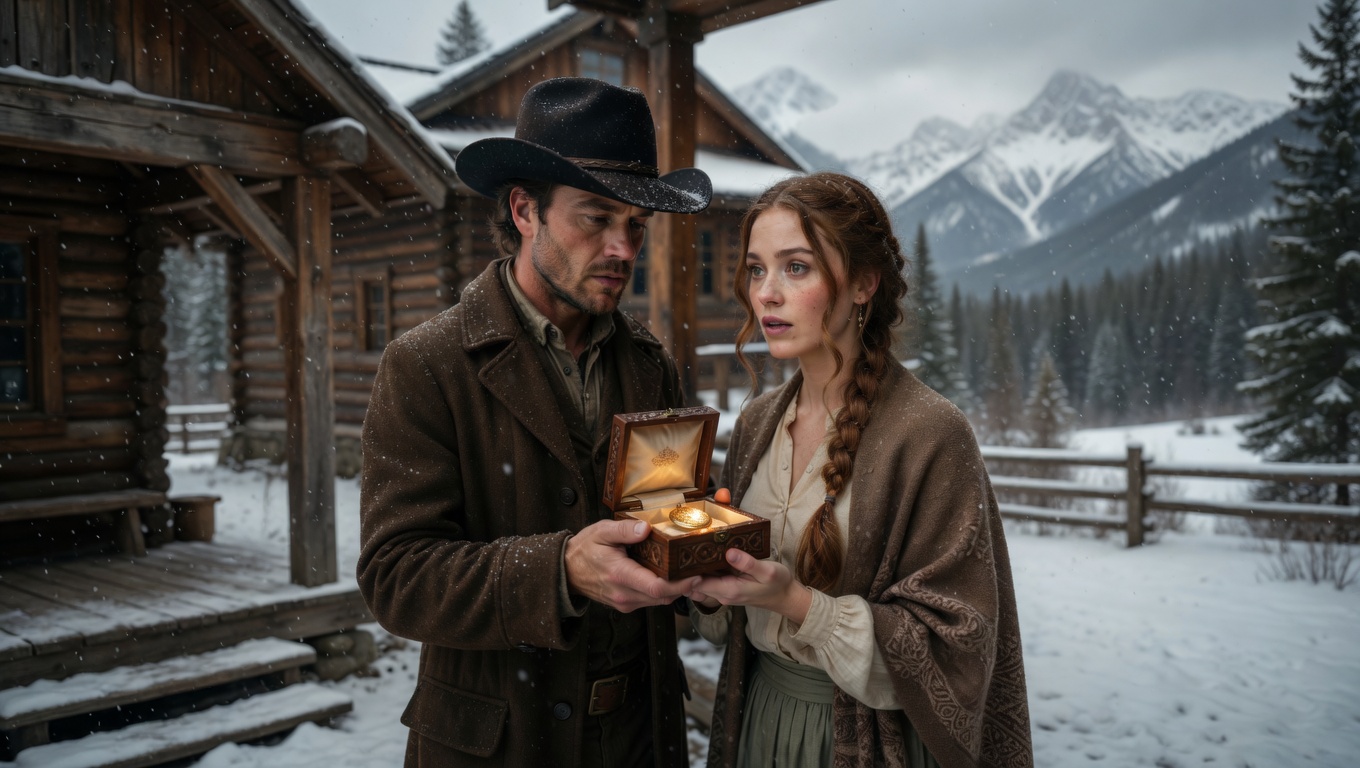
The Locket in the Snow
Clara Whitaker had kept her mother’s promise for five long years, and every one of them had felt like a quiet sentence.
The cabin sat high on the shoulder of Blackpine Ridge, where the wind never stopped whispering through the pines and the snow arrived each October like an old, unwelcome guest. It was a sturdy thing—hand-hewn logs, a wide porch that faced the jagged wall of the Rockies, a single woodstove that fought a losing battle against the high-country cold. Clara, twenty-six now, with her mother’s auburn braid and her father’s stubborn jaw, had learned to split kindling before breakfast, to read the sky the way other women read letters, and to live with a question that grew heavier every winter: Why?
On the night her mother died, the promise had been the last thing Margaret Whitaker asked of her. Fever-bright eyes, thin hand clutching Clara’s wrist, voice barely more than breath. “Never sell the cabin, Clara. Swear it on my soul. It isn’t just wood and stone. It’s… it’s everything I couldn’t tell you.” Then the hand went slack, and the only sound left was the wind rattling the windowpanes.
Clara had sworn. She had buried her mother in the small plot behind the cabin, planted wild lupine on the grave, and stayed. She sold the few head of cattle, took in mending and herbal remedies for the occasional trapper who passed through, and told herself the promise was enough. But some nights, when the lantern burned low and the mountains pressed close, she would open the small carved box her mother had kept under the bed. Inside lay a single sepia photograph of a man she did not recognize—broad shoulders, kind eyes, a faint smile that made something ache behind her ribs. On the back, in her mother’s careful hand: Thomas, 1897. Before the world took him.
She never understood. And the mountains kept their silence.
Then came the winter that changed everything.
It was late February, the kind of cold that made the trees groan. Snow fell in thick, silent curtains, turning the world into a watercolor of white and gray. Clara was on the porch, shaking snow from her shawl, when she heard it: the muffled crunch of hooves. A horse emerged from the trees, a deep-chestnut gelding with a white blaze down its face. On its back rode a man wrapped in a heavy oilskin coat, collar turned high, dark hat pulled low. He moved like someone who had traveled far and expected no welcome.
He reined in at the edge of the porch and looked at her for a long moment. Snow clung to his lashes. His face was weathered, perhaps forty-five, with the kind of eyes that had seen too many hard winters.
“Miss Whitaker?” His voice was low, roughened by wind and smoke.
Clara’s hand tightened on the porch rail. “Who’s asking?”
“Caleb Harlan.” He swung down from the saddle, boots sinking into the fresh powder. “I’ve come a long way to give you something that belongs to you. Something your mother waited twenty-eight years to see returned.”
Her heart gave one hard, painful thud. “My mother’s dead.”
“I know.” He reached into his coat and withdrew a small, beautifully carved wooden box, dark with age and polished by years of handling. Snowflakes melted the instant they touched the lid. “She made me promise I wouldn’t come until the time was right. Said I’d know when I saw you standing on this porch, lantern in hand, looking exactly like the girl she described.”
Clara stared at the box as though it might bite her. “I don’t know you.”
“No,” he said quietly. “But you knew my father.”
He opened the box.
Inside, nestled on dark velvet, lay a heavy golden locket the size of a silver dollar. It gleamed even in the gray light, catching the lantern’s flame like captured sunlight. Clara’s breath caught. She had never seen it before, yet something in her blood recognized it.
Caleb lifted it carefully and pressed the tiny catch. The locket sprang open.
On one side was a miniature portrait of the man from the photograph—Thomas—younger, laughing, eyes full of life. On the other side, folded so small it had survived decades, was a letter written in the same hand as the back of the photograph. And beneath the letter, pressed flat, a single lock of auburn hair tied with a faded blue ribbon.
Clara’s knees buckled. She caught the rail.
Caleb spoke before she could ask. “My father, Thomas Harlan, built this cabin with his own hands. For your mother. They were going to marry in the spring of ’97. But her family had already arranged a match with a man who could give them land and status. Your father.” He said the last two words gently, as though they might bruise. “Thomas left for the goldfields up north, thinking he could earn enough to change their minds. He never made it back. Avalanche took him that winter.”
Clara’s voice was barely a whisper. “My mother never spoke of him.”
“She couldn’t.” Caleb closed the locket with a soft click. “Your father found out about the pregnancy two months after the wedding. He was a hard man. Threatened to cast her out, to claim the child wasn’t his. So she made the only bargain she could: she would raise you as his daughter, keep this cabin as a monument to the love she lost, and never speak Thomas Harlan’s name again. In return, he let her live. But he made her swear the cabin would never be sold. He wanted the reminder of her shame to stand here forever.”
Clara felt the world tilt. The snow seemed louder now, each flake a small accusation.
Caleb continued, voice steady but kind. “Before he died, my father wrote this letter and gave the locket to a friend with instructions to deliver it when the child came of age. That friend was my mother’s brother. When he passed last year, the box came to me. I’ve been searching for you ever since.”
He held the locket out to her. “It’s yours, Clara. And so is the truth inside it.”
She took it with trembling fingers. The metal was warm from his body heat. She unfolded the letter.
My dearest Margaret,
If you are reading this, our child has grown and the mountains have kept you safe. I built this cabin for us, for the life we almost had. Every log, every nail, every stone in the hearth carries my love for you. If the world was cruel and you had to marry another, know that I never blamed you. I only pray our child knows joy. Tell her—or him—that the cabin, the land it sits on, and everything I left in the strongbox beneath the floorboards belong to our blood. The deed is hidden behind the third stone of the chimney. Sell nothing. Live free. And if the mountains ever feel too lonely, remember that love like ours does not end with snow.
Forever yours, Thomas
Clara read it twice. Then she sank onto the porch step, the locket clutched to her chest, and cried the way she had not cried since the day they lowered her mother into the ground.
Caleb did not speak. He simply sat beside her in the snow, the horse nickering softly behind them, and let the silence do what words could not.
When the worst of the tears had passed, Clara looked up at him. “You’re… my half-brother?”
Caleb gave a small, rueful smile. “By blood, yes. Though I reckon we’re strangers still. I have a wife and two boys down in the valley. But I promised my father’s memory I would see this done.”
She stared at the locket, then at the cabin that had been both prison and sanctuary. “All these years I kept a promise I didn’t understand. I thought I was honoring her. I never knew I was protecting me.”
Caleb nodded. “Sometimes the hardest promises are the ones that save us.”
They went inside together. By the light of the woodstove, Clara pried the third stone from the chimney with a poker. Behind it lay a narrow metal strongbox. Inside: the original deed to forty acres of prime mountain land, a small leather pouch of gold coins that had not seen daylight in nearly thirty years, and a second letter addressed simply To my child.
She read it aloud, voice shaking only a little. Thomas had written of dreams he never got to live, of the daughter he imagined would one day stand on this porch and feel the same wind he had felt. He had signed it Your father, who loved you before he ever saw your face.
Clara closed the box and looked at Caleb. The lantern light painted soft shadows across both their faces—two strangers bound by a love that had outlasted avalanches, lies, and decades of silence.
“I’m not selling the cabin,” she said. The words felt different now. Not a burden. A choice.
Caleb smiled. “Didn’t figure you would.”
Outside, the snow kept falling, blanketing the ridge in quiet mercy. Inside, the woodstove crackled and the locket lay open on the table between them, the tiny portrait of Thomas smiling at the daughter he had never held.
For the first time in five years, Clara Whitaker did not feel alone on Blackpine Ridge.
She felt claimed.
She felt home.
And somewhere in the wind that moved through the pines, she could have sworn she heard her mother sigh with relief at last.
Disclaimer: The video you watched and the story you just read is a fictional cinematic story created for entertainment purposes only. All characters and events are imaginary. It does not depict any real people or actual events.