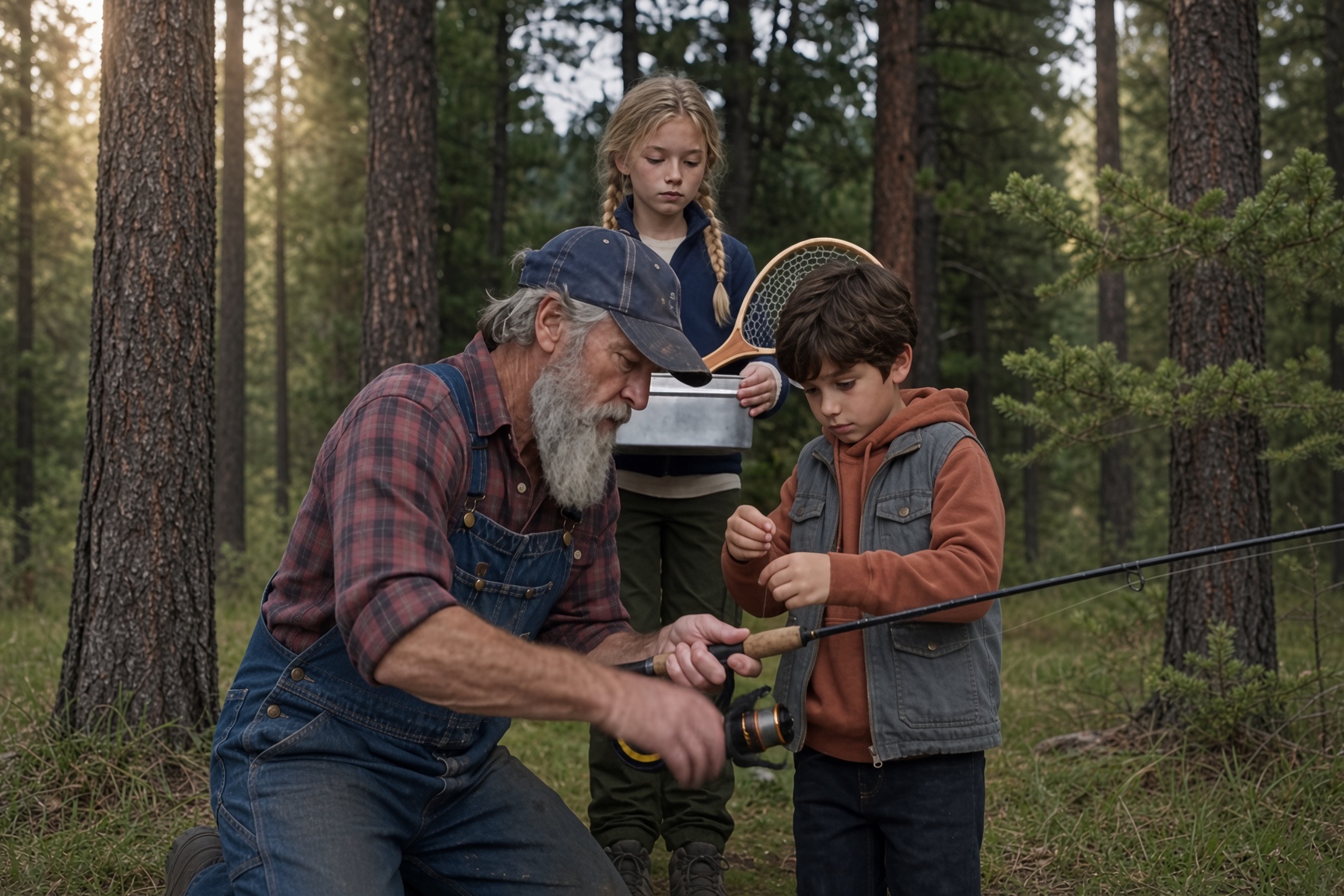
When three black gunboats cut across the lake to hunt an old surveyor, a grandfather triggers a hidden fortress to pull his two grandchildren out of the crosshairs.

THE BUTTON
Thomas Miller shoved his thumb into the center of the crimson switch.
The red dome sank flush into its brushed steel housing with a dull, heavy click.
For half a second, the house was dead silent, save for the wild gasps of the two children pressed against his denim overalls.
Then the timber rafters shrieked.
Deep within the cedar walls, four heavy pneumatic solenoid valves released with a sharp hiss of compressed nitrogen.
Steel drop-plates, half an inch thick and greased with graphite, plunged through internal channels inside the door frames.
The heavy oak front door slammed shut forever behind a sheet of cold-rolled armor with a concussive boom that rattled the glass in the wall sconces.
Across every lakeside window, rolling steel shutters dropped simultaneously from the lintels.
Thud. Thud. Thud.
Total darkness swallowed the hallway.
Only the crimson halo around the recessed button and the low amber filament of the hallway lantern remained.
Outside, tactical boots thundered up the wooden porch steps.
A mechanical battering ram struck the exterior planking of the front door.
The outer oak splintered with a sound like snapping bones, but the manganese steel armor plate inside didn’t even ring.
“Grandpa!” Clara cried, her two blonde braids brushing against his sleeve as her fingers dug into his plaid flannel shirt.
“Stay against the baseboard,” Thomas whispered, his voice steady as iron. “Both of you. Right now.”
Leo dropped to his knees, his brown eyes wide with terror, the orange hood of his sweatshirt pulled tight over his ears.
“Are they going to shoot through the wood?” Leo asked, his lower lip quivering.
“They’re going to try,” Thomas said. “And the steel will turn their lead to dust.”
THE HEARTH
A second blow shook the porch, followed by the high-pitched squeal of a diamond-tipped masonry saw biting into the frame.
They had twenty seconds before the intruders realized the door was a solid steel barrier.
Thomas stepped across the hallway into the open parlor, pulling both children by their collars.
The stone fireplace dominated the north wall, built from river stones he had dragged up from the lakeshore with a handcart eight summers ago.
He knelt in front of the cold hearth, ignoring the ache in his seventy-year-old knees.
He reached his hand directly into the soot of the chimney flue, finding the cast-iron damper control.
Instead of turning the flue open, he hauled the iron handle downward and twisted it forty-five degrees to the left.
A counterweight shifted behind the stone veneer with a grinding sigh of mortar and granite.
The bottom three courses of river stone swung inward on a hardened pivot axle, revealing a dark, square portal that smelled of cold clay and forgotten lime.
“Clara, feet first,” Thomas commanded gently, pointing a small brass flashlight into the shaft.
The girl hesitated, holding her small wooden landing net tightly against her ribs.
“Drop the net, sweetheart,” Thomas said.
“You carved it for my birthday, Grandpa,” she whispered, tears cutting pale trails through the lake dust on her cheeks.
“Take it then,” Thomas said, softening for a fraction of a second. “Slide down. It’s six feet to a cedar sawdust pit. It won’t hurt.”
Clara swung her legs into the stone opening, clutched the net against her chest, and let go.
A soft thump and a muffled gasp came from below.
“I’m down!” she called softly. “Leo, come on!”
Thomas grabbed Leo under the arms, lifting the boy off his feet.
“Down you go, buddy. Keep your knees bent.”
Leo dropped into the dark, landing squarely beside his sister.
Above their heads, a shaped breaching charge detonated against the steel window shutter in the parlor.
The concussion blew plaster from the ceiling, filling the hallway with a blinding cloud of white gypsum dust.
Thomas didn’t look back.
He grabbed a heavy canvas rucksack tucked beside the woodbox, threw it into the hole, and swung his long legs into the opening.
He caught the interior handle of the pivoting stone hearth, pulled the massive granite block shut until the latch engaged, and dropped into the cellar.
THE CELLAR BENEATH THE SLAB
The darkness down below was absolute until Thomas clicked on the flashlight.
The narrow beam cut through the sawdust haze, illuminating the raw concrete slab that supported the cabin above.
This wasn’t a standard root cellar.
The walls were reinforced with eight-inch cedar posts and heavy treated timber lagging, holding back tons of lakeside glacial till.
Racks of glass preserve jars—peaches, pickled beans, and venison—lined the western wall, completely undisturbed.
Beside the preserve shelves sat a wooden gun chest bound with iron straps.
Thomas set the flashlight on a cedar crate and flipped the padlock hasps on the chest.
Inside lay a stainless-steel lever-action carbine in .44 Magnum, three boxes of heavy flat-nosed cartridges, and two pairs of rubber-coated work gloves.
He levered six rounds into the tubular magazine with practiced thumb strokes, the mechanical clicks crisp and sure in the confined air.
“Grandpa,” Leo whispered, his hand reaching out to touch the heavy denim of Thomas’s bib overalls. “Who are those men?”
Thomas looked down at his grandson.
The boy was wearing the grey utility vest they had bought at the hardware store in town last spring, the pockets still bulging with lead sinkers and plastic bobbers.
“Men who work for a firm called Sentinel Maritime,” Thomas said, his voice flat. “Men who thought I took their secrets to the bottom of the lake twelve years ago.”
“Did you?” Clara asked, her blue eyes wide in the flashlight beam.
“No,” Thomas said, pulling a heavy brass cylinder from the false bottom of the gun chest and dropping it into his canvas pack. “I kept them right here.”
Above them, boots stomped across the pine floorboards.
Muffled voices shouted commands through the ventilation registers.
“The place is rigged!” a harsh voice barked from above. “The whole interior is clad in ballistic plate! Find the secondary egress!”
“They won’t find it from up there,” Thomas whispered. “Move.”
THE TIMBER TUBE
At the rear of the cellar, half-buried behind a stack of split oak firewood, lay the entrance to the outflow tube.
It was a forty-inch culvert of galvanized corrugated steel, installed thirty years earlier when the lake’s seasonal high-water line threatened the cabin’s footings.
It ran one hundred and twenty yards through the glacial moraine, terminating in a dense tangle of cedar and wild willow near the mouth of the western creek.
“On your hands and knees,” Thomas ordered, kneeling at the culvert’s mouth. “Clara first, then Leo. Keep your heads low.”
Clara crawled into the ribbed metal pipe without a word, dragging her net behind her.
Leo followed close behind, his boots scraping against the corrugated steel with a tinny rattle that set Thomas’s teeth on edge.
Thomas strapped the canvas pack to his shoulders, slid the lever-action carbine forward in his right hand, and squeezed into the culvert.
The air inside was cold, carrying the sharp mineral scent of wet galvanized zinc and dead leaves.
Behind them, a dull rumble echoed through the pipe as the intruders detonated a secondary breaching charge inside the cabin’s kitchen.
The shockwave pushed a cloud of stale, dry air through the culvert, fluttering the hem of Thomas’s flannel shirt.
“Keep moving,” Thomas hissed forward. “Don’t stop until you see the daylight.”
Leo was panting, his palms dragging through icy puddles that had pooled in the bottom ridges of the pipe.
“Grandpa, my knees are wet,” the boy whimpered.
“Cold water never killed a Miller,” Thomas said gently. “Ten more yards, Leo. Look for the green.”
Ahead, the mouth of the culvert appeared—a circle of pale grey light crisscrossed by the black, leafless branches of mountain alder.
Clara reached the opening first, pushing the branches aside with the handle of her wooden net.
She scrambled out onto the wet moss, followed immediately by Leo.
Thomas pulled his tall frame through the narrow opening, his knees sinking into the black mud of the creek bank.
He immediately hauled a bundle of cut cedar boughs over the mouth of the pipe, concealing the raw metal from anyone scanning the draw from above.
THE SMOKING RIDGE
They crouched in the shadow of a massive, moss-covered granite boulder that rose twelve feet out of the creek bed.
Above them, through the dense canopy of lodgepole pines, a thick column of black smoke rose into the overcast sky.
The cabin was burning.
The intruders had realized the interior was impenetrable from the outside and had poured accelerant through the eaves.
The dry cedar shakes were crackling with a distant, hollow roar that sounded like rushing water.
“Our house,” Clara breathed, tears spilling over her eyelashes. “Grandpa, they’re burning the house.”
“It’s just wood and stone, Clara,” Thomas said, his jaw tightening until the tendons stood out against his white beard. “We can fell more trees. We can’t replace you.”
He peered around the edge of the boulder, scanning the open water of the lake two hundred yards to the east.
Two of the black tactical gunboats remained anchored off the gravel point, their low-profile hulls idling with a dull, wet burble.
The third boat—the lead vessel that had beached itself directly on the pebbles—was empty, its bow grounded against the gravel bank where he and Leo had been fixing the reel twenty minutes ago.
Two masked operators stood on the shoreline, holding carbines at the ready, watching the treeline for movement.
A third operator was jogging down the porch steps of the burning cabin, holding a handheld thermal imaging unit to his face.
“They’ve got infrared,” Thomas muttered under his breath. “The smoke will blind them for five minutes, but once they sweep the creek bed, we’re lit up like lanterns.”
“What do we do?” Leo asked, clutching Thomas’s denim trouser leg.
“We go down the wash,” Thomas said. “The cold creek water masks our heat. We stay in the creek bed until we reach the old railway culvert.”
“The water is freezing, Grandpa,” Leo whispered.
Thomas reached into his coat pocket and pulled out his wool watch cap, pulling it down over Leo’s dark hair.
“Keep your head dry,” Thomas said. “The rest dries out when we reach Ellis.”
THE CREEK BED
The water in the creek came straight from the snowfields on the upper peak, clear as glass and cold enough to make the bones in Thomas’s ankles ache within three strides.
He held Leo by the hand, lifting the boy over the deeper pools where the water rose to the child’s waist.
Clara followed directly in his wake, stepping on the flat river stones, her wooden net tucked securely under her arm like a soldier’s rifle.
The creek ran through a deep, shaded ravine carved into the granite hillside, sheltering them from the line of sight of the burning cabin.
The sound of the roaring water drowned out their footsteps, but it also masked the approach of anything behind them.
Thomas stopped every twenty paces, raising his right hand for silence, his eyes searching the dark timber above the ravine walls.
He smelled the cordite before he saw the boots.
High on the western lip of the creek bank, thirty yards upstream, a twig snapped with a clean, sharp crack.
Thomas instantly shoved both children beneath the overhanging roots of a fallen hemlock.
He dropped to one knee in the freezing current, bringing the carbine to his shoulder, thumbing the hammer back into full cock.
Through the screen of dripping hemlock needles, he saw a black tactical boot step onto a mossy log on the ridge.
The operator was moving slow, his weapon held at the low-ready, his balaclava obscuring everything except a pair of pale, scanning eyes behind clear shooting glasses.
On the sleeve of his black assault jacket was a velcro patch: a stylized silver trident inside a broken red gear.
Trident Maritime Security.
The private contractors who had run the offshore supply lines when Thomas was chief surveyor for the Northern Basin project.
The man paused, his head turning slowly toward the creek.
He raised a small, black radio to his collar.
“Sweeper Three,” the operator spoke, his voice carrying clearly over the rush of the water. “Negative visual at the creek mouth. Thermal unit is washed out by the fire. Expanding perimeter toward the old rail bed.”
A burst of static answered him, followed by a clipped, metallic voice: “Do not lose them. The old man has the physical ledger. Command wants the drives recovered before local law gets the fire call.”
“Copy that,” the operator said.
He stepped off the log, his boots crunching into the dry pine needles as he moved parallel to the creek, heading directly toward the railway crossing.
Thomas lowered the hammer of the carbine with his thumb, his breath coming in a long, silent plume of white mist.
“They’re heading for the tracks,” Thomas whispered, turning back to the children under the roots. “They know the geography.”
“Who is Ellis, Grandpa?” Clara asked, shivering violently, her teeth chattering against each other.
“An old man who owes me forty dollars and his life,” Thomas replied. “Now get out of the mud. We have to beat that patrol to the hydro siding.”
THE ABANDONED LINE
They climbed out of the creek bed two hundred yards below the cabin, scrambling up a steep bank of loose shale and wet ferns.
At the top of the embankment lay the roadbed of the abandoned timber railway that had once hauled old-growth fir to the mills on the coast.
The steel rails had been pulled up forty years ago for scrap, leaving a flat, gravel path that wound through the dense secondary growth of the valley floor.
The gravel was grey river stone, crunching softly under their boots.
Thomas kept the children off the centerline of the path, forcing them to walk along the soft, mossy verge where their footprints were swallowed by the forest floor.
The rain began to fall in earnest now—a cold, heavy mountain downpour that hammered against the pine canopy and beat down the smoke rising from the ridge behind them.
Leo was lagging, his small boots heavy with mud, his breathing ragged and shallow.
Thomas stopped, slung the carbine across his chest on its leather strap, and swung the boy up onto his broad shoulders.
Leo wrapped his cold arms around Thomas’s neck, burying his face into the rough wool collar of his grandfather’s flannel shirt.
“Hold on tight, buddy,” Thomas said. “Clara, stay on my right hip. If I drop, you drop.”
“I’m right here, Grandpa,” she said, her voice small but steady.
They moved at a fast, ground-eating march along the rail bed.
To their left, the hillside rose steeply into jagged limestone cliffs; to their right, the forest sloped down toward the marshy northern shallows of the lake.
Two miles down the track, the tree line gave way to a rusted chain-link fence topped with three strands of corroded barbed wire.
Behind the fence stood the concrete bulk of the old hydro station—a two-story fortress of rough-cast concrete built in the 1930s to power the timber flumes.
A rusted sign hung crooked from the gate:
NORTHERN BASIN HYDRO ELECTRIC – DECOMMISSIONED 1984 – NO TRESPASSING.
The gate was secured with a modern, heavy brass padlock.
Thomas didn’t touch the lock.
He walked twenty feet down the fence line to where a section of chain link had been sliced clean and reattached with rusted copper wire.
He untwisted the wire with his gloved fingers, peeled the fence back like an iron curtain, and ushered Clara through.
THE HYDRO PLANT
The interior of the hydro station smelled of damp concrete, dead grease, and sixty years of bat guano.
The central hall was fifty feet wide, dominated by two massive cast-iron turbine housings that rose from the floor like the shells of prehistoric beetles.
Rainwater dripped from the broken glass of the high clerestory windows, pattering onto the grease-stained concrete floor.
“Ellis!” Thomas called out, his voice sharp and low, echoing off the high brick walls.
Silence answered him, save for the dripping rain and the distant hum of the wind through the broken glass.
Thomas pulled Leo down from his shoulders, setting the boy on a wooden crate beside a dormant generator shaft.
He unslung the carbine, thumbed the safety off, and stepped toward the wooden office partitioned off in the corner of the turbine hall.
The door of the office was made of tongue-and-groove fir, weathered to a pale drift-wood grey.
A faded cardboard calendar from 1991 hung beside the doorknob.
Thomas knocked three times with the butt of the rifle: two fast raps, a pause, then one heavy strike.
The door swung inward six inches.
The twin barrels of a twelve-gauge side-by-side shotgun poked through the gap, leveled squarely at Thomas’s chest.
Behind the steel barrels stood an old man in a greasy wool sweater, his eyes bloodshot and watery behind wire-rimmed spectacles, a cigarette dangling unlit from his lip.
“You’re tracking mud on my porch, Thomas,” the old man said, his voice like gravel grinding in a bucket.
“Lower the iron, Ellis,” Thomas said, exhaling slowly. “They burned the cabin.”
Ellis Rowe lowered the barrels of the shotgun, his gaze darting past Thomas to the two children shivering beside the turbine housing.
“Sweet mother of mercy,” Ellis muttered, pushing the door wide. “You brought the babies into it.”
“They brought themselves into it,” Thomas said, waving Clara and Leo inside. “Three black gunboats on the water. A full retrieval team.”
“Trident?” Ellis asked, shutting the door and throwing a heavy sliding bolt into place.
“Trident,” Thomas confirmed. “They want the surveyor’s logs from the north tunnel.”
THE SAFE ROOM
The office was warm, heated by an ancient potbelly stove that glowed cherry-red in the gloom.
A battered teakettle hissed on the iron plate, filling the small room with the smell of boiling pine needles and chicory.
Ellis immediately pulled two dry wool blankets from a cot in the corner and wrapped them around Clara and Leo.
He pulled a wooden stool over for Leo, setting the boy’s soaking boots beside the ash pan of the stove.
“Sit, boy,” Ellis said, his rough hands surprisingly gentle as he tugged the wet socks from Leo’s feet. “Get your toes to the iron.”
He looked up at Clara, who still clutched her wooden fishing net with white knuckles.
“You catch anything with that today, little girl?”
“Just water,” Clara said quietly. “And then the boats came.”
“Well, water’s better than nothing,” Ellis said with a dry chuckle.
He turned back to Thomas, his face hardening as he reached for an iron poker to stir the coals.
“How much time do we have?”
“Ten minutes,” Thomas said, unzipping the canvas rucksack and pulling out the brass cylinder. “Maybe fifteen if the rain keeps washing out their boots. They have thermal scopes, Ellis. They know we’re on foot.”
Ellis stared at the brass cylinder on the desk.
It was ten inches long, four inches thick, with threaded bronze end-caps sealed with red sealing wax.
Inside were three micro-cassettes and forty pages of hand-drawn engineering schematics detailing the illegal disposal of industrial toxins in the mountain aquifer twelve years ago—the project that Trident had been paid forty million dollars to conceal.
“I told you to burn that brass ten years ago, Tom,” Ellis whispered.
“If I burned it, they would have killed me the next morning,” Thomas said. “A dead man with a secret is useless. A living man with a dead-man’s switch stays alive.”
“Well, your switch just popped,” Ellis said. “They ain’t here to talk terms. If they’re using tactical boats in daylight, they’ve already bought the regional dispatch.”
“The county sheriff in Oakhaven won’t take their money,” Thomas said.
“Oakhaven is twenty miles down the river road,” Ellis countered. “The bridge at Cutter’s Creek washed out in the spring thaw. The only way out of this valley is through the railway cut, and they’ll have an assault team waiting at the trestle.”
“Then we don’t take the road,” Thomas said.
He walked over to the back window of the office, which looked out over the deep concrete flume that ran behind the power station.
“We take the work skiff,” Thomas said.
THE SLUICE GATE
Behind the powerhouse, the concrete flume plunged four hundred yards down a steep granite gorge to the lower river.
In the old days, it had carried timber logs and maintenance crews between the upper lake and the downstream sorting ponds.
Resting on a pair of wooden skids beside the dry flume sat a sixteen-foot river skiff built of heavy riveted aluminum.
Its stern was fitted with a forty-horsepower tiller-steered outboard engine, the propeller protected by a welded steel rock-cage.
Ellis shook his head slowly.
“The flume is dry, Tom,” Ellis said. “The sluice gates have been rusted shut since ninety-four. If you drop that boat in there, you’ll slide fifty feet and smash into the iron trash racks.”
“Then we open the sluice,” Thomas said.
“The winch is electric,” Ellis spat. “The grid went down here twenty years ago. The only thing that turns those gears is the emergency diesel generator in the lower bay.”
“Does it run?”
Ellis paused, chewing on his unlit cigarette.
“I cranked it last Tuesday,” he admitted. “Got twenty gallons of filtered fuel in the day-tank. But the starter solenoid is sticky. You have to jump the contacts with a screwdriver while somebody holds the throttle rack open.”
“Show me,” Thomas said.
He turned to the children.
“Clara, you stay right beside this stove. Leo, keep your boots by the heat until they stop steaming. If you hear shooting, you crawl under that iron cot and you don’t make a sound.”
Clara looked at him, her eyes dark and serious.
“Don’t let them hurt you, Grandpa,” she whispered.
Thomas knelt, pulling both of them into his arms, his rough white beard scratching against their cheeks.
“I’ve survived sixty-eight years of timber, ice, and river water,” he said softly. “A few men in black pajamas aren’t going to change that. Now stay low.”
THE LOWER BAY
The generator bay was located beneath the main turbine floor, accessible only by a narrow spiral staircase of perforated iron.
The air down here was freezing, smelling of stale diesel fuel and battery acid.
In the center of the concrete room sat a massive six-cylinder diesel engine painted faded industrial yellow, connected by a thick driveshaft to an ancient alternator.
Ellis limped across the floor, carrying a battered toolbox and a grease-stained flathead screwdriver.
“Here’s the solenoid,” Ellis pointed to a cylindrical starter motor mounted low on the engine block. “The copper terminals are pitted to hell. I’ll hold the governor rack forward with the pliers. When I yell, you bridge those two brass lugs with the screwdriver.”
“Got it,” Thomas said, kneeling on the damp concrete.
From the floor above, the sharp crack of a rifle shot echoed down the iron stairwell.
The glass in the office window shattered with a sound like ringing silver.
“They’re here,” Ellis hissed, his hands trembling slightly as he clamped a pair of vice-grips onto the diesel fuel linkage.
“Don’t think about the noise,” Thomas commanded. “Focus on the rack. Ready?”
“Ready!” Ellis barked.
Thomas jammed the broad blade of the screwdriver across the heavy copper terminals of the starter.
A brilliant shower of blue-white electrical sparks erupted in the gloom, illuminating the concrete walls with strobe-like intensity.
The starter motor groaned, its heavy bendix drive slamming into the flywheel teeth with a violent metallic clack.
The engine cranked slowly:
Chug… chug… chug…
“More fuel!” Thomas yelled over the screech of the starter. “Give her the rack!”
Ellis hauled back on the vice-grips.
The diesel coughed, spat a ring of black soot from its rusted exhaust manifold, and caught with a deafening roar that shook the concrete under their knees.
The room filled instantly with the sweet, oily smell of burning diesel exhaust.
Above their heads, the drive belts began to sing as the generator spun up to eighteen hundred revolutions per minute.
On the wall panel, an ancient needle gauge surged from zero into the green band: two hundred and forty volts.
“She’s up!” Ellis shouted, his face split by a wild, toothless grin. “The board is live!”
THE WINCH
They scrambled back up the iron stairs into the main turbine hall.
A volley of automatic gunfire was tearing through the upper windows of the powerhouse.
Rounds struck the iron casing of the turbines, ricocheting with terrifying, high-pitched whines that filled the hall with the scent of pulverized copper and lead.
Two operators were on the catwalk outside the high eastern windows, their silhouette dark against the rain-swept sky.
Thomas brought the lever-action carbine up, resting the stainless barrel against an iron pillar.
He aligned the brass bead on the lower frame of the window and squeezed the trigger twice.
The .44 Magnum barked with a deep, authoritative boom.
The heavy lead rounds tore through the window framing, shattering the remaining glass and sending the two operators scrambling back into the shelter of the concrete parapet.
“Go to the sluice console!” Thomas yelled to Ellis. “Get the water flowing!”
Ellis sprinted across the turbine hall toward a rusted iron pedestal near the river-side doors.
He slammed his palm down on a large black lever and hauled it upward.
Across the room, an electric motor groaned into life, turning a massive set of cast-iron spur gears that had been greased with tallow forty years ago.
Outside, the heavy steel sluice gate—twenty feet wide and six feet high—began to rise from the bottom of the lake canal.
A wall of dark, foam-flecked lake water surged under the gate with a deafening roar, pouring into the dry concrete flume like a brown freight train.
The concrete walls of the building vibrated under the hydraulic fury of forty thousand gallons of water rushing through the channel.
“The flume is charging!” Ellis screamed, coughing violently from the diesel smoke drifting up from the cellar. “Get the kids in the boat!”
THE FLUME
Thomas kicked open the office door.
Clara and Leo were huddled beneath the iron cot, their eyes wide as saucers in the dim light.
“Out!” Thomas shouted. “Right now!”
He grabbed Leo with one arm and hauled Clara to her feet with the other.
They ran across the slippery concrete of the turbine hall toward the slipway doors.
Outside, the rain was falling in sheets, but the concrete flume was now a boiling torrent of whitewater, rushing downward at twenty knots toward the river below.
The aluminum skiff sat on its timber skids at the edge of the flume, held in place by a single three-quarter-inch manila rope looped around an iron bollard.
Thomas dropped Leo into the center bench of the boat.
“Get on the floorboards! Lay flat!”
He lifted Clara over the gunwale, dropping her beside her brother.
She still had her wooden landing net in her hand.
“Hold onto the bench ribs!” Thomas told her. “Don’t let go, no matter how much water comes over the side!”
He turned back toward the powerhouse door to call Ellis.
An operator in black tactical gear stepped through the broken side entrance of the hall, his carbine leveled at the skiff.
Ellis Rowe stepped between the operator and the boat, raising his double-barreled ten-gauge shotgun with both hands.
“Get off my river, you bastard!” Ellis roared.
The operator fired a three-round burst.
The rounds punched into Ellis’s chest, driving the old man backward against the concrete wall of the slipway.
As he fell, Ellis pulled both triggers of the ten-gauge.
The massive blast of buckshot tore the operator off his feet, shredding the sheet-metal doorframe and hurling the man backward onto the broken glass of the turbine floor.
“Ellis!” Thomas yelled, lunging forward.
Ellis lay against the concrete, blood pooling dark on his grey wool sweater, his breathing wet and broken.
He looked at Thomas, his eyes swimming behind his cracked spectacles.
“Cut the rope, Tom,” the old man wheezed, blood bubbling at the corner of his mouth. “Cut the damn rope and go.”
“I can carry you,” Thomas said, reaching for his friend’s shoulder.
“You can’t carry dead weight down a whitewater flume,” Ellis whispered, his hand weakly shoving Thomas’s chest toward the skiff. “Take the little ones. Tell your daughter… I kept the lights on.”
A second team of operators was already rounding the north corner of the building, their boots splashing through the mud.
Thomas looked down at his oldest friend, his heart tearing in two.
He drew his pocketknife, severed the three-quarter-inch manila rope in a single, vicious stroke, and vaulted over the gunwale of the skiff.
THE DROP
The skiff slid off the greased timber skids and dropped into the roaring torrent of the flume with a bone-jarring crash.
The cold water grabbed the aluminum hull, accelerating the sixteen-foot boat instantly down the forty-degree concrete incline.
The speed was terrifying.
The grey concrete walls of the flume blurred past on either side, three feet from the gunwales, throwing blinding sheets of spray over the bow.
Thomas threw his weight against the long tiller arm of the outboard, keeping the boat centered in the violent V-shaped trough of the current.
Above them, on the catwalk of the powerhouse, an operator fired a volley down the flume.
Rounds pinged off the concrete walls and skipped across the boiling surface of the water, but the speed of the drop was too great.
Within four seconds, the powerhouse was two hundred yards behind them, swallowed by the mist and the spray.
Ahead lay the exit.
The concrete flume terminated ten feet above the surface of the Blackwood River, launching the water out into a wide, foaming cascade over the rocks.
“Brace!” Thomas screamed over the roar of the water. “Brace yourselves!”
Leo and Clara curled into balls against the aluminum ribs of the hull, burying their faces into the canvas life jackets Thomas had shoved between them.
The skiff shot out into open air.
For a single, breathless second, the boat hung suspended above the river, grey sky above, boiling brown water ten feet below.
Then gravity took them.
The flat aluminum bottom slammed into the river current with a concussive shock that knocked Thomas to his knees.
Water poured over the transom, filling the bottom of the boat to their shins.
The hull spun ninety degrees in the current, caught an eddy behind a massive granite boulder, and righted itself.
Thomas scrambled to his feet, lunging for the pull-cord of the forty-horsepower outboard.
He hauled back on the rope with everything he had.
The engine sputtered once, coughed a plume of blue smoke, and roared to life.
Thomas shoved the throttle arm wide.
The propeller bit into the deep water of the river, and the skiff surged forward, cutting through the standing waves of the rapids, heading downstream toward the county line.
THE RIVER CHASE
The Blackwood River was running high and wild, swollen by the autumn rain and choked with drift timber from the upper logging cuts.
Thomas worked the tiller with his left hand, his right hand gripping the carbine, his eyes scanning the grey riverbanks ahead.
Behind them, through the mist that hung over the water, came the deep, supercharged roar of marine engines.
One of the black tactical gunboats had bypassed the flume, navigating the shallow outlet from the lake, and was now entering the river channel three hundred yards behind them.
The gunboat was faster—twin inboard diesels pushing a stepped fiberglass hull that skimmed across the chop like an arrow.
A mounted searchlight on the gunboat’s cabin flashed to life, its blinding white beam cutting through the rain and locking onto the aluminum skiff.
“Grandpa!” Clara screamed, looking back over the stern. “They’re coming!”
“Keep your heads down!” Thomas shouted back. “Clara, hold your brother’s hand!”
A burst of automatic fire kicked up twin spouts of water six feet off their port side.
They were trying to disable the outboard.
If a single round cracked the cast-iron cylinder head of the engine, the current would drag them into the log jams at Devil’s Elbow within two minutes.
Ahead, the river split around a long, gravel island overgrown with willow and black cottonwood.
The main channel went right—broad, deep, and clear.
The left channel was a narrow chute, choked with deadfall and half-submerged boulders that local fishermen avoided even in high water.
Thomas didn’t hesitate.
He hauled the tiller hard to port, sending the skiff skidding across the surface of the river, straight into the narrow chute.
THE CHUTE
The willow branches whipped across the gunwales, tearing at Thomas’s flannel shirt and stinging his face.
The water was shallow here—barely three feet over a bed of jagged river rocks that scraped against the aluminum bottom with a sickening grind.
Behind them, the tactical gunboat followed, its deep V-hull drawing four feet of water.
The gunboat’s searchlight was blinding, reflecting off the wet willow leaves in a dizzying storm of green and white glare.
The operator at the bow raised a heavy semi-automatic rifle, aiming for the back of Thomas’s head.
Thomas saw what the operator couldn’t see through the spray.
Ten yards ahead, a massive spruce log lay pinned across the channel, six inches below the surface of the boiling current.
It was an old deadhead—a waterlogged trunk, four feet thick, anchored to the river bottom like an anvil.
The light aluminum skiff, drawing only eight inches of water on plane, skipped over the log with a violent shudder that launched the boat two feet into the air.
The heavy gunboat, weighing four tons and traveling at thirty-five knots, hit the submerged trunk dead center.
The impact was catastrophic.
The fiberglass keel shattered against the petrified wood with the sound of an exploding mortar.
The gunboat’s stern lifted into the air, its twin props screaming as they spun free of the water, before the vessel rolled violently onto its starboard side.
The boat smashed into the bank of the gravel island, its superstructure tearing away against the cottonwood trunks in a spray of fiberglass, fuel, and black water.
A secondary explosion ignited the fuel lines, sending a column of orange fire roaring into the rain.
Thomas didn’t look back.
He throttled the engine down to half-speed, navigating the remaining rocks of the chute until the boat spilled out into the calm, deep waters of the lower basin.
THE HIGHWAY BRIDGE
Two miles downstream, the forest receded, replaced by the open pastureland and barbed-wire fences of the river valley.
Ahead rose the concrete piers of the State Route 9 bridge—the primary arterial connecting the mountain timber towns to the state capital.
Traffic was moving across the span: logging trucks, farm pickups, and school buses, their yellow headlights reflecting on the wet asphalt.
Civilization.
Public ground.
Thomas cut the throttle, letting the skiff glide into the soft mud beneath the northern bridge abutment.
The engine died with a soft gurgle of cooling water.
The only sound was the steady hiss of tires on the wet pavement fifty feet above their heads and the soft, exhausted sobbing of the two children in the bottom of the boat.
Thomas stood up, his legs shaking with a deep, bone-weary fatigue that had nothing to do with his age.
He reached down and lifted Leo into his arms.
The boy was shivering uncontrollably, but his eyes were clear, his arms wrapping tightly around Thomas’s neck.
“We’re here, Leo,” Thomas whispered. “We’re out of the woods.”
He turned to Clara, holding out his hand.
The girl took it, stepping over the aluminum bench, her wooden landing net still held firmly in her left hand.
“Where are we going now, Grandpa?” she asked, her voice cracking with the cold.
“Up to the road,” Thomas said, pulling the heavy brass cylinder from his rucksack. “To find a state trooper who isn’t on a private payroll.”
THE SHERIFF’S CRUISER
They climbed the muddy embankment to the highway shoulder just as a county sheriff’s cruiser was pulling onto the bridge from the north approach.
The cruiser’s spotlight caught them in its beam—an old man with a bloodstained shirt and a white beard, carrying a small boy, flanked by a young girl with blonde braids and a wooden fish net.
The cruiser stopped instantly, its red and blue lights flashing to life across the wet guardrail.
A deputy stepped out into the rain, his hand resting on the holster of his service pistol, his face tight with suspicion.
“Step away from the rail, sir!” the deputy shouted over the traffic noise. “Put your hands where I can see them!”
Thomas didn’t raise his hands.
He set Leo gently on the gravel shoulder, took two steps forward, and set the heavy brass cylinder on the hood of the patrol car.
“My name is Thomas Miller,” he said, his voice carrying clearly through the mountain wind. “I am the former chief surveyor for the Northern Basin project.”
The deputy paused, his eyes flicking from the brass cylinder to the old man’s face.
“Miller?” the deputy said, lowering his hand from his holster. “We got a nine-one-one call twenty minutes ago about a massive structure fire up at Blackwood Lake. They said there was automatic gunfire.”
“The fire was set by Trident Security,” Thomas said, pointing back toward the mountain ridge. “They killed Ellis Rowe at the hydro plant. And they tried to kill these two children.”
The deputy’s face went pale.
“Trident? Sir, that’s a licensed state infrastructure contractor—”
“Open the cylinder, son,” Thomas commanded, his voice carrying the authority of forty years on the river. “Inside are the original manifests for the toxic dumps in the upper aquifer, signed by the regional director and countersigned by three members of the state procurement board. The men who burned my house are thirty minutes behind us. Call the State Police. Call the Attorney General. And get these kids some dry clothes.”
The deputy stared at Thomas for three seconds.
Then he reached for the radio mic clipped to his shoulder.
“Dispatch, this is Unit Four,” the deputy said, his voice shaking slightly. “I need all available units and an emergency medical rig to the Route Nine river bridge. Code Three. We have a mass casualty situation and state-level evidence in custody. Move.”
THE PRECINCT
By midnight, the briefing room of the State Police Barracks in Oakhaven was filled with smoke, coffee steam, and fifty armed troopers in tactical gear.
On the large projector screen at the front of the room, the contents of the brass cylinder were displayed in stark, high-resolution scans:
CONTRACT 88-B: NORTHERN BASIN REMEDIATION.
AUTHORIZED EXPENDITURE: $42,000,000.
DISPOSAL SITE: UNRECORDED AQUIFER SHAFTS 4 THROUGH 9.
SIGNATURE: GABRIEL STONE, MANAGING DIRECTOR, TRIDENT MARITIME.
Two federal prosecutors from the capital were already at the conference table, their phones ringing continuously as emergency warrants were signed by a federal magistrate in the middle of the night.
In the corner of the room, on an old leather sofa, Clara and Leo were asleep beneath two heavy wool police blankets.
Leo’s wet boots were sitting beside the radiator, completely dry now, his small fishing rod leaning against the wall beside them.
Clara’s hand was draped over the wooden handle of her net, even in her sleep.
Thomas sat at the table in a borrowed dry flannel shirt, a thick ceramic mug of black coffee between his calloused hands.
A state investigator sat opposite him, taking notes on a yellow legal pad.
“They’ve already arrested Gabriel Stone at his estate in the capital,” the investigator said quietly. “The coast guard intercepted the remaining two gunboats at the south lake narrows an hour ago. The operators are in federal holding.”
Thomas took a slow sip of the coffee, feeling the heat spread into his aching shoulders.
“What about Ellis?” Thomas asked.
The investigator looked down at his legal pad, his face grim.
“The recovery team found him in the turbine hall,” the investigator said. “He was dead before the fire brigade reached the siding. But he took down two of their shooters, Thomas. He held that door.”
Thomas closed his eyes.
He saw the old man standing in the smoke with the ten-gauge, spitting his unlit cigarette onto the concrete.
“He always was stubborn,” Thomas murmured. “He never did like people tracking mud on his floor.”
THE MORNING AFTER
The sun came up cold and bright over the valley, burning off the river mist and painting the snowy mountain peaks in shades of pale rose and gold.
Thomas stood on the front steps of the county courthouse, holding Leo’s hand.
Clara walked beside them, wearing a new blue fleece jacket bought from the local general store, her blonde braids freshly tied by the county nurse.
A dozen reporters and television cameras were gathered at the foot of the steps, held back by a line of state troopers with wooden batons.
Microphones were thrust into Thomas’s face as they reached the bottom step.
“Mr. Miller! Is it true Trident was operating an illegal disposal site for ten years?”
“Mr. Miller! Did the company attempt to assassinate your family to keep this quiet?”
“Are you going to testify before the grand jury on Monday?”
Thomas stopped.
He looked at the sea of lenses, then looked down at his two grandchildren.
“I am going to buy these children some breakfast,” Thomas said, his voice cutting through the clamor of the press corps like a bell. “Then I am going to buy two boxes of framing nails and a fresh spool of eight-pound fishing line.”
“Are you going back to the lake?” a reporter shouted.
Thomas looked up at the mountains, where a thin thread of smoke was still drifting from the distant ridge.
“The lake belongs to the people who live on it,” Thomas said quietly. “Not the people who buy it.”
THE NEW DOCK
Two months later, the ice was beginning to form along the edges of Blackwood Lake.
On the point where the old cabin had burned, a new timber frame rose against the pines—rough-sawn hemlock beams and green fir rafters, smelling of fresh sawdust and resin.
The ground had been cleared of soot and twisted iron, the soil leveled and packed with clean crushed granite.
Down at the shoreline, the old wooden dock had been repaired with new cedar planks.
Thomas knelt at the edge of the dock, wearing his old denim overalls with a fresh pair of leather work gloves.
He was holding the tip of a light fiberglass fishing rod, guiding Leo’s hands as the boy threaded a small lead weight onto the line.
Clara sat on an upturned wooden bucket nearby, her feet dangling over the clear water, her wooden net resting across her knees.
“Now pull it tight, Leo,” Thomas said, his voice patient and warm in the cold morning air. “Not too hard or you’ll kink the mono. Just enough to seat the knot.”
Leo pulled the line, his small tongue tucked into the corner of his mouth with intense concentration.
The knot seated perfectly against the eye of the hook.
“I got it, Grandpa!” the boy beamed, holding the rod up into the winter sunlight. “Look! It’s tight!”
“Good knot, buddy,” Thomas smiled, patting the boy’s shoulder. “That’ll hold a five-pound lake trout all day long.”
Across the water, the lake was peaceful and vast, the mountains mirrored perfectly in the dark, still surface.
No engines broke the silence.
No wakes cut across the mirrored water.
Just the wind in the hemlocks, the faint lap of the current against the cedar pilings, and the steady, rhythmic sound of an old man teaching his grandchildren how to hold the line.
—
DISCLAIMER
This is an original work of fictional entertainment. All characters, names, tactical security groups, maritime contractors, government entities, and events depicted are entirely products of the author’s imagination or used fictitiously. Any resemblance to real persons, living or dead, or to actual commercial organizations, private military companies, or law enforcement procedures is strictly coincidental. This text does not constitute legal, tactical, survival, or emergency response instruction.