We have all experienced that specific Sunday afternoon frustration. You pull out a ripe heirloom tomato, set it on your cutting board, and press your chef knife down—only to watch the blade squish the skin flat, spewing seeds everywhere instead of making a clean slice. Actually, reaching for the best kitchen knife sharpener is the single most important cooking upgrade you can make this year.
Most home cooks assume that fancy Japanese steel or expensive German cutlery stays razor-sharp forever on its own. However, microscopic friction against cutting boards and tough ingredients quickly curls that delicate metal edge out of shape. Consequently, your culinary prep work morphs from a soothing ritual into a dangerous wrestling match.
Why a Dull Blade Is Your Kitchen’s Biggest Hazard
It sounds counterintuitive, but dull blades cause far more emergency room visits than razor-sharp ones. When your knife is blunt, you must apply heavy downward force to wedge the steel through raw sweet potatoes or thick squash. As a result, the blade easily skitters off slick surfaces and heads straight for your knuckles.
A razor-sharp edge requires almost zero muscle. The weight of the knife and a gentle draw stroke should do all the heavy lifting for you. Furthermore, clean cuts keep cellular walls intact, which means your chopped onions release significantly fewer sulfur gases to make you weep at the counter.
Honing Steel vs. Knife Sharpener: What Is the Difference?
Before you run out and spend your hard-earned cash on new tools, let us clear up a massive misconception that trips up almost everyone. That long, grooved metal wand sitting inside your wooden knife block is technically not a sharpener at all. It is a honing steel, and it performs a completely different task.
Every time you chop on wooden or composite boards, the microscopic “teeth” of your blade get pushed out of alignment. Honing simply nudges those tiny teeth back into a straight line without removing any real metal. On the other hand, genuine sharpening grinds away microscopic shavings of steel to create a fresh, brand-new cutting edge.
For instance, think of honing like brushing your teeth every single morning, while sharpening is like heading to the dentist for an annual deep cleaning. You should hone your primary prep knife once a week, but you only need to run it through a full sharpener two to three times a year.
The 3 Main Types of Knife Sharpeners Compared
Finding the right sharpening setup depends entirely on your personal budget, your patience level, and the specific steel sitting in your drawers.
1. Handheld and Pull-Through Sharpeners ($15 – $45)
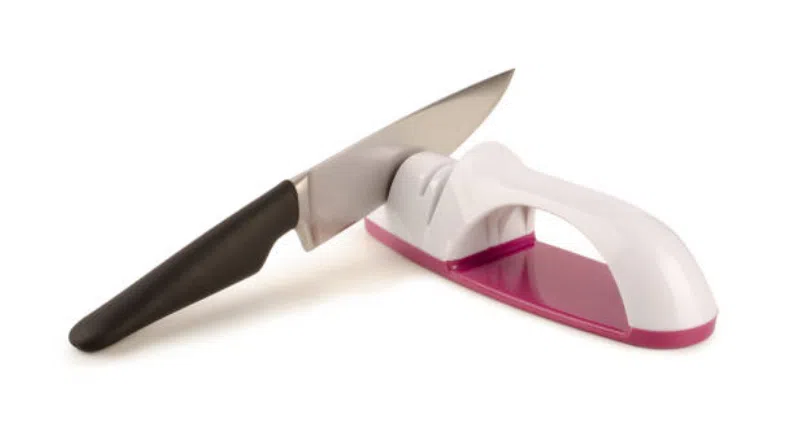
These compact manual units feature preset V-shaped slots made from tungsten carbide and fine ceramic rods. They are delightfully straightforward and take up zero counter space. However, they remove metal aggressively, which means they are best reserved for budget-friendly everyday utility knives rather than custom handmade blades.
2. Multi-Stage Electric Sharpeners ($80 – $180)
If you want quick, consistent results without learning complex muscle memory, premium motorized units from brands like Chef’sChoice or Work Sharp are fantastic investments. These machines use rotating diamond-grit wheels and magnetic angle guides. Naturally, they deliver a shaving-sharp edge in roughly thirty seconds per blade.
3. Traditional Water Whetstones ($30 – $75)
For the purist who finds kitchen prep genuinely relaxing, dual-sided water stones (such as a 1000/6000 grit combination block) provide unmatched precision. Whetstones allow you to polish both 15-degree Japanese santokus and 20-degree Western chef knives to a mirror finish without removing unnecessary steel.
Step-by-Step: How to Sharpen with a Whetstone at Home
Do not let Japanese whetstones intimidate you. Once you get the muscle memory locked in, the entire process feels wonderfully meditative.
- Soak the Stone: Submerge your water stone in a bowl of fresh water for 10 to 15 minutes until tiny air bubbles stop rising to the surface.
- Set Your Angle: Place the stone on a damp kitchen towel to prevent slipping. Rest the heel of your knife on the rough side (1000-grit) at a consistent 15 to 20-degree angle—roughly the height of two stacked pennies beneath the spine.
- Draw and Glide: Apply light, even fingertip pressure on the blade face. Sweep the knife across the stone from heel to tip in smooth diagonal strokes, repeating 8 to 10 times per side until you feel a tiny metal ridge (a burr) form along the opposite edge.
- Polish on Fine Grit: Flip your whetstone over to the fine side (6000-grit). Repeat the same gentle sweeping motion for five passes per side to polish off the burr and create a mirror shine.
The 5-Second Paper Test
How do you know when your edge is truly finished? Skip running your thumb across the blade, which is both dangerous and unreliable. Instead, grab a standard sheet of scrap printer paper or junk mail from your recycling bin.
Hold the paper up by one corner with your non-dominant hand. Rest the blade against the top edge of the sheet and pull downward with light forward momentum. If the steel effortlessly glides through the paper like warm butter without snagging or ripping, your edge is in peak condition.
Daily Habits to Keep Your Knives Sharp Longer
Once you put a clean edge on your cutlery, a few easy habits will protect that investment for months at a time. First, ditch glass, granite, and marble cutting boards entirely; their rock-hard surfaces will dull a sharp edge in a single afternoon. Instead, stick with end-grain butcher blocks, edge-grain maple, or soft rubber boards.
Second, never put your quality chef knives inside a hot dishwasher. The high-heat drying cycles and abrasive chemical detergent pods will erode fine steel and warp wooden handles in no time. Always hand-wash your knives with warm water, mild plant-based soap, and a soft dishcloth immediately after meal prep.
Ultimately, taking a few minutes to master the best kitchen knife sharpener for your routine will make slicing, dicing, and meal prep faster, safer, and infinitely more satisfying every day.