We have all stood in the refrigerated dairy aisle, staring down rows of colorful cartons while fluorescent lights hum overhead. Most of us flip open the lid, check for hairline cracks, glance at the “Best By” stamp, and toss the carton into the cart. Yet how often have you cracked an egg into a hot skillet only to watch the white run like water across the pan, or scrambled a batch that turned out rubbery and flavorless despite an intact expiration date?
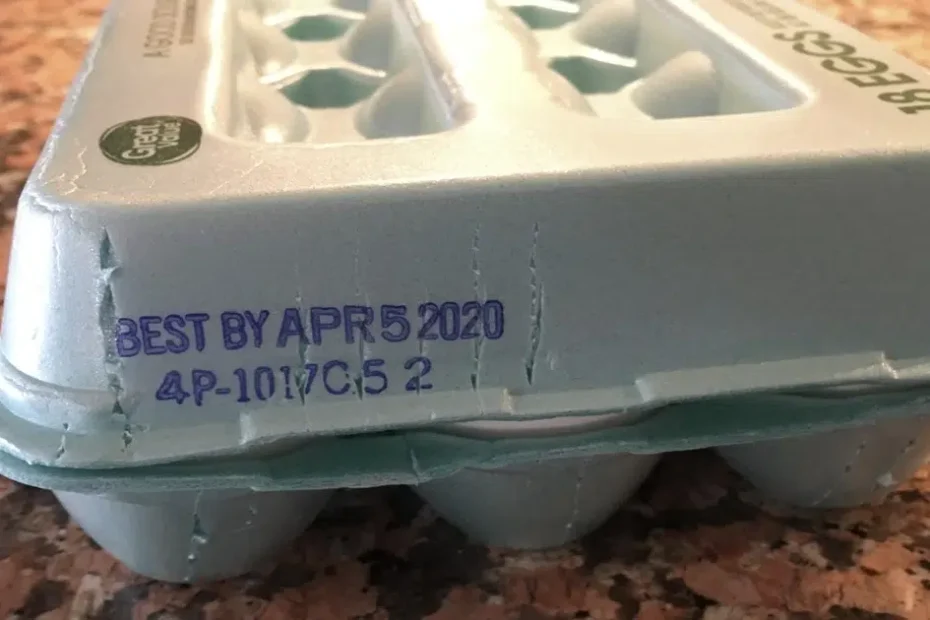
The secret to dependable breakfast textures and bakery-level bakes does not sit in the bold marketing claims printed across the top of the box. It hides on the short side panel, stamped in tiny purple or black alphanumeric characters. Once you learn how to read egg carton numbers, grocery shopping changes permanently. You stop guessing shelf life and start reading the exact farm-to-table timeline of your food.
The 3-Digit Julian Date: Your Egg’s Real Farm Birthday
The most important number on any carton is the three-digit Julian date. Unlike standard calendar formats that read month and day, the Julian calendar numbers each day of the year sequentially from 001 to 365 (or 366 in leap years).
January 1st is stamped as 001. February 1st appears as 032. December 31st finishes the cycle as 365. This three-digit number tells you the exact day those eggs were washed, graded, and packed into that carton.
Federally inspected egg plants are required by the USDA to stamp this pack date on every graded carton. While “Sell By” and “Use By” dates are determined by store agreements or voluntary state guidelines, the Julian date is pure, unvarnished data. It gives you an objective timestamp from the moment the egg left the packing facility.

Comparing a farm-fresh egg with a firm, high-standing yolk against an older egg whose white spreads out thin and watery.
Quick-Reference Julian Date Cheat Sheet
Keep these calendar benchmarks in mind when scanning the dairy case:
- Early January (Day 001–031): Winter pack dates.
- Mid-Spring (Day 090–120): Late March through April.
- Mid-Summer (Day 180–210): Late June through July.
- Early Fall (Day 244–273): September harvest window.
- Late Year (Day 335–365): December holiday baking season.
If you shop on day 150 and the carton reads 142, those eggs were packed just eight days ago. If that carton reads 115, they have spent over a month in transit and refrigerated warehouse storage. Aim for cartons packed within 14 to 21 days for prime frying, poaching, and morning scrambles.
Plant Codes: Your Direct Food Safety Insurance
Right beside the Julian pack date, you will spot a code that begins with the letter “P” followed by a four-digit number, such as P-1489. This is the USDA plant number, assigned to the specific facility that washed, sorted, and packed the carton.
Under USDA grading guidelines, every licensed packing plant has an exclusive identifier. This number allows regulators and consumers to trace an egg back to its specific washing and grading facility anywhere in the country.
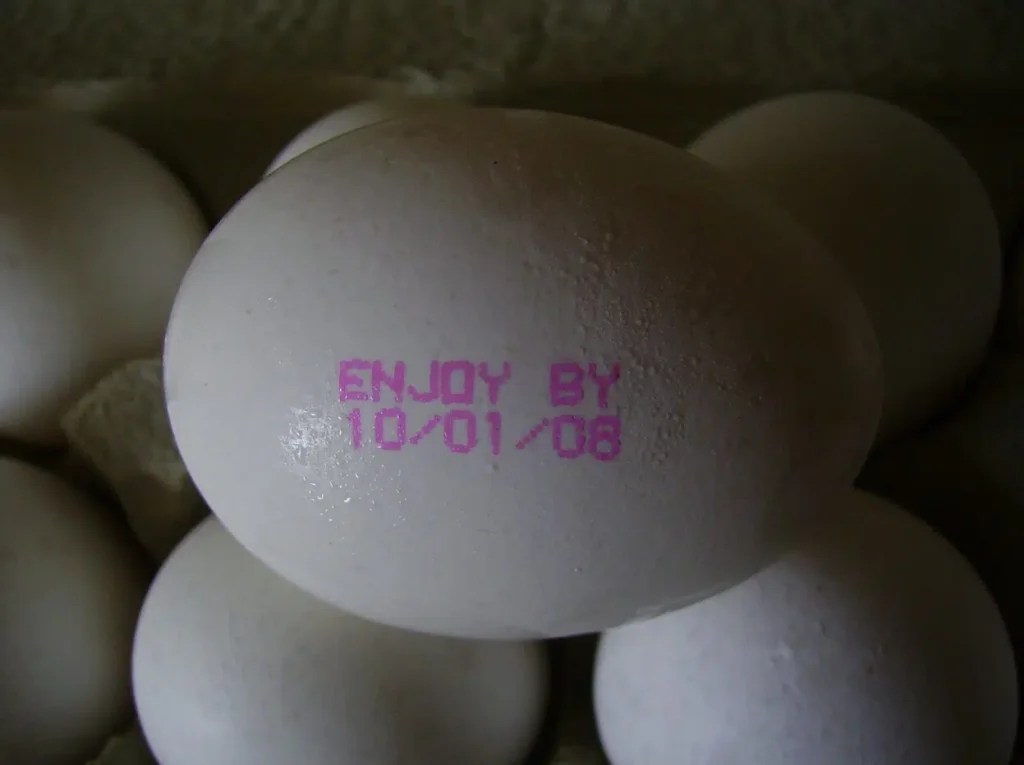
Individual egg stamps show recommended consume-by dates, but the pack numbers stamped on the carton tell the true story of farm freshness.
While you may ignore this stamp during normal weekday routines, it becomes essential during regional health advisories. If a safety recall occurs, official health agencies identify affected products by plant code and Julian date ranges rather than brand names alone. Checking those digits takes thirty seconds and saves you from discarding perfectly good food or feeding compromised batches to your household.
Kitchen Habit: Keep your eggs inside their original cardboard or pulp carton until the last one is used. Transferring loose eggs into decorative ceramic counter trays strips away both your Julian freshness stamp and your plant code record.
The “Best By” vs. Julian Date Myth: Why Calendar Dates Mislead
Why do grocery stores print expiration dates if the Julian code already exists? The difference comes down to store logistics versus food science. The various calendar dates stamped on packaging represent distinctly different timelines.
- Sell By: Directed at grocery store stock clerks. It tells the store how long the product can stay on display. By USDA rule, a “Sell By” date cannot exceed 30 days past the Julian pack date.
- Best If Used By / Best By: A voluntary recommendation from the manufacturer regarding peak culinary flavor and performance. Under USDA regulations, this cannot exceed 45 days from the pack date.
- EXP (Expiration): Some states require a hard expiration date on perishable goods. Like Best By dates, these are typically capped at 30 to 45 days after packing.
An egg does not magically spoil at midnight on its “Best By” date. When stored properly in a steady cold environment, whole eggs often remain safe to eat for three to five weeks past the printed calendar date, though their cooking performance gradually changes.
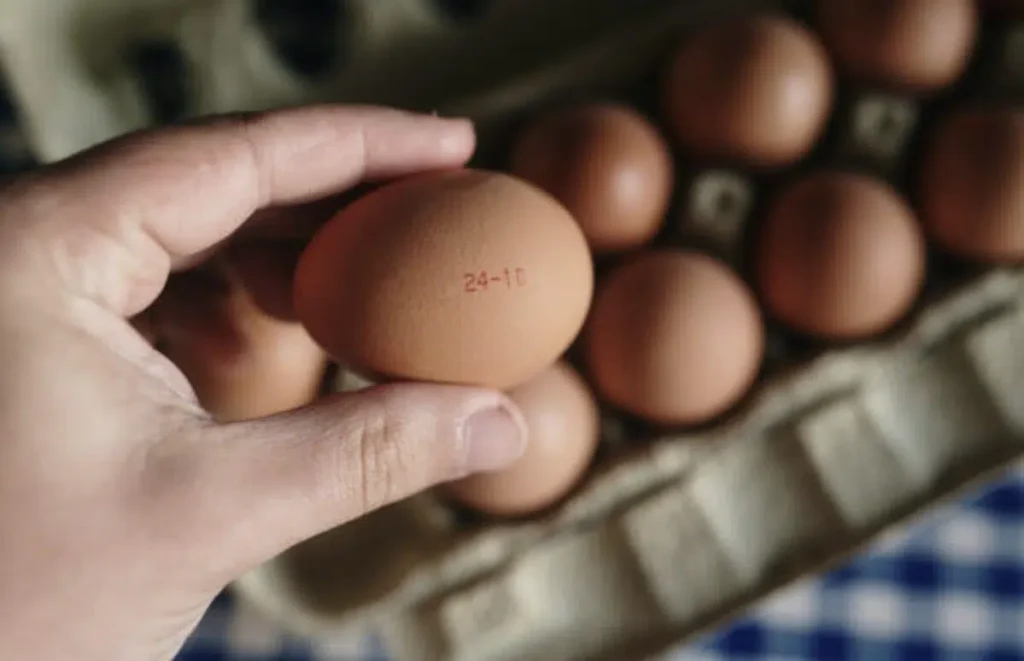
Inspecting individual lot stamps and shell markings before cracking ensures each egg matches carton quality standards.
How Egg Chemistry Changes as Days Tick By
Understanding the internal structure of an egg explains why fresh and older eggs behave differently in a skillet or mixing bowl. An eggshell is a semi-permeable membrane with thousands of microscopic pores.
As an egg sits in the carton over several weeks, two critical physical changes happen:
- Moisture and gas escape: Carbon dioxide and moisture gradually evaporate through the shell pores. At the same time, air enters through the wide end of the egg, expanding the inner air cell.
- The albumen shifts alkaline: The loss of carbon dioxide causes the egg white’s pH to rise from roughly 7.6 to around 9.2. This alkaline environment thins the thick albumen proteins, transforming dense, jelly-like whites into a loose, runny liquid.
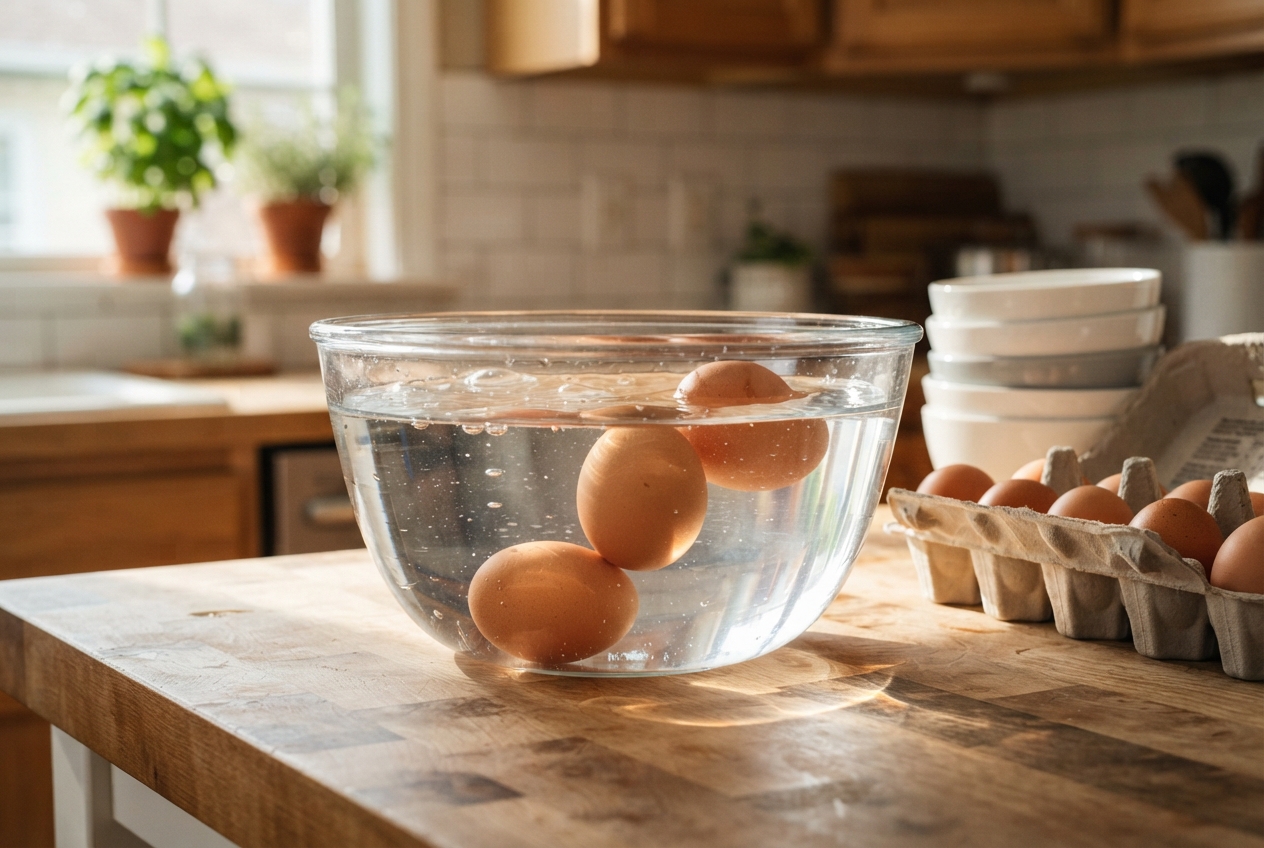
The water density test shows how internal air cells expand as eggs age over weeks in the refrigerator.
Matching Egg Age to Cooking Methods
| Egg Age (From Julian Date) | Internal Physical State | Best Cooking Application |
|---|---|---|
| 1 to 14 Days | Small air pocket, tall domed yolk, compact thick albumen ring. | Poaching, sunny-side-up frying, rich carbonara, silky custards. |
| 15 to 30 Days | Moderate air pocket, yolk slightly flattened, whites begin to spread. | Scrambles, omelets, everyday cake batters, quick breads. |
| 30+ Days | Large air pocket, fragile yolk membrane, loose watery whites. | Hard-boiling (easy peel), meringues (higher whip volume), soufflés. |
Older eggs peel cleanly when hard-boiled because the higher pH keeps the inner shell membrane from fusing to the cooked egg white. Fresh eggs cling stubbornly to their shells when boiled, tearing the albumen into jagged pieces.
Decoding USDA Grades: AA, A, and B
Right next to the carton sizing (Medium, Large, Extra Large), you will find the USDA shield displaying an official grade. Egg grading is a voluntary commercial service where eggs are candled (passed over a bright light) to evaluate interior quality without breaking the shell.
- Grade AA: The highest standard. The whites are thick and clear, the yolks sit high and firm, and the inner air cell measures less than 1/8-inch deep. These are exceptional for delicate frying and gentle poaching.
- Grade A: The most common grocery store grade. Whites are reasonably firm, yolks stand round, and the air cell measures between 1/8 and 3/16-inch. They perform dependably across all general cooking and baking tasks.
- Grade B: Whites are thin and watery, yolks are flattened, and shells may show minor surface irregularities. These eggs rarely reach retail cartons and are routed straight into commercial bakeries or liquid egg products.
Sorting Through Carton Labels: Real Standards vs. Marketing Buzzwords
Supermarket shelves are crowded with labels designed to sound pastoral and wholesome. Sorting verified agricultural practices from clever branding helps you spend grocery dollars wisely.
Cage-Free
Hens live unconfined by individual battery cages inside large enclosed barns. They can spread their wings, roost, and walk across open floor space. However, they rarely have access to the outdoors or natural sunlight.
Free-Range
Hens must have continuous access to the outdoors during their laying cycle. However, federal guidelines do not specify the quality or size of that outdoor space. In practice, this can range from sprawling pastures to a small screened concrete porch attached to a commercial barn.
Pasture-Raised
While not strictly defined by federal law, reputable third-party certifications (such as Certified Humane or Animal Welfare Approved) require a minimum of 108 square feet of rotated pasture per hen. Hens forage on open fields, consuming seeds, grasses, and insects. This diverse natural forage yields rich, deep orange yolks with higher levels of omega-3 fatty acids and vitamin E.
Certified Organic
Regulated directly by the USDA National Organic Program. Hens receive 100% organic, non-GMO feed grown without synthetic fertilizers or pesticides, receive no prophylactic antibiotics, and must have outdoor access. Outdoor space quality varies, making pasture-raised organic the gold standard for both bird welfare and nutritional richness.
The Right Way to Store Eggs for Maximum Freshness
How you store eggs at home matters just as much as picking a recent Julian date at the market. American commercial eggs are washed in hot, sanitized water before packing, which removes dirt but also strips away the natural protective outer cuticle (the “bloom”). Because that porous shell is now exposed, refrigeration is mandatory.
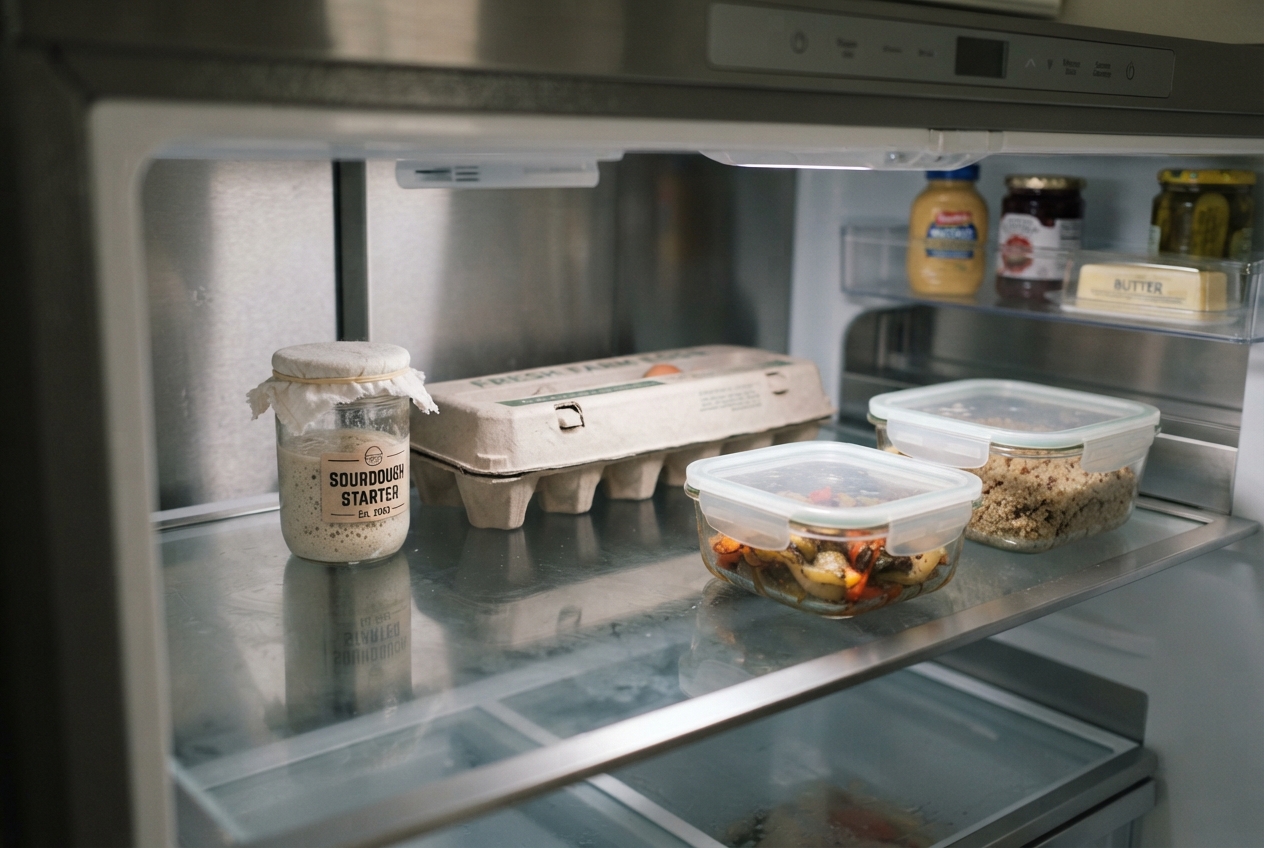
Storing egg cartons on a middle or top back shelf protects eggs from the constant temperature swings of refrigerator door bins.
Follow these essential storage guidelines to keep every carton in prime condition:
- Skip the door racks: Refrigerator doors experience severe temperature swings every time someone opens the fridge. Store cartons on an interior shelf near the back wall, where temperatures stay steady at 38°F to 40°F (3°C to 4°C).
- Keep the pointy end down: Store each egg large-end up. The internal air pocket rests at the blunt end; keeping it pointed upward prevents the air bubble from pressing against the yolk, keeping the yolk centered and fresh.
- Store away from strong aromas: Eggshells readily absorb surrounding scents through their microscopic pores. Keep open containers of chopped onions, sliced melons, or pungent cheeses on separate shelves.
The Sniff Test: The Final Word on Egg Safety
When in doubt, trust simple physical diagnostics over speculation. If an egg passes the water float test by sinking or standing upright, crack it into a small clean prep dish before adding it to hot pans or mixing bowls.
A spoiled egg will reveal itself instantly through a sharp, unmistakable sulfur scent. If the white is cloudy or milky, rejoice: that is simply trapped carbon dioxide indicating extreme farm freshness. If the egg shows no off-odors, abnormal pink or green iridescent sheens, or visible mold, it is ready for the pan.
Next time you walk through the grocery aisles, skip the vague marketing slogans and look straight at the side stamp. Check the 3-digit Julian date, verify the plant code, grab a fresh carton, and enjoy the dependable, delicious results at your breakfast table.