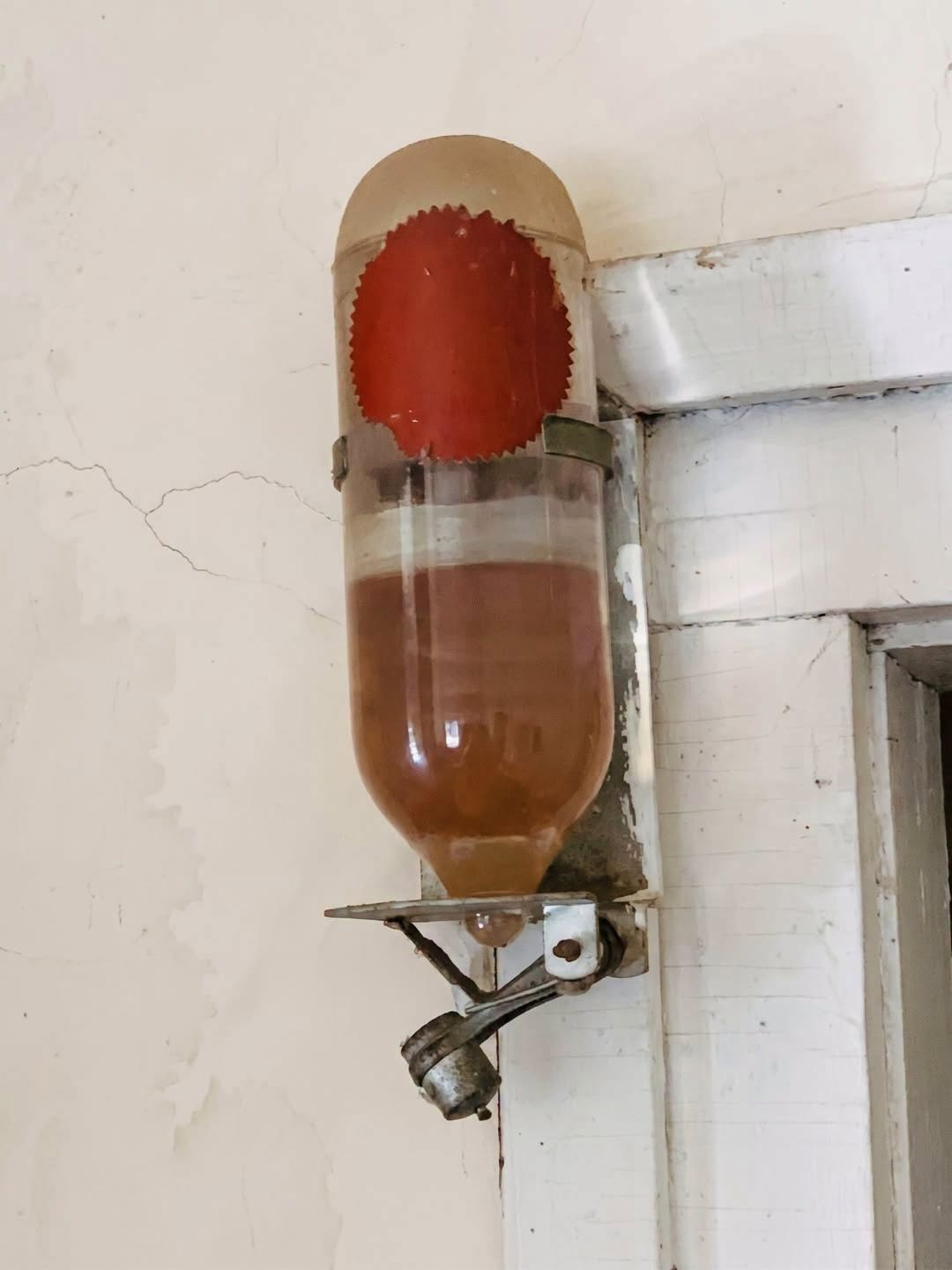
That forgotten glass bottle above the farmhouse doorway may look like a homemade gadget, a fire extinguisher, or something from an old laboratory. But if it has a glass reservoir, a small metal mechanism, and a high mounting position, there is a much more practical possibility: an old automatic fly and insecticide dispenser. The catch? You should not assume the exact purpose from appearance alone.
Objects like this are fascinating because the details do most of the talking. Before modern pest-control products filled hardware-store shelves, farms and rural homes had to deal with flies around kitchens, barns, animal areas, porches, and open doors. Mechanical dispensers and sprayers offered a way to distribute insect-control chemicals without someone standing there with a hand sprayer every few minutes.
So, what exactly are you looking at?
Why the Location Above the Door Matters
The first clue is where the device was installed. A gadget positioned high above a doorway was not placed there randomly.
Open doors are easy entry points for flying insects. On a farmhouse, especially one near livestock or food storage, that could mean a steady stream of unwanted visitors. Mounting equipment overhead also kept it away from children, animals, carts, and everyday bumps.
However, location alone does not prove that the object was an insecticide dispenser. Old homes were full of practical devices that have since disappeared from ordinary use. A wall-mounted oil lamp accessory, household sprayer, bell mechanism, or even a specialized agricultural device could look surprisingly similar.
How an Old Fly Dispenser May Have Worked
The basic design is easier to understand when you separate the object into two parts: the reservoir and the mechanism.
The glass container held the liquid. Beneath it, a metal assembly could control, meter, pump, or release a small amount of that liquid. Depending on the design, the device may have relied on a manual trigger, mechanical timing, evaporation, or another release method.
That is where the original mystery becomes interesting. A dark liquid inside an old glass reservoir does not automatically mean insecticide. The color could have changed because of age, contamination, residue, or chemical breakdown.
For that reason, don’t open the container just to satisfy curiosity.
What Makes This Kind of Vintage Device So Interesting?
Older pest-control equipment tells us a lot about how households handled everyday problems before disposable modern products became common.
Today, someone dealing with flies might reach for a sticky fly trap, electric insect trap, screen repair kit, or ready-made household pest-control product. A farmhouse from an earlier era had fewer convenient choices, so reusable mechanical equipment made practical sense.
There was also a strong connection between home and farm life. The kitchen, pantry, porch, stable, and animal areas were not always separated the way they are in modern homes. A device placed near a doorway could therefore serve a very ordinary purpose: reducing the number of insects moving through a frequently used entrance.
How to Identify an Old Insecticide Dispenser
If you find a similar object in an attic, barn, garage, or farmhouse, resist the urge to clean it immediately. First, document what you have.
- Check the reservoir: Look for molded glass markings, embossed lettering, measurement lines, or a manufacturer name.
- Inspect the metal mechanism: Note whether it has a pump, valve, lever, spring, nozzle, or threaded connection.
- Study the mounting hardware: Screws, brackets, hooks, and mounting plates can reveal whether it was designed for a wall, doorway, ceiling, or machinery.
- Look for labels: Faded paper labels may contain product names, warnings, instructions, or patent information.
- Photograph everything: Take clear photos before moving, disassembling, or polishing the item.
A vintage tool that looks worthless can become much easier to identify once you find a maker’s mark or patent number.
Don’t Make This Vintage-Farmhouse Mistake
The biggest mistake would be treating an unknown liquid as harmless.
If an old glass container still contains liquid, leave it closed. Do not smell it, taste it, pour it out, heat it, or transfer it to another container. Even if the device looks decorative, its contents may be old chemical residue.
Naturally, gloves and good ventilation are sensible precautions when simply handling the exterior, but the safest approach is to avoid unnecessary contact with the liquid itself. If the container is cracked, leaking, or damaged, keep people and pets away and ask a qualified local hazardous-materials or environmental service how it should be handled.
Also, don’t plug, pump, press, or activate an unfamiliar mechanism. A device that has sat untouched for decades can have brittle seals, stuck springs, or corroded parts.
Common Clues That Can Point to a Different Device
Not every glass bottle with a metal assembly is a fly-control product. That distinction matters if you’re trying to identify an antique for restoration or resale.
For example, a container connected to tubing might have served a laboratory, medical, agricultural, or industrial purpose. A device with a wick could belong to an old lighting system. A mechanism with a bell, pull chain, or electrical contacts could have served as an alarm or signaling device.
The surrounding building can help, too. A barn suggests different possibilities than a kitchen pantry. A workshop filled with old machinery tells a different story than a rural bedroom.
That’s why the strongest identification combines several clues instead of relying on one unusual feature.
What Should You Do If You Find One?
Start with preservation, not restoration.
Write down where you found it, approximately how long it has been there, and anything family members remember about its use. Then photograph the front, back, top, bottom, glass markings, metal mechanism, and mounting hardware.
Next, search the exact wording of any visible manufacturer mark or patent number. Vintage farm catalogs, antique-equipment references, museum collections, and old product advertisements can be especially useful because they show how these devices were originally marketed.
If you eventually confirm that it was an automatic fly and insecticide dispenser, you will have something more interesting than an odd piece of farmhouse clutter. You will have a small snapshot of everyday pest control from another era.
The Real Story Behind the Mystery
The appeal of an old farmhouse object is not simply that it looks strange. It is that ordinary people once used these things without giving them a second thought.
A glass reservoir above a doorway may have been as routine to its owners as a fly screen or kitchen broom is today. Years later, however, the purpose disappears while the hardware remains.
That is what makes an old automatic fly and insecticide dispenser such a fun mystery to solve. The glass, metalwork, mounting position, labels, and surrounding building can all provide clues.
And if that mysterious bottle still contains an unknown liquid, leave it alone. The safest vintage treasure is the one you identify without opening it.