For over a century, public beaches served as the frontlines of a bitter cultural tug-of-war between institutional modesty and personal liberty. In this battle, the bikini emerged as both public enemy number one and the ultimate symbol of modern liberation. Popes condemned it as an offense to God. Politicians outlawed it by decree. Law enforcement patrolled sandy shores armed with tape measures.
Yet women refused to surrender their autonomy. With every daring appearance in the sun, they pushed boundaries, challenged outdated laws, and permanently rewrote the rules of fashion.
Tailors on the Beaches
At the dawn of the twentieth century, seaside attire bore little resemblance to the sleek, lightweight swimwear of today. Swimming garments were cumbersome, heavy affairs made of thick wool that absorbed water like a sponge. They were designed not for athletic comfort or aquatic speed, but for absolute concealment, ensuring that not an inch of feminine form was visible to passersby.
Strict modesty regulations governed public beaches throughout the United States. In their detailed historical study of 1920s culture, historians Kathleen Morgan Drowne and Patrick Huber documented that municipal recreation departments—such as Chicago’s Clarendon Beach—routinely employed on-duty beach tailors. These officials were authorized to make immediate, on-the-spot alterations to any bathing dress deemed excessively short or revealing.
Similar ordinances sprang up in resort towns from coast to coast. In 1915, Coney Island prohibited rolled-down bathing stockings if they dared to expose a woman’s knees. Meanwhile, in Washington, D.C., uniformed beach police regularly prowled the shores with measuring rulers, calculating the precise distance between the hemline of a woman’s tunic and her kneecap to ensure it complied with city decency codes.
Arrested for a One-Piece?
Early twentieth-century social etiquette demanded complete coverage. Men and women alike were expected to enter the water swathed in dark garments running from high collar to knee. Exposing bare limbs was not merely seen as bad manners; it was classified as public indecency.
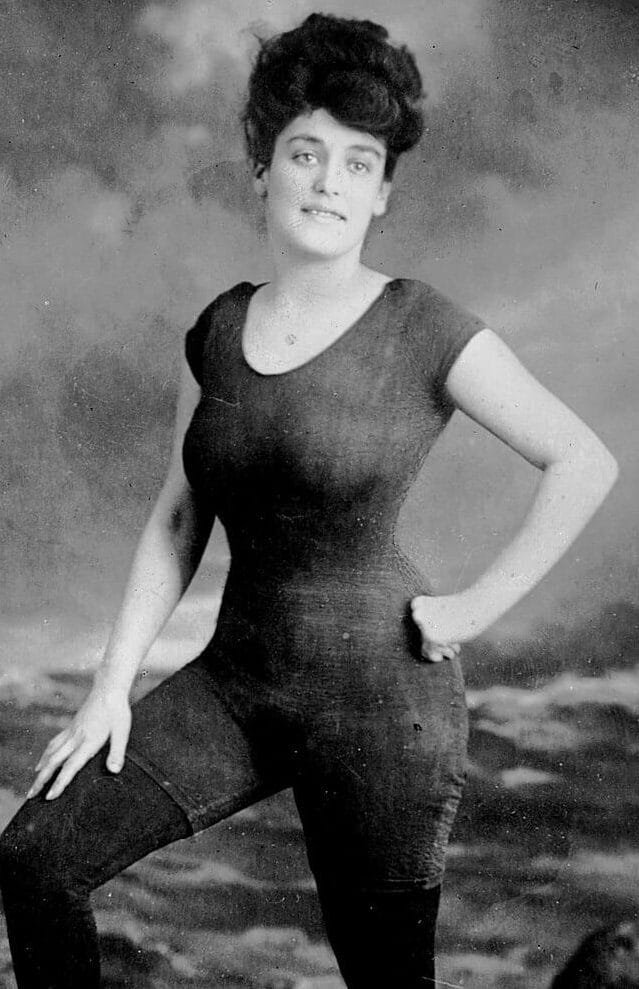
The first major crack in this armor appeared in 1907, courtesy of Australian swimming sensation Annette Kellerman. Renowned internationally as the “Australian Mermaid” for her record-setting endurance swims, Kellerman grew tired of nearly drowning under heavy skirts and pantaloons. She took matters into her own hands by designing a form-fitting, sleeveless one-piece suit that freed her arms, neck, and legs.
Kellerman was famously detained by police on a Boston beach for daring to wear her streamlined suit in public. While formal court records of the arrest remain debated by historians, the public scandal was undeniable. The headlines sent shockwaves across the globe, sparking an international conversation on women’s athletic freedom.
Capitalizing on the sensation, Kellerman launched her own commercial swimwear line. Her daring one-piece became a massive retail success, representing the first major milestone in the evolution of modern women’s swimwear.
The Roaring ‘20s: A New Wave of Freedom
As the 1920s gained momentum, the flapper revolution swept away Victorian restraint, transforming not only evening dance halls but public shorelines as well.
The push for functional swimwear gathered steam on the West Coast, where energetic young women formed grassroots rebellion movements. Among the most famous were California’s “skirts be hanged girls,” whose philosophy was delightfully straightforward: swimsuits ought to be made for actual swimming.
Under this cultural pressure, heavy skirts gave way to knitted jerseys and shorter trunks. While still conservative by contemporary standards, these garments marked a massive leap toward physical liberation and everyday comfort. Yet the true cultural earthquake was still decades away.
The Bikini: An Atomic Step Forward
In July 1946, French automotive engineer Louis Réard introduced a design so radical it redefined swimwear forever: the modern two-piece bikini. With just thirty square inches of printed fabric, Réard’s creation exposed the midriff and uncovered the female navel in public for the very first time.
Just four days prior to the unveiling at the Piscine Molitor in Paris, the United States military had conducted its first peacetime atomic bomb test at Bikini Atoll. Réard deliberately borrowed the island’s name, betting that his revealing creation would generate an explosive shockwave across global culture.
The backlash was instant and severe. Municipalities across the United States swiftly banned the two-piece from their coastlines. In Europe, the opposition was equally fierce: France barred the bikini from Atlantic beaches in 1949, while West Germany prohibited it in municipal swimming facilities well into the 1970s. Across the Eastern Bloc, ideological critics denounced the swimsuit as an example of Western decadence.
Pope Pius XII publicly condemned the garment as scandalous, prompting staunchly Catholic nations—including Spain, Portugal, Italy, and Belgium—to enforce strict legal bans. Even as late as 1952, beauty queen Ann Ferguson was formally escorted off the sands of Australia’s Surfers Paradise because her designer bikini breached local decency statutes.
The Truth Behind the Famous Viral Photo
Decades later, one particular vintage photograph came to symbolize the mid-century war over beachside modesty.
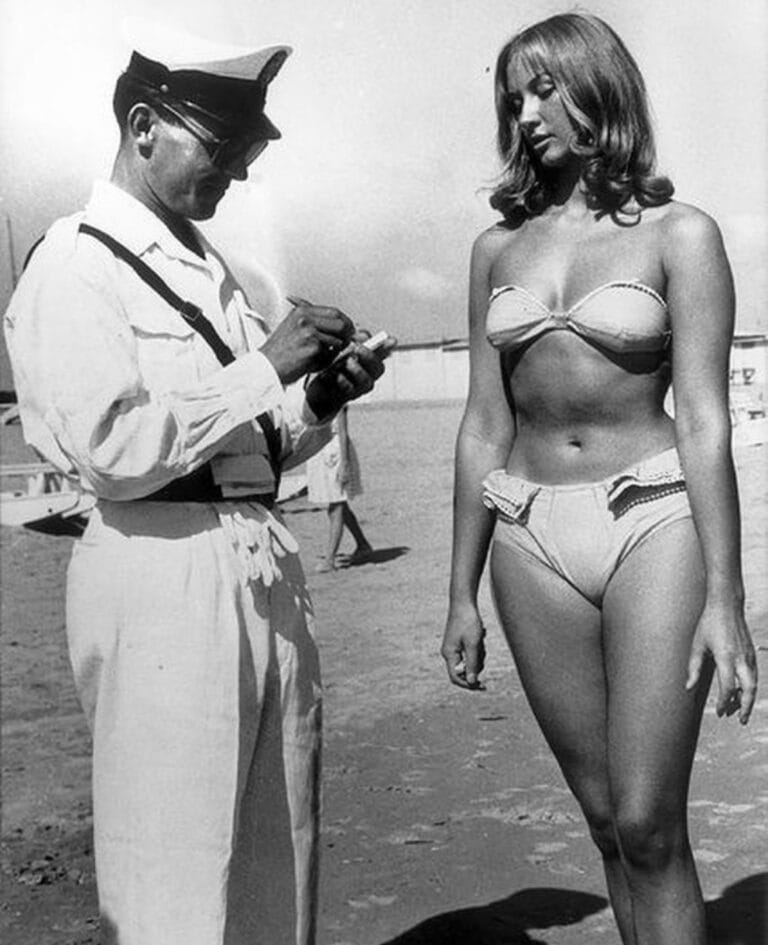
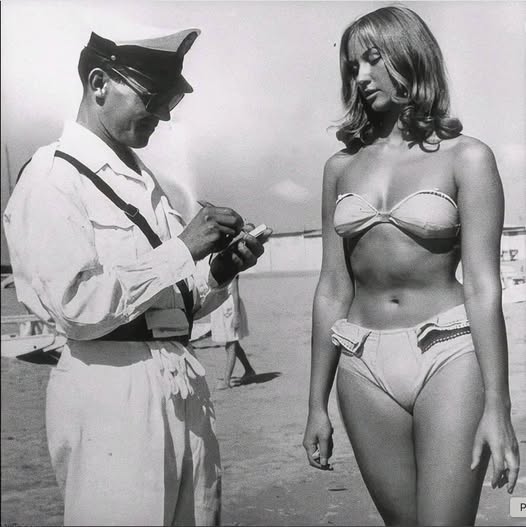
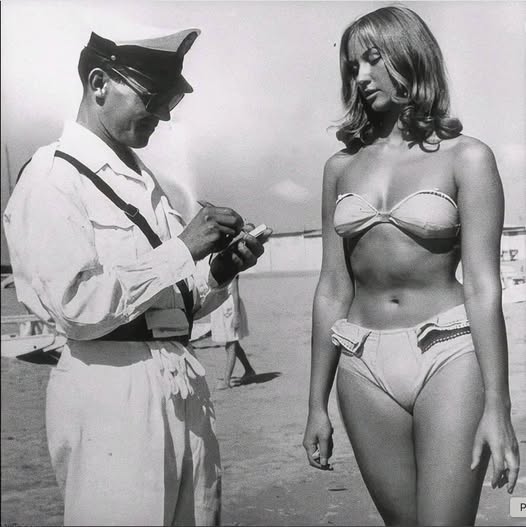
The viral black-and-white picture shows a uniformed police officer standing over a young woman in a strapless two-piece on a sunlit beach, pen and notebook in hand. Widely circulated across platforms like Reddit and Facebook, posts frequently claim the image depicts a 1957 Italian police officer issuing a citation in Rimini purely because the bather was wearing a bikini.
The photograph itself is entirely authentic, though archival researchers note that the exact narrative behind it remains open to interpretation. Some historians suggest the scene may have been a staged publicity shoot for a magazine, while others note the officer could have been taking a routine statement.
Nevertheless, the historical reality behind the image is undisputed. Archival records confirm that Italy enforced a strict public decency law dating back to 1932, which banned “bathing in public view with indecent attire.” That statute remained technically active for decades, giving local authorities full legal power to fine women who dared to bare their midriffs.
The Hollywood Rebellion and the Battle Over the Navel
It took the cinematic power of the 1960s to finally break the social taboo surrounding the bikini.
Even in cinema, the garment faced formidable hurdles. The Motion Picture Production Code—better known as the Hays Code—strictly forbade major Hollywood studios from showing an exposed female navel on screen. Concurrently, the National Legion of Decency exerted immense political and financial pressure on film distributors to keep two-piece suits out of movie theaters.
Yet trailblazing screen legends like Marilyn Monroe, Ursula Andress, and Brigitte Bardot turned the forbidden garment into a worldwide phenomenon.

No star did more to legitimize the bikini than Brigitte Bardot. In her breakthrough 1952 film The Girl in the Bikini (Manina, la fille sans voile), Bardot turned her strapless two-piece into a cultural sensation. Lounging against the sun-drenched backdrop of the French Riviera, she brought a youthful, unapologetic confidence to the screen that captured the imagination of an entire generation.

A decade later, Ursula Andress delivered one of the most iconic moments in cinematic history in the 1962 James Bond classic Dr. No. Rising majestically from the Caribbean surf in an ivory belted bikini with a scabbard at her hip, Andress redefined female sexuality as self-assured, athletic, and fiercely independent.
By the 1970s, the battle over square inches of fabric was essentially won. String bikinis and daring cuts entered the mainstream, while traditional moral policing evaporated from seaside resorts.
The Modern Era: From Forbidden Attire to Total Freedom
Today, swimwear is no longer a battleground of state regulation or institutional control. The global beachwear industry has evolved to celebrate body positivity, individual comfort, and personal expression.
Modern beachgoers choose freely from retro one-pieces, athletic rash guards, classic bikinis, or minimalist designs without fear of legal fines or moral condemnation. What began as a fierce fight against oppressive modesty codes has transformed into a universal celebration of bodily autonomy.
The next time you pack a swimsuit for a summer getaway, remember: that small piece of cloth carries the legacy of a century-long revolution for personal freedom.