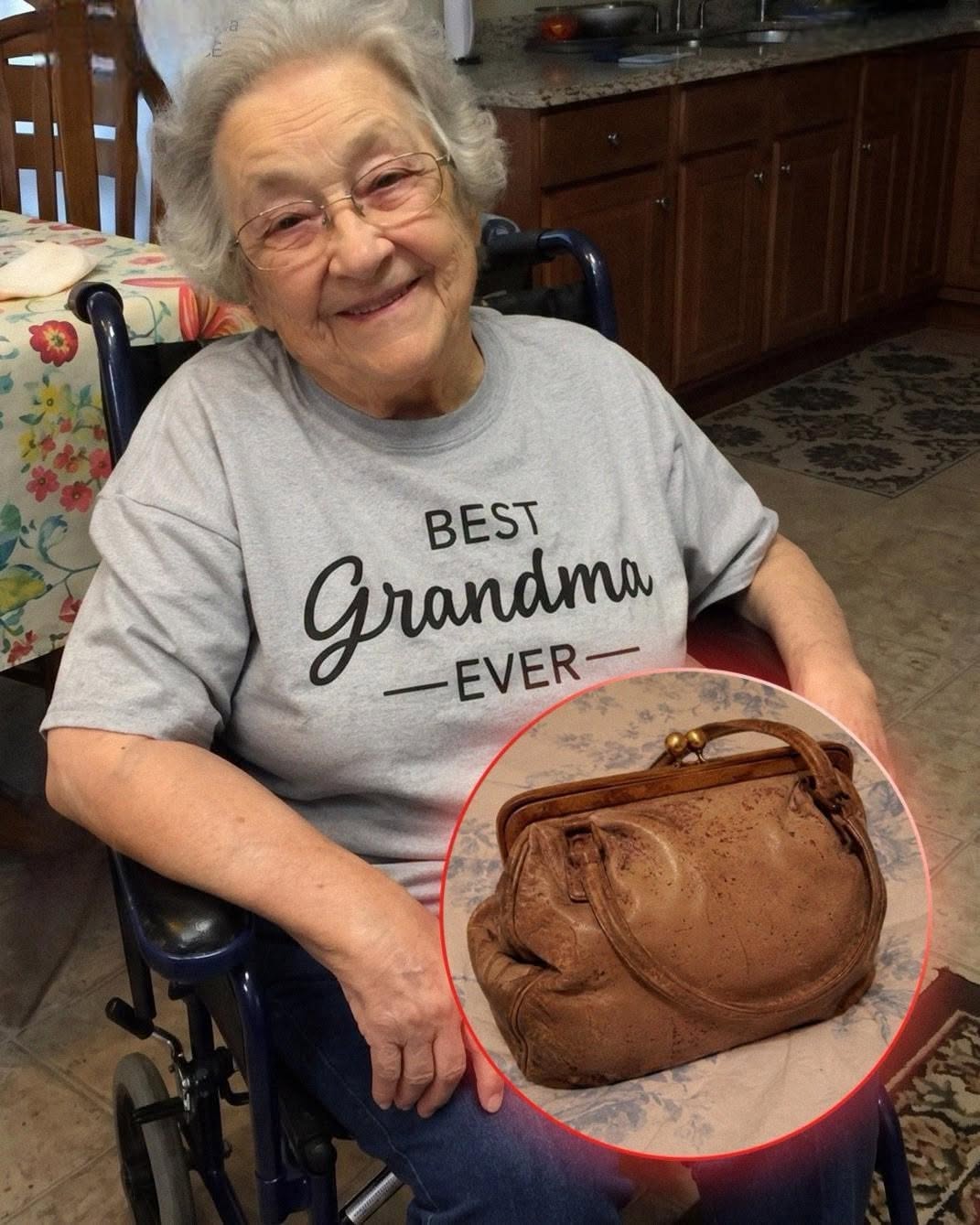
Nancy’s hand cracked across Robert’s wrist before his fingers ever brushed the strap.
“I SAID DON’T TOUCH IT.”
I was maybe fifteen. We were all crammed into her bedroom laughing about something, and Uncle Robert had reached up on his tiptoes toward the faded brown handbag on the top shelf of her closet, in mock ceremony.
“Don’t open it until I’m gone.”
“Come on, Ma, what’s the big secret?” he had teased, a second before her palm found him.
The room went dead silent. Robert rubbed his wrist and laughed it off, but nobody else laughed with him. After that, none of us joked about that bag again.
Every few months for the rest of her life, though, Nancy would catch me alone in her kitchen. She would gather my hand into both of hers, the papery, cool ones, and lean in close.
“Promise me, sweetheart,” she would whisper. “Don’t open it until I’m gone.”
Grandma noticed everything.
“Why me, Grandma?”
“You’ll understand everything the moment you open this bag.” She would squeeze my hand gently. “And when you’ve taken out what’s inside, put the bag back with me.”
I always promised. I never asked again.
The church smelled of white lilies and polished wood, and I sat in the front pew counting faces I had not seen in years. Eleven grandchildren, three aunts, two uncles, and my mother Carol, tucked into the last row like she was hoping no one would notice she was there. Grandma Nancy would have noticed. Grandma noticed everything.
I wasn’t immune to it.
I was twenty-eight years old, and I had called that woman every single Sunday for a decade.
“She looks peaceful,” Aunt Susan whispered, sliding in beside me.
“She looks like she’s about to sit up and tell us we’re wearing too much perfume,” I murmured.
Susan laughed softly, then covered her mouth like laughing was a sin.
“Emily, honey, come sit by me.”
Across the aisle, Uncle Robert was already working the room. He squeezed shoulders, kissed foreheads, and told my cousin Megan she looked just like Nancy at that age. Everyone believed him. Robert had that golden voice, the one that made you feel chosen.
I wasn’t immune to it. He’d taught me to ride a bike, slipped me folded twenty-dollar bills, and was the first person I called when my car broke down at nineteen.
Nancy had that same gift, I thought. Eleven grandchildren, and every single one of us grew up certain we were the favorite.
“Emily, honey, come sit by me,” Aunt Linda called.
Mom preferred it that way.
“In a minute,” I answered quietly.
I kept staring down at the closed program in my lap. There was only one thing Nancy had never shared with any of us — that worn bag on the top shelf of her closet. Old letters from Grandpa Frank, she’d once claimed. Private things that belonged only to her.
The organist began the slow processional. My mother sat two rows behind me, dabbing her cheek with a tissue, isolated as always. No one had spoken to her at the wake. Not even her own siblings.
For years, I’d told myself Mom preferred it that way. She never spoke about what had happened, and I learned not to pry. It was easier to believe the family’s silence belonged to some ancient hurt that wasn’t mine to understand.
“We forgot the bag.”
The funeral director stepped forward to close the polished casket, and my whole body went cold.
The bag. We had left the bag sitting on that closet shelf.
I stood up in the pew before I could talk myself out of it.
“We forgot the bag,” I said. My voice cracked slightly on the last word.
“Let me handle it.”
My mother, Carol, closed her eyes.
“Emily, sit down. The cars are waiting outside.”
“She asked us. For years. She made me promise.”
Uncle Robert turned around from the front row, his hand already extended like he was reaching for a child about to stumble.
“Sweetheart, this isn’t the time. We can slip it in at the graveside. Let me handle it. I’ll drive over right now.”
“I’ll be fifteen minutes.”
Something in the smooth way he said it made my skin tighten.
“No,” I said firmly. “She asked me.”
“Emily.”
“She asked me, Uncle Robert.”
Aunt Susan touched Robert’s arm. Aunt Linda looked down at the floor. Cousin Megan whispered something to Jake that I couldn’t quite hear.
Envelopes. Twelve.
“I’ll be fifteen minutes,” I said, and I was already moving toward the exit.
Grandma Nancy’s house smelled of her wool cardigan and Sunday cinnamon. I dragged a heavy kitchen chair to her closet, climbed up on shaking knees, and pulled down the faded brown handbag.
It was heavier than I had ever imagined. Not jewelry heavy. Paper heavy.
I sat down on the edge of her bed and undid the stiff brass clasp.
READ THIS LAST.
Envelopes. Twelve of them, stacked neatly and bound with a thick rubber band.
Eleven bore names in her careful, looping cursive. Emily. Megan. Jake. Ashley. Tyler. Six more, one for each of the other grandchildren.
The twelfth had no name. Only three crisp words.
READ THIS LAST.
I gathered them up, tucked the twelfth deep inside my purse, and drove back to the church.
The lid closed.
The funeral director paused the moment I walked back in. Every head turned in unison.
“I have something,” I said quietly. “She wanted each of you to have one.”
I walked down the aisle handing them out. Megan took hers with trembling fingers. Jake frowned down at the familiar handwriting. Ashley pressed hers to her chest without opening the seal.
I placed the empty handbag in Grandma Nancy’s folded hands, exactly the way she had asked. The lid closed. The heavy clasps clicked shut.
I am so proud of the woman you have become.
She was buried with her bag, precisely as she wanted.
Nobody dared open their envelope until after the burial.
At the wake, back at Aunt Susan’s house, I slipped into the hallway and opened my own letter.
‘My sweet Emily. I am so proud of the woman you have become. I remember you at seven, feeding the neighbor’s cat because you were sure no one else would. Thank you for calling me every Sunday. Thank you for asking about my week when nobody else did.’
‘All I protected was the silence.’
I smiled through the tears and kept reading.
‘You are the only one of them from whom I didn’t have to hide anything. This family learned a long time ago that silence was easier than the truth. Each of your parents asked me to keep something buried, and I did.’
“Keep what buried?” I whispered to myself.
‘I told myself I was protecting everyone. I know now that all I protected was the silence. All my love, Grandma.’
It had changed the room.
I read those last lines again.
‘All I protected was the silence.’
I didn’t yet understand what she meant.
I stepped out of the hallway into the main living room and froze.
“Did your letter say anything about my dad?”
People were reading and rereading their letters, murmuring in corners, flatly refusing to meet one another’s eyes. Whatever Grandma had written, it had completely changed the room.
Across the floor, by the large window, stood my mother. She hadn’t been spoken to in twenty-five years, but now people kept glancing nervously her way.
She wasn’t looking at them. She was watching me.
I stepped toward her, and before I could speak, Uncle Robert crossed the floor and gently — so gently — closed his fingers around my elbow.
“What’s in the twelfth one?”
The wake was supposed to be a wake. It became something else entirely by the second morning.
My cousin Megan called me at seven the next morning.
“Emily, did your letter say anything about my dad?”
“No. Why?”
She completely ignored the question.
“Everyone’s keeping them.”
“We all saw you hand out eleven letters yesterday,” Megan said tensely. “And we all saw you keep two envelopes for yourself. So what’s in the twelfth one?”
“I don’t know.”
“Everyone wants to know.”
She hung up abruptly.
By noon, the entire family group chat had gone strangely quiet.
“Be careful what you believe about me.”
Then my mother called. She hadn’t called me crying in my entire adult life.
“Emily,” she said, her voice shaking, “what did your grandmother put in those envelopes?”
“Mom, I don’t know. Everyone’s keeping them to themselves.”
“Oh God.”
“What is it?”
“What money?”
A long, suffocating silence followed.
“Just… be careful what you believe about me.”
Aunt Susan let the first crack open in her driveway that afternoon.
“Your mother didn’t take that money, Emily. She never did.”
“What money?”
“Your mother didn’t take that money.”
“Twenty-five years ago. Thanksgiving. Grandpa Frank’s safe.”
“Aunt Susan, everyone claimed Mom stole it. That’s why she left town.”
“That’s just what we let people say.”
Aunt Susan let the first crack open in her driveway that afternoon.
“Your mother didn’t take that money, Emily. She never did.”
“Aunt Susan told me it wasn’t you.”
“You’re telling me you knew she was innocent all these years?”
“I knew enough to know we should’ve asked more questions.”
I reached for my car keys. Aunt Susan probably assumed Grandma had told me the whole story in my letter. But she hadn’t. I still didn’t know what had truly happened.
I was about to find out.
“Who took it?”
I drove to my mother’s that evening. She let me inside without a word and put the kettle on, though neither of us touched our mugs.
We sat side by side on her couch. She folded her hands tightly in her lap.
“Mom. Aunt Susan told me it wasn’t you.”
She didn’t look up at me.
“You let everyone think you stole it?”
“Who took it?”
“Emily, please.”
“I already know you were innocent. You have to tell me the rest.”
She remained quiet for a long, heavy moment.
“I can’t.”
I just didn’t know who.
“And you let everyone believe you stole it? You took me and just left.”
“I thought it would be temporary. The person I was protecting had young children. If the truth came out, someone could’ve gone to prison. But I knew your grandfather would never let them prosecute me. I was his daughter, raising you alone, and you were only three.”
She looked down at her hands.
“I thought eventually the truth would surface on its own.”
I left knowing my mother had sacrificed twenty-five years for someone in our family. I just didn’t know who.
“There’s a twelfth letter.”
Robert called me the next evening.
“Sweetheart, Susan called me. I’m really worried about you.”
“I’m fine.”
“You don’t sound fine. This whole mess has torn the family apart.”
“Let Nancy die with her secrets.”
I hesitated. “There’s a twelfth letter. Grandma told me to read it last.”
He went dead quiet on the line.
“Emily, don’t.”
“Why?”
“Look at what the first eleven have already done. Your mother is hurting all over again. Let Nancy die with her secrets.”
I almost listened to him.
Something cold in his tone made me deeply uneasy.
“Just think before you do something you can’t undo,” he warned softly.
After we hung up, I stared at the dresser drawer where I’d hidden the envelope.
For a moment, I almost listened to him.
That night, alone in my quiet apartment, I slid the twelfth envelope out from under my pillow and carefully broke the seal.
The truth now would destroy the family.
‘Emily, if you’re reading this, then I owe you an apology.’
My throat tightened. I kept reading.
Grandma wrote that a few years ago, she had decided to gather the family and finally clear my mother’s name. She called one of her sons first to tell him.
He begged her to leave it buried. His children had grown up believing the same lie everyone else did, and he claimed telling the truth now would destroy the family he had spent twenty-five years holding together.
She explained why me.
When Grandma refused to stay silent, his tone changed completely.
‘You do that, and you’re out of this house.’
The words blurred before my eyes. Grandma had signed the deed of her home over to him, thinking it would make estate matters simpler. He had used it as a weapon against her.
‘I was seventy-two with almost nothing of my own. I chose the roof over my head. I have hated myself for it every day since.’
Then she explained why me.
‘He was the one who took the money.’
‘Each of my children had something to lose. You were the only one who cared about the truth more than the story.’
That was why my letter held nothing damaging — not out of favoritism, but for freedom.
Then came the final paragraph.
‘There is one more thing you need to know, Emily. The man who threatened to put me on the street was Robert.’
I let the paper rest on my knees.
I read the twelfth letter aloud.
‘He was the one who took the money from your grandfather’s safe. Your mother loved her brother enough to take the blame, believing it would only be temporary. Robert let her. And years later, when I finally decided to clear her name, he threatened me with the very home I had trusted him with.’
For a moment, all I could see was every version of him I’d trusted — the uncle who taught me to ride a bike, who showed up whenever I called, who always seemed to know how to fix everything.
And the entire time, he’d let my mother carry the weight of what he’d stolen.
Robert, who had pleaded with me, ‘Let her die with her secrets.’
“Emily, sweetheart, let me explain…”
The next morning I called Carol, Aunt Susan, and Aunt Linda into Grandma’s living room. I read the twelfth letter aloud, my voice steady for the first time in a week.
Carol wept the way people cry when they have waited twenty-five long years to be believed.
My phone buzzed before I had even finished folding the letter. Robert. It rang again an hour later. And a third time as I was walking my mother out to the driveway. I let it ring every single time.
He drove over to the house that evening. I heard his heavy knuckles on the door before I saw him through the glass — the same warm, familiar smile, holding two coffees in a cardboard tray, as if we were simply starting over.
“Don’t call me again.”
I opened the front door but did not step back.
“Emily, sweetheart, let me explain…”
“You stole the money, let my mother lose everything for you, and then used Grandma’s own home to keep her silent. And all these years, you let us believe you were the hero holding this family together.”
His mouth fell open.
This time, no one asked her to leave.
“Don’t call me again.”
I shut the door before he could set those coffees down. Through the glass, I watched him stand frozen for a long moment, the tray still in his hands, before he finally turned and walked down the porch steps.
I walked my mother through the front door of the family home she hadn’t been welcome in for twenty-five years and brewed her fresh coffee in her mother’s kitchen.
For decades, she had carried someone else’s shame while the rest of us mistook her silence for guilt. Grandma’s letters couldn’t give those lost years back, but they gave her something she had stopped expecting — the truth, spoken out loud.
Mom sat down at the kitchen table and looked around the room she had once been forced to leave.
This time, no one asked her to leave. And no one would ever make her carry their secrets again.
END