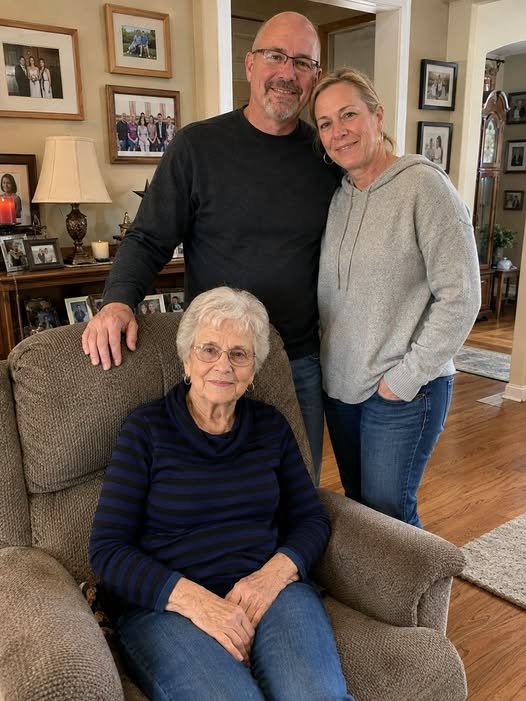
My name is Nicole, and for over a decade, I operated as a dedicated peacekeeper.
I want to lay this out plainly from the start, because stories like this often tempt the narrator to sound instantly triumphant or calculatedly heroic. The truth is far more mundane and human. Maintaining harmony at all costs was never a noble virtue I consciously chose; it was a survival mechanism forged during a childhood where every room’s emotional climate was dictated by whoever had the shortest fuse. The only reliable shield in that environment was turning yourself into a smooth, frictionless pebble in a rushing river.
I carried that reflexive compliance into my marriage, into my interactions with my mother-in-law, Patricia, and into eleven exhausting years of swallowed indignities. I bit my tongue over critiques of my cooking, my housekeeping, my parenting, and even the geometry of loading our dishwasher. Patricia had dissected my dishwashing methods on multiple occasions with a solemn, forensic intensity that suggested the fate of the kitchen depended on it.
Peter, my husband, is a genuinely decent man. That matters to say out loud, because his character is central to this reckoning. But Peter was raised in Patricia’s household. He possessed the natural immunity people develop when they grow up immersed in a specific turbulence. The sharp barbs that felt like sandpaper against my skin were, to Peter, simply the background hum of his childhood—no more startling than traffic rushing past an open window.
He wasn’t malicious or uncaring. He was simply conditioned. There is a vast distinction between the two, though understanding it did nothing to make eleven years of suppressed frustration go down any easier.
So, when Patricia phoned three weeks ago weeping about an excruciating back spasm, I believed her without hesitation.
Let me be very clear: I harbored no dark suspicions. I responded with the authentic empathy of a woman watching an aging parent falter. Spines wear out, and proud, fierce elders are notoriously stubborn about admitting weakness until crisis hits. Patricia had always lived with an aggressive vitality, treating physical stillness as a moral failure. That her body had finally buckled under decades of relentless friction seemed completely plausible. In fact, it seemed inevitable.
“Of course she can stay in our guest room,” I told Peter when he approached me, eyes tight with concern.
And I meant every syllable.
The opening week was exhausting in that relentless, heavy-rotation way caregiving always is. It wasn’t a nightmare, but it was unending. Every scrap of my focus was diverted to her comfort. I carried three meals a day upstairs on trays. I washed her delicate laundry. I stood in line for prescriptions, fluffed pillows, hunted down magazines, and spent twenty minutes untangling our television setups to find the solitary remote that operated the guest bedroom screen. Every surge of minor annoyance was neatly swallowed, just like always.
She was hurting, she was family, and during those first several days, she was even moderately pleasant. It was that cautious, calculated charm people display when they are getting everything they want and know that hostility might interrupt the pipeline.
Peter noticed my exhaustion. He offered his familiar reassurance—that he didn’t know how his mother could survive without me. I took it as sincere praise, though a quiet part of me recognized he was commending my endless utility rather than acknowledging my real sacrifice. Those two things are worlds apart.
The brass bell materialized during the second week.
Patricia claimed she lacked the lung power to call down the stairwell, having unearthed a small vintage brass bell from the back of my dining storage—a decorative piece from an old holiday dinner table. She placed it squarely on her nightstand and pitched it to Peter as a clever logistical fix. Peter agreed instantly, presenting the arrangement to me not as an idea requiring my consent, but as a solved logistical problem.
The first time its chime pierced the ceiling, I bolted up the stairs. I’m not proud of that panic, but I ran because she had painted her pain as dangerously erratic, and the thought of her collapsed in agony was intolerable. I burst into her room out of breath, only to find her comfortably propped against four pillows, politely requesting peppermint tea.
Some people ask for tea out of simple thirst. Patricia rang for tea to test the mechanism. There was an unmistakable, decadent satisfaction in her eyes—the quiet thrill of knowing she could summon another human being at will.
Within ninety-six hours, that brass bell dictated the tempo of my life.
A fresh cup of tea. Then extra ice. Then a different throw blanket. Then lowering the blinds half an inch. Then—the moment that nearly cracked my composure completely—a sharp chime to report that her remote control had slipped from the duvet onto the carpet, followed by a sweet request for me to fetch it.
It was twelve inches away on a plush rug.
I bent down, picked it up, and handed it to her.
I want to explain what was happening inside my mind during those days, because the internal shift is the core of this entire ordeal. On the surface, I remained impeccably functional. I went to work, returned home, cooked, served, smiled across the table at Peter, and maintained the pleasantries that prevented the evenings from fracturing. I woke up, the bell clanged, and I climbed the stairs.
Underneath, however, a slow chemical change was occurring. It wasn’t wild rage, though resentment simmered. It was an unmistakable, cold realization snapping into sharp focus.
I was being systematically exploited.
This wasn’t the ordinary, messy neglect that happens in busy households where spouses take each other for granted. This was deliberate. My lifelong aversion to conflict had been mapped, evaluated, and weaponized with the precision of someone who had spent eleven years studying my weak points.
Patricia knew I wouldn’t revolt. She understood that any refusal from me would immediately be interpreted through Peter’s protective instincts, framed as my stubborn intolerance rather than a boundary against an impossible dynamic. She had built a cage out of my own virtues, climbed inside, and sat there clanging the bell.
I was still prepared to grind through it. My strategy was pure endurance: survive the ordeal until her recovery was complete, send her home, and restore our quiet life. That was still my mindset on Thursday morning when I slipped out early to take an international conference call in a quiet workspace. But the call wrapped up an hour ahead of schedule, leaving me with an unexpected window of free time.
I returned home, entering through the back pantry door because the front latch tended to creak in the November chill, and avoiding unnecessary noise was second nature to me.
The house was silent.
Then, the floorboards above creaked.
Footsteps moved along the upper landing—not the dragging, hesitant shuffle of someone nursing a ruined back, but the brisk, rhythmic stride of an able-bodied woman moving with total confidence. I froze near the archway as Patricia descended the stairs. She didn’t touch the banister. Her posture was straight, her shoulders level, completely free of the winces and pauses that had framed every single movement for three weeks.
She walked straight into the kitchen.
Without pausing, she stood on her tiptoes, stretched both arms effortlessly to the cabinet above the refrigerator, and pulled down a jar with casual athleticism.
I stood motionless in the shadow of the pantry door, scarcely breathing.
Her phone chimed.
She answered with a breezy, vibrant chuckle. The voice through the speaker belonged to one of her weekly luncheon companions—the very group she had supposedly abandoned due to her sudden physical decline.
“You should see Nicole sprint every time I tap that little bell,” Patricia laughed into the receiver.
There are specific moments where the world freezes into pristine clarity. They don’t arrive with cinematic thunder; they arrive in dead silence. You feel cold, alert, and entirely grounded.
“Peter still thinks I’m practically bedridden,” she continued, leaning back against the marble island with casual delight. “And as long as he believes it, she has to wait on me hand and foot.”
She paused to listen to her friend.
“Honestly, darling, I should have moved into this house years ago.”
I turned around, walked quietly out the back door, and stepped into the sharp November air without a jacket.
I stood in my backyard and pulled the cold air deep into my lungs.
I didn’t shed a tear. When you imagine catching someone in a profound betrayal, you assume you’ll feel devastated or incendiary. What washed over me was a clean, icy sense of absolute relief. The quiet suspicion I had spent weeks doubting was now verified fact. The fog was gone. I was dealing with reality now, and reality is something you can manage.
I walked back inside.
I brewed a fresh pot of tea.
I carried the mug upstairs before she even touched the bell. When I walked in, she was already beneath the covers, resuming her frail persona with practiced ease. She offered her usual mechanical smile. I smiled back, set down the saucer, went downstairs, and began prepping dinner.
Peter came home at six. We sat at the dining table while Patricia performed her slow, agonizing descent—hand trembling on the banister, groaning at the bottom landing, eliciting Peter’s immediate, anxious concern. I watched the entire display with detached fascination. I wasn’t furious; I was evaluating the machinery of her performance, dissecting every cue.
I served dessert. I asked about Peter’s meetings.
I said absolutely nothing about what I had witnessed.
Late that night, lying beside my husband in the quiet dark, I mapped out my strategy.
There is an impulsive path where I shake him awake, recount the kitchen conversation, and demand justice. But I discarded that idea within minutes.
The flaw was obvious: I had no guarantee Peter would believe me instantly. Not because he lacked integrity, but because Patricia had spent his entire lifetime perfecting the role of the vulnerable mother. Her narrative was deeply rooted in his emotional wiring; my sudden midnight accusation would feel like an attack born of resentment.
Furthermore, tipping my hand would allow Patricia to weaponize the accusation. She would instantly paint herself as a frail, persecuted elder bullied by a vindictive daughter-in-law. I had been forced into that role for eleven years; I refused to give her the script for its grand finale.
My response required precision.
Patricia’s entire occupation rested upon three structural beams: her performance of physical helplessness, Peter’s automatic guilt, and my endless peacekeeping.
I couldn’t shatter Peter’s conditioning through debate; he had to witness the truth with his own eyes. My compliance was entirely mine to revoke, but an angry showdown would only play into her hands. That left the first pillar: the physical illusion.
Patricia was not injured. She was acting.
Every performance requires an audience that buys the ticket.
If the audience sees behind the curtain, the show ends.
The next morning, the bell chimed at eight-fifteen sharp. I had already finished my espresso and was seated at the kitchen island, writing notes.
I climbed the stairs at an unhurried pace.
Patricia sat propped against her mound of pillows, grimacing slightly as she shifted.
“Good morning,” I said, my tone brisk and pleasant. “How is the back today? Any improvement?”
She offered her standard, calibrated reply: about the same. Just enough pain to require royal treatment, but not enough to suggest a hospital ward.
“I’m booking an appointment with an orthopedic spine specialist this afternoon,” I stated cleanly.
Her posture stiffened instantly. “Oh, that’s unnecessary, Nicole. Rest is all I need.”
“You’ve rested for three weeks with zero progress,” I countered gently. “We need full imaging and a professional assessment. Peter is worried sick, and he won’t forgive himself if we neglect a serious spinal issue.” I smiled brightly. “He cares so deeply about your health.”
I watched the panic flicker across her eyes. An orthopedic exam meant actual physical tests, palpation, and X-rays—things no performance could survive.
“I’ll… think about it,” she stammered.
“Splendid,” I said. “I’ll bring up some oatmeal.”
Over the following three days, I carried out the rest of my campaign. I didn’t raise my voice; I simply provided full visibility.
I began calling Peter during his workday.
I didn’t whine. I merely reported verifiable data: Patricia had rung the bell sixteen times before noon. I had fetched three separate beverages, adjusted the radiator twice, hunted down lost reading glasses, changed the bed sheets, and postponed a team meeting to run her errands.
“Sixteen times?” Peter asked on day two, his voice tight.
“Give or take,” I said cheerfully. “Just keeping you in the loop regarding her care needs.”
He was silent. The illusion of effortless domestic peace was quietly dissolving.
On Friday afternoon, Peter arrived home unannounced at two o’clock.
He wanted to witness the dynamic firsthand. I was at the stove preparing soup when his keys jingled in the lock.
“Hey,” he said, setting his briefcase down. “Wrapped up early.”
“Perfect timing,” I said smoothly. “Patricia’s lunch is ready on the tray. Could you bring it up? I need to hop on an urgent client email.”
There was no email. I simply stepped back.
I listened from the base of the stairs. I heard Peter climb up, tap on the door, and enter. Then, within two minutes, the brass bell clanged sharply from inside the very room Peter was standing in.
I heard muffled confusion in Peter’s voice, followed by Patricia’s sharp directives. Moments later, Peter came down the stairs holding an alternate feather pillow.
His expression was a mixture of bewilderment and deep realization.
“She wanted the firmer pillow from the hallway closet,” he muttered.
“I can swap it,” I offered gently.
“No, I’ll do it,” he said, pausing. “Nicole… does she do this all day?”
“From morning until bedtime,” I replied. “I try to sprint ahead of the bell, but yes.”
He took the replacement pillow upstairs and remained there.
I sat down at the kitchen table, poured myself a glass of water, and waited.
When Peter finally returned downstairs, his face was pale. He sat across from me and stared at his hands.
“Mom was walking around the room,” he said quietly.
I kept my expression neutral. “What do you mean?”
“She jumped out of bed to show me a sweater on the top closet shelf,” he said, his voice flat with disbelief. “She reached right up to the ceiling without a flinch. She had both hands in the air.”
I waited, letting the silence do the heavy lifting.
“She looked completely healthy,” he whispered.
“I know,” I said softly.
He looked up, meeting my eyes. “How long have you known?”
“Since last Thursday,” I said.
I recounted the kitchen scene plainly, without drama or embellishment: the unassisted descent down the stairs, the high cabinet, the speakerphone laughter, and her exact words about making me wait on her.
Peter remained utterly motionless.
“Why didn’t you scream at me that night?” he asked.
“Because you needed to see it with your own eyes,” I told him honestly. “If I told you, it would have been a fight between your wife and your mother. Now, it’s just the truth.”
He covered his face with his hands. “Three weeks of you running yourself into the ground for a lie.”
“The exhaustion was real,” I said. “The dinner I ate at ten o’clock was real. The four a.m. bell I didn’t tell you about was real. The only thing that wasn’t real was her injury.”
Peter took a long, trembling breath. “I’m so sorry, Nicole. Not just for this month, but for eleven years of letting you carry the weight of her demands because it kept my life comfortable.”
I reached across the wood and squeezed his fingers. “Thank you for saying that.”
“I’m fixing this right now,” he said, standing up.
Peter went upstairs.
For twenty minutes, muffled voices echoed through the ceiling. I didn’t catch every word, but I heard Peter’s tone remain remarkably steady, refusing to yield, while Patricia’s voice swung wildly from indignation to theatrical weeping.
When Peter returned, he looked drained but resolute.
“She’s leaving tomorrow morning,” he said. “I’m driving her back to her house.”
Saturday was quiet. Patricia descended the stairs with a stiff, icy dignity, refusing to meet my gaze. Peter loaded her suitcases into the trunk. I handed her a thermos of tea for the journey—not out of subservience, but as an assertion of my own standards. She took it without a word.
After the car disappeared down our street, I went upstairs to the guest room.
The room smelled of stale perfume and entitlement. I stripped the linens, opened the windows wide to let the crisp November breeze sweep through, and picked up the little brass bell from the nightstand.
I looked at it. It was just an object of molded metal.
I carried it down to the basement and placed it squarely into a cardboard donation box. It didn’t need to be smashed; it simply needed to be expelled from my life.
When Peter returned, we sat down over sandwiches and spoke with unprecedented honesty. We dismantled eleven years of unspoken compromises—including the infamous dishwasher lectures she had delivered like state addresses. For the first time in our marriage, we stopped smoothing over rough edges and began building real boundaries.
Months have passed since that Saturday.
In February, I repainted the guest bedroom a warm, rich terracotta. I moved my favorite velvet reading armchair by the window where the afternoon sun pours in, turning the space into my private sanctuary.
Patricia called six weeks after her departure. The conversation was brief, cool, and strictly civil, but built on actual ground rather than comfortable lies. We don’t pretend to be close, and that honesty is vastly preferable to performative warmth.
As for Peter and me, we are stronger than we have ever been. He loaded the dishwasher last night—my way—without a single comment.
I used to believe that keeping the peace meant absorbing everyone else’s discomfort at my own expense. But true peace isn’t the absence of conflict; it is the presence of self-respect.
The brass bell is gone, and the only chime in this house is the front door, where I am the one who decides who is welcome to come inside.
And that makes all the difference.