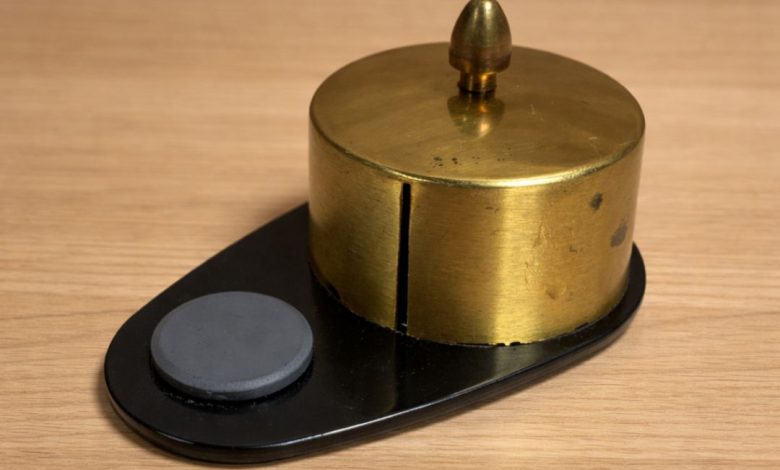
There’s a good chance you’ve seen this little brass gadget and thought, “What on earth is that?” It looks like something rescued from an old executive desk, yet its strange shape had a very practical job. This vintage brass stamp dispenser was made to keep a roll of postage stamps ready to pull, feed, and tear without the usual desk-drawer mess.
So, What Is This Brass Desk Gadget?
The item is commonly described as a vintage brass desktop postage stamp roll dispenser, stamp roll holder, or stamp roll dispenser/feeder. In plain English, it was a small mailing tool designed to sit on a desk and make repeated stamping jobs faster.
Instead of hunting through an envelope drawer for individual stamps, an office worker could load a roll into the brass housing, guide the strip through the opening, and pull out the next stamp when needed. That sounds simple because it was. Good office equipment often solved one tiny annoyance extremely well.
Why Did Offices Need One?
Before today’s digital-first offices, outgoing mail was a daily chore for businesses, reception desks, secretaries, mailrooms, and small shops. Letters, invoices, statements, forms, and packages could pile up quickly.
A stamp roll dispenser kept the stamps together and positioned them where the worker needed them. As a result, it reduced fumbling and helped keep the mailing station organized.
It also made sense for anyone sending a steady stream of letters. When you have dozens of envelopes in front of you, saving a few seconds per envelope adds up surprisingly fast.
How the Vintage Stamp Dispenser Works
The mechanism is easier to understand once you look at the parts. The brass cylinder acts as the main housing, while the black base gives the unit enough weight to stay put during use.
- Open the housing. The top knob is typically used to lift or remove the cover.
- Load the roll. Place a compatible postage stamp roll inside the cylindrical chamber.
- Feed the strip. Guide the leading edge through the narrow vertical opening.
- Pull the stamps forward. Draw out enough of the strip for the next mailing task.
- Tear at the perforation. Separate the stamp or section of stamps along the perforated edge.
The exact internal arrangement can vary between models, so don’t force a roll through the slot if it catches. A dispenser that has sat unused for decades may need gentle cleaning or inspection before you try operating it.
The Little Magnet on the Base Is a Clue
One of the most interesting details is the round magnetic area on the base. At first glance, it can look decorative. It probably wasn’t there just for looks.
A magnetic catch point gives the user a handy place to park paper clips or other small metal office fasteners. That makes the object more than a stamp holder; it becomes a compact desktop organizer.
Imagine an old reception desk with envelopes on one side, stamps in front, and a handful of paper clips constantly wandering around. Having a small magnetic spot built into the dispenser would have been genuinely useful.
Who Made It?
The competitor description associates the piece with Pat Products and references K & McD, Inc.. Those markings can be important when identifying a vintage office accessory, but they should be treated as clues rather than proof of an exact manufacturing date.
Patent wording, company names, catalog references, and construction details can help narrow down a piece’s history. However, without a clear manufacturer mark, patent number, catalog page, or dated advertisement, it is safer to describe the dispenser as a mid-to-late 20th-century-style office accessory rather than attach a precise year to it.
What the Brass Construction Tells You
The heavy brass body is one reason these objects still attract attention. Brass gives a small desk accessory a reassuring weight, and it develops a different surface appearance as it ages.
You may notice darker areas, soft scratches, or an uneven patina. Those marks can tell a story about years of handling. Naturally, collectors should think twice before aggressively polishing an old piece, because removing the aged surface can change its character and, depending on the item, its collector appeal.
Pro Tip: If you’re cleaning a vintage brass office accessory, start with a soft dry cloth. If more cleaning is needed, use a gentle method appropriate for the finish and test an inconspicuous area first.
What Can You Use It For Today?
You probably aren’t running a 1970s mailroom, but that doesn’t mean this gadget has to sit on a shelf collecting dust. Its basic dispensing idea still works with several small rolls, provided the dimensions fit safely.
- Washi tape: A fun option for a craft desk when the roll width and core size match.
- Small adhesive labels: Useful for a packing station, scrapbook area, or home office.
- Narrow sealing tape: Some compatible rolls may work for lightweight packaging tasks.
- Paper clips: The magnetic area can keep small metal clips from spreading across the desk.
Before repurposing it, measure the chamber, check the opening, and make sure the roll turns freely. A modern roll that is too wide, too heavy, or tightly wound can put unnecessary strain on an old dispenser.
Common Mistakes When Identifying One
The biggest mistake is assuming every brass cylinder on an old desk is a stamp dispenser. Vintage office equipment can include tape holders, pencil accessories, memo tools, and other small fixtures with similar shapes.
Look for the combination of clues instead: a roll-sized interior, a feeding slot, a tear point or perforation-friendly edge, a stable desktop base, and any manufacturer or patent markings.
Another mistake is dating the item from its appearance alone. Brass and black finishes were used across many decades, so style can suggest an era but rarely proves it.
Is It Worth Keeping?
For vintage-office collectors, the appeal is easy to understand. This is a small object with a job you can still explain and, in some cases, still demonstrate.
It also has the kind of compact footprint that works nicely in a home office, library, writing desk, or vintage-inspired workspace. Unlike a purely decorative object, it can actually hold something and dispense it.
If you find one at a flea market, estate sale, or tucked inside an old desk, check the underside and inside the housing before cleaning it. Manufacturer marks, patent information, unusual fasteners, and original wear may be more interesting than a freshly polished finish.
The Real Charm of This Old Desk Tool
What makes a vintage brass stamp dispenser fascinating isn’t that it was complicated. It’s the opposite. Someone had a repetitive little office problem, and this compact tool gave them a neat answer.
Today, the same piece can serve as a conversation starter, a functional desk accessory, or a clever craft-room organizer. So the next time you spot that mysterious brass cylinder with a black base and a tiny magnetic pad, don’t dismiss it as random old office clutter.
It may be a vintage brass stamp dispenser—a modest reminder of how much thought used to go into the smallest tools on a working desk.