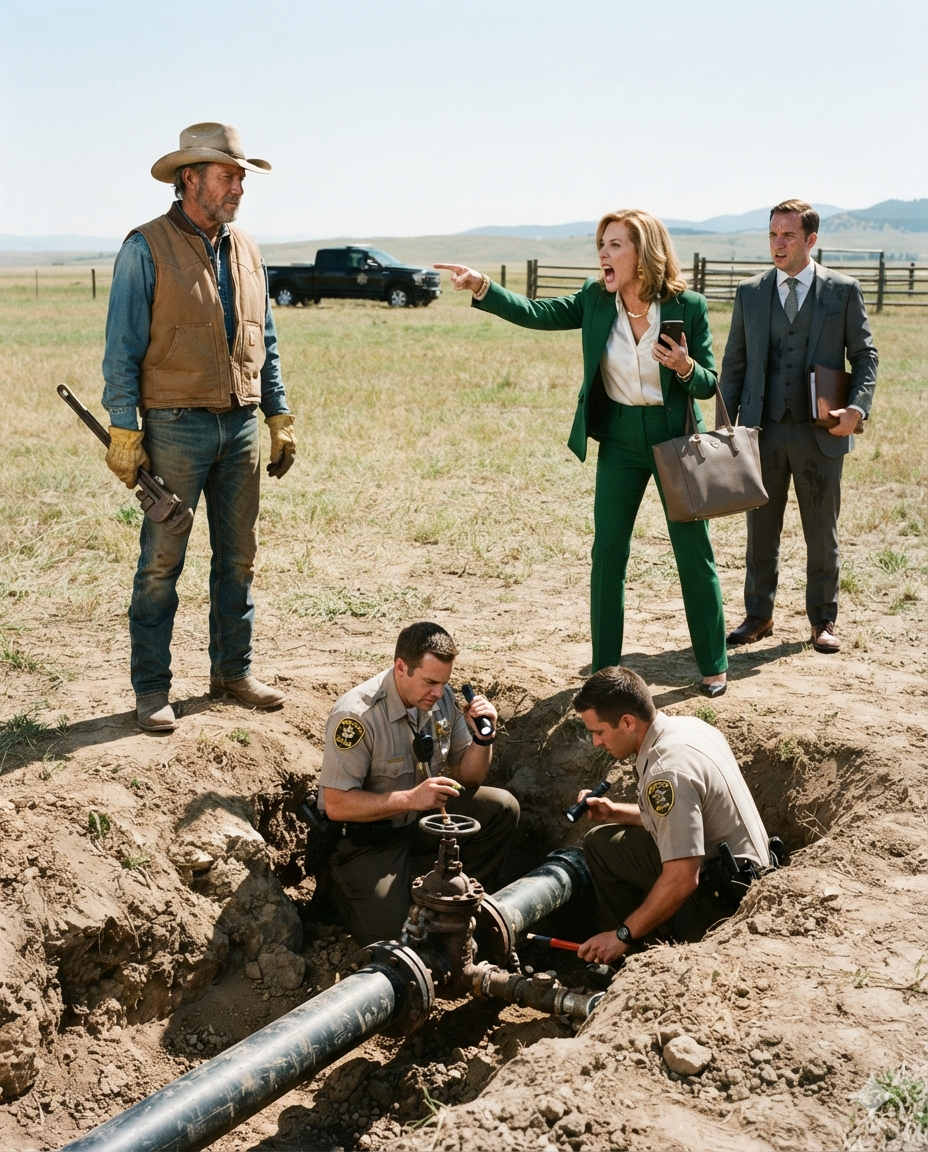
That small movement told me more than anything she had said.
Deputy Ortiz noticed it too.
“When did you ask for those records?” he said.
“Twelve days ago.”
“Did you notify the HOA you intended to close the valve?”
“I sent notice by certified mail eight days ago. The delivery receipt was signed.”
Arthur looked down.
Victoria said, “I never received it.”
“Your signature is on the postal receipt.”
“I have an office administrator who handles correspondence.”
“It isn’t your administrator’s signature.”
For one second, no one spoke.
Then a man across the road called out, “Victoria, did you know about this?”
She spun toward him.
“Go home, Leonard.”
“You told us the municipal main ruptured.”
“This is being handled.”
The man stepped closer to the entrance gate.
He was in his early seventies, wearing khaki shorts and a Summit Crest polo shirt. His face was red, but not from anger. He looked frightened.
“My wife’s oxygen concentrator and medical filtration setup need a steady line.”
I turned toward him.
“The domestic holding tanks still have pressure, sir. Don’t drain them for lawn care. If the HOA keeps the irrigation zones isolated, you should have enough supply until a legitimate tie-in is arranged.”
He stared at me.
“You’re sure?”
“I checked the subdivision’s visible storage indicators from the ridge early this morning. You have far more reserve than Ms. Sterling is telling you.”
Victoria’s voice cut through the air.
“Do not take engineering advice from him.”
The man looked at her.
“You said we had three hours.”
“That was a precaution.”
“You told us to fill every sink and tub.”
“I was protecting our community.”
“No,” I said. “You were manufacturing a panic before law enforcement got here.”
Deputy Vance turned her head slightly toward me.
It was a warning not to push too hard.
I stopped.
I had learned a long time ago that the first person to lose control usually lost the room.
Victoria had not learned that.
“He is doing this out of spite for Summit Crest,” she said. “His father hated us too.”
The words landed harder than she intended.
Deputy Ortiz looked at her.
“You knew his father?”
Victoria froze.
Arthur closed his eyes for half a second.
I lowered my hands.
Vance did not tell me to raise them again.
“My father died long before Summit Crest was completed,” I said.
Victoria’s face lost color.
“I meant the developers. His family fought the developers.”
“You said my father hated you.”
“It was a figure of speech.”
“My father’s name was Franklin Bennett. Did you know him?”
“No.”
The answer came too quickly.
I looked at Arthur.
He would not meet my eyes.
Deputy Ortiz stepped toward the cattle guard.
“All right. We’re going to inspect the valve. Mr. Bennett, lead the way. Ms. Sterling, you stay here with Deputy Vance.”
“I am not staying at the road while he stages a scene.”
Ortiz’s gaze did not change.
“Then you can wait inside your vehicle.”
Victoria stared at him.
People usually backed down when she stared at them.
Deputy Ortiz did not.
She turned away with a sharp breath and folded her arms.
I walked with Ortiz down the gravel track.
My ranch stretched west beneath a jagged dark ridge that gave the property its name. The dry grass had turned amber in the late summer heat. Ponderosa pines stood along the wash, their needles whispering whenever the canyon draft picked up.
Three weeks earlier, I had signed the closing deeds at an escrow office in Oakhaven, Wyoming, putting down my entire life savings and every cent from the sale of my engineering consultancy.
The ranch had once belonged to my family.
My grandfather had grazed cattle there. My father had built the stone spring house with his own hands. I had learned to swim in the lower weir pool and learned to drive in a beat-up Dodge truck that struggled up the western grade.
Then my father died.
The official coroner’s file stated he lost control on Old Timber Road during a midnight storm.
His truck breached a barrier and tumbled into Crow Creek Ravine.
I was twenty.
My mother sold the ranch ten months later because probate debts, bank liens, and legal fees had consumed everything we owned.
I left the region after finishing my engineering degree and convinced myself I was done with Blackwood Basin.
That was a lie I told myself for twenty-four years.
When the parcels surfaced in a bank foreclosure docket that spring, I bought the land back.
I expected collapsed fences, corroded feeder pipes, and overgrown outbuildings.
I did not expect my mountain spring to be pressurized and feeding a luxury enclave that hadn’t existed when my father was alive.
Deputy Ortiz walked beside me without speaking until we reached the pump shed.
The building was older than the rest of the compound. Hand-hewn timbers. Corrugated tin roof. A heavy wooden door fitted with a hardened padlock I had installed right after closing.
The neon yellow survey rod leaned against the outer wall.
Ortiz picked it up.
“Deadly weapon.”
“I’m glad you got here before I reached for the tripod.”
A corner of his mouth moved.
Then he looked down at the gravel.
Fresh boot impressions circled the concrete footing.
Not mine.
The profile was narrow with an elevated, tapered heel.
Victoria had been wearing tailored leather boots that morning.
Ortiz noticed immediately.
“She came down here?”
“At six-fifteen. I found her standing right by the manifold when I walked out.”
“What was she doing?”
“Taking photos. She told me the HOA board would condemn this entire parcel by winter if I touched a single line.”
“Did she threaten you directly?”
“She called it an inevitable outcome.”
“Did you record it?”
“My phone was back in the truck.”
He studied me.
“You’re remarkably calm about this whole mess.”
“My father used to say that panic is just water finding the weakest seam. People ought to have better containment.”
Ortiz looked out toward the wash.
“Your father was Frank Bennett?”
I turned.
“You knew him?”
“I was eighteen when he went off the road. My family ran the hardware supply in town. Frank used to come in every other Saturday.”
That was not the answer I anticipated.
“Did he ever mention Summit Crest?”
“It wasn’t Summit Crest back then. It was Pine Ridge Development Corporation.”
The name stirred an old memory.
A faded newspaper clipping.
My mother weeping over bank statements at the kitchen table.
A man in an expensive tailored coat standing near our corral.
“Garrett Vance,” I said.
Ortiz nodded slowly.
“Developer out of Salt Lake City. Bought up all the parcels east of your boundary fence.”
“Victoria’s maiden name was Vance.”
He glanced back toward the main road.
“You certain of that?”
“I pulled the corporate registry filings on the HOA board.”
“Did your father have problems with Garrett?”
“My father told my mother that Garrett was trying to tap our aquifer. He never went into specifics.”
Ortiz’s face turned stony.
“Show me the valve.”
I unlocked the pump house.
The cool air inside carried the scent of iron-rich water, aging timber, and hydraulic grease.
The primary aquifer line entered through the west stone foundation in a fourteen-inch welded steel pipe. It discharged into an open concrete settling tank before splitting into three headers.
One header ran south toward the livestock tanks.
One ran downhill toward the lower weir.
The third disappeared straight beneath the east foundation wall.
That branch did not appear on a single survey, property title, water right adjudication, county infrastructure chart, or engineering blueprint tied to the ranch.
Its heavy gate valve was painted industrial red.
A brass identification plate had once been riveted to the masonry directly above it. Four empty anchor holes remained.
I pointed to the ultrasonic flow logger I had clamped onto the pipe forty-eight hours after moving in.
“This line was drawing approximately sixty-four gallons a minute throughout the night,” I said.
Ortiz knelt down to read the digital display.
“And this morning?”
“I began closing the wheel at six-thirty. Complete cutoff took eighteen minutes.”
“You set up the meter?”
“A licensed master pipefitter installed it. The county water inspector signed off on the calibration yesterday.”
He looked at the red handwheel.
A deep scratch scored the painted rim.
Someone had taken a tool to it after I had chained and padlocked it shut.
Ortiz spotted the floor next.
“Where’s the lock?”
I pointed toward the corner.
A heavy case-hardened chain lay coiled on the slab.
One link had been sheared cleanly through.
The raw steel edge sparkled in the dim light.
“I didn’t cut that,” I said.
“Who did?”
“I found it like that when I walked back from the front gate.”
Ortiz stood up.
“You left this shed unlocked?”
“I locked the outer hasp at six-forty-nine.”
He stepped toward the severed chain.
“What time did Ms. Sterling call dispatch?”
“Seven-oh-two.”
“When did we roll up?”
“Seven-twenty-four.”
“Who else holds a key to that padlock?”
“Nobody. Just me.”
“Then whoever cut that link came in through a different way.”
“There isn’t another way in.”
Ortiz took out a heavy tactical flashlight.
He swept the beam across the timber walls, the floor seams, and the ceiling joists.
The shed was fourteen feet square. No exterior windows. One heavy timber door. A poured slab underfoot.
He swept the light along the east wall.
Then the beam locked in place.
A fine trickle of sawdust and dried moss lay beside a row of stacked burlap feed sacks.
“What’s behind those bags?”
“Just cedar siding.”
We hauled the sacks aside.
The rough timber boards matched the rest of the shed, but the fasteners were modern hex-head screws rather than old cut nails.
Ortiz pressed against the center board.
It gave way with a soft mechanical click.
He stepped back immediately.
“Don’t touch another thing.”
He keyed his shoulder mic and called Vance.
Within four minutes, she had instructed Victoria, Arthur, and the onlookers to move back toward the main asphalt road. Then she stepped into the shed wearing latex gloves and carrying a departmental DSLR camera.
Together, the deputies backed out four screws.
Behind the wood paneling sat a heavy vault door fabricated from plate steel.
It had no external latch on our side.
A recessed digital keypad was set into the reinforced frame.
Its status LED glowed steady green.
Deputy Vance stared at it.
“You had no idea this was behind the wall?”
“None.”
“When did you last shift those feed sacks?”
“I didn’t. They were sitting right there when the bank handed over the keys.”
Ortiz photographed the keypad assembly.
“Do you have a combination?”
“I didn’t even know there was a reinforced wall.”
Vance ran a gloved finger along the jamb.
“Fresh synthetic lubricant on the hinge pins.”
Ortiz looked toward the pasture.
“Someone comes in and out of here regularly.”
The pump shed fell dead quiet.
A faint, deep pulse vibrated through the concrete beneath our boots.
It wasn’t water surge.
It was heavy mechanical machinery cycling somewhere below.
The vibration ran for four seconds, then vanished.
Deputy Vance looked down at the floor.
“What was that?”
“I don’t know.”
A heavy series of knocks rattled the outer timber door.
Three rapid raps.
“Deputies?” Arthur Hayes called out from the path. “I need to present an urgent update.”
Ortiz opened the outer door halfway, blocking the threshold.
Arthur stood alone on the gravel.
Sweat had soaked clean through the collar of his dress shirt.
“Ms. Sterling has produced the recorded water conveyance document,” he said.
“That was remarkably quick,” Ortiz replied.
“She pulled it from the association’s secure cloud repository.”
“Let me look at it.”
Arthur handed over a ruggedized tablet.
Ortiz scrolled through the PDF.
His eyes scanned the paragraphs methodically.
Then he turned the screen toward me.
The header read PERPETUAL SUBSURFACE CONVEYANCE AND EXTRACTION EASEMENT.
It granted Pine Ridge Development Corporation the irrevocable right to draw up to one hundred thousand gallons per day from the Blackwood Basin spring network.
It bore my father’s full legal name.
It bore what looked like his signature.
The execution date was November 12, twenty-four years ago.
Six days after my father was buried.
I read the notary seal twice.
Arthur watched me closely.
“That recorded instrument has governed this utility corridor since initial ground breaking,” he said.
“My father signed an easement six days after his funeral?”
Arthur didn’t blink, but his throat moved.
Deputy Vance looked over his shoulder at the screen.
“Are you certain this is the document you want to enter into official record, counselor?”
His complexion drained to gray.
“Instruments are occasionally drafted and signed prior to their formal notarization date.”
“The jurat explicitly states Franklin Bennett appeared in person before a notary on November twelfth,” I said.
Arthur reached out to retrieve the tablet.
Ortiz pulled it out of his reach.
“Where did this file come from?”
“Ms. Sterling provided it.”
“Where is the original paper instrument?”
“I cannot confirm its physical location.”
“Is it indexed with the county clerk?”
“It may have been missed during the digital migration.”
“I searched the physical deed vaults myself,” I said. “There is no record of it.”
Arthur’s voice went tight and thin.
“This is entirely a civil matter.”
Deputy Ortiz stared at the forged signature of a dead landowner.
“It might have started that way.”
Outside, an engine roared to life.
Vance reacted instantly.
She bolted out the pump shed door.
I followed her onto the sunlit gravel.
Victoria’s Lexus was throwing dust as it backed rapidly away from the cattle guard.
Deputy Vance shouted for the vehicle to halt.
Victoria gunned the throttle.
The rear bumper caught the corner of a heavy wooden gatepost, shattering the taillight housing, before the car swung wildly onto Old Timber Road.
The second patrol SUV pulled forward, cutting off the eastern lane.
Victoria slammed on the brakes.
A cloud of gray dust drifted across the pavement.
Deputy Vance reached the driver’s window and ordered the door opened.
Victoria dropped the glass two inches.
“I am returning to my residence to handle an urgent community matter.”
“Turn off the engine and step out of the car.”
“My legal counsel instructed me that I am free to leave.”
Arthur had just hurried up the gravel path behind us.
“I gave no such instruction.”
Victoria stared at him through the side mirror.
The glare was cold enough to freeze iron.
“You told me this was a property dispute.”
“I told you the water access was a civil question.”
She locked the doors.
Deputy Vance’s tone became ice-cold.
“Ms. Sterling, exit the vehicle immediately.”
“I have committed no infraction.”
“Then you can answer our questions on the shoulder.”
“I have answered everything relevant.”
“You told county dispatch Mr. Bennett brandished a firearm at you.”
“He did.”
“The object on scene is a fiberglass survey tool.”
“He held it in a threatening posture.”
“I have already reviewed Mr. Bennett’s perimeter trail camera footage. He never held that tool anywhere near you.”
Victoria’s head snapped toward me.
That was the exact moment panic cracked through her composure.
I had placed two cellular game cameras along the approach after finding cut wire on my perimeter fence during my first week on the property. One monitored the main cattle guard. The other was mounted in a pine tree watching the pump shed.
I had informed Ortiz about the system while Vance was managing the crowd at the road.
The footage showed Victoria pulling up before daylight.
It showed her walking down the drive alone.
It showed her entering the pump shed carrying a heavy set of hand tools.
It showed her emerging eleven minutes later.
Then it showed me walking down from the house.
Victoria finally unlocked the Lexus and stepped out.
Vance did not apply handcuffs.
Not yet.
She escorted her over to the patrol cruiser and asked where the digital easement file had originated.
Victoria crossed her arms.
“It came from the association’s historic records.”
“Why does the document bear the signature of a man who died nearly a week prior to that date?”
“I don’t know. It’s a legacy scan from twenty years ago.”
“Did you enter the pump house this morning?”
“No.”
“We have time-stamped video.”
“I walked past it.”
“You opened the door.”
“The door was sitting wide open.”
“It was padlocked shut.”
“Our association holds historic access rights.”
“How did you open the lock?”
“I didn’t.”
“What did you use to cut the hardened steel link?”
“I never touched any chain.”
Vance held up a clear evidence pouch.
Inside was the cut link of chain.
Victoria looked away toward the horizon.
Deputy Ortiz walked up the drive holding the tablet.
“Ms. Sterling, do you want to explain the reinforced vault door built into the east wall of that shed?”
Her reaction was almost imperceptible.
Her eyes flicked toward the upper canyon.
Not the shed.
Not the road.
The upper canyon.
Then she said, “I have no idea what door you’re talking about.”
Ortiz and Vance traded a look.
The entire tenor of the scene changed.
The deputies were no longer mediating an aggressive property squabble. They were securing an active criminal scene.
They called in the county forensic unit.
They notified the regional environmental protection division.
They phoned the duty magistrate to request an emergency search warrant covering the concealed structure, the utility bypass, and all files connected to the forged instrument.
Victoria was not placed in custody right then.
She was formally ordered not to leave the jurisdiction.
Her vehicle was searched with her signed consent after Vance explained the alternative was impoundment pending a separate warrant.
Inside the center console, deputies found a pair of heavy compound-action bolt cutters.
Fresh metal shavings clung to the cutting edges.
They also recovered a brass key ring holding three keys.
One of those keys slid perfectly into the padlock on my outer pump house door.
I had replaced that padlock five days earlier.
Only two keys had been cut.
One was clipped to my belt.
The other was sitting inside a locked oak desk in my ranch office.
When Deputy Ortiz held the key under the light, I recognized the small three-digit code stamped on the bow.
The locksmith in Oakhaven had stamped the exact same code on both of mine.
It was an exact copy.
Which meant someone had been inside my home while I was away.
Victoria insisted she had never seen the key ring before.
Arthur Hayes went completely silent.
At 9:45 that morning, Summit Crest’s property management group broadcast an email informing all homeowners that the water disruption was due to an “unforeseen property line discrepancy.”
At 9:52, captures of the forged document began hitting the neighborhood private forum.
At 10:04, a resident uploaded a clipping of my father’s obituary from twenty-four years ago.
At 10:15, the first neighbor walked across the county asphalt to speak with me.
Her name was Claire Dawson.
She was a middle school science teacher in Oakhaven who lived on the lower loop of Summit Crest with her husband and two daughters. She wore running shoes, denim shorts, and looked like someone whose entire world had just shifted beneath her feet.
“I want to apologize for what Victoria was shouting,” she said.
“You weren’t the one shouting it.”
“I believed her when she called the meeting.”
“Most people believe what they’re told until the pressure drops.”
She nodded, taking the point.
“We’ve paid a special infrastructure assessment every quarter for twelve years.”
“What does that run?”
“It started at ninety dollars a month. It’s up to three hundred and ten now.”
“For every lot?”
“Every single home.”
Summit Crest contained two hundred and eighteen properties.
I did the mental arithmetic.
Over eight hundred thousand dollars annually.
“What does the board claim that fee pays for?”
“Water rights leasing, certified testing, filtration maintenance, backup reservoir upkeep.”
“Have you ever seen an independent lab certificate?”
“Victoria shows summary slides at the annual general meeting.”
“Actual laboratory manifests?”
“No.”
“Itemized maintenance contracts?”
“The board claimed those were protected under critical utility infrastructure privacy rules.”
I glanced back toward the pump shed, where yellow barrier tape was now fluttering in the breeze.
“What contractor handles the system maintenance?”
“Clearwater Basin Environmental.”
I had run that name through the state licensing database two nights ago.
No corporate entity by that name held a valid plumbing, engineering, or excavation license.
“Who is listed as the owner?”
“I don’t know.”
“You should ask your treasurer.”
Claire’s expression faltered.
“Our treasurer stepped down five days ago.”
“Why?”
“Victoria announced he was dealing with sudden health issues.”
“What was his name?”
“Warren Miller.”
“Does he still live in the development?”
She pointed toward a gray timber home on the upper ridge.
“Top of Aspen Ridge Road.”
Before I could follow up, her phone buzzed in her hand.
She looked at the screen.
Then at me.
“It’s the community emergency broadcast system.”
She put the call on speaker.
Victoria’s recorded voice rang out clearly.
“Attention, Summit Crest homeowners. Due to an unlawful and destructive act by the new occupant of Blackwood Basin Ranch, all households are instructed to initiate emergency water conservation. Do not approach Mr. Bennett. Do not enter his perimeter. Do not release association documents to outside parties without explicit executive board clearance. Legal counsel is pursuing emergency injunctions and immediate utility eminent domain.”
Claire slowly lowered her phone.
Deputy Vance, standing six feet away, had caught every syllable.
“Board clearance?” Vance noted flatly.
Claire looked shaken.
“She can’t order us not to cooperate with an investigation, can she?”
“No,” Vance said. “She cannot.”
The search warrant was signed at 11:30.
The county locksmith took thirty-five minutes to bypass the electronic lock on the concealed vault door.
The passcode had not been randomized.
It was 110602.
November 6, 2002.
The exact date my father died.
Nobody spoke the date out loud when the relay clicked.
We all knew what it was.
The heavy steel slab swung inward.
A blast of cold, dry air swept out of the opening.
Deputy Ortiz led the entry with his flashlight and service weapon drawn. Vance followed directly behind. The crime scene technician stepped in with an equipment kit.
I stayed on the threshold until they verified the perimeter was clear.
From the doorway of the shed, I watched their flashlights sweep across smooth poured concrete.
The subterranean vault extended far out under the eastern pasture. It dwarfed the timber shed above, measuring roughly twenty-five feet wide and fifty feet in length.
A steel industrial staircase descended eight feet.
The unpermitted main line ran straight down the centerline of the chamber.
It wasn’t standard ductile iron or farm-grade PVC.
It was high-pressure stainless steel, sixteen inches in diameter, anchored to reinforced vibration-dampening cradles.
Two massive multi-stage booster pumps sat side-by-side on raised pads.
Both pump casings were still warm to the touch.
A digital telemetry cabinet displayed active line pressure, flow velocity, and storage volume.
The entire station had been running until I closed the gate valve that morning.
Racks along the wall held industrial filter cartridges, replacement mechanical seals, chemical drums, and specialized valve wrenches.
A metal workbench stood against the far bulkhead.
Pinned above it was a detailed engineering schematic of Summit Crest.
No corporate title block.
No engineering seal.
No county approval stamp.
Yet every parcel was numbered.
The two main holding tanks, the clubhouse grounds, the private golf greens, and Victoria Sterling’s multi-acre estate on the upper crest were clearly designated.
Her parcel showed three separate high-capacity supply lines.
Every other house had one standard line.
The technician photographed the schematic from several angles.
Deputy Ortiz waved me down once the room was fully documented.
I descended the metal steps, feeling the air turn distinctly colder.
It carried a sterile, sharp scent—like ozone and damp limestone.
“This isn’t something a local rancher threw together in a spare season,” Ortiz remarked.
“No. This took structural blueprints, heavy subterranean boring rigs, high-voltage electrical drops, and certified industrial pipefitters.”
“Could this have been put in twenty years ago?”
“The pumps and telemetry are modern. Maybe four or five years old. The main conduit looks older.”
Vance pointed toward an upright steel filing cabinet.
The lock had been forced.
Inside were multiple three-ring binders.
The top binder contained handwritten maintenance logs.
The records dated back twenty years.
Many entries were initialed.
VS.
Victoria Sterling.
Others were marked GV.
Garrett Vance.
Her father.
A third set of initials appeared consistently throughout the earliest twenty-four months of records.
FB.
My father’s initials.
I moved closer to the desk.
Ortiz put a hand up to hold me back.
“Let forensics log it first.”
“My father never ran pipe for Garrett Vance.”
“You certain of that?”
“He spent three years fighting him in county planning meetings.”
“Men sometimes end up cutting deals with people they fought.”
“Not six days after they’re put in the ground.”
Ortiz looked at the open log.
Several entries marked FB were dated months after the accident at Crow Creek Ravine.
A dead man had supposedly checked line pressures, replaced impellers, balanced chlorine feeds, and certified delivery volumes.
Year after year.
His identity had been used as cover.
A legal shield.
A way to make an unpermitted tap look like a private family agreement.
Vance opened a lower drawer.
It held rows of labeled folders.
Inside the most recent folder were bank transfer slips, wire receipts, and invoices from Clearwater Basin Environmental.
The billing address was a commercial mail drop in Salt Lake City.
The bank statements tracked recurring deposits from the Summit Crest Master Association.
The receiving entity was Sterling Land & Resource Management LLC.
Victoria Sterling was listed as the sole managing member.
Claire Dawson had remained near the yellow tape at the shed entrance. When Deputy Vance brought one of the bagged invoices up the steps, Claire caught sight of the LLC name and pressed her hands to her face.
“Victoria owns Clearwater Basin?”
“She’s the registered manager,” Vance replied.
“She swore to the entire neighborhood that it was an independent regional utility company.”
Deputy Ortiz tapped the display of a desk calculator near the logs.
The last calculation remained on the LCD screen.
812,160.
Almost the exact sum of twelve months of neighborhood water assessments.
I assumed that was the extent of what was hidden down there.
It was not.
At the far eastern end of the chamber, the main line split at a massive forged manifold.
The upper header ran east toward Summit Crest.
The lower branch angled sharply downward into the reinforced foundation slab.
Its isolation valve stood wide open.
Yet no fluid was moving through the sight glass.
A heavy stainless tag was welded to the neck of the valve.
Unlike the rest of the polished hardware, the metal had deep, jagged gouges across the surface, as if someone had tried to grind the text away.
The technician cleaned the face with a solvent wipe.
Three stamped words became visible.
RAVINE DRAINAGE CONDUIT.
Deputy Ortiz read the plate carefully.
“Ravine as in Crow Creek Ravine?”
“Where my father’s truck was found,” I said.
The subterranean vibration returned.
Four seconds of deep mechanical hum.
Then dead silence.
Ortiz dropped to one knee and placed his palm against the lower conduit.
“That pulse traveled through the pipe.”
“That isn’t a hydraulic surge,” I told him. “It’s a compressor or a deep pump cycling.”
“Where is it originating?”
I looked toward the upper canyon.
“Somewhere past our property line.”
An hour later, an engineering team from the state water authority arrived with subterranean sonar and line-locating gear.
The supervisor was an engineer named Elena Rostova. She had decades of pipeline experience and zero interest in bureaucratic delays.
She inspected the manifold, the booster setup, and the valve linkages.
“This distribution capacity could easily handle three separate subdivisions,” she said.
“Is there any municipal permit for this bypass?” Ortiz asked.
“None on file with the state engineer.”
“Could it be tied into a secondary system?”
“You can plumb anything into anything if you have enough capital and don’t care about regulations.”
She deployed ground-penetrating radar along the Summit Crest header.
The line traversed my pasture, crossed under Old Timber Road, and entered the development through a concealed drainage culvert.
That established the unauthorized diversion.
Then she traced the lower conduit.
The signal went north-northwest.
Not toward the subdivision.
It cut beneath my lower weir, ran along the dry creek bed, and tracked toward the old abandoned limestone quarry above Crow Creek Ravine.
After fourteen hundred feet, the line plunged into a deep rock formation where the radar lost the signal.
Elena returned to the underground vault and paged through the historic logs.
“This manifold was engineered as a bidirectional transfer system,” she observed.
“What does that mean in practical terms?” Vance asked.
“Water wasn’t just pumped out of this ranch.”
She traced the check valves along the lower conduit.
“The valving is set up to draw flow from the north and push it either into the subdivision or back into this aquifer.”
“Why would anyone pump water from an abandoned quarry into a drinking system?”
“Unless the quarry isn’t abandoned, or they were using the mountain cavern as a high-pressure storage reservoir.”
I looked at the open gate valve.
“If fluid came from the north, where did it end up?”
“Straight through these boosters. Into the neighborhood line, and directly into your spring if the primary head pressure dropped.”
“Could that contaminate the fresh water supply?”
“Instantly.”
The air in the vault seemed to grow colder.
Deputy Ortiz looked at the drums of chemical neutralizer.
“How often was Summit Crest testing its tap water?”
Elena’s face hardened.
“A private system feeding domestic residences is required by state statute to run comprehensive certified quarterly panels.”
Claire was standing by the stairs.
“Victoria told us the water was tested every month.”
“By what laboratory?”
“Clearwater Basin Environmental.”
Elena looked at the invoice in the evidence bag.
“Clearwater Basin is not a certified environmental laboratory.”
Claire went pale.
“What have we been running through our houses?”
Nobody answered.
The county health department issued an emergency boil-water order for Summit Crest at 2:15 that afternoon.
Potable water tankers arrived before dusk.
Residents formed long lines with water jugs, coolers, and plastic totes. The scene looked less like a luxury mountain community and more like an evacuation camp.
Victoria stood near the clubhouse veranda attempting to direct residents until several homeowners surrounded her demanding answers about Sterling Land Management.
She claimed the corporate name was an administrative technicality.
A homeowner pulled the state business filing on a smartphone and held it in front of her face.
She claimed the filing had been submitted incorrectly by an outside accountant.
Then Warren Miller drove up.
The former HOA treasurer arrived in an old green Volvo wagon. He parked near the tennis courts and remained inside the vehicle for several minutes.
When he stepped out, he held a heavy gray plastic file crate.
He walked past Victoria without acknowledging her.
She called his name.
He didn’t turn around.
Deputy Vance intercepted him at the edge of the lot.
“My name is Warren Miller,” he said quietly. “I want this documentation entered into the official record before anything happens to it.”
Victoria went silent.
The residents around her did too.
Warren was in his late sixties, slight of build, with a noticeable tremor in his hands. He held the file crate tightly against his chest.
“What kind of documentation?” Vance asked.
“Everything she kept off the official board minutes.”
He looked straight at Victoria.
She let out a dry laugh.
“Warren has been under tremendous personal strain,” she said loudly. “His resignation was due to cognitive fatigue.”
Warren turned toward the crowd gathered by the tanker truck.
“For twelve years, Victoria Sterling has charged this neighborhood for water rights that belong to the Bennett family.”
Silence fell over the parking lot.
“She charged you for environmental testing that never took place. She charged you for state compliance filings that were never submitted. She routed maintenance contracts through an entity she personally controlled. And every time I asked to review the foundational easement, she presented an agreement bearing Frank Bennett’s name.”
He turned toward me.
“I’m sorry, Cole.”
Hearing my name from him hit hard.
“Did you know my father?”
“A little.”
“Before the ravine accident?”
“Yes.”
Victoria stepped off the curb.
“Warren, you need to stop talking.”
Deputy Ortiz placed himself between them.
Warren’s hands shook, but his voice stayed steady.
“Your father found out about the bypass conduit while the access roads were being cut. He knew Garrett Vance was pulling unmetered volume from the mountain aquifer and using the old quarry caverns as an unpermitted storage bank.”
“What kind of storage?”
“I don’t know the exact nature of it.”
“You signed the corporate checks,” I said. “You were the treasurer.”
“I reconciled the ledgers against the invoices she provided. Victoria held the banking authority.”
“You could have brought this to the sheriff’s department years ago.”
“I should have.”
“Why didn’t you?”
He looked over at Victoria.
“Because she had files on my son.”
A cold anger settled into my chest.
“What files?”
Warren swallowed hard.
“My son had a severe prescription dependency years ago. He was arrested in another county. Victoria had photographs and police records from before his record was sealed. She told me she would send them to his medical licensing board and file for third-party custody of my grandson if I interfered with the water accounts.”
Victoria shook her head with a look of mild disgust.
“This is an absurd fabrication.”
Warren placed the file crate onto the hood of Deputy Vance’s cruiser.
Inside were years of internal spreadsheets, bank transfer receipts, email printouts, and executive session logs.
One folder held canceled checks endorsed to Sterling Land & Resource Management.
Another held formal warning letters from the state engineer noting the lack of an approved utility connection.
A third contained a handwritten roster of homeowners who had raised questions during board meetings.
Beside each name was a notation.
Pending foreclosure.
Marital separation.
Undisclosed tax lien.
Unpermitted room addition.
Juvenile court record.
Health insurance claim.
Warren had pulled the files from the association’s locked vault before handing in his key.
Claire Dawson leaned over and spotted her own name on the list.
Beside it were four handwritten words:
Husband’s tenure review pending.
She turned toward Victoria with wide eyes.
“You threatened Mark’s university standing when I asked for the utility audit?”
“I have no idea what that note means.”
“You told me that challenging board decisions often leads to unexpected professional complications.”
“That was general advice.”
“You wrote this in your own handwriting.”
“Warren could have written anything in that box.”
Warren held up his hands.
“The handwriting analysis will settle that very quickly.”
Shouting broke out across the parking lot.
Deputy Ortiz stepped forward with authority.
“Everyone back up. Give us room.”
The crowd complied.
Not out of deference to Victoria.
Because they knew it was over.
The deputies placed Victoria in the rear seat of a patrol cruiser while they inventoried the file crate.
She was formally handcuffed after Deputy Vance discovered a printed email tucked inside one of the bank folders.
It was an email from Victoria to Arthur Hayes sent nine days prior, exactly two hours after my certified letter had been logged.
The subject line read: BENNETT ACQUISITION RISK.
The text was brief:
Locate the original conveyance file. Rectify the signature date discrepancy immediately. We cannot allow him to isolate the valve prior to the Ridge consolidation closing. If required, trigger an operational disruption and involve county law enforcement. Once the board secures emergency receivership over his infrastructure, we initiate statutory condemnation.
Arthur read the paper over Vance’s shoulder.
He sank down onto the curb and rested his head in his hands.
“I never altered any document,” he whispered.
Victoria watched him through the cruiser’s tinted glass.
Arthur took off his glasses with trembling hands.
“She told me she had found a pre-dated draft. I refused to modify the notarization block.”
“You carried that forged document to the property this morning,” Ortiz said.
“I believed it was an authentic prior draft.”
“You knew Franklin Bennett died six days before the notarization date?”
“Not until Cole stated it on the road.”
“Then why did her email instruct you to rectify the date issue?”
Arthur opened his mouth, but no sound came out.
Victoria hammered both fists against the cruiser window from the inside.
“Arthur, do not say another word!”
Deputy Vance opened the cruiser door and ordered her to slide around.
The handcuffs clicked shut around Victoria Sterling’s wrists at 4:40 p.m.
The residents of Summit Crest watched their board president placed under arrest directly beneath the community’s carved stone gate.
She didn’t look defeated.
She looked enraged.
At me.
At Warren.
At Arthur.
At every neighbor who had turned their back on her.
As Vance guided her toward the transport vehicle, Victoria wrenched her shoulders and called out across the road.
“You think this ends because you shut off a pipe, Cole?”
I didn’t reply.
“You have no concept of what your father actually built down there.”
Deputy Vance placed a hand over her head to guide her into the seat.
Victoria braced against the frame just long enough to finish.
“He didn’t die trying to fight us. He died trying to bury what he started.”
The door slammed shut.
For the first time all day, a cold weight settled in my gut.
I watched the cruiser pull onto the county road.
Deputy Ortiz walked over to where I stood.
“She’s looking for leverage.”
“I know.”
“Doesn’t mean there isn’t something behind it.”
“I know that too.”
He looked back toward the dark ridge.
“We’ll find out what’s down there.”
By sunrise the next morning, Blackwood Basin Ranch had become the center of a massive multi-agency investigation.
State water resource investigators arrived alongside forensic auditors, environmental safety teams, the regional district attorney, and news vans from three regional networks.
I declined every interview request.
The news crews broadcast from the cattle guard anyway.
They referred to me as “the hydraulic engineer who cut off an exclusive enclave.”
They described Victoria as “a prominent regional developer.”
By mid-afternoon, as the court filings went public, the headlines shifted to “the master architect of a twenty-year water scheme.”
By nightfall, cameras were positioned outside her estate as state investigators carried boxes of records from her residence.
The formal charges listed in the preliminary complaint included filing a false police report, criminal trespass, evidence tampering, felony forgery, grand utility theft, and corporate embezzlement.
The initial financial audit estimated that the association had collected more than nine million dollars in fraudulent utility assessments over the years.
That figure didn’t include the value of the diverted aquifer volume.
It didn’t include state environmental fines.
It didn’t account for the capital spent excavating and concealing the subterranean bypass network.
And it didn’t explain what Victoria meant by the Ridge consolidation.
Warren Miller spent most of the night providing statements at the county justice center.
Arthur Hayes retained a criminal defense firm before midnight.
At 1:45 a.m., a piece of heavy aggregate was hurled through my rear porch window.
Wrapped around the stone with yellow electrical tape was a printed note:
OPEN THE VALVE OR LOSE THE RANCH.
I didn’t disturb the physical evidence.
I dialed dispatch immediately.
Deputy Vance arrived on scene ten minutes later.
She photographed the shattered glass, bagged the rock and note, and surveyed the perimeter track.
A heavy truck had idled near the northern fence line.
The tread marks were deep.
Commercial-grade all-terrain tires.
The same specification used by Summit Crest’s grounds maintenance fleet.
“You ought to stay in town tonight,” Vance suggested.
“I’ve got marine plywood in the workshop.”
“That wasn’t what I meant.”
“Whoever threw that wants me to abandon the property.”
“Clearly.”
“Which is why I’m staying right here.”
She looked at me through the cracked frame.
“You always this difficult?”
“Only when people remodel my porch without an engineering permit.”
Her radio chirped.
A patrol unit had intercepted a grounds truck four miles west on the county highway.
The driver was a twenty-four-year-old landscaper named Tyler Briggs. He had a wrist-rocket slingshot on the floorboard, yellow electrical tape in the console, and safety glass dust on his jacket.
He also had three thousand five hundred dollars in cash in a bank envelope under the seat.
Tyler gave a full statement before dawn.
He said an unidentified woman had contacted him from a burner phone, offering cash to “rattle the guy at the ranch.”
He claimed he didn’t know her identity.
Yet she knew his cell number.
She knew he was on supervised release.
She knew his family’s address.
And she knew precisely which county roads lacked surveillance coverage.
Victoria had been in county processing when the call was placed.
She wasn’t operating alone.
At 7:00 a.m., I walked out to the lower weir with a mug of black coffee and my father’s old leather survey log.
I had recovered the notebook from a metal strongbox after reclaiming the property.
Most entries detailed timber cuts, precipitation levels, ditch repairs, and weir calibrations.
The final eight pages had been sliced cleanly from the binding with a razor.
For twenty-four years, I believed my mother had destroyed them out of grief.
When I phoned her that morning, she told me she had never touched the book.
My mother lived outside Boise, Idaho now. She had remarried, settled into a quiet routine, and spent her mornings in a greenhouse.
She had supported my purchase of the ranch, but she had never once agreed to return.
I was beginning to see why.
“Did Dad ever have dealings with Garrett Vance?” I asked.
The silence on the line stretched out so long I thought the call had dropped.
“Mom?”
“He met with him several times.”
“Regarding the aquifer?”
“What aquifer line?”
I laid out what the state teams had uncovered beneath the shed.
Her breathing became rapid and shallow.
“Cole, walk away from that valley.”
“I’m not leaving, Mom.”
“You don’t know what you’re dealing with.”
“Then tell me.”
“I promised Frank I would never speak of it.”
“He’s been gone for twenty-four years.”
“I know precisely how long he’s been gone.”
Her voice cracked on the last word.
I kept my tone gentle.
“Mom, someone forged his name on legal instruments. They used his identity to mask an illegal pipeline for two decades. Victoria Sterling said he built that system. I need to know what happened.”
“She is Garrett’s daughter?”
“Yes.”
“Lord help us.”
“Did you know her?”
“She came out to the house once.”
“When was this?”
“Three days before your father died.”
I stopped in my tracks.
“What was she doing there?”
“She delivered a sealed envelope from Garrett. Your father burned it in the cast-iron stove without opening it completely.”
“Did you see what was inside?”
“He told me to go out to the barn.”
“Did they argue?”
“Violently.”
“About the water?”
“About you.”
The word hit me like a physical blow.
“Me?”
“Your father yelled, ‘My boy will never be part of your operation.’ Victoria stood there and told him that choice wasn’t entirely his to make.”
I looked across the lower weir pool.
The water level was noticeably lower than the historic high-water marks carved into the stone banks.
“How old was she then?”
“Twenty-six, maybe twenty-seven.”
“Did she know Dad well?”
“She acted like she held total authority over him. Frank was furious enough to tear down the doorframe, and she just stood there by the counter, smiling.”
That matched the woman I had met at the gate.
“What did Dad do after she left?”
“He drove up toward the old limestone quarry.”
“The abandoned quarry above Crow Creek Ravine?”
“It wasn’t abandoned back then.”
“What was he looking for?”
“He said he had to secure physical evidence.”
“Evidence of the diversion?”
“I don’t know, Cole.”
“Mom.”
“I truly don’t know.”
She was crying softly now.
My mother had never been dramatic with her sorrow.
She simply held it inward until it solidified into silence.
“Your father came back after two in the morning,” she said. “His clothes were soaked. His hands were cut up. He went straight into your room.”
“I don’t recall that.”
“You were asleep. He sat beside your bed for almost forty minutes without saying a word.”
“What did he say to you before he left again?”
“He told me that if he didn’t make it back by morning, I had to take you and leave the county immediately. He said Garrett would send people looking for a field log and a heavy brass key.”
I looked down at the log in my hand.
“What brass key?”
“I never found any key.”
“Did Garrett’s people search the ranch?”
“Not Garrett.”
“Who did?”
“County deputies.”
I stiffened.
“The night of the accident?”
“Before the sun even came up.”
“On what grounds?”
“They said they were securing personal effects from his vehicle and office for the accident reconstruction.”
“Did they have a warrant?”
“I was twenty-four hours a widow, Cole. I didn’t know to ask.”
“What did they remove?”
“All of your father’s survey files. Blueprints. A locked steel transport case from the shop.”
“Which officers came out?”
“I only remember the lead investigator.”
She said the name in a whisper.
“Ortiz.”
I pictured Marcus Ortiz standing over the cut chain in the pump shed.
“That doesn’t track, Mom. Marcus was nineteen back then.”
“Not Marcus.”
“His father?”
“Sheriff Hector Ortiz.”
The former sheriff had passed away seven years ago.
Marcus had told me his father ran a hardware store.
Perhaps he had.
After he surrendered his badge.
Or perhaps Marcus had omitted that part of the history when we were standing at the shed.
“Mom, why didn’t you mention any of this when I bought the place back?”
“Because you were twenty and stubborn and thought you were invincible.”
“That wasn’t your call to make.”
“It was the only way I could keep you safe.”
She drew a ragged breath.
“Listen to me now, Cole. Your father didn’t lose control because of wet pavement. The weather was completely dry that night.”
I closed my eyes.
The official report had explicitly cited hydroplaning on slick asphalt.
My recollections of that entire week were obscured by shock, grief, and adults talking in hushed tones behind closed doors.
“Did you challenge the coroner’s report?”
“Hector Ortiz wrote the final report himself.”
“Sheriff Ortiz?”
“Yes.”
“Did anyone question him?”
“He came by the house after the burial. He told me the mortgage holder was calling the notes due immediately. He had the exact figures. He said Garrett Vance was prepared to buy out the entire parcel in cash so we could relocate without bankruptcy.”
“Was that a threat?”
“He phrased it as a kindness.”
“What did he actually say?”
“He said tragic road accidents tend to run in families who stay too long in the basin.”
A dry breeze rattled the pine branches overhead.
“When did you sign the deed over?”
“Ten months later.”
“Directly to Garrett Vance?”
“No. To a corporate entity.”
“Which one?”
“Blackwood Basin Land Holdings Corp.”
I knew that name from the title abstract.
That entity had held the deed for fifteen years before rolling it into an agricultural trust that eventually collapsed.
I had assumed it was standard real estate restructuring.
“Who controlled Blackwood Basin Land Holdings?”
“I never knew.”
“I can pull the corporate records.”
“Cole, that is the exact sentence your father said before he walked out the door.”
My mother hung up after making me promise to call her before nightfall.
I didn’t promise to leave.
At 8:30, Deputy Ortiz drove his cruiser down to the lower weir.
He got out and approached the bank alone.
“You had a long conversation with your mother,” he said.
It wasn’t a question.
“How did you know that?”
“She called the sheriff’s desk twenty minutes ago checking on our presence out here.”
“Did she tell you about your father?”
His expression tightened incrementally.
“What about him?”
“He cleared out my father’s office the night of the crash.”
Ortiz looked toward the dark water.
“He was the county sheriff back then.”
“You told me he ran a hardware store.”
“He did. After he turned in his commission.”
“Why leave out the fact that he led the department?”
“Because we were standing in an unpermitted vault looking at a forged deed tied to a man my father processed twenty-four years ago.”
“That seems like critical context.”
“You’re right. It was.”
“Did he ever talk to you about what happened that night?”
“No.”
“Did he leave journals?”
“Most of his departmental case boxes were lost in the municipal storage fire twelve years ago.”
“That’s remarkably convenient.”
“You think I don’t see that?”
His voice flared with sudden heat.
Then he stopped, took a breath, and lowered his tone.
“My father drank heavily for the final decade of his life. Every November sixth, he spent the night locked in his workshop. I asked him about Frank Bennett once.”
“What did he say?”
“He said good men get themselves buried when they think the truth moves faster than institutional power.”
“What was that supposed to mean?”
“I don’t have an answer for you.”
“You say that often.”
“Because I’m not going to feed you speculation when you’re looking for facts.”
We stood six feet apart on the gravel bank.
He was angry now.
Not at me.
At the exact same wall of silence I was facing.
“What was in that locked transport case my father kept in the shop?” I asked.
“I have no record of any case.”
“Did your father have ties to Garrett Vance?”
“Everyone in the county had ties to Garrett.”
“How deep were his?”
“Deep enough that Garrett showed up at my father’s wake even though he was told he wasn’t welcome.”
“When did your father resign his badge?”
“About seven months after your family conveyed Blackwood Basin.”
“Why did he step down?”
“Officially, an early medical retirement.”
“And unofficially?”
“He had a shouting match with the county commissioners over buried environmental testing logs near the old limestone quarry.”
The lower conduit.
The injection manifold.
The reversible flow design.
“What were they dumping up there?”
“Industrial tailings from early mineral extraction. High-density solvents. Heavy metals. Nobody ever established the chain of custody.”
“Did Summit Crest get built directly over the drainage path?”
“Part of the upper parcel sits right on the edge of the fracture zone.”
“Did the state conduct pre-development surveys?”
“The engineering reports submitted to the commission came back clean.”
“Signed by which engineering firm?”
“I don’t recall the seal.”
“Clearwater Basin Environmental?”
“No. That name wasn’t around then.”
“Sterling Land?”
“Cole.”
He held up an open palm.
“Slow your pace.”
“I’ve been waiting twenty-four years to understand what happened to my family.”
“And in less than forty-eight hours, you’ve uncovered a massive utility fraud, an unpermitted subterranean vault, millions in corporate theft, and a direct line to a quarry your father inspected before his fatal crash. If you push the wrong lever right now, you blow the legal case wide open or put people in the hospital.”
“Someone put a rock through my window six hours ago.”
“Which is why I’m standing on your property.”
“Did Tyler identify who gave him the envelope?”
“Not yet.”
“Can you trace the burner phone?”
“Encrypted routing. The state cyber unit is running the trace.”
“Does Victoria have unmonitored calls from the holding cell?”
“Recorded attorney access only.”
“Arthur Hayes?”
“His devices are in the evidence locker.”
“Garrett Vance?”
“Deceased. Eight years ago.”
“Then who is still managing this infrastructure?”
Ortiz looked toward the high limestone ridge to the north.
“Someone who understood precisely what would happen when you closed that gate valve.”
At 10:15, Elena Rostova called from the subterranean vault.
The lower bypass line had spontaneously pressurized.
No fluid was moving through the sight glass.
Yet the digital telemetry showed static pressure surging from zero to one hundred twenty-five pounds per square inch.
Something north of our boundary was forcing pressure against the closed manifold.
We ran back to the timber shed with two state environmental specialists.
The heavy lower conduit shuddered every thirty-eight seconds.
Four seconds of sustained vibration.
The interval was exact.
Automated.
Elena pointed to an electronic pressure logger she had clamped to the pipe flange.
“There is an automated pump cycle engaging on the other side of this valve.”
“Can we bleed off the head pressure?” Ortiz asked.
“The main valve is seated tight. Pressure is stacking up against the gate.”
“What is the burst rating on that casing?”
“Three hundred PSI when new. If there’s interior corrosion, significantly less.”
“Which means we shouldn’t be standing in this chamber,” I said.
We cleared out of the subterranean room immediately.
A remote monitoring camera remained focused on the gauge.
At 10:42, the telemetry read one hundred fifty-five PSI.
At 10:51, it climbed to one hundred eighty.
At 11:04, the reading abruptly plummeted to eighty-five.
Then the charging cycle started again.
Elena reviewed the pressure curve on her screen.
“Someone is attempting to force an obstruction out of the line.”
“With what medium?” I asked.
“Pneumatic pressure pulses. Or high-pressure fluid injection.”
“Why now?”
“To clear the conduit.”
“Or to blow the seals and flood this vault to destroy the manifold?”
She looked at me intently.
“That is entirely possible.”
The district attorney secured an emergency search warrant for the abandoned limestone quarry.
County tax records listed the property owner as the Crow Creek Habitat Conservation Trust.
The trust’s registered trustees were corporate attorneys based in Salt Lake City.
Its registered mailing address was identical to the commercial mail drop used by Clearwater Basin Environmental.
At 11:45, a tactical convoy moved north along the ridge road.
I was explicitly directed to remain on my property.
I followed the convoy as far as the ranch boundary, stopping only when Deputy Vance maneuvered her patrol vehicle across the lane.
“You’re not part of the entry detail, Cole,” she called through my window.
“That conduit originates on my deeded land.”
“It traverses your land. The warrant does not authorize private citizens on an active industrial search.”
“My father died fifty yards from that quarry entrance.”
“Which is the single biggest reason you cannot be walking into an unsecured operational zone.”
“I’m an engineer. I know how those hydraulic systems behave.”
“So does Elena Rostova.”
“She doesn’t know this terrain.”
“The quarry isn’t your pasture.”
“It’s tied directly into my aquifer.”
She stepped up to the driver’s door.
“Cole, Victoria tried to orchestrate an armed confrontation with you yesterday. Today, someone is over-pressurizing a subterranean pipeline running right under your house. We don’t know what’s stored in those old quarry tunnels—unstable chemicals, explosive hazards, or people willing to use lethal force. Stay on this side of the line.”
I tightened my grip on the wheel.
“You think I’m going to compromise the search?”
“I think you’ve waited twenty-four years for closure, and people looking for closure often run straight into crossfire. Stand down.”
She held my gaze until I shifted the truck into reverse.
“Understood.”
“Don’t make me come back down here to cuff you.”
She moved her vehicle and accelerated up the ridge.
I turned the truck back toward the yard.
For the next two hours, the valley remained completely still.
The mechanical pulses on the remote monitor stopped at 12:40.
At 1:05, a regional emergency helicopter swept low over the ranch toward Crow Creek Ravine.
At 1:20, two rescue ambulances sped up the quarry access road.
At 1:55, a column of thick dark smoke drifted up over the north ridge.
I dialed Ortiz.
No signal.
I dialed Vance.
Straight to automated voicemail.
At 2:10, a reverse-911 notification chimed on my phone, instructing all residents within a four-mile radius of Crow Creek Quarry to shelter in place due to a subterranean hazardous containment event.
Summit Crest devolved into panic once more.
Dozens of vehicles lined up at their main gate.
The access road was jammed with outbound traffic.
Several homeowners drove across the median. Others demanded that the ranch gate be opened so they could exit toward Highway 14 because Old Timber Road was completely blocked by emergency units.
Claire Dawson hurried down to my fence with her two daughters and a packed overnight bag.
“Is the basin safe?” she asked, her voice shaking.
“I don’t have clear information yet.”
“Victoria always claimed the quarry drainage flowed away from our water tables.”
“Victoria lied about everything else.”
Her youngest daughter held tight to her jacket.
The older girl looked up at the circling helicopter.
“Is something going to explode?”
“No,” I told her calmly.
I didn’t have proof of that.
But children need reassurance while the situation is sorted out.
I unlocked the south pasture gate and guided the neighborhood vehicles along an old logging trail that tied directly into the lower highway.
Within thirty minutes, a steady stream of luxury SUVs, sedans, utility pickups, and a vintage sports car moved across Blackwood Basin.
Some neighbors looked down as they passed.
Many waved in gratitude.
Leonard, the man whose wife relied on specialized medical equipment, stopped his truck beside mine.
“Thank you, Cole.”
“Keep moving. The lower highway is wide open.”
“My wife is already at the clinic in town.”
“Good. Go join her.”
He paused, looking at the smoke over the ridge.
“Victoria told everyone you were trying to ruin the neighborhood out of family bitterness.”
“I just bought my family’s land back.”
“Looks like you inherited the whole war that went with it.”
He shifted into drive and moved down the track.
The last car cleared the pasture at 2:50.
Claire stayed behind.
Her husband was coordinating the evacuation of a summer youth center in Oakhaven, and she refused to leave the area until he arrived.
We waited inside my house with the storm shutters secured and the ventilation system turned off.
At 3:15, Deputy Vance’s name flashed on my phone.
Her voice sounded strained and hoarse.
“We’re clear of the tunnel.”
“What happened up there?”
“Subsurface fire.”
“Inside the quarry workings?”
“An old industrial maintenance gallery. Someone dumped an accelerant and ignited it right before the entry team breached the outer doors.”
“Were there casualties?”
“Two fire officers suffered smoke exposure. Elena took a minor burn to her forearm. No fatalities.”
“What did you find in the gallery?”
“A high-capacity booster terminal.”
“Tied into my lower conduit?”
“Yes.”
“Did you catch whoever set the fire?”
“They had an auxiliary exit through the old drainage shaft.”
“Was anyone living up there?”
A long pause.
“Canned rations. Modern sleeping gear. The digital surveillance recorders were unbolted and taken less than thirty minutes before we made entry.”
“Did you find anything related to my father?”
“Not yet, Cole.”
“Where is Ortiz?”
“Processing the upper staging area.”
“What were they pumping through that system, Sarah?”
“We’re waiting on mobile lab spectrometry.”
“Give me the preliminary read.”
“I cannot release unverified chemical data.”
“Give me what you know for certain.”
“The installation connected a massive subterranean holding cavern directly to the manifold under your shed. It had the capability to inject high volumes south into your ranch and into the Summit Crest distribution grid.”
“What was in the holding cavern?”
“Liquid.”
“What else?”
“Sarah.”
She exhaled sharply over the static.
“Preliminary sensors flagged heavy industrial solvents, organic chlorides, and high-density saline solutions.”
Claire Dawson had heard enough from across the room.
She sat down heavily in a wooden chair.
“Did that reach the drinking system?” I asked.
“We don’t know the extent of the cross-contamination.”
“You found bidirectional pumps in my vault.”
“I know.”
“The entire development has been drawing from that manifold.”
“We are running full toxicity panels right now.”
“How long has that cavern been tied into the line?”
“Cole, we don’t have that timeline yet.”
The phrase felt like an impenetrable wall.
“What else did you find in the gallery?”
Another hesitation.
“We recovered human remains.”
Claire gasped.
“Who was it?” I asked, my grip tightening on the handset.
“Male. The heat from the accelerant caused a partial ceiling collapse. The remains appear historic.”
“How old?”
“Years. Possibly decades.”
My throat went dry.
“Any personal effects?”
“Work boots. A belt buckle with heavy corrosion. Metal hardware.”
“What kind of hardware?”
“Cole.”
“Tell me.”
She took a slow breath.
“A vintage wristwatch.”
My father had worn the same timepiece for twenty years.
A mechanical steel field watch with a dark green dial and a distinct deep scratch across the twelve marker.
My mother had given it to him when they took over the ranch.
The coroner had returned that watch after the accident at the ravine.
At least, that was the story.
I had seen it sitting in the velvet-lined tray of my mother’s jewelry chest.
I had held it in my hands.
Or so I had always believed.
“Describe the watch,” I said.
“Stainless case. Dark green face.”
“Deep mark at the twelve?”
“I didn’t handle the evidence directly.”
“Was there an inscription on the caseback?”
“The forensics unit has it in a protective container.”
“My father’s watch was engraved with his wedding date and our initials.”
“I’ll have the team verify the engraving.”
The front screen door opened.
Claire’s husband came in, breathing hard and streaked with dust.
Claire jumped up and wrapped her arms around him.
I walked out onto the front porch.
The smoke above the northern ridge had begun to dissipate into the afternoon sky.
At 3:45, Ortiz called my cell.
“It isn’t your father,” he said immediately.
The wave of relief hit hard, followed instantly by cold clarity.
“You’re certain?”
“The caseback is stamped with the initials J.L.”
“Who is J.L.?”
“We’re cross-referencing regional missing-persons files from the late nineties.”
“Was it a homicide?”
“The medical examiner hasn’t made a determination.”
“What survived the fire in the gallery?”
“An auxiliary control room. Most of the paper records were destroyed.”
“Most of them?”
“A fireproof locker was breached by the rescue team.”
“What was in it?”
“Pumping manifests.”
“For water?”
“That’s how they’re categorized.”
“To Summit Crest?”
“Some volume transfers match the HOA demand cycles.”
“And the rest?”
“They list delivery coordinates across three neighboring counties.”
“Other residential developments?”
“Potentially.”
“How big is this network?”
“Cole, this operation runs far beyond one corrupt HOA board.”
A police helicopter roared over the house, drowning out the audio.
When the rotor wash cleared, I asked, “Who controls the Crow Creek Trust?”
“We pulled one of the managing signatures from the state corporate registry.”
“Who?”
“Arthur Hayes.”
Victoria’s attorney.
The man who claimed the matter was an ordinary property dispute.
The man who carried a forged deed onto my property with trembling hands.
The man who sat on the curb looking like a bystander who had just realized the scope of the crime.
“Where is Arthur right now?” I asked.
“We can’t locate him.”
“I thought he was cooperating with investigators.”
“He missed his scheduled interview at the sheriff’s annex. His townhouse is cleared out. His Lincoln was located in long-term parking at the regional airport.”
“Did he board a commercial flight?”
“No TSA match.”
“Private charter?”
“State aviation units are checking manifests.”
“What about Victoria?”
“She refuses to speak to local or state prosecutors.”
“Why?”
“She claims the entire subterranean pipeline network was constructed under a classified federal remediation authority.”
I let out a harsh laugh.
“Does that program actually exist?”
“Not according to any agency we’ve contacted today.”
“And yet?”
“And yet an attorney from the regional federal district office contacted our DA forty minutes ago requesting that we suspend all excavation at the quarry site.”
I stared up at the ridgeline.
“Did the DA comply?”
“No.”
“Good.”
“Cole, listen to me very carefully. Do not discuss that lower conduit with any media. Do not go back into that vault under your shed. Do not handle any of your father’s archived files.”
“Why?”
“Because someone breached our internal county server two hours ago and purged the initial photo archive from your pump shed.”
“Could Arthur Hayes pull that off?”
“Not from an airport terminal.”
The line went dead.
By twilight, unmarked utility vehicles had arrived at the Crow Creek Quarry gate.
No agency crests.
Dark gray Suburbans.
Personnel in plain utility clothing.
The county sheriff announced that local law enforcement remained in command of the perimeter.
Off the record, Deputy Vance told me that local units had been directed to establish a secondary perimeter half a mile back.
They had been pushed off the primary dig.
The hazardous materials advisory remained in effect throughout the night.
Preliminary testing from the Summit Crest water distribution loop detected elevated levels of chlorinated solvents, barium, and methyl tertiary butyl ether.
The concentrations were described as “non-acute under limited exposure.”
That was the official phrase released to the press.
Non-acute under limited exposure.
Dozens of families took their children to regional medical centers anyway.
Residents demanded toxicology panels.
Broadcast trucks crowded the entrance to the development.
By morning, multiple national news desks had reporters stationed at my property line.
Victoria Sterling’s bail proceeding was placed under seal.
Arthur Hayes remained missing.
The newly appointed interim HOA committee voted unanimously to grant state investigators full access to all association computers and filing cabinets.
They quickly discovered that eight years of encrypted cloud records had been systematically erased at midnight.
Warren Miller had maintained paper ledgers of several operational accounts, but critical technical files were missing.
The financial institution managing the Clearwater Basin Environmental accounts confirmed that four point two million dollars had been wired overseas the evening before I closed the ranch valve.
The beneficiary was an offshore entity identified as Solstice Basin Holdings.
Its public filings listed no physical headquarters, no operating staff, and no verifiable beneficial owner.
I knew the word Solstice.
It was written once in my father’s survey log.
A single entry penned on the inside of the rear cover.
SOLSTICE?
Underneath the word, he had inked a small geometric hexagon.
At mid-day, my mother called again.
“Did you locate the key?” she asked immediately.
“What key?”
“The heavy brass key your father spoke of before he died.”
“You told me you never found it.”
“I remembered something from that morning.”
“What did you remember?”
“The day after the funeral, you were wearing Frank’s canvas field coat.”
“I don’t recall that.”
“You wore it constantly. You slept in it for two straight days.”
“Was the key in the coat pocket?”
“I checked the pockets before I put it in the donation box.”
“You gave away Dad’s coat?”
“I couldn’t bear to see it hanging by the door.”
“Where did you take it?”
“The community charity center in town.”
“Twenty-four years ago?”
“Yes.”
That jacket was decades gone.
Unless it never made it into the charity bin.
“Who handled the donations that week?”
“I left the boxes on the front porch.”
“When were they collected?”
“The evening Sheriff Ortiz came back to the house.”
“Why did he come back a second time?”
“To return your father’s field watch.”
The watch.
The one sitting in the jewelry tray.
“Did you inspect it closely?”
“No. It was sealed inside a clear evidence pouch.”
“Did you ever take it out of the pouch?”
“I placed the whole pouch right into the wooden box.”
“Do you still have it with you?”
“It’s sitting on my dresser.”
“Take a clear photo and message it to me.”
She sent the image a minute later.
At first glance, it looked like his watch.
Stainless case.
Dark green dial.
A scratch near the twelve.
Then I zoomed in on the high-resolution photo.
The scratch was straight and clean, made by a file.
My father’s watch had a jagged curved mark from catching on a barbed-wire stretcher.
The engraving on the rear plate showed my parents’ initials.
The date was wrong.
Their wedding anniversary was September 14.
The watch was stamped September 11.
It was a replacement.
Someone had substituted a replica.
“Mom, take the velvet lining out of that jewelry box.”
She stayed on the line while she checked.
“Nothing under the first layer.”
“Pry the false bottom up.”
“The wood is glued down.”
“Break it open.”
I heard the splintering of thin mahogany over the phone.
Then she stopped speaking.
“What’s in there, Mom?”
“There’s a sealed wax envelope.”
My father had built a secret compartment into the base of that box.
Inside was a single folded sheet of drafting paper.
No brass key.
My mother read the first sentence and began to weep softly.
“Photograph it and send it through.”
“Cole, I don’t want you involved in this.”
“Mom, send it now.”
The transmission came through thirty seconds later.
My father’s distinct block lettering filled the page.
Mara,
If Hector brings you my watch in a plastic envelope, it means Garrett located the truck before the state patrol reached the ravine.
Do not accept the accident reconstruction.
Do not trust the water certifications.
Do not believe anyone who claims the bypass line was built to service Pine Ridge. That subdivision is nothing more than surface cover.
The lower conduit was bored long before Vance ever bought a parcel in this county. It was already running through the bedrock when my father purchased Blackwood Basin.
I unsealed the north gallery because I believed it was an abandoned silver extraction shaft.
I was wrong.
There is an engineered subterranean containment ring beneath Crow Creek.
Garrett needs this ranch because the only manual isolation valve is set inside our stone spring house.
I have concealed the brass key at the place where Cole first learned how to manage water head.
If I do not make it back, convey the land and take our son far from this valley.
Do not let him search for the ring.
Do not let Solstice discover who he is.
I read the final line three times.
Solstice wasn’t an ordinary development corporation.
It was a classified program.
Or an entity far larger than Garrett Vance.
My father had documented the lower line before the modern subdivision was ever surveyed.
Victoria had not designed the infrastructure.
Her family had inherited control of it.
The utility theft was real.
The millions in stolen HOA funds were real.
Yet all of it was an elaborate financial front for a deeper installation sealed beneath the limestone mountain.
I got into my truck and drove down to the lower weir.
The location where I first learned to manage water head was not the pump shed.
It was the manual sluice gate my father had constructed at the southern spillway of the weir.
When I was nine years old, he showed me how to ease the cast-iron wheel around.
Never fight hydrostatic pressure, he had told me. Give it an engineered relief path.
The old sluice gate remained where he had bolted it, weathered and oxidized with age.
I pulled away brush from the concrete footer.
Nothing.
I checked inside the cast gearbox, behind the timber guide tracks, and under the stone flume.
No key.
Then I recalled a morning when I was eleven.
My father had helped me build a miniature stone diversion channel in the mud bank to demonstrate how bed load shifted the current.
I had set a flat slab of gray slate in the center and scratched my name into it.
The weir pool had dropped significantly over the decades.
The original shoreline was dry and exposed.
I walked along the ancient high-water mark until I located the remnants of that stone channel beneath the ponderosa pines.
In the middle lay the slate slab.
I pried it upward.
A length of heavy galvanized pipe had been buried vertically in the hardpack below.
Inside the pipe sat a sealed mason jar.
Inside the jar was a heavy, notched brass key.
Along with eight folded sheets sliced cleanly from my father’s survey log.
I didn’t open the jar immediately.
I dialed Deputy Ortiz.
No answer.
I dialed Vance.
The call failed instantly.
I called the county emergency desk.
The operator stated that all on-duty units had been dispatched back toward Crow Creek Quarry.
Before I could ask for details, the sound of a vehicle engine rumbled through the pines.
A dark utility SUV stopped on the access road twenty yards away.
Not a sheriff’s vehicle.
Not an emergency unit.
Its glass was deeply tinted.
I slipped the jar inside my canvas jacket.
The driver’s door opened.
A man in dark gray work clothes stepped out onto the gravel.
He appeared to be in his early sixties. Lean, weathered frame. Short white hair. No hat under the harsh afternoon sun.
He stood beside the open door without walking toward me.
“Cole Bennett?”
“Who’s asking?”
“My name is Joseph Lawson.”
The initials on the recovered timepiece were J.L.
The remains discovered in the burnt quarry tunnel had been found with that watch.
Yet Joseph Lawson was standing twenty yards away on my property.
“You own the Crow Creek Trust?” I asked.
“No.”
“Are you tied to the original quarry operators?”
“My family held the mineral claims before Garrett Vance bought the surface rights.”
“What are you doing on my ranch?”
“I need the key.”
His tone was quiet, devoid of anger.
I kept my hands visible at my sides.
“What does it unlock?”
“You’ve read your father’s log.”
“I know it controls an installation beneath the quarry.”
He looked up toward the dark limestone ridge.
“Not beneath the quarry.”
“Where is it?”
“Directly beneath your spring.”
The ground seemed to lose its solidity beneath my boots.
The subterranean vault.
The reinforced foundation.
The lower bypass conduit.
The manual isolation valve my father had referenced.
“Why was your watch recovered from a body in the tunnel?”
Joseph’s expression shifted.
“They located him?”
“Who was he?”
“My brother.”
“What was his name?”
“Jesse.”
“Why was he carrying your watch?”
“Because I handed it to him the night Frank Bennett’s truck went off the road.”
The wind through the pines ceased entirely.
Every branch went dead still.
“Did you have a hand in my father’s death?”
“No.”
“Did your brother?”
“No.”
“Then who ran his truck off Old Timber Road?”
Joseph looked past my shoulder.
Toward the upper ranch track.
A second dark SUV had crested the ridge and was descending fast.
“You need to unlock the manifold chamber before their team breaches it,” he said urgently.
“Who is their team?”
“People who have spent twenty-four years monitoring the pressure decline in that cavern.”
“What’s being pressurized?”
“The geological containment cap holding the Solstice formation in place.”
My phone vibrated in my hand.
Deputy Vance.
I answered while keeping my eyes locked on Joseph.
“Cole,” she said, her voice strained and out of breath. “Get away from the pump shed.”
“I’m down at the lower weir.”
“Do not approach that structure.”
“What’s happening?”
“The static head in the lower conduit just dropped to absolute zero.”
Joseph closed his eyes.
“It started,” he murmured.
Vance’s voice cut through the receiver.
“Specialized teams breached the lower cavern eight minutes ago. They found the distribution controls, but the master containment bypass isn’t located at the quarry.”
“What are they trying to contain?”
“We don’t know, Cole. The monitoring instruments are registering deep seismic displacement right beneath your property.”
A low tremor surged through the gravel beneath my feet.
Not the four-second pump cycle from earlier.
A continuous, heavy rumbling.
The surface of the weir pool began to ripple.
Concentric rings spread across the water with no wind to drive them.
Joseph took two steps toward me.
“The brass key, Cole.”
“Stay right where you are.”
“If that lower chamber is breached from the north without the manual bypass open, your entire pasture is going to collapse into the sink.”
The second SUV skidded to a halt on the track behind mine.
Two individuals stepped out into the dust.
A man and a woman.
Both wore dark windbreakers despite the mid-day heat.
The woman displayed a tactical credential wallet from fifteen feet away.
“Mr. Bennett,” she projected clearly. “Federal Resource Security Detail. Place the container from your jacket onto the ground.”
Joseph moved closer to my side.
“They are not federal resource personnel.”
The man near the SUV shifted his jacket back.
A tactical sidearm was holstered at his waist.
The woman called out again.
“Step clear of Joseph Lawson. He is a primary person of interest in multiple historical disappearances.”
Joseph didn’t look at them.
“They told your father the exact same thing about my family.”
A siren wailed in the distance.
Ortiz.
Moving fast.
The ground along the dry stone channel suddenly fractured.
A fissure ripped through the hard mud toward the weir.
Water began geysering upward through the crack.
Joseph made a sudden move.
Not at me.
Toward the jar in my coat.
I caught his forearm, twisted my hips, and used his own weight to direct him against a pine trunk.
The armed man by the SUV drew his weapon.
“Drop the container!”
A rifle shot echoed off the canyon walls.
Bark exploded from the tree right beside my face.
The round had not been fired by the man near the SUV.
It came from the high ridge far above us.
The woman took cover behind the vehicle’s engine block.
Joseph grabbed my sleeve with desperate strength.
“Get to the spring house!”
“You just said the ground could cave in!”
“It will cave in completely if that valve stays seated!”
A second round slammed into the cast-iron sluice gate.
The heavy wheel sheared off its axle.
Water roared through the breach.
I broke into a sprint.
Joseph was right behind me.
The dark SUVs backed up aggressively as rifle fire chipped away at the rocks along the road.
I crossed the lower pasture while the soil buckled beneath my boots.
The ranch horses broke through the paddock rails and ran south toward the open range.
The stone pump shed stood on the knoll seventy yards ahead.
Deputy Ortiz’s cruiser slid around the final bend of the driveway, emergency lights flashing.
He saw me and steered straight toward the shed.
The pasture floor between us dropped eight inches in a single heave.
A jagged trench opened across the turf.
The cruiser hit the depression hard, threw a cloud of dirt, and tore its front suspension apart.
Ortiz kicked the door open and emerged with his sidearm drawn.
“Cole!”
“Rifle fire from the ridge!”
“Get behind the masonry!”
He fired three rounds toward the tree line on the upper slope.
Joseph stumbled beside me.
Blood soaked through his jacket sleeve.
He had caught a fragment of a ricochet.
We threw ourselves through the door of the timber shed as the exterior masonry cracked.
Inside, the vault door stood wide open.
I had followed instructions.
I had stayed out of the chamber.
Someone else had entered.
Fresh mud was tracked down the metal steps.
The evidence cabinets had been completely ransacked.
The heavy lower conduit was shuddering violently in its floor brackets.
Every digital readout on the telemetry cabinet flashed red at zero.
Yet something massive was hammering against the rock beneath the slab.
Ortiz came down the stairs backward, his gun raised.
He swung the barrel toward Joseph.
“Hands flat against the wall!”
Joseph lifted his uninjured arm.
“You’re Hector’s son.”
“You’ve been listed as deceased for twenty years.”
“So was the man your father signed a death certificate for in my place.”
Ortiz’s face went rigid.
“What are you claiming?”
“Ask why your father’s incident report logged Frank Bennett’s vehicle at Crow Creek thirty minutes before it ever left this yard.”
“My father is dead.”
“He left a personal journal.”
“The county files burned.”
“Not the ones he kept in his home.”
The concrete floor surged upward.
A fracture split the slab right between the booster pumps.
A wave of icy, super-cooled air blasted from the crack.
Joseph pointed toward the back of the settling tank.
“Behind the primary stone bulkhead.”
I pulled the heavy brass key from the jar.
Ortiz saw it under his tactical light.
“What does that turn?”
“The manual pressure cutoff,” I said.
“You don’t know what’s behind that wall.”
“My father did.”
We moved behind the concrete tank.
A flat plate of aged naval brass was flush with the stone foundation.
Mineral scale had masked the seams for decades.
At the center was a heavy keyway.
The brass key slid into the slot with precision.
Before I applied torque, I unfolded the pages taken from my father’s survey log.
The first page showed a detailed subterranean schematic.
Three large chambers.
One under the limestone quarry.
One under the Blackwood Basin spring.
One under the highest crest of Summit Crest.
High-pressure conduits linked all three in a closed loop.
The second page tracked geological core pressure data.
The third listed names and signatures.
Garrett Vance.
Hector Ortiz.
Joseph Lawson.
Arthur Hayes.
And one name I had never seen before:
Dr. Evelyn Sterling.
Victoria’s mother.
The fourth page bore a single line written in heavy ink and underscored three times:
THE EXTRACTION WAS NEVER ABOUT THE WATER.
The fifth page was blank except for the Solstice hexagon.
The sixth page had been written with a shaking hand:
If the manifold cycles without fluid flow, they have initiated the recovery sequence in the north chamber.
If the north chamber unseals, isolate Blackwood Basin immediately.
Do not let the upper aquifer breach.
Do not permit the retrieval team to access the containment core.
Cole must never learn why his biometric profile was coded into the terminal relay.
I read that final sentence twice.
“My biometric profile?”
Joseph looked at the yellowed drafting paper.
His face completely drained of color.
“Frank actually logged that?”
“What terminal relay?”
The brass plate behind the settling tank hummed with an intense high-frequency vibration.
A small indicator light recessed into the stone above the keyway flickered.
Red.
Amber.
Steady green.
Nobody had touched an electrical switch.
A synthesized voice crackled from a small speaker behind the plate.
Distant.
Muffled by rock and heavy metal shielding.
Yet unmistakably clear.
“Manual pressure sequence authorized.”
Ortiz raised his weapon toward the bulkhead.
The mechanical relay clicked.
“Biometric genetic confirmation established: Bennett lineage.”
Joseph stared at me with wide eyes.
The deep hammering under the concrete floor suddenly stopped.
For one suspended second, the entire subterranean vault went completely silent.
Then the sound of heavy pneumatic locking pins began disengaging behind the brass plate.
One.
Two.
Three.
A sequence of twelve heavy steel bolts retracting.
Deputy Vance’s voice erupted through Ortiz’s tactical radio.
“Marcus, get everyone out of that shed now! The state team at the quarry breached the lower files.”
Ortiz snatched the radio from his vest.
“What did they find, Sarah?”
“They weren’t storing chemical waste down there.”
The final pin clicked back.
The heavy brass plate shifted outward half an inch.
A draft of freezing air rushed through the seal.
It carried an intensely clean, sterile scent.
Cold.
Like an environmental isolation facility sealed deep in the bedrock.
Vance’s voice broke over the frequency.
“The entire pipeline system was built to circulate coolant to keep something preserved.”
The plate swung outward another two inches.
A narrow band of intense white LED light spilled across the concrete floor.
The speaker above the frame hummed with static.
This time, the voice that emerged was not an automated recording.
It was older.
Raspy.
Frail.
A voice I had not heard since I was twenty years old.
“Cole,” my father’s voice spoke through the open seam. “If you’ve turned that key, then Victoria was too late.”
My hands went completely numb against the cold brass.
Deputy Ortiz stared at the seam in disbelief.
Joseph Lawson backed toward the stairs and whispered, “Do not open that door.”
The voice from within the chamber continued.
“And if Lawson is standing in that room with you, he hasn’t told you the truth about what we pulled from the ravine.”
The overhead lights went completely black.
Something heavy shifted in the illuminated gap beyond the plate.
Then the voice inside the chamber spoke the final words that made Joseph Lawson lunge directly for Deputy Ortiz’s sidearm.
Disclaimer: This is a work of complete fiction. All characters, names, entities, incidents, locations, and events depicted in this story are entirely the product of the author’s imagination or are used fictitiously. Any resemblance to actual persons (living or deceased), real organizations, existing businesses, local lore, or actual legal or geological occurrences is purely coincidental.