The courtroom doors banged against the wooden wall as Elias Porter, Sophie’s school counselor, stepped into the aisle, holding the plastic flash drive out like a shield.
His chest heaved as though he had run all the way from the elementary school across town.
“Your Honor!” Elias shouted, ignoring the murmur of the startled bailiffs.
“You need to look at this before anyone touches that evidence bag.
This was handed to me by Sophie Harrington this morning before school.
It’s an audio file recorded on her tablet.”
Julian’s attorney leaped to his feet.
“Objection! Hearsay! Unauthenticated digital media has no place in a family court custody proceeding!”
Judge Ellison slammed his gavel down once, the sharp crack silencing the room instantly.
“Sit down, counselor.
When a military medical colonel diagnoses acute poisoning in my courtroom, the rules of evidence take a very flexible turn.
Mr. Porter, step forward.”
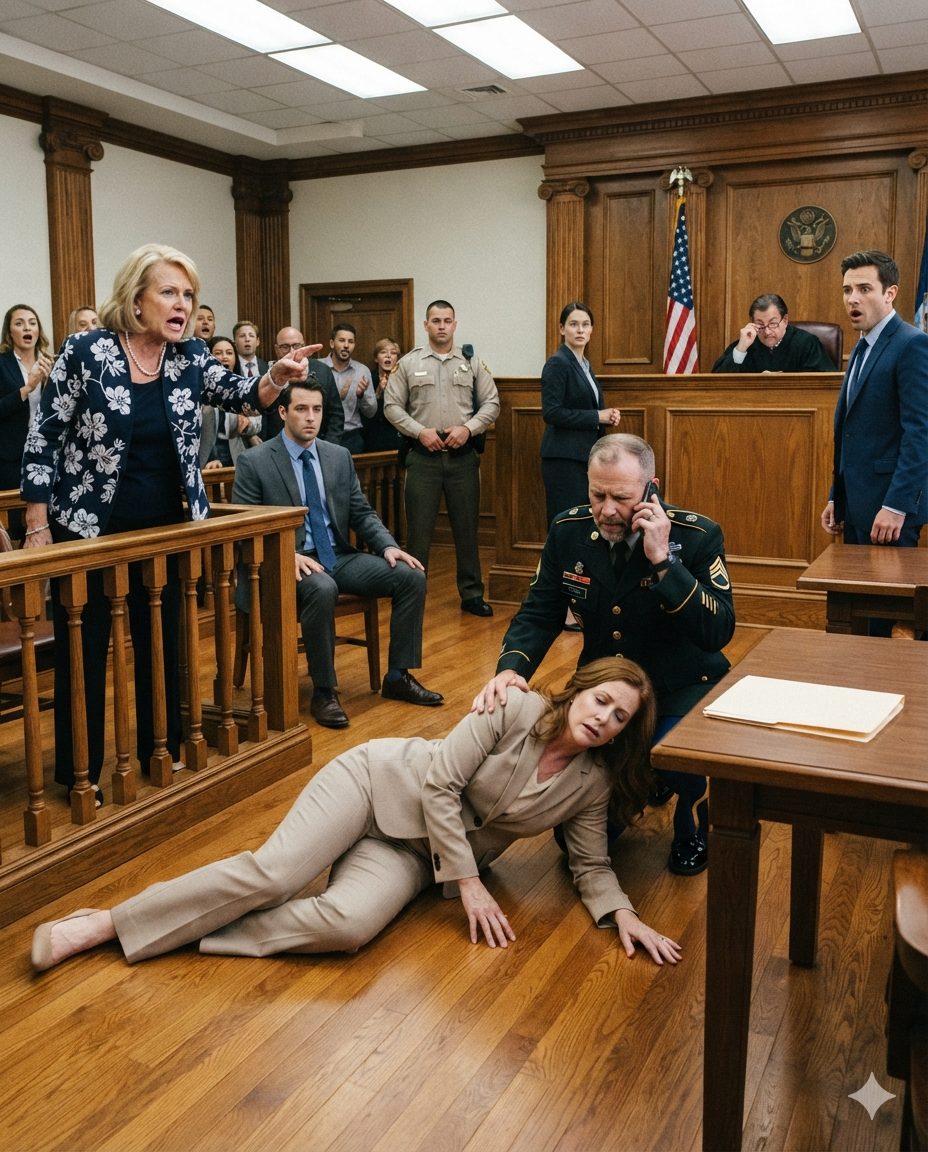
Colonel Reyes, who had not left my side while the paramedics stabilized my breathing with an oxygen mask, looked up at the judge.
“Your Honor, my field training in military toxicology recognizes this specific presentation.
It’s a slow-release heavy metal or neurotoxic compound.
It accumulates in the system, causing chronic fatigue, dizziness, and sudden cardiovascular collapse.
Someone has been administering it to her in small, consistent doses.”
All eyes in the courtroom slowly turned away from the stretcher and fixed themselves on Vivian Harrington.
Vivian’s calm, practiced smile had completely shattered.
Her fingers dug frantically into her designer handbag, her knuckles turning bone-white.
“That’s a lie! That woman is unhinged! She’s trying to frame us because she knows she’s losing custody of Sophie!”
“Quiet, Mrs. Harrington,” Judge Ellison ordered, his voice dropping into an icy register.
He turned to the bailiff.
“Play the file.”
Elias handed the flash drive to the tech clerk, and within seconds, the courtroom speakers crackled to life.
At first, there was only the faint rustle of fabric and the sound of television cartoons playing in the background.
Then, a sharp, familiar voice rang out clearly across the silent room.
“Drink it all down, sweetie.
Mommy needs to feel better so she takes a long nap, and then Grandma can take you to get ice cream without her getting dizzy and ruining the afternoon.”
It was Vivian’s voice.
Followed instantly by a smaller, trembling voice—Sophie’s.
“Grandma, why does Mommy’s tea smell funny? It tastes like the metal stuff in the garage.”
“Hush, child.
It’s just special sugar.
Don’t you ever tell your mother you saw me put it in her mug, or we won’t be able to play our game anymore.”
The audio stopped.
The courtroom was so dead silent that the hum of the overhead lights sounded like a roaring engine.
Julian stared at his mother in absolute horror, his mouth opening and closing like a fish out of water.
“Mom… what is that? Did you… did you do that?”
Vivian lost whatever composure she had left.
She lunged forward toward the defense table, pointing a shaking finger at me.
“She was ruining his life! She was weak! She couldn’t even keep up with a normal household! We just wanted her out of the way so Julian could have a real family!”
“Incredible,” Colonel Reyes muttered, standing up from his kneeling position beside my stretcher.
He straightened his uniform jacket, his dark eyes blazing with a cold, unforgiving fury.
He walked slowly toward the defense table, towering over Julian and his stunned attorney.
“As an officer of the United States Army Medical Corps,” Colonel Reyes stated loudly, looking directly at Judge Ellison, “and as a federally appointed medical proxy who happened to be reviewing local civilian hospital records for a veteran outreach program, I am officially filing federal charges of attempted homicide, chemical poisoning, and conspiracy against both Vivian Harrington and Julian Harrington.”
Julian stumbled back, knocking his chair over onto the polished floor.
“No! I didn’t know! I swear I didn’t know she was poisoning her! I just thought she was faking her illness!”
“You knew she was sick, Julian, and you used it as a weapon,” Judge Ellison said, his voice trembling with barely contained rage.
He stood up from the bench, looking down at the pair of them with utter disgust.
“You stood in my courtroom today and mocked a dying woman while your mother systematically murdered her drop by drop.”
The bailiffs didn’t wait for further instructions.
Two sets of silver handcuffs clicked into place—first around Vivian’s wrists as she shrieked and clawed at the air, and then around Julian’s as he wept openly, begging me to forgive him.
As the paramedics wheeled me toward the double doors, the heavy oxygen mask pressing against my face, I caught sight of Sophie standing nervously in the doorway with her school counselor, clutching her little purple backpack.
Colonel Reyes walked beside my stretcher, gently placing a reassuring hand on the metal rail.
“You’re safe now, Mrs. Harrington.
The nightmare is over.”
I closed my eyes, a single tear slipping down my cheek—not of pain, but of profound, overwhelming relief.
I had survived the battlefield they made of my marriage, and for the first time in seven years, my daughter and I were finally free.
PART 3
The heavy metal doors of the county courthouse swung open, spilling the harsh afternoon sunlight across the wide stone steps. Outside, the air smelled of exhaust and rain-slicked asphalt—the scent of the real, living world that I had been slowly locked away from for years.
As the paramedics wheeled my gurney down the ramp, the flashing red and blue lights of the ambulances painted the gray concrete in stark, pulsing strokes. A knot of local reporters and camera crews surged forward, their voices blending into a chaotic wall of sound.
“Mrs. Harrington! Is it true she poisoned you for months?” “Did Julian know about the plot?” “How is Sophie?”
Through the clear plastic edge of my oxygen mask, I took a deep, steadying breath. My chest no longer felt like it was filling with molten lead. The acute fog that had clouded my brain during the darkest months of the custody trial was already beginning to lift, replaced by a sharp, crystal-clear awareness.
Colonel Dominic Reyes walked steadily beside the stretcher, his boots matching the rhythmic pace of the medical crew. When a reporter thrust a microphone too close, Dominic stepped smoothly into the path, his imposing military posture and quiet, authoritative glare instantly forcing the journalist back a step.
“She requires immediate medical attention and privacy,” Dominic said, his voice flat, low, and carrying the unmistakable weight of command. “No statements will be made at this time.”
As they lifted the gurney into the back of the ambulance, Dominic turned to look down at me. For a fleeting second, the stern, unyielding mask of the military doctor softened. He placed a steady, calloused hand on the edge of the stretcher rail.
“I’ll meet you at Riverside Mercy Hospital,” Dominic said quietly. “Federal investigators are already securing your medical archive and the evidence chain. You’re going to be looked after, I promise you.”
“Thank you, Colonel,” I whispered, my voice sounding weak even to my own ears, yet filled with a profound strength.
He gave a sharp, respectful nod, stepped back, and the heavy ambulance doors closed, sealing out the noise of the media storm.
Three days later, the sterile white walls of my hospital room felt less like a cage and more like a sanctuary. According to the attending toxicologists, the heavy metal compound—a slow-release thallium derivative—had been cleared from my bloodstream significantly faster once I was removed from the environment and administered the specialized chelation therapy Dominic had immediately ordered on-scene.
The door clicked open softly, and Elias Porter stepped in, holding a small paper bag from a local bakery and leading a small, familiar figure by the hand.
“Mommy!”
Sophie didn’t wait. She dropped her purple backpack by the door and threw her arms gently around my waist, burying her face in the hospital gown. She was crying, but these weren’t the terrified, confused tears of a Friday night drop-off. These were the tears of a child who finally understood she didn’t have to keep a dark secret anymore.
“Hey, my sweet girl,” I choked out, wrapping my arms around her tightly, burying my face in her hair. “I’m right here. I’m not going anywhere.”
Elias stood nearby, smiling softly while holding up the paper bag. “The school psychologist and I cleared her schedule for the rest of the week. CPS and the family court commissioner expedited emergency temporary custody. As of yesterday afternoon, you hold absolute, unassailable legal guardianship. Julian’s assets are frozen pending federal asset forfeiture, and Vivian is being held without bail at the county detention facility on charges of attempted aggravated homicide and child endangerment.”
I looked up at Elias, feeling the last lingering ghost of my fear evaporate into the air. “And Julian?”
“Julian spent the entire night sobbing in a holding cell, realizing his mother threw him under the bus just as easily as she poisoned you,” Elias said, shaking his head. “His defense attorney resigned this morning. There’s no spinning an audio recording like that to a federal judge. They’re looking at decades.”
Later that evening, after Sophie had fallen fast asleep on the pull-out couch in the corner of my room, clutching her favorite stuffed rabbit, a soft knock echoed at the door.
Colonel Reyes entered, dressed in his dress-uniform jacket, holding a thick manila folder under one arm. He paused when he saw Sophie sleeping peacefully.
“I hope I’m not intruding,” he whispered, stepping softly across the linoleum.
“Not at all,” I replied, sitting up slightly and adjusting my pillows. “Please, sit down.”
Dominic pulled up a chair beside the bed, placing the folder on the rolling tray. “I just came from the federal prosecutor’s office. The digital forensics team pulled the metadata from your home’s smart-home security logs. They found a digital trail of Vivian purchasing the compounds online using a burner account linked back to her personal tablet. Julian’s fingerprints weren’t on the purchases, but his text logs show he actively gaslit your medical complaints to every physician you saw, deliberately cutting off your access to independent second opinions.”
I looked down at my hands, resting quietly against the white blanket. The validation was staggering. For years, I had questioned my own sanity. I had stared at the ceiling at night, wondering if my body was simply failing me, if I was truly the weak, unstable creature my ex-husband and mother-in-law had convinced the world I was.
“For a long time, Colonel, I thought I was losing my mind,” I confessed, my voice barely above a whisper. “When everyone tells you that you’re sick, that you’re imagining things, eventually you start believing it.”
Dominic leaned forward, his dark eyes locking onto mine with an intensity that made my breath catch. “That wasn’t weakness, Mrs. Harrington. That was survival. You fought against a slow-acting poison with nothing left in your tank except the sheer will to protect your daughter. Most people wouldn’t have lasted this long.”
He reached out and slid the manila folder across the tray, opening it to reveal a clean, newly printed birth certificate and emergency protection order bearing Judge Ellison’s final, irrevocable signature.
“You’re free,” Dominic said softly. “And your record—medical, legal, personal—is being cleared of every single lie they wrote about you.”
I looked from the papers up into his steady, compassionate face, feeling the heavy armor of my past life finally fall away. The battlefield was behind us. The smoke had cleared. And as the evening light poured through the hospital window, painting the room in warm, golden hues, I smiled—not just for myself, but for Sophie, and for the bright, unbroken horizon waiting for us tomorrow.
This is a work of fiction. Any resemblance to actual persons, living or dead, or actual events is purely coincidental.