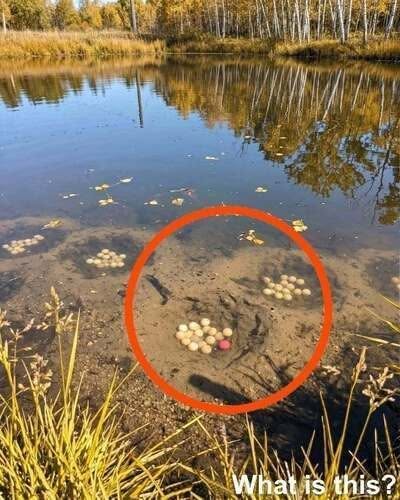
A quiet pond can look completely still until you spot something that makes you stop mid-step. If you have ever wondered about frog eggs in pond water, a cluster of pale, jelly-covered spheres can look surprisingly strange at first glance. Are they eggs, seeds, insect cases, or something that fell into the water? In many cases, the answer is much more ordinary—and much more fascinating.
What Do Frog Eggs in Pond Water Look Like?
Frog eggs are usually found in clusters, with individual eggs surrounded by a clear, slippery layer of jelly. Depending on the frog species, water temperature, sunlight, and the condition of the pond, the mass can look clear, cloudy, cream-colored, grayish, or slightly green.
The jelly is not just decoration. It helps protect the developing embryos from drying out, cushions them from bumps, and keeps the eggs grouped together. As a result, a fresh egg mass can look very different from one that has been sitting in shallow water for several days.
Look closely, but do not poke it. You may see tiny dark dots inside the jelly. Those dots are developing embryos, and their appearance changes as they grow.
Frog Eggs vs. Toad Eggs: What’s the Difference?
Here is where pond spotting gets interesting. Frogs and toads do not always lay eggs in the same pattern.
Many frogs leave egg masses that look like rounded clusters or floating blobs. Some attach them to submerged plants, while others place them near the pond surface. Toads, on the other hand, commonly lay eggs in long, jelly-covered strings that can wrap around stems and underwater vegetation.
Still, nature does not follow a neat checklist. Species vary, and water movement can break apart or rearrange an egg mass. Therefore, shape alone is not enough to identify the animal with certainty.
Why Do the Eggs Have Dark Spots?
Those little dark circles can make the whole discovery look mysterious. However, dark centers are often simply the developing embryos inside the transparent jelly.
The surrounding pond can also create misleading patterns. Mud, decaying leaves, algae, shadows, and small water currents may form dark patches around an egg mass. A few minutes of wind can shift floating debris and make yesterday’s scene look completely different.
If the dark marks appear outside the jelly rather than inside the eggs, they may have another explanation. Small holes, disturbed sediment, insect activity, or plant debris can create circular-looking marks without being related to the eggs at all.
A Simple Way to Check What You Found
Before touching anything, observe the area from the bank. A phone camera with a zoom feature can give you a much better look without disturbing the pond.
First, check the shape. Is the mass a compact cluster, a loose patch, or a long string?
Next, check where it sits. Is it floating, attached to a plant, resting on mud, or suspended just below the surface?
Then look for movement. Tadpoles may appear later as tiny swimmers, although very young embryos will not move around like mature tadpoles.
Finally, note the surroundings. Submerged grass, fallen leaves, algae, shallow edges, and calm water can all help explain why the eggs are there.
Pro Tip: Take one photo from the same spot each day. You can often see development more clearly through a short series of pictures than by examining the pond for a single afternoon.
What Happens After the Eggs Are Laid?
The tiny dark embryo inside each egg does not stay the same for long. Development depends on the species and water temperature, so the timing can vary considerably.
As development continues, the embryo becomes more recognizable. Eventually, tadpoles hatch and begin swimming through the pond. At this stage, they are part of a completely different chapter of the life cycle.
Tadpoles gradually develop stronger swimming abilities and other body features. Later, they undergo metamorphosis, developing legs and changing their bodies for life on land.
Not every egg makes it that far. Fish, aquatic insects, birds, changing water levels, poor water quality, and disease can all affect survival. That is normal in a wild pond ecosystem.
Common Mistakes People Make When They Find Egg Clusters
The biggest mistake is assuming every jelly-like cluster is frog spawn. Some aquatic organisms and natural materials can look surprisingly similar.
Another mistake is moving the eggs to a bucket or container because they seem abandoned. In reality, moving wild eggs can expose them to different temperatures, water chemistry, sunlight, and predators.
Do not add tap water, cleaning products, fertilizer, or other substances to the pond to “help” them. Even small changes can affect aquatic life.
Also, avoid stirring the mud around the egg mass. You might accidentally bury the eggs, break attached vegetation, or disturb other creatures living nearby.
If you are curious, observation is usually the safest approach.
What If the Egg Mass Looks White or Cloudy?
A cloudy appearance does not automatically mean something is wrong. Sunlight, sediment, algae, and the natural aging of the jelly can change how an egg mass looks.
However, if a mass appears coated in unusual fuzzy growth, has a strong odor, or sits in visibly polluted water, it may be worth contacting a local wildlife or environmental organization for identification. A clear photograph can make that conversation much easier.
For pond owners, this is also a good reminder to check water quality and avoid unnecessary chemicals around amphibian habitat.
How to Photograph Pond Eggs Clearly
You do not need an expensive wildlife camera. A smartphone can work surprisingly well.
Stand where your shadow does not cover the subject, then use the camera’s zoom carefully. Try a close photo and another wider shot showing the surrounding plants and pond edge.
If the water surface is reflecting the sky, change your angle instead of tapping the water. A side view can sometimes reveal the jelly structure much better.
For identification, the most useful photos usually show the entire cluster, a closer view of the individual eggs, and the habitat around them.
Why These Tiny Clusters Matter
A pond is more than a patch of water. It is a living community where amphibians, insects, plants, fish, microorganisms, and birds interact every day.
Finding frog eggs can be a small sign that amphibians are using that habitat to reproduce. That does not prove the pond is pristine or perfectly healthy, but it does show that the area is supporting part of an amphibian life cycle.
For gardeners and homeowners with ponds, leaving natural edges, limiting unnecessary chemical runoff, and keeping some plant cover can make a pond more useful to wildlife.
The next time you see a strange cluster of pale spheres in shallow water, resist the urge to assume it is something bizarre. Those little jelly-covered dots may simply be the beginning of a remarkable transformation.
And if you are looking specifically for frog eggs in pond water, the best clue is often the simplest one: a quiet cluster, tiny dark embryos, and a pond that suddenly seems much busier than it looked a moment ago.