Found a P-38 Can Opener? Here’s What It Is
That tiny folding metal tool hiding in a kitchen drawer looks almost too simple to have a story behind it. Yet if you found a P-38 can opener, you’ve stumbled across one of the most recognizable little pieces of military field gear ever made. The P-38 can opener was designed to open ration cans, but its clever folding design made it useful long after soldiers stopped carrying it every day.
What Is a P-38 Can Opener?
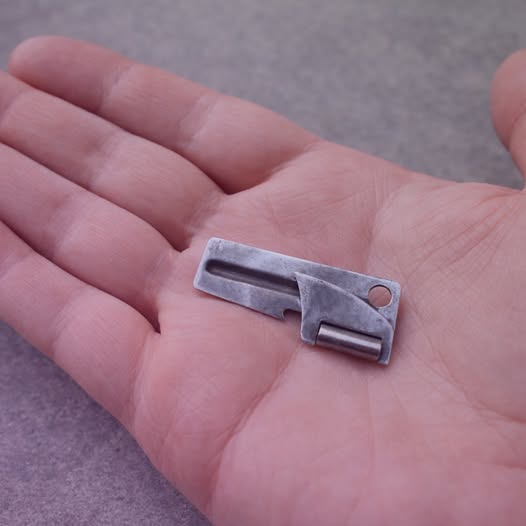
The P-38 is a small, stamped-metal manual can opener with a hinged cutting point that folds against the body. Closed, it takes up almost no space. Open, the sharp point hooks over a can rim and cuts the lid a little at a time.
The name P-38 is usually associated with the tool’s roughly 38-millimeter length. However, several explanations for the name have circulated over the years, including the idea that it took about 38 punctures to open a ration can. The exact origin is less certain than the tool itself.
This was not designed to win a beauty contest. It was designed to work.
Why Did the Military Use It?
During the mid-20th century, compact field rations often came in metal cans that needed a reliable opening method. A bulky kitchen can opener made little sense for soldiers carrying limited gear, so the P-38 offered a small solution with very few parts.
Its biggest advantage was simplicity. There was no spring-loaded mechanism, battery, complicated gear assembly, or large handle to break. The metal body could fold flat, slip into a pocket, and stay ready for the next meal.
The tool became closely associated with U.S. military rations, particularly C-rations. Later, similar compact openers continued to be used with field rations and emergency food supplies.
How Do You Use a P-38?
If you have one in a kitchen drawer, the basic technique is surprisingly straightforward.
First, unfold the cutting point so it locks into its working position. Hold the can firmly on a stable surface, keeping your fingers away from the lid and cutting edge.
Next, hook the small cutting point over the rim of the can. Push the sharp point into the lid near the edge, then rock or lever the opener forward to make a cut.
Repeat that motion around the lid. The P-38 does not remove the lid in one smooth sweep like a modern manual can opener; instead, it makes a series of small cuts.
Pro Tip: If the opener feels slippery, dry the can and your hands first. A steady grip makes the process much easier.
And remember, the cutting edge is genuinely sharp. Treat an old P-38 like a tool, not a novelty keychain.
What Does “John Wayne” Mean?
You may also hear the P-38 called the “John Wayne.” The nickname is strongly linked with American military culture, especially stories connected with the U.S. Marine Corps and Navy.
One popular explanation says the name came from a military training film featuring actor John Wayne demonstrating how to use the opener. Another story says troops simply associated the tool’s rugged, dependable character with Wayne’s screen image.
The training-film story is widely repeated, but details about the exact origin of the nickname have varied. In other words, the nickname has a little folklore attached to it.
That uncertainty is part of what makes the tiny opener so interesting.
Why Is the P-38 Still Popular?
You might wonder why anyone would bother with a little manual opener when inexpensive kitchen can openers are everywhere. Actually, the answer is the same reason the tool became popular in the first place: size and simplicity.
A P-38 can fit into a small emergency kit, camping box, hiking pouch, or drawer without taking up meaningful space. It also has no batteries to replace and no complicated mechanism that needs adjustment.
For camping, however, comfort matters. If you are opening several large cans, a full-size ergonomic can opener will usually be easier on your hands. The P-38 makes more sense when compact storage is the priority.
What Else Was It Used For?
Like many simple field tools, the P-38 developed a reputation for doing jobs beyond its original purpose. People have used examples for light scraping, opening small packages, cleaning under fingernails, and making minor adjustments.
That does not mean every improvised use is safe. The metal can be sharp, and using it as a pry bar or heavy-duty screwdriver can bend or damage the tool.
For household repairs, keep a proper precision screwdriver set nearby. A small multitool is also a better choice when you need several functions in one package.
P-38 vs. Modern Can Openers
The difference becomes obvious the moment you put the two side by side.
A modern countertop or handheld manual can opener is designed for comfort. It usually has larger handles, a cutting wheel, and a mechanism that travels around the rim with much less hand movement.
The P-38 is the opposite. It is tiny, inexpensive, lightweight, and built around a single cutting action.
For a kitchen used every day, a quality stainless-steel manual can opener is generally the more comfortable choice. For an emergency kit or compact camping setup, the P-38 has an advantage because it folds almost flat.
How to Clean an Old P-38
Found one in a junk drawer, camping box, or inherited kitchen collection? Before using it on food, inspect it carefully.
Look for heavy rust, deep pitting, cracks, sharp burrs, or a hinge that no longer moves correctly. Surface grime can often be wiped away with warm water and a mild dish soap, followed by thorough drying.
Do not assume an old, heavily corroded opener is food-safe simply because it looks clean after scrubbing. If the metal is badly deteriorated, keep it as a collectible rather than using it with food.
For a newer stainless-steel version, follow the manufacturer’s cleaning instructions and dry it completely after washing.
Common Mistakes to Avoid
The first mistake is gripping the can too close to the cutting area. Give your fingers plenty of room.
Another is forcing the hinge when it is stiff. A stuck mechanism can cause the tool to slip, so inspect it rather than muscling it through.
Finally, do not toss a P-38 loose into a drawer where someone can grab the sharp point accidentally. Fold it closed and store it in a small tool pouch or container.
The Bottom Line
If you found a tiny folding metal opener in your kitchen, there is a good chance you are looking at a P-38 can opener, especially if it has a small hinged cutting point and a flat stamped-metal body. This humble tool became famous because it solved a very specific problem with almost nothing to go wrong.
It is small. It is rugged. And it has a surprisingly long history.
So before throwing that strange little metal gadget into the junk drawer, take a closer look. You may be holding a piece of everyday military design that has survived simply because the original idea was so practical.