
Imagine settling into your usual train seat for a routine morning commute. You have your thermos of coffee, your headphones in place, and a podcast queued up. Then you glance across the aisle and see the passenger opposite you resting a heavy, matte-black console across their lap—completely bristling with eight distinct, menacing antennas.
That exact scene played out on a regional transit line recently, prompting an eagle-eyed passenger to snap a quick photo and turn to the internet for answers. A person on Reddit asked this simple question: “Saw it today during the commute, what’s this? Signal searching? Booster? Hacking?”
Saw it today during the commute, what’s this ?
by
u/Phantom_6765 in
whatisit
Within hours, thousands of online sleuths chimed in with theories ranging from covert government surveillance gear to Hollywood-style movie hacking rigs. Let us walk through the mystery, break down what this mysterious antenna gadget on train seats actually does, and reveal why you do not need to panic if you spot one near you.
The Anatomy of a Public Transit Mystery
Public transit brings together all kinds of people, from sleepy office workers to students finishing last-minute assignments. Every so often, you cross paths with a hobbyist whose gear looks like it was plucked straight out of an eighties cyberpunk novel.
The photo shows a rugged, pocket-sized terminal featuring a built-in miniature keyboard, a wide LCD screen, and an entire array of SMA antenna posts running along the top chassis. Several rubber ducky antennas and telescopic metal wands jut out in every direction, pointing straight up toward the train ceiling.

A quiet morning look at custom portable computing gadgets blending right into everyday home spaces.
For anyone unfamiliar with modular electronics, the device looks undeniably intimidating. It easily resembles something a movie villain might use to override railway switches or wipe nearby phone data in seconds. The reaction from the commuter community was an immediate mix of dark humor, curiosity, and genuine safety concerns.
Hollywood Myths vs. Radio Frequency Reality
Whenever a gadget with multiple antennas appears in public, observers quickly assume the worst. The top guesses on the forum revolved around three main fears: signal jamming, mass Wi-Fi theft, and active cellular snooping.
Signal jamming is the most common worry, yet basic physics makes that practically impossible for a compact battery-powered device like this. Overpowering local cellular towers or train communications takes an enormous amount of continuous electrical power and produces significant heat. A tiny battery-operated unit sitting on someone’s jeans simply cannot generate the wattage required to knock out train communications.
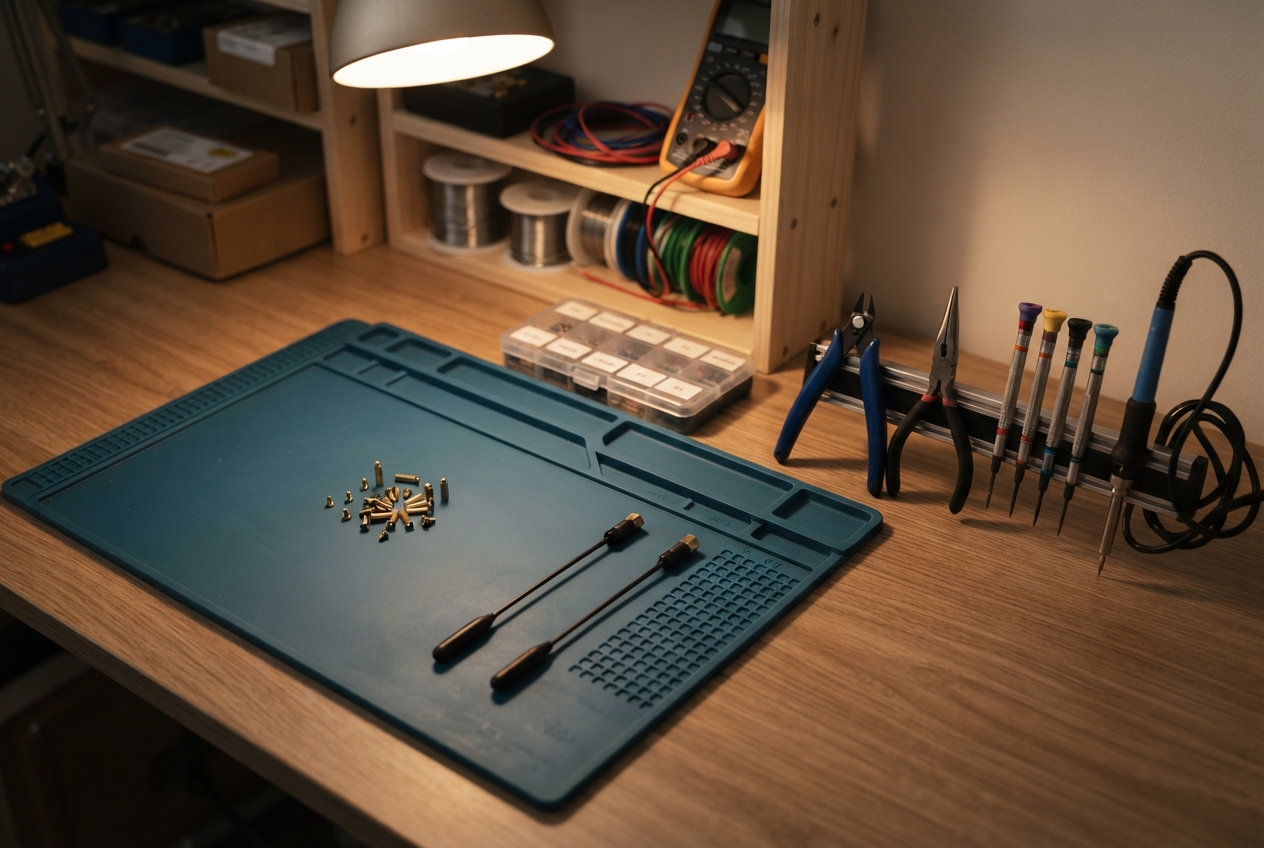
Building custom tech from scratch starts with a handful of modular parts and a good workspace.
What about stealing passwords or cloning phones? Modern digital traffic—from your smartphone’s banking apps to standard web browsing—is protected by heavy end-to-end encryption. Even if a nearby antenna picks up raw wireless packets bouncing through the air, decoding private data without keys is virtually impossible in real-time.
“Picking up ambient radio waves is like listening to birds in your backyard. You can hear that they are chirping and recognize the species, but you cannot speak their private language.”
The Growing World of DIY Cyberdecks
To truly understand what this hardware represents, you have to look into the fascinating maker subculture known as “cyberdecks.” Inspired by classic science fiction, builders assemble custom portable computers inside rugged metal enclosures, vintage computer cases, or 3D-printed shells.
Rather than buying another sleek, locked-down commercial tablet, makers prefer total control over their hardware. They solder their own expansion boards, wire up custom battery packs, and load lightweight open-source operating systems designed for field experimentation.

Everyday commutes often turn into prime spots for catching unusual sights and interesting hobbies.
These devices are built for practical tinkering: testing wireless network strengths, running local offline documentation, or creating off-grid emergency radios that function even during heavy power outages. They look mechanical and raw because every component is modular, swappable, and completely visible.
Why Does It Need So Many Different Antennas?
The most striking feature of the viral photo is the forest of antennas crowning the top edge. Each antenna is cut to a precise physical length to resonate with a specific frequency band on the electromagnetic spectrum.
- LoRa (Long Range) Antennas: Designed for low-power, direct text-based communication between nodes without cell service or home internet.
- Dual-Band Wi-Fi & Bluetooth Sticks: Used to map local access points and check signal density in different environments.
- Software-Defined Radio (SDR) Wands: Broad-spectrum antennas capable of tuning into everything from aviation weather broadcasts to amateur ham radio bands.
- GPS Modules: Small ceramic or cylindrical antennas that lock onto satellite positioning data for offline mapping projects.
Having multiple antennas simply means the operator wants to observe different radio frequencies simultaneously without swapping hardware every five minutes. It is the digital equivalent of carrying a multi-lens camera bag while walking through an art museum.
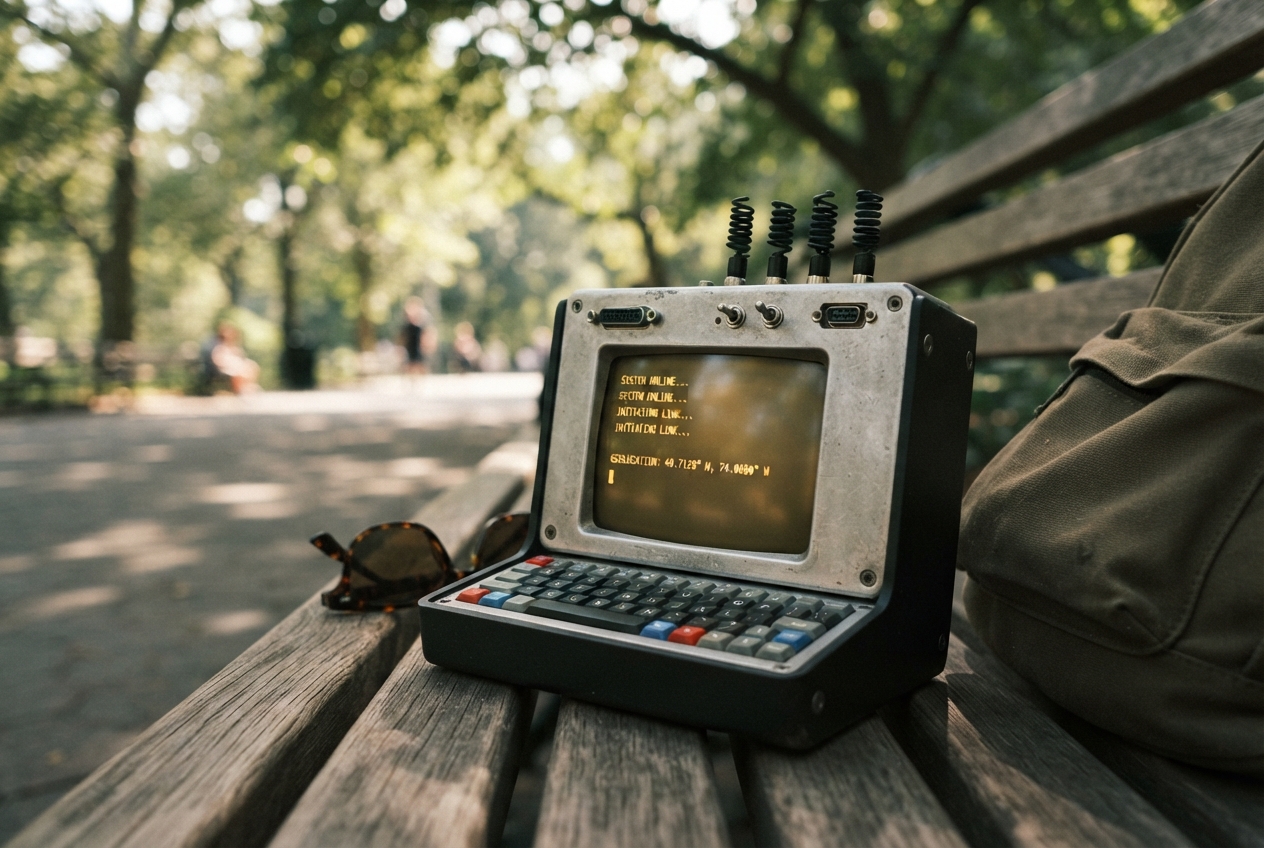
Portable custom terminals combine retro hardware design with modern radio monitoring capabilities.
The Big Reveal: What Is This Gadget Really?
So, what was that passenger on the train actually holding? The mystery machine is a customized ClockworkPi uConsole, fitted with a specialized multi-antenna expansion board from HackerGadgets.
Under the hood, the uConsole is an open-source, ultra-portable Linux computer powered by a modest single-board compute module. Hobbyists around the world purchase the modular DIY kit, assemble the aluminum shell themselves, and customize it with Software-Defined Radio (SDR) receivers and Meshtastic communication modules.
Instead of hacking public transit or disrupting cellular signals, the commuter was most likely doing one of three completely harmless activities:
- Monitoring Meshtastic Mesh Networks: Sending text messages across a localized, off-grid neighborhood radio network built by local radio enthusiasts.
- Passive Spectrum Analysis: Watching how everyday radio frequencies move through the city, much like checking a weather radar map.
- Listening to Open Airwaves: Tuning in to unencrypted weather broadcasts, local amateur repeaters, or public aircraft telemetry data.
What to Do If You Spot One in the Wild
Spotting unusual technology in everyday spaces can startle you at first glance, especially when it looks like a prop from an action thriller. But in reality, handheld SDR terminals are the modern equivalent of the classic shortwave radio sets your grandparents kept in the garage.
If you see a fellow commuter holding a mysterious antenna gadget on train seats or park benches, there is no need to change subway cars. In fact, most makers who carry their custom builds in plain view are passionate hobbyists who are happy to talk about how they assembled it.
The next time you cross paths with a peculiar gadget bristling with wires and dials, take a breath. You are not witnessing a high-stakes digital heist—just an enthusiastic tech creator enjoying a uniquely fascinating radio hobby on their morning ride.